Applied AI Lab or Managed AI? AI pilot or continuous operation: Where companies will really make money in the future – Creative image on the topic, with AI: Xpert.Digital
From AI experiment to business success: Why operations are crucial
Using AI economically: Why continuous operation is more important than the next prototype
Managed AI is becoming a business: What companies need after the AI pilot project
Many companies are testing artificial intelligence – but there's a crucial gap between a convincing prototype and reliable deployment in daily operations. This is precisely where the strategic question arises: Is an Applied AI Lab sufficient, one that develops ideas and tests use cases, or is a Managed AI model needed that takes long-term responsibility for quality, safety, costs, and benefits? For Xpert.Digital, the most economically viable answer lies in combining both approaches: The lab generates awareness and develops suitable applications to production readiness; Managed AI transforms this into reliable, measurable, and recurring business value. Particularly in industry, intralogistics, and B2B processes, success is therefore not determined by the next AI pilot project, but by the ability to ensure its long-term impact in ongoing operations.
Those who only experiment will lose their business – and therefore their business
The strategic decision between an Applied AI Lab and Managed AI initially appears to be a choice between innovation and operations. However, from an economic perspective, this comparison is too simplistic. Both models address different segments of the same value chain. The Applied AI Lab provides guidance, translates new technological possibilities into concrete applications, and develops selected use cases to production readiness. Managed AI then assumes ongoing responsibility for availability, quality, security, costs, adaptability, and economic impact. One model generates awareness and opens up the market, while the other transforms technological possibilities into predictable revenue.
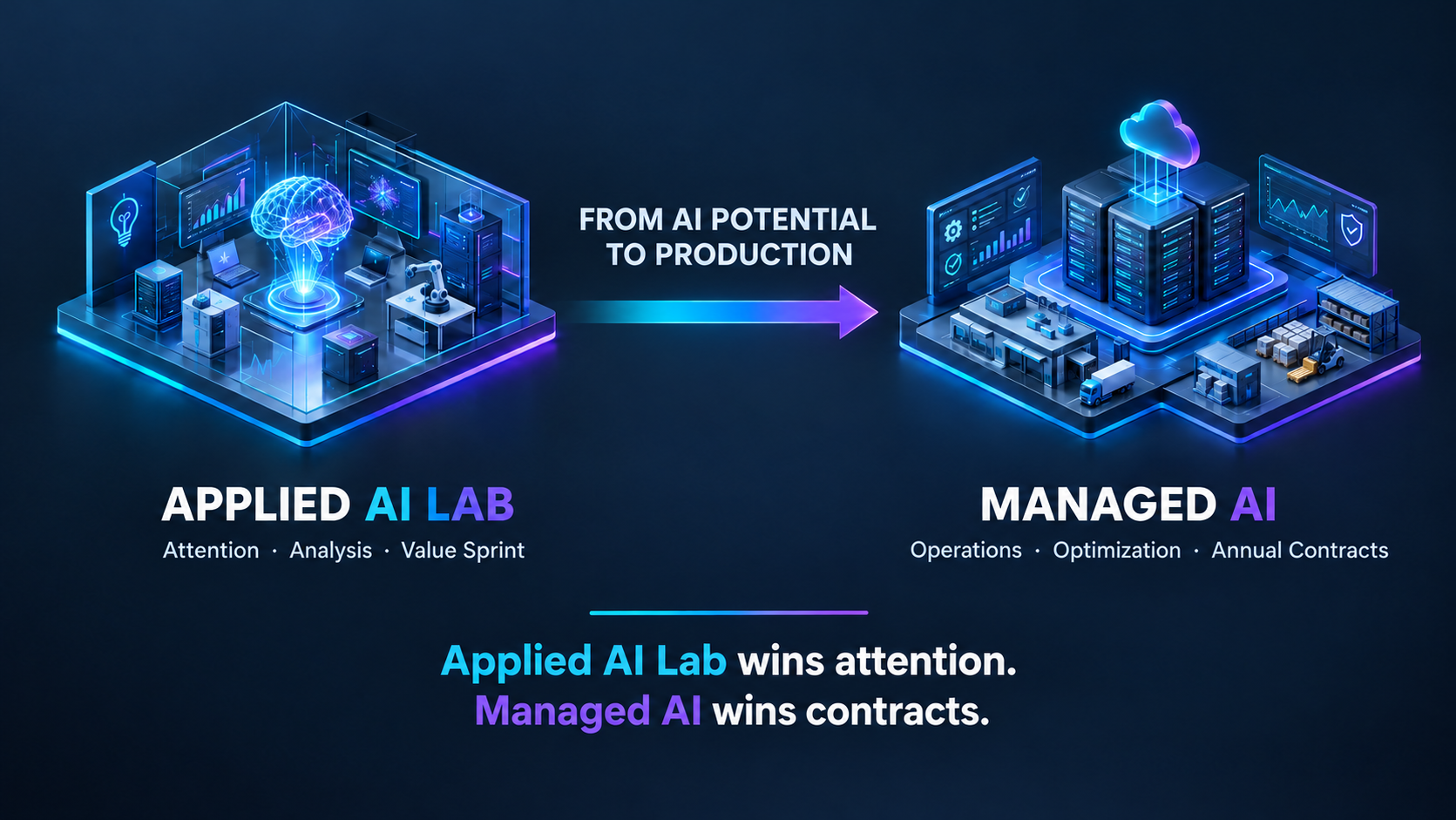
For Xpert.Digital, this results in a clear, yet nuanced perspective. Over the next three to five years, Managed AI is expected to contribute more to revenue, customer loyalty, and company value than a standalone Applied AI Lab. Nevertheless, abandoning the lab concept would be a strategic mistake. It possesses strong communicative power, facilitates access to decision-makers, and can serve as a credible framework for developing new business cases. Therefore, the most economically compelling solution lies in a two-tiered architecture: The Applied AI Lab forms the visible positioning and the methodological entry point, while Managed AI becomes the purchasable service model and the basis for recurring contracts.
A suitable market positioning would be an Applied AI Lab for Managed AI in industry, logistics, and B2B processes. If the technical implementation is primarily handled by partners, a term like Applied AI and Managed AI Orchestration is more honest and also economically viable. It doesn't promise a research organization that doesn't actually exist, but rather describes the ability to combine demand, expertise, technology partners, implementation, and operation into a responsible overall offering.
Two offers for two different customer problems
Applied AI Labs and Managed AI don't address the same question. An Applied AI Lab is aimed at companies that are generally interested in artificial intelligence but don't yet know which process is economically viable, what data is needed, and how to develop a robust use case from an idea. The client initially purchases insights, guidance, prioritization, and implementation expertise. The focus is on workshops, assessments, prototypes, evaluation processes, and demonstrating that an application can work both technically and economically.
Managed AI comes into play later. Here, the customer's question is no longer what is possible, but who will take responsibility in day-to-day operations. A productive AI solution must be monitored, updated, secured, documented, and integrated into existing systems. The quality of the results can change when new data is added, processes are adapted, or a model provider changes its technology. At the same time, costs, access rights, failure risks, regulatory requirements, and user feedback must be controlled. Managed AI therefore sells less of a futuristic vision and more of a solution that offers relief, reliability, and institutionalized responsibility.
The economic difference is significant. A lab is often acquired and paid for as a project. Its revenue is discreet, requires explanation, and depends on new budgets. Managed AI, on the other hand, can be organized as a monthly or annual contract with a defined scope of services, service levels, reporting, and ongoing development. This increases predictability, customer lifetime value, and potential company value. The challenge lies in ensuring that managed AI doesn't appear as ordinary IT outsourcing. The customer shouldn't simply be buying labor hours, but rather a measurable improvement in a business process, including the necessary technical operations.
The market is shifting from experimentation to responsibility
The European AI market is growing rapidly. Spending in Europe is expected to reach nearly US$470 billion by 2030. The average annual growth rate between 2025 and 2030 is around 35 percent. Generative AI is projected to account for more than half of the market by the end of this period. At the same time, the global market is showing a clear shift towards infrastructure, software embedding, and ongoing services. Global AI spending is expected to reach approximately US$2.67 trillion in 2026, with around US$1.48 trillion allocated to infrastructure and approximately US$576 billion to AI services. The forecast for AI services rises to approximately US$746 billion by 2027.
These figures should not be confused with the directly addressable market of a specialized provider. However, they do illustrate where the economic gravity lies. The largest share of expenses arises not from one-off idea generation, but from computing power, integration, software, security, and operations. Once AI is embedded in business processes, the budget shifts from experiments to ongoing commitments. A voluntary innovation project becomes a business dependency that must be monitored and financed.
At the same time, market penetration is far from complete. By 2025, 19.95 percent of companies in the European Union with at least ten employees were using at least one AI technology. For small businesses, the figure was 17 percent, for medium-sized businesses 30.36 percent, and for large businesses 55.03 percent. This is creating two simultaneous markets. The first consists of companies still seeking a viable entry point. The second comprises organizations that have already implemented applications and now require scaling, integration, governance, and operational support. A provider that bridges both phases can guide a client from initial orientation to a long-term portfolio.
Germany's shortages are a business model
In Germany, the use of artificial intelligence is accelerating, but the organizational prerequisites are not growing at the same pace. By 2025, 36 percent of companies with 20 or more employees were using AI. Another 47 percent were planning to implement it or were discussing it. The main obstacles were legal uncertainties and a lack of technical expertise, each cited by 53 percent, as well as a lack of personnel resources, cited by 51 percent. Data protection requirements, concerns about company data, a lack of traceability, and doubts about the quality of the results were additional factors.
These obstacles are not a minor issue for a provider, but rather the economic foundation of a managed AI model. If companies only needed software, they could purchase it directly from a platform provider. The value of a specialized service provider arises where technology, organization, regulation, and process responsibility must be converged. Legal uncertainty demands documented governance. A lack of expertise requires consistently available specialists. Staff shortages necessitate an external operational organization. Doubts about quality demand continuous evaluation and transparent key performance indicators.
For the German market, a strong need for control is also a key factor. For 88 percent of the companies surveyed, the country of origin of an AI provider is important; 93 percent would prefer a provider from Germany. This preference does not mean that companies will exclusively use German base models. Rather, it shows that they are looking for a trustworthy, German-speaking, and European-oriented entity responsible for data. A provider can orchestrate international models, cloud services, and specialized platforms as long as data residency, access rights, liability limits, and decision-making processes are clearly defined.
Industry and logistics are facing a tough test
AI has already arrived in the operational environment of German industry. By 2025, 42 percent of industrial companies were using artificial intelligence in production, and another 35 percent were planning or discussing such applications. AI was particularly widespread in analytics and machine monitoring. Many companies were still in the planning phase for energy management, although significant efficiency gains were expected in this area. Robotics, quality assurance, maintenance, production planning, and warehouse management are also gaining in importance.
Especially in industry and logistics, it becomes clear why a lab alone is insufficient. A demonstrator can, for example, detect a malfunction from machine data, locate spare parts in technical documentation, or predict warehouse movements. However, its economic value only materializes when the system operates reliably under real-world conditions, communicates with ERP, WMS, TMS, or production systems, and is integrated into shift operations, defined responsibilities, and escalation processes. Errors are far more costly here than in a non-binding information system. A single incorrect recommendation can impact material flow, delivery capacity, energy consumption, or workplace safety.
Industrial companies therefore don't always buy the most intelligent model, but rather the one with the most reliable impact within their process landscape. This favors providers who combine technical understanding with industry knowledge, governance, and operational capability. This is particularly relevant for Xpert.Digital because its existing credibility in industry, intralogistics, supply chain, energy, and B2B communication facilitates market entry. A broad positioning as a general AI provider would dilute this advantage.
The real problem lies between the pilot and production phases
The widespread notion that companies primarily lack AI ideas is increasingly unrealistic. Ideas and prototypes have become significantly cheaper thanks to powerful models, programming interfaces, and development tools. The bottleneck lies in transitioning an experiment into a reliable production process. Studies show that companies discard a large portion of their proofs of concept before widespread implementation. On average, 46 percent of AI prototypes were abandoned before being deployed in production. The percentage of companies abandoning the majority of their AI initiatives increased significantly within a single year.
These figures do not mean that AI is inherently uneconomical. Rather, they show that the traditional project approach is often unsuitable. A prototype is built under favorable conditions, but without a reliable data supply, accountability model, integration architecture, and usage strategy. Production then incurs costs that remain invisible during the trial phase: rights management, quality assurance, interface maintenance, fail-safe operation, documentation, training, change management, and ongoing adaptation.
An Applied AI Lab can close this gap if it doesn't end with the demonstrator. It must define from the outset which key performance indicator (KPI) should be improved, which data will be permanently available, who is responsible for the process, and how the application will be operated after launch. Managed AI then monetizes the longer and more economically valuable phase. This includes monitoring, evaluation, model changes, cost control, security updates, user support, and continuous process improvement.
Why Managed AI is more economically attractive
Managed AI offers four structural advantages. First, it generates recurring revenue. A retainer or annual contract spreads revenue and performance over a longer period, reducing dependence on constant new business. Second, it increases customer loyalty because the provider becomes deeply integrated into processes, data flows, and decision-making paths. Third, it fosters learning: With each month of operation, understanding, automation, and reusability improve. Fourth, the provider's strategic value increases because they not only provide technology but also assume a share of the operational responsibility.
Demand trends support this logic. In an international survey of more than 1,200 executives, 91 percent considered managed services necessary for the effective implementation of AI. For 99 percent, managed services were strategically relevant, and 87 percent had already integrated them into their transformation strategy. 56 percent cited the management of AI systems as their top investment priority for the next two years. These results come primarily from large organizations and therefore cannot be directly applied to medium-sized businesses. Nevertheless, they point in the right direction: companies are not just looking for technology, but also for an entity that manages complexity, risk, and further development.
At the same time, it would be wrong to automatically consider every managed AI offering attractive. Traditional, labor-intensive managed services are under price pressure. Standard tasks are being automated, platforms are taking over technical functions, and large providers are bundling operations with cloud and software. A service that can be replaced by person-days will therefore lose margin. Managed AI will only be successful if it combines industry expertise, process design, governance, and measurable results.
Why the Applied AI Lab remains indispensable
The Applied AI Lab possesses a different kind of economic value. It generates relevance before a client can purchase an operating contract. Many companies are still unable to clearly define which process is suitable, which data may be used, and what a robust business case looks like. A lab creates a protected environment in which business units, IT, management, and external specialists can collaboratively develop an application. It fosters a connection to technological development without limiting itself to theoretical research.
The term is gaining further visibility. Leading AI companies are establishing applied labs where technical specialists work directly with European companies to transfer pilot projects into production. Other providers are positioning themselves as Applied AI Labs, translating new basic models into trusted, productive enterprise systems. In practice, the lab thus stands not for academic research, but for customer-centric engineering, rapid implementation, and bridging the gap between technological frontiers and real-world business processes.
For communication, expert articles, executive briefings, and initial consultations, this narrative resonates more strongly than the term "Managed AI." A lab evokes the future, design, and exclusive access. Managed AI initially sounds like an operation. Especially for a high-reach specialist portal, the lab is therefore a suitable content and media brand. The mistake would be failing to translate this attention into a marketable service model.
The dangerous expectation behind the word lab
An Applied AI Lab raises high expectations. Clients expect in-house engineering expertise, robust evaluation processes, rapid prototype development, and visible technical references. If the term merely refers to lead generation and partner matching, a credibility gap arises. This might generate short-term attention, but in the long run, it damages trust and reduces the likelihood of closing deals.
For Xpert.Digital, it must therefore be clearly identifiable which services are provided in-house, which are orchestrated, and which are supplied by partners. Transparency is not a sign of weakness, but a prerequisite for industrial procurement. An orchestrator can create significant value by taking on market knowledge, business case development, partner selection, offer architecture, and customer management. However, they must not give the impression of possessing a large in-house research team or a comprehensive software platform if this is not the case.
Credibility is built through clearly defined competencies, transparent methodologies, technical demonstrators, case studies, and unambiguous responsibilities. A customer must be able to identify who is responsible for architecture, development, hosting, security, governance, and operations. Only then does a network become a robust delivery model. Without this clarity, orchestration feels like mere brokering, and brokering is more easily interchangeable in a competitive market.
No tender wins attention, but operational capability does
From a marketing perspective, the Applied AI Lab has the edge. It signals innovation, expertise, and a proactive approach. However, from the perspective of IT management, procurement, and risk management, Managed AI often offers greater marketability. A service can be structured with a service description, service level, duration, pricing logic, and escalation paths. The customer can integrate the benefits with existing procurement processes and contractually define responsibilities.
This difference explains why a lab can generate many high-quality conversations but not automatically recurring revenue. The lab answers the question of whether and how an application makes sense. The managed service agreement answers the question of who remains liable, accessible, and able to act after launch. The more AI intervenes in core processes, the more important the second question becomes.
The strategic implication is therefore this: The lab should not be sold as a standalone end product. It is the acquisition, diagnostic, and development frontier of a larger operating model. The later operation must be considered as early as the assessment phase. The value sprint itself should prepare for monitoring, data access, security, documentation, and exit capability. This ensures that a project doesn't become a dead end, but rather the beginning of a long-term customer relationship.
A new dimension of digital transformation with 'Managed AI' (Artificial Intelligence) - Platform & B2B solution | Xpert Consulting


A new dimension of digital transformation with 'Managed AI' (Artificial Intelligence) – Platform & B2B solution | Xpert Consulting - Image: Xpert.Digital
Here you will learn how your company can implement customized AI solutions quickly, securely and without high entry barriers.
A managed AI platform is your all-inclusive, worry-free solution for artificial intelligence. Instead of dealing with complex technology, expensive infrastructure, and lengthy development processes, you receive a ready-made solution tailored to your needs from a specialized partner – often within just a few days.
The key advantages at a glance:
⚡ Rapid implementation: From idea to ready-to-use application in days, not months. We deliver practical solutions that create immediate added value.
🔒 Maximum data security: Your sensitive data stays with you. We guarantee secure and compliant processing without sharing data with third parties.
💸 No financial risk: You only pay for results. High upfront investments in hardware, software, or personnel are completely eliminated.
🎯 Focus on your core business: Concentrate on what you do best. We take care of the entire technical implementation, operation, and maintenance of your AI solution.
📈 Future-proof & scalable: Your AI grows with you. We ensure continuous optimization and scalability, and flexibly adapt the models to new requirements.
More information here:
How companies benefit from standardized managed AI solutions
Regulation turns operations into a permanent task
With the European AI Act, governance is transforming from a voluntary, optional service into an ongoing management responsibility. Key transparency and enforcement rules have been in effect since August 2026. Requirements for certain high-risk applications will follow no later than December 2027, while rules for AI systems embedded in regulated products will take effect from August 2028. For companies, this means that classification, documentation, transparency, risk management, and accountability cannot be accomplished with a single workshop.
Regulation thus alters the economic viability of both models. An Applied AI Lab can assess risks at the outset and develop an appropriate architecture. However, ongoing compliance only arises during operation. Models are exchanged, data sources are changed, user groups are expanded, and processes are adapted. Every significant change can trigger new auditing and documentation obligations. Managed AI can consolidate these tasks into a recurring governance module.
Particularly in industry, human resources, critical infrastructure, and regulated products, governance is becoming part of the product promise. A provider must avoid promising legal advice if they are not authorized or able to provide it. Their contribution lies in the technical and organizational implementation: documentation processes, role models, logging, quality controls, approvals, and auditability. Legal assessment and liability issues belong in a clearly defined partner or customer model.
Small and medium-sized enterprises (SMEs) need a different approach
German SMEs represent a large but demanding target market. Around 20 percent of these companies already use at least one AI technology. Easily accessible applications for natural language processing and text recognition are particularly widespread. More sophisticated data analysis and autonomous machine applications are used considerably less frequently. The use of AI depends heavily on the level of digitalization, existing knowledge, and innovative capacity.
It follows that a comprehensive enterprise contract would be too large for many medium-sized businesses. At the same time, a general workshop is often insufficient because internal personnel and technical expertise are lacking. A suitable offering must therefore start small but already consider the company's operations. A clearly defined assessment, a standardized value sprint, and a modular retainer lower the barrier to entry. Crucially, the customer is not buying an abstract AI program, but rather the improvement of a concrete process.
For medium-sized businesses, the idea of AI without an in-house AI team is attractive, provided it isn't misinterpreted as a complete relinquishment of responsibility. The customer must provide process knowledge, data access, and decision-making. The provider handles methodology, technical orchestration, monitoring, and further development. This division of labor is more realistic than the promise of completely outsourcing artificial intelligence.
The target image: A visible lab, a purchasable business
The most effective brand architecture consists of four levels. Xpert.Digital remains the umbrella brand. Applied AI Lab becomes the positioning term for content, market approach, and development. Managed AI forms the core commercial offering. Industry, intralogistics, supply chain, energy, and selected B2B processes provide the necessary industry focus. The operational role can be described as discovering, qualifying, orchestrating, and operating.
A suitable key message is: From AI potential to productive operation. Xpert.Digital identifies economically relevant applications, orchestrates the appropriate implementation, and supports solutions as Managed AI during ongoing operations. This formulation avoids two typical mistakes. It neither reduces the company to consulting and workshops nor claims to provide every technical service in-house.
If partners handle a large part of the technical implementation, Applied AI and Managed AI Orchestration should be used as complementary terms. However, the term "orchestration" only has economic substance if Xpert.Digital actually manages the customer relationship, the business case, quality control, and coordination. Simply forwarding contacts would not create sufficient differentiation.
From the initial conversation to the annual contract
A robust offering architecture begins with a brief executive briefing or a clearly structured opportunity check. This is followed by an applied AI assessment that evaluates processes, data, risks, and economic impact. The next stage is a value sprint, in which a prioritized workflow is tested against a pre-defined key performance indicator (KPI). Production integration only follows if technical and economic viability are demonstrated.
The crucial step is the transition to Managed AI Operations, which has already been contractually prepared. Operations encompass monitoring, evaluation, optimization, support, governance, and regular business reviews. At a higher level, this can evolve into a portfolio agreement that centrally manages multiple applications, partners, and departments. In this way, the relationship develops from an individual process to a strategic AI roadmap.
This approach reduces risk for both parties. The customer doesn't have to immediately sign a large transformation contract. The provider can determine early on whether data, responsibilities, and budget are sufficient. At the same time, the clear follow-up logic prevents successful pilot projects from fizzling out after the demonstration or being taken over by another service provider.
Managed AI shouldn't just mean support
A financially strong managed AI offering sells ongoing business responsibility. Technical operations are only one part of this. Core services include availability monitoring, error analysis, incident coordination, and management of agreed-upon service levels. Additional services include quality measurement, model switching, control of token and infrastructure costs, and measures to avoid unnecessary platform dependencies.
Another module concerns data and integration. Interfaces, permissions, data sources, and process changes must be continuously maintained. Governance encompasses risk classification, documentation, transparency, policies, and auditability. Adoption and enablement combine user feedback, training, and the optimization of prompts and workflows. Finally, value management measures whether time, costs, quality, revenue, or risk are actually improved.
This last level is particularly important. In 2026, only 37 percent of the surveyed companies reported a positive contribution of artificial intelligence to their operating results. Successful companies were significantly more likely to fundamentally redesign their workflows. It follows that managed AI cannot be reduced to mere technical availability. A system can run flawlessly and still generate no economic value. The contract must therefore include regular process improvement and performance monitoring.
The best market lies in concrete operational problems
For industry and intralogistics, use cases arise where documents, decisions, and recurring processes converge. These include technical document searches, spare parts identification, offer and specification analysis, service knowledge, quality management, maintenance, forecasting, energy optimization, and warehouse processes. Tasks with high manual effort, a sufficient data basis, and clearly measurable error or time costs are particularly attractive.
Pure chatbots without process integration should not be prioritized. They are easy to demonstrate, but often poorly differentiated and difficult to justify economically. One-off strategy workshops without follow-up options also generate little business value. Individual research projects without reusable components tie up scarce resources. Small clients with high consulting needs and limited operating budgets can also negatively impact margins.
High-risk applications should only be offered once responsibilities, documentation, liability limits, and technical controls are reliably defined. Otherwise, rapid revenue generation can create a disproportionate risk in the long run. Therefore, target customers must be selected not only based on market potential but also on operational maturity, data availability, and willingness to pay.
Reach becomes a demand and trust engine
The existing 27-language B2B and industry portal, with over 1.1 million monthly visitors, can represent a significant competitive advantage. However, this reach should not be viewed solely as media value. It can generate market intelligence, reveal demand, prioritize topics, and convert qualified leads into concrete offers. Applied AI Lab serves as a central communication hub, while calls to action lead to assessments, use-case checks, and executive briefings.
Relevant topics include applied AI in industry, managed AI compared to in-house development, the transition from pilot to production, governance and auditability, agent-based workflows in logistics and sales, and European data control. Content that translates technological developments into operational consequences is particularly effective. Decision-makers are less interested in model names than in time savings, error risk, integration effort, and accountability.
Multilingualism also offers the opportunity to test demand in various European markets. However, reach should not be confused with purchase intent. A large audience only generates economic value if visitors are qualified according to industry, process problem, maturity level, and budget. Content must therefore be systematically linked to sales logic, CRM data, and partner capabilities.
Sales do not begin with the model
The sales pitch should begin with an operational bottleneck. First, it's essential to identify which process is causing time, costs, errors, or lost revenue. Next, data sources, systems, and responsibilities are examined. Only then should it be determined which decisions or activities can be improved through AI. A baseline and a target metric make the benefits verifiable. Finally, it must be clarified who will be responsible after production begins.
This approach protects against technology-driven projects lacking a sound economic basis. It also facilitates discussions with management, departments, IT, and purchasing, as each group recognizes a tangible contribution. The model becomes a tool, not a product. If rule-based automation is more cost-effective and reliable, it should also be recommended. Objective consultation strengthens trust and prevents AI from becoming an end in itself.
The fifth point, post-launch responsibility, is the most important differentiating factor. Consulting often ends with a recommendation. System integration often ends with acceptance testing. Software vendors deliver a platform. Managed AI bridges these gaps and remains responsive to quality, customization, and benefits.
Partners must form a system, not a loose network
An orchestration model requires clearly defined partner roles. A core delivery partner is responsible for architecture, development, and the platform. A cloud or infrastructure partner handles hosting, data residency, and technical security. Specialist partners contribute industry, logistics, or process expertise. Governance partners address data protection, AI Act compliance, standards, and auditing. Xpert.Digital integrates market intelligence, lead generation, qualification, business case analysis, offer architecture, and customer relationship management.
These roles must be clearly defined in both contracts and communications. The customer must know who bears responsibility for results, operations, and liability. Margins, escalation channels, data access, intellectual property, and customer handover must also be clarified before the sale. Without this foundation, conflicts arise precisely when a project transitions from trial to operation.
While exclusive technology lock-in can initially generate speed, it increases dependency in the long run. A model- and platform-agnostic architecture is therefore generally advantageous. Applications should ideally be able to run in the customer's cloud, in a private environment, on-premises, or as managed software. However, completely eliminating dependencies is unrealistic. The crucial point is to make dependencies visible, define migration paths, and avoid unnecessarily coupling critical data and process logic to a single model provider.
The revenue model must be designed for expansion
A suitable contract model follows the "land and expand" logic. Entry begins with a limited, fixed-price assessment. A value sprint tests a clearly defined hypothesis. Production integration only commences once technical and economic viability is demonstrated. The contract should already include an option for twelve months of managed AI operation. Quarterly business reviews provide the framework for optimization and additional use cases.
Three months are often sufficient for technical stabilization, but rarely for a reliable assessment of adoption and process impact. Six to twelve months are therefore usually more sensible for managed AI. Performance-based compensation can provide incentives, but should be in addition to a base fee. Data quality, internal acceptance, and organizational decisions are not entirely within the provider's control.
Revenue streams differ in their strategic importance. Assessments often have high margins and qualify follow-up business, but are not recurring. Value sprints build references. Implementations provide access to operations. Managed AI retainers, governance services, and portfolio orchestration generate the most valuable recurring contribution margins. Partner or referral revenues can be scalable, but reduce direct influence on the customer relationship. Therefore, in the long term, the largest contribution to revenue should come from retainers, not individual projects.
Standardization determines the profit margin
Managed AI is only highly profitable when recurring tasks are standardized. While each customer requires individual processes and data, monitoring, evaluation procedures, reports, governance checklists, role models, and cost controls can be developed as reusable modules. The higher the proportion of standardized components, the lower the additional effort per customer.
The Applied AI Lab provides valuable information for this. If certain use cases recur within an industry, blueprints can be developed. A blueprint is not a rigid, standard software solution, but rather a pre-structured combination of process model, data requirements, integration patterns, quality metrics, and governance components. This reduces the time from assessment to production.
The greatest risk lies in a hidden agency structure where each retainer effectively remains an individual project. In such cases, revenue and staffing needs rise almost simultaneously, while margins come under pressure. Therefore, management should track key performance indicators (KPIs) such as recurring revenue, gross margin per service module, degree of automation, customer retention rate, time to productive use, and the percentage of reusable components.
The biggest risks do not lie in the technology
A key risk is the lack of clarity surrounding the term. Managed AI can sound like ordinary IT outsourcing. Therefore, the term should always be linked to a promise of results, such as Managed AI for measurable process improvement or Managed AI Operations and Business Value. Conversely, Applied AI Lab can promise more technical depth than is actually present. Transparency regarding partners, methods, and responsibilities is therefore essential.
Another risk is a lack of economic benefit. Widespread adoption alone does not guarantee a positive impact on results. Every project needs a baseline, a key performance indicator (KPI), and a designated process owner before it starts. User acceptance, data maintenance, and organizational decisions must also be addressed as part of the business case.
Long sales cycles can strain liquidity. Standardized entry-level packages with a fixed price and limited scope shorten decision-making times. At the same time, the supplier must not provide too many individual services upfront without a clear intention to purchase. A structured qualification model should assess technical suitability, economic relevance, data access, internal responsibility, and operating budget.
Finally, there is a risk of concentration if a single platform partner controls the majority of the technical resources. Speed and references must be weighed against negotiating power, switching costs, and customer trust. A small number of carefully selected core partners is usually more sensible than a sprawling, unwieldy network.
A realistic roadmap for the first twelve months
The brand decision should be made within the first 30 days: Applied AI Lab as the visible overarching narrative, Managed AI as the commercial service model. Simultaneously, three prioritized target processes must be defined for each core industry. Partner roles, responsibilities, and margins must be documented. A standardized assessment and a landing page with a single, clear call to action form the basis of the market approach.
Between days 31 and 90, three industry-specific value sprint packages should be developed. Demonstrators or reference cases require measurable before-and-after metrics. The managed AI service catalog must cover service levels, governance, cost control, and business reviews. In parallel, a multilingual content series will begin to address the transition from pilot to production. Existing contacts will be segmented according to process problem, maturity level, and readiness for a service agreement.
In months four through twelve, the focus is on two to five Lighthouse customers. At least one customer should transition from the sprint to a yearly retainer. Quarterly AI Value Reviews are standardized, and the partner portfolio is strategically expanded. Case studies should not primarily focus on technical features, but rather on time savings, quality improvements, revenue impact, or risk reduction.
From individual cases to the platform economy
In years two and three, individual projects should evolve into a portfolio of reusable industry blueprints. Managed AI contracts can be extended to multiple use cases. Governance and European compliance are scaled as add-on modules. Market intelligence generated from the content ecosystem can be used to prioritize new offerings.
In the long term, a platform economy is possible without having to immediately develop a proprietary technical platform. The platform can initially be organizational: standardized methods, partners, data models, evaluation procedures, and contract components. Only when recurring patterns emerge and a sufficient customer base is it worthwhile to develop proprietary software for monitoring, reporting, governance, or cost control.
This sequence protects against high upfront investments. Many companies build a platform too early, before they have understood the repeatable customer problem. The Applied AI Lab creates the learning curve, Managed AI generates the recurring data and revenue, and only from this does the foundation for proprietary, scalable technology emerge.
The reasoned decision
Managed AI will be more economically attractive in the coming years than a standalone Applied AI lab. The reasons are structural: companies are shifting budgets from experiments to production systems, ongoing responsibility is becoming more important, regulatory requirements are increasing, and the majority of costs are incurred after the pilot phase. Managed AI enables recurring contracts, deeper customer loyalty, and a higher proportion of predictable revenue.
The Applied AI Lab remains strategically indispensable. It possesses a stronger innovation track record, generates attention, and provides access to use cases that can be developed later. Without the lab, the differentiating entry point is missing. Without Managed AI, economic sustainability is lacking. The right decision, therefore, is not a choice between two brands, but a clear division of responsibilities within a single business model.
For Xpert.Digital, this means: Applied AI Lab gains attention, Managed AI wins contracts, and credible orchestration connects both. Positioning should be closely tailored to industry, intralogistics, supply chain, energy, and B2B processes. Every sprint must be prepared for a potential operating contract from the outset. Every retainer must sell measurable process impact, not just technical support. And every partnership must be so transparent that the client can clearly understand responsibility, quality, and liability.
The provocative truth is this: the pilot project is not the product. The product is the sustained, controlled effect within the company. Those who merely demonstrate what artificial intelligence can do remain interchangeable. Those who reliably ensure its economic viability within the company every day occupy the more valuable segment of the market.
🎯🎯🎯 Data-driven B2B industry hub as a quasi-in-house solution


The quasi-in-house solution: How Xpert.Digital closes operational gaps in B2B marketing and sales – Smart Content-Driven Business - Image: Xpert.Digital
Xpert.Digital is a data-driven B2B industry hub led by Konrad Wolfenstein . The company acts as an external, quasi-in-house solution for industrial partners, closing operational gaps in marketing, content, and sales – without requiring additional resources on the client side.
More information here:
Your global marketing and business development partner
☑️ Our business language is English or German
☑️ NEW: Correspondence in your native language!

Konrad Wolfenstein
I and my team are happy to be available to you as your personal advisor.
You can contact me by filling out the contact form here wolfenstein@xpert.digital:or simply call me at +49 7348 4088 965. My email address is
I'm looking forward to our joint project.