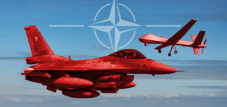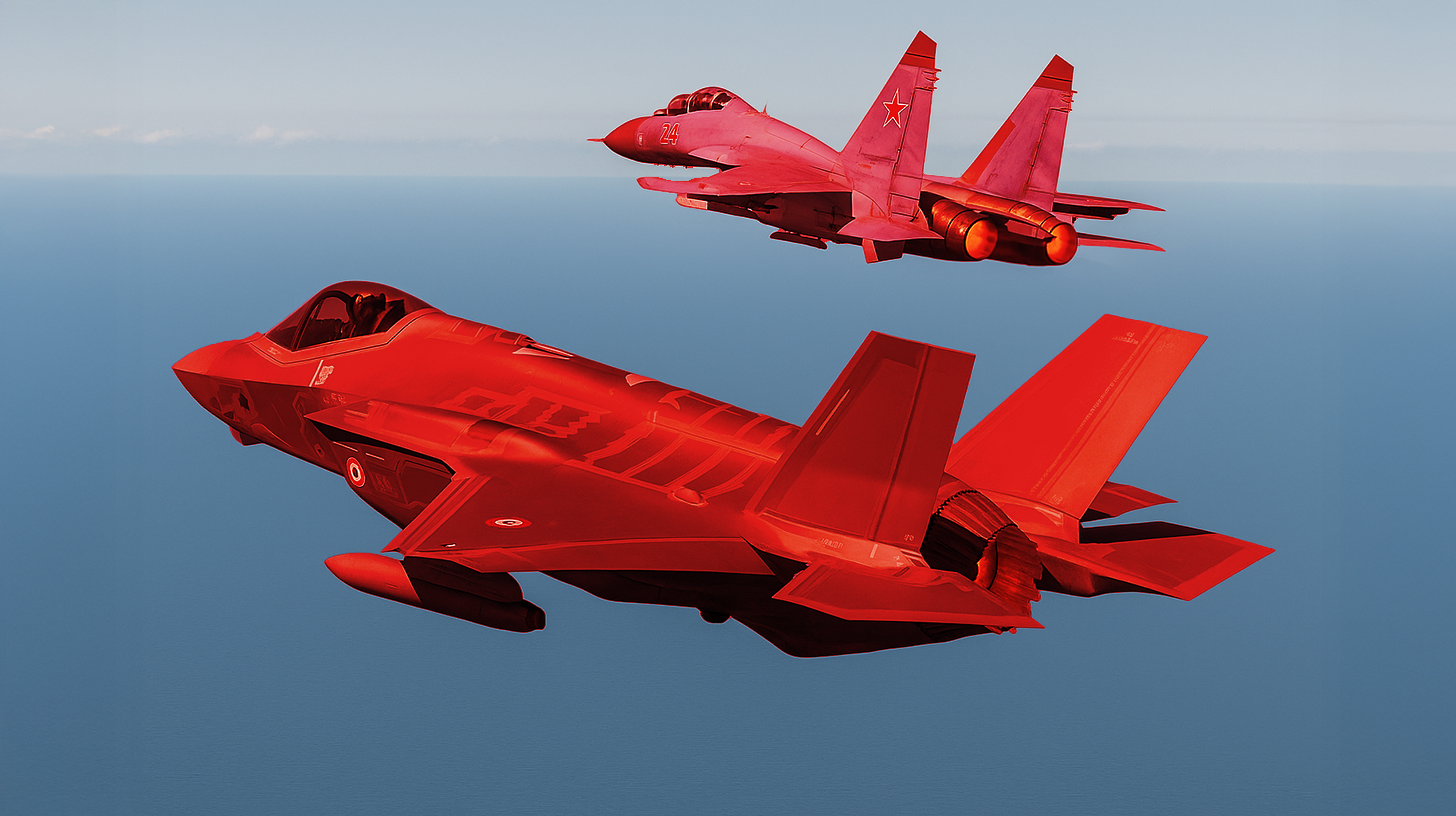
Twelve minutes over foreign territory – scramble over the Baltic Sea: Italian F-35s chase Russian jets out of NATO airspace – Creative image: Xpert.Digital
Provocation in the Baltic Sea region: Russian fighter jets violate Estonian NATO airspace
Red line crossed? What the Russian provocation means for the security of Europe
On the morning of Friday, September 19, 2025, a serious incident occurred over the Gulf of Finland, further escalating tensions between Russia and NATO. Three Russian MiG-31 Foxhound fighter jets entered Estonian airspace without authorization and remained there for an exceptionally long twelve minutes. The incident took place near the Baltic Sea island of Vaindloo over the Gulf of Finland, a strategically important sea area between Estonia and Finland.
The Russian fighter jets violated all international air traffic regulations: they had not submitted flight plans to Estonian air traffic control, their electronic identification systems were deactivated, and they were not in radio contact with Estonian air traffic control. This behavior violates fundamental norms of international civil aviation and is considered a clear provocation.
Related to this:

Immediate NATO response by Italian F-35 jets
NATO responded immediately to the airspace violation. Italian F-35 fighter jets of Task Force Air – 32nd Wing, operating from Ämari Air Base in Estonia as part of the Baltic Air Policing Mission since August 2025, immediately scrambled to intercept the aircraft. These F-35 Lightning II jets, operating under NATO Quick Reaction Alert command, intercepted the Russian aircraft and escorted them out of Estonian airspace.
The Italian Air Force only assumed responsibility for Baltic airspace surveillance from the Portuguese Air Force on August 1, 2025. Operation Baltic Eagle III marked Italy's fourth participation in the Baltic Air Policing Mission and its second with F-35 fighter jets. The Baltic states of Estonia, Latvia, and Lithuania do not possess their own fighter jets, which is why NATO allies take turns protecting their airspace in four-month rotations.
Estonian outrage and diplomatic consequences
The Estonian government reacted with strong condemnation to the Russian incursion. Foreign Minister Margus Tsahkna described the incident as unprecedentedly brazen and emphasized the particular gravity of the provocation. Russia had already violated Estonian airspace four times earlier this year – on May 13, June 22, September 7, and now September 19 – but the current violation involving three fighter jets over such a long period represented a new level of escalation.
The Estonian Foreign Ministry immediately summoned the highest-ranking Russian diplomat in the country and delivered a formal protest note. Tsahkna called for a rapid increase in political and economic pressure on Russia in response to its growing transgressions and increasing aggression. Prime Minister Kristen Michal condemned the airspace violation as completely unacceptable and announced far-reaching consequences.
Activation of NATO Article 4
In direct response to the Russian provocation, Estonia invoked Article 4 of the NATO treaty on Friday and requested formal consultations with all alliance partners. This article provides for consultations among NATO member states if one of them perceives a threat to its territorial integrity, political independence, or security.
Article 4 is a rare and significant instrument in NATO history. Since the alliance's founding in 1949, it has only been invoked eight times. The last activation occurred on February 24, 2022, when eight Eastern European NATO states requested consultations following Russia's invasion of Ukraine. The NATO North Atlantic Council announced that the consultations regarding the Estonian incident will take place in Brussels early next week.
International reactions and solidarity
The international community reacted with broad support for Estonia and strong condemnation of Russia. NATO Secretary General Mark Rutte stated that the alliance had responded swiftly and decisively to the Russian airspace violation. NATO spokeswoman Allison Hart described the incident as yet another example of Russia's reckless behavior, but also emphasized NATO's ability to respond appropriately.
German Foreign Minister Johann Wadephul condemned the violation of Estonian airspace as unacceptable and assured the government in Tallinn of Germany's full solidarity. EU High Representative Kaja Kallas, herself Estonian, called it an extremely dangerous provocation and warned that Putin was testing the West's resolve. She emphasized that the EU must not show any weakness and promised her homeland the full support of the European Union.
EU Council President Antonio Costa announced that the heads of state and government will discuss a collective response to Russia's violation of European airspace at their meeting in Copenhagen on October 1. EU Commission President Ursula von der Leyen commented that as the threats escalate, so too will the pressure on Russia.
Russian denials and counterarguments
Russia immediately rejected the accusations of airspace violation. According to the state news agency TASS, the Russian Defense Ministry stated that the flight was conducted in strict compliance with international airspace regulations and without violating the borders of other states. The MiG-31 jets did not deviate from the agreed flight path and did not violate Estonian airspace.
According to the Russian account, the route led over neutral waters more than three kilometers north of the Estonian Baltic island of Vaindloo. The ministry claimed the aircraft flew from Karelia to the Kaliningrad region, and that this had been confirmed by objective monitoring. However, this account directly contradicts the statements of the Estonian authorities and NATO, who unequivocally confirmed the incident.
Technical details of the MiG-31 fighter jets
The MiG-31 fighter jets involved in the airspace violation are among the most powerful and fastest interceptors in the world. The Mikoyan-Gurevich MiG-31, NATO reporting name Foxhound, reaches a top speed of 3,000 kilometers per hour and can climb to an altitude of 24,400 meters. With a maximum takeoff weight of 46,200 kilograms and two Solovyov D-30F6 turbofan engines, it is twice as heavy as a Eurofighter.
The interceptor has been in service since 1981 and was specifically designed for engaging long-range targets. The powerful Zaslon radar enables the modernized MiG-31BM to track up to 24 aerial targets and engage six of them simultaneously. Its radar range is 320 kilometers, and the R-37M missile allows it to engage enemy aircraft at a distance of over 280 kilometers.
Of particular concern is the MiG-31K variant's ability to carry Kinzhal hypersonic missiles. This development has significantly increased the threat potential of these already dangerous interceptors and makes them a key component of Russia's military arsenal.
Hub for Security and Defense - Advice and Information


Hub for Security and Defense - Image: Xpert.Digital
The Security and Defence Hub offers expert advice and up-to-date information to effectively support companies and organizations in strengthening their role in European security and defence policy. Working closely with the SME Connect Defence Working Group, it particularly promotes small and medium-sized enterprises (SMEs) that wish to further develop their innovative capacity and competitiveness in the defence sector. As a central point of contact, the Hub thus creates a crucial bridge between SMEs and European defence strategy.
Related to this:
From drones to Su-35s: Why the Baltic Sea region is a danger zone
Further provocations and escalation
The incident over Estonia was not an isolated event, but part of a series of Russian provocations in the Baltic Sea region. Just a few hours after the airspace violation over Estonia, Poland reported another incident. Two Russian fighter jets approached a Polish oil platform in the Baltic Sea at low altitude, violating the Petrobaltic platform's security zone. The jets flew at an altitude of only 150 meters over the facility, which is located about 70 kilometers north of Jastarnia in Poland's exclusive economic zone in the Baltic Sea.
These actions followed a wave of drone incidents in recent weeks. Just ten days earlier, during a Russian airstrike on Ukraine, around 20 Russian drones had entered Polish airspace. Poland and other NATO allies shot down some of these drones for the first time, marking a new escalation in Russian-Western tensions. Romania also reported similar incidents involving Russian drones in its airspace.
Related to this:
Strategic importance and expert analysis
Security experts interpret these incidents as a deliberate Russian strategy to test NATO's limits and responses. Military expert Fabian Hoffmann from the University of Oslo assessed the situation as extremely serious and warned that Russia would continue to test the boundaries. NATO must react sooner or later, otherwise the alliance will lose its credibility.
The provocations come at a strategically significant time. They coincide with the Russian military exercise Zapad 2025, whose name translates to "West," and which is clearly aimed at making an impression on NATO's eastern flank. Although Russia claims to have 100,000 troops involved in the exercise, British intelligence estimates the actual numbers to be considerably lower.
The airspace violations serve several strategic purposes: they test NATO's reaction time and capability, demonstrate Russian presence in the Baltic Sea region, and are intended to sow uncertainty and division within the Western alliance. At the same time, Russia gathers valuable intelligence about NATO defense systems and procedures.
Historical context of the airspace violations
Airspace violations by Russia are not a new phenomenon, but they have increased significantly since the start of the war in Ukraine. Estonia has already recorded four confirmed violations of its airspace by Russian aircraft in 2025. On May 13, a Sukhoi Su-35 entered Estonian airspace over the Juminda peninsula but remained for less than a minute. Further incidents followed on June 22 and September 7, with a Russian Mi-8 helicopter involved in the September incident.
This cluster of incidents reveals a systematic pattern of Russian provocations along NATO's eastern flank. Similar incidents have also occurred in recent months over other Baltic states and Poland. The international community is observing a worrying intensification of these activities, which aim to test NATO solidarity and identify potential weaknesses within the alliance.
Technical aspects of airspace surveillance
The Baltic Air Policing Mission is one of NATO's most important operations on its eastern flank. Since the Baltic states do not possess their own fighter jets, various NATO member states rotate this responsibility every four months. The mission operates from two main bases: Ämari Air Base in Estonia and Šiauliai Air Base in Lithuania.
The Italian F-35 jets currently conducting airspace surveillance represent state-of-the-art fighter jet technology. This fifth-generation aircraft boasts advanced stealth capabilities, sophisticated sensors, and the ability to network data with other NATO systems. Their presence sends a clear signal of the alliance's technological superiority and resolve.
Political and economic reactions
In direct response to escalating Russian provocations, the European Union announced a tightening of its sanctions. The European Commission presented its 19th sanctions package, which includes an early ban on Russian liquefied natural gas (LNG) imports starting in January 2027. Additionally, 118 more vessels belonging to Russia's so-called shadow fleet were added to the sanctions list, further restricting Russia's ability to circumvent existing sanctions.
Ukrainian President Volodymyr Zelenskyy used the incident to call for a tougher international response to Russian aggression. He warned that Russia's destabilizing measures would spread to new countries if there were no decisive action. His Foreign Minister, Andriy Sybiha, spoke of a direct threat to transatlantic security and demanded a truly powerful response.
Military-strategic implications
Russian airspace violations have far-reaching military-strategic consequences for NATO and the regional security architecture. They force the alliance into a state of constant readiness and tie up significant military resources for air defense. At the same time, they serve as a test run for potential military scenarios and allow Russia to study NATO's reaction times and patterns.
These incidents also highlight the strategic importance of the Baltic Sea region as a potential conflict zone. The region encompasses vital sea lanes, critical infrastructure, and NATO's particularly exposed eastern flank. Russia's systematic provocations aim to test the region's defense capabilities and potentially identify vulnerabilities for future operations.
International law and international law
The Russian airspace violations constitute clear breaches of international aviation law and the sovereignty of the affected states. The 1944 Chicago Convention, which forms the basis of international civil aviation law, establishes the principle of the complete and exclusive sovereignty of states over their airspace. Military aircraft may only overfly foreign airspace with explicit authorization.
Russia's systematic violation of these principles undermines the international legal order and sets dangerous precedents. The NATO states concerned have the right to self-defense under Article 51 of the UN Charter and may take legitimate measures to safeguard their sovereignty, including the use of combat aircraft to deter and escort intruding aircraft.
Future developments and forecasts
The increasing number of Russian provocations suggests a further escalation of tensions in the Baltic Sea region. Experts anticipate an intensification of NATO air defense and potentially stricter rules of engagement for dealing with airspace violations. The planned NATO consultations under Article 4 could lead to increased defense measures on the eastern flank, including an upgrade of air defense systems and a greater presence of fighter jets.
At the same time, a vicious cycle of provocation and reaction threatens to increasingly destabilize the region. The international community faces the challenge of responding decisively to Russian aggression while simultaneously avoiding an uncontrolled escalation that could lead to a larger conflict.
The coming weeks will show how successful the NATO consultations are and what concrete measures are decided upon to strengthen regional security. The solidarity of the alliance and the unity of the international response will be crucial in determining whether Russia's strategy of provocation and destabilization can be successfully countered or whether it leads to a lasting deterioration of the security situation in Europe.
Consulting - Planning - Implementation

Markus Becker
I would be happy to serve as your personal advisor.
Head of Business Development
Chairman SME Connect Defense Working Group
Consulting - Planning - Implementation
Konrad Wolfenstein
I would be happy to serve as your personal advisor.
You can contact me at wolfenstein∂xpert.digital or
Just call me on +49 7348 4088 965 .