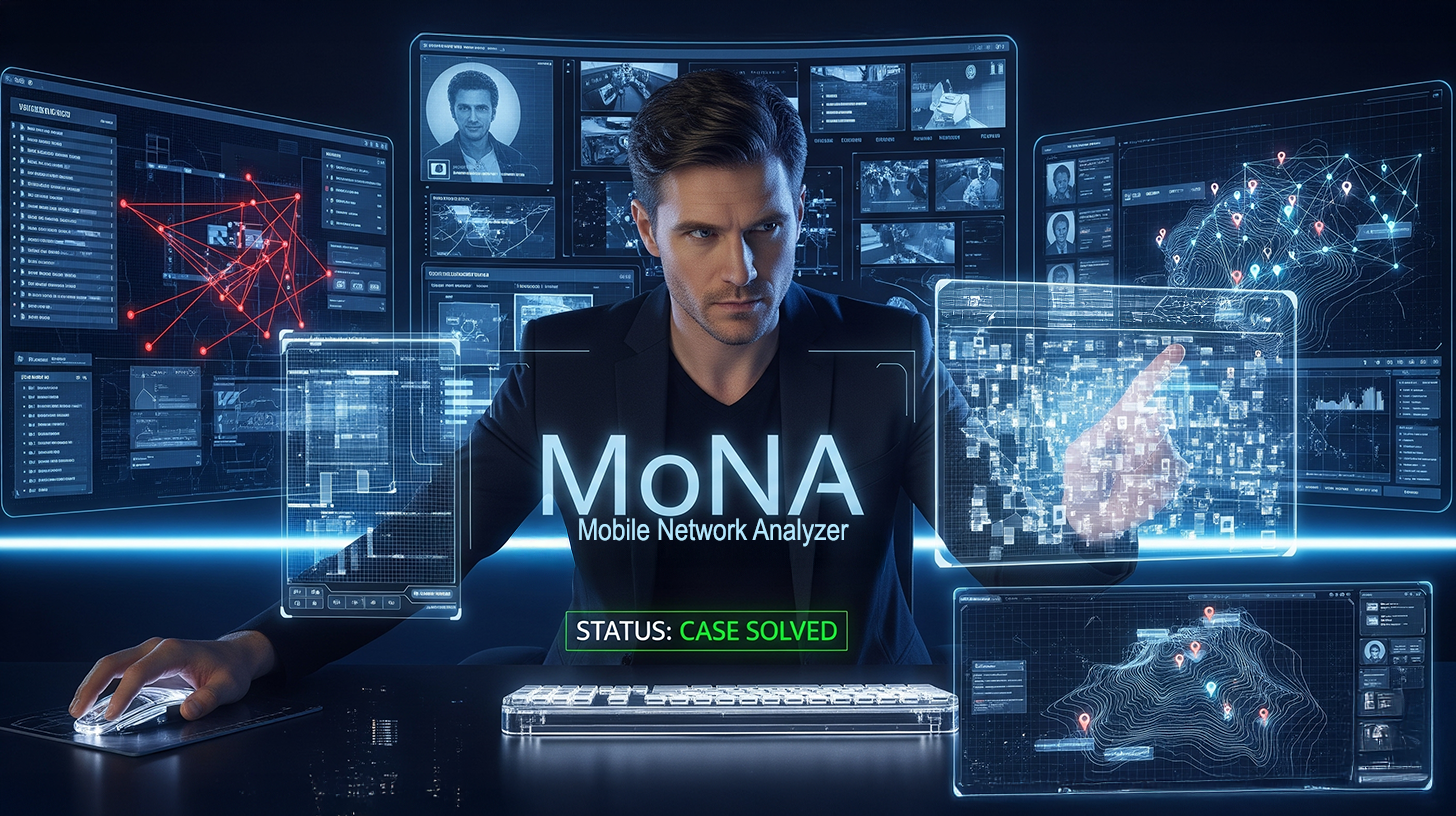
Six months, 18 investigators, zero success: Then AI arrived and solved the case in 20 minutes – AI-supported investigation software MoNA – Image: Xpert.Digital
90% less reading effort: This ingenious software finds the needle in the data haystack for investigators
AI-powered investigative software is revolutionizing police work in Germany
###“MoNA”: Germany’s new wonder weapon against crime cracks every case ### The silent revolution: How an AI from Braunschweig is forever changing German police work ### Criminals use AI – but the German police are now striking back with their own super software ###
Born out of necessity: How an unsolvable case became the birthplace of Germany's cleverest investigative AI
Imagine this: 18 investigators struggle for six months with a seemingly insurmountable flood of mobile phone data. Then a software program comes along and accomplishes the same task in just 20 minutes. What sounds like science fiction is already a reality in Germany and marks a turning point in crime fighting. We're talking about "MoNA," a revolutionary AI-supported investigative software developed by the Cybercrime Unit in Braunschweig in cooperation with Mittweida University of Applied Sciences.
This innovation is more than just a technological breakthrough; it's the answer to the biggest challenge facing modern policing: the gigantic amounts of data generated by crimes. Given the increasing professionalism of cybercriminals, who themselves have long relied on AI technologies, MoNA offers officers a crucial tool to get a handle on the situation. The software analyzes, translates, and connects chat histories, uncovers criminal networks, and reduces manual evaluation efforts by up to 90 percent. But this enormous progress also raises important questions: How is data protection guaranteed, what legal limits exist, and what does the digital future of crime fighting in Germany look like? MoNA's success story not only provides fascinating insights into the present but also a groundbreaking glimpse into the future of policing.
The innovation from Braunschweig is changing the way crime is fought
The German police are undergoing a technological revolution. The development of advanced AI-supported analysis software by the Cybercrime Unit in Braunschweig, in cooperation with Mittweida University of Applied Sciences, is ushering in a new era of investigative work. These innovations demonstrate how artificial intelligence can dramatically increase the efficiency of police work, while simultaneously creating new challenges in handling digital evidence.
The software MoNA, whose full name is Mobile Network Analyzer, represents a breakthrough in the forensic analysis of mobile communication data. This technological achievement is not only a local success but has already attracted the interest of European law enforcement agencies and is considered a unique solution across Europe for the challenges of modern cybercrime.
The birth of a revolutionary technology
The origins of MoNA are closely linked to a spectacular case of investment fraud that pushed Braunschweig investigators to their limits two and a half years ago. Analyzing 46 confiscated mobile phones belonging to an international fraud ring proved to be a virtually impossible task for the available personnel. Eighteen investigators worked for six months sifting through the enormous amount of data without reaching a satisfactory conclusion.
This experience led to an intensive search for technical solutions that would allow for a faster understanding of communication flows and patterns of crime. The Cybercrime Unit of the Braunschweig Central Criminal Investigation Department recognized the need for a fundamentally different approach and initiated the development of specialized software in cooperation with the Mittweida University of Applied Sciences in Saxony.
The result of this collaboration was impressive: What eighteen investigators hadn't managed to accomplish in six months, MoNA accomplished in just twenty minutes. This dramatic increase in efficiency marked the beginning of a new era in digital forensics and demonstrated the enormous potential of artificial intelligence in law enforcement.
Technical Functionality and Capabilities
MoNA is based on an innovative concept of semantic data analysis that goes far beyond conventional search functions. At the heart of the software is a semantic dictionary in the form of a complex concept graph. This graph links individual keywords and patterns into semantic chains, representing each term not as a simple textual occurrence, but as a vector of possible forms, including synonyms and foreign language variants.
The software uses statistics, algorithms, and artificial intelligence to filter and analyze mobile data from end devices. It can search for suspicious chat histories, frequent communication partners, criminal networks, or repeatedly used terms. According to Mario Krause, head of the cybercrime unit, this functionality saves investigators about ninety percent of the otherwise necessary reading work.
A particularly valuable aspect of MoNA is its ability to translate and transcribe images, audio, and video files. Language barriers pose no problem for the software, as it can translate messages into the desired language. This functionality is invaluable to investigators given the increasingly international dimension of cybercrime.
The software enables interactive analysis that incorporates the investigators' experience and case knowledge. This approach takes into account the uniqueness of each individual case and ensures that human expertise is not replaced by technology, but rather enhanced.
Increased efficiency in investigative work
The practical impact of MoNA on investigative work is revolutionary. Mario Krause reports an increase in efficiency by a factor of ten to twelve. This dramatic improvement enables officers to understand communication content much faster and identify relevant evidence.
In every new case, investigators must first identify which information is relevant to potential crimes. This initial assessment, which previously could take weeks or months, is reduced to a few hours or even minutes by MoNA. The software can pre-sort large amounts of data and prioritize the most likely relevant information, allowing investigators to focus their time and energy on the truly important aspects of a case.
The time savings are particularly important in cases of organized crime, where numerous devices are often involved, but not all of them contain the complete communication history. Individual deletion of messages or differing join times to groups result in highly fragmented communication. MoNA can link these fragmented communication histories and enable a near-complete reconstruction of the communication, while simultaneously reducing the reading effort by merging identical messages.
Distribution and acceptance
Since last year, police throughout Lower Saxony have been able to use the MoNA software. This statewide implementation demonstrates the authorities' confidence in the technology and its practical applicability. These successes have led to other European investigative authorities also expressing interest in the software.
The Lower Saxony Ministry of the Interior considers the use of artificial intelligence in police work, particularly in the review of large datasets during investigations, to be of great importance. Ministry spokespeople predict that further AI functionalities will become an integral part of police investigative work in the coming years.
For investigators in Braunschweig, MoNA has already become an indispensable tool in the fight against cybercriminals. The software has proven so valuable that it is now used in all major cybercrime investigations.
The scientific basis
The development of MoNA is closely linked to the academic work at Mittweida University of Applied Sciences. Dr. Michael Spranger developed a comprehensive platform for analyzing mobile communication as part of his doctoral dissertation. The concept is based on the understanding that, due to the unique nature of each individual case, only an interactive solution incorporating the experience and case knowledge of an investigator can be successful.
The Communication Forensics research group at Mittweida University of Applied Sciences focuses on supporting law enforcement agencies in two fundamental tasks: the analysis of mobile communication and social networks. For these two areas, the researchers develop and adapt text mining methods to facilitate the evaluation of immense amounts of messages and posts and to identify case-relevant content as well as relationships between suspects.
The State Criminal Police Office of Baden-Württemberg is funding the further development of the software, thus enabling the long-term implementation of additional intelligent services that will make MoNA an internationally competitive analysis solution for mobile devices. In addition, NUIX, a global market leader in forensic software solutions and services, plans to integrate MoNA into its system landscape.
A new dimension of digital transformation with 'Managed AI' (Artificial Intelligence) - Platform & B2B solution | Xpert Consulting

A new dimension of digital transformation with 'Managed AI' (Artificial Intelligence) – Platform & B2B solution | Xpert Consulting - Image: Xpert.Digital
Here you will learn how your company can implement customized AI solutions quickly, securely and without high entry barriers.
A managed AI platform is your all-inclusive, worry-free solution for artificial intelligence. Instead of dealing with complex technology, expensive infrastructure, and lengthy development processes, you receive a ready-made solution tailored to your needs from a specialized partner – often within just a few days.
The key advantages at a glance:
⚡ Rapid implementation: From idea to ready-to-use application in days, not months. We deliver practical solutions that create immediate added value.
🔒 Maximum data security: Your sensitive data stays with you. We guarantee secure and compliant processing without sharing data with third parties.
💸 No financial risk: You only pay for results. High upfront investments in hardware, software, or personnel are completely eliminated.
🎯 Focus on your core business: Concentrate on what you do best. We take care of the entire technical implementation, operation, and maintenance of your AI solution.
📈 Future-proof & scalable: Your AI grows with you. We ensure continuous optimization and scalability, and flexibly adapt the models to new requirements.
More information here:
How AI is revolutionizing the German police — opportunities and limitations
Further AI applications in German police work
The development of MoNA is part of a broader trend towards the digitalization of police work in Germany. In addition to MoNA, the Lower Saxony State Criminal Police Office has developed two other AI-supported tools: Tracebook Chats and the Kipo Analyzer.
Tracebook Chats focuses on processing communication data and providing transcription and translation services. The software aims to offer investigators the best possible support in evaluating previously encrypted messenger data while minimizing the time required for analysis. Following a successful test phase, Tracebook Chats is now available to users in all Lower Saxony police authorities, tailored to specific target groups.
The Kipo Analyzer and Tracebook Kipo were specifically developed for case officers working in the field of child pornography. Using AI, the Kipo Analyzer can quickly classify large amounts of data for pornographic content through a preliminary analysis and prioritize this data. These results can be used in Tracebook Kipo, thus supporting police investigators and analysts in their evaluation and significantly reducing the time required.
Data protection and legal framework
The introduction of AI-supported analysis systems in police work raises important questions regarding data protection and the legal framework. In its Hessendata ruling, the Federal Constitutional Court set clear standards for the use of AI in police work. The court emphasizes that self-learning systems may only be used in police work under special procedural safeguards that ensure a sufficient level of protection despite the limited traceability of the processes.
The analysis of mobile phone data constitutes a massive intrusion into privacy and is therefore only permissible under certain conditions. There must be a strong suspicion of a crime, the intrusion must be proportionate, and a court order is generally required. These legal restrictions ensure that technological possibilities do not lead to an unjustified expansion of surveillance powers.
The proportionality of mobile phone data analysis is given when the measure is proportionate to the severity of the crime and the importance of the evidence. In cases of serious crimes such as organized drug trafficking or terrorism, the use of AI-supported analysis systems may be justified, whereas in minor offenses, proportionality would not be given.
The evidence cloud as a vision of the future
Another forward-looking project is the development of an evidence cloud by the Lower Saxony Ministry of the Interior, the Ministry of Justice, and the State Criminal Police Office. The aim is to develop a shared platform to make the storage, processing, and analysis of digital evidence by the police and judiciary more efficient and secure.
The evidence cloud is intended to guarantee cross-system, target group-specific, and legally compliant network access. Digital evidence should be available, analyzable, and evaluable for all colleagues, regardless of their location. This would represent a revolution in collaboration between different authorities and organizations.
The project is designed to run for at least two years and will gather its first key findings by the end of the year. The evidence cloud will reach its full potential once future-proof, high-performance, and AI-supported analysis tools can be integrated and made operational on the platform. These tools would finally make it possible to establish crucial links to crimes quickly, comprehensively, and seamlessly across all media.
Challenges and threats
The rise of cybercrime poses increasing challenges for law enforcement. In 2024, a total of 131,391 cybercrimes were registered in Germany. An additional 201,877 of these were foreign offenses, committed from abroad or from an unknown location. These figures demonstrate the scale of the threat and underscore the need for effective technological solutions.
The damage caused by cyberattacks is immense. According to a survey by the German IT industry association Bitkom, they caused €178.6 billion in damage in 2024. That's €30 billion more than the previous year. The greatest threat continued to come from ransomware attacks, in which attackers encrypt computers and only release them after paying a ransom.
Criminals are increasingly using AI technologies for their own purposes. With AI's help, they can optimize and improve malware without having to adhere to legal or ethical restrictions. This asymmetric situation, in which criminals can use the technology unhindered while law enforcement agencies are bound by legal regulations, presents a particular challenge.
The future of police AI use
The development of AI-supported systems in policing is still in its early stages. Several German states are working on implementing further AI applications. North Rhine-Westphalia is currently building its own infrastructure for providing AI applications, and the first AI applications for analyzing large datasets are expected to be operational this year.
Lower Saxony is planning to be one of the first German states to use AI for crime prevention. With the help of AI, the Lower Saxony police will soon be able to automatically recognize faces, voices, and movement patterns. These technologies are intended to help identify dangerous situations or suspicious behavior patterns more quickly.
A prominent example of the successful use of AI in police work is the arrest of suspected former RAF terrorist Daniela Klette. Journalists tracked down Klette, who is now on trial, using a facial recognition program. The computer calculated what Klette would look like in old age based on old photos found online, thus enabling her identification.
International Perspectives and Cooperations
The successes of German AI developments in police work have also attracted international attention. The communication analysis software MoNA is unique in Europe and is generating interest among other European investigative authorities. This international recognition underscores the quality and innovative strength of German developments.
The collaboration between universities and law enforcement agencies is proving particularly fruitful. The cooperation between Mittweida University of Applied Sciences and the Braunschweig Cybercrime Unit demonstrates how academic research and practical police work can mutually enrich each other.
Mittweida University of Applied Sciences has established itself as a center for excellent applied research and offers various degree programs in the fields of IT forensics and cybercrime. These educational programs address the growing need for specialists in public authorities and contribute to the long-term preservation of expertise.
Fair algorithms: How police AI can become transparent and legally sound
The use of AI in policing raises important social and ethical questions. While the technology undoubtedly has the potential to improve crime detection and increase public safety, the fundamental rights of citizens must be protected at the same time.
The transparency and traceability of AI decisions are of paramount importance. Investigators must be able to understand how the AI arrived at its conclusions in order to evaluate the results and defend them in court. Forensic evaluation must always remain with humans, even when AI systems assist with pre-screening and analysis.
The danger of discriminatory algorithms is another important issue. AI systems can unintentionally reinforce prejudices or disadvantage certain population groups. Therefore, special procedural safeguards are necessary to ensure an adequate level of protection.
The digital future of policing
The development of MoNA and other AI-powered systems marks the beginning of a new era in policing. The dramatic increase in efficiency made possible by these technologies allows law enforcement agencies to keep pace with the rapidly growing threat of cybercrime.
The future will bring further innovations. Virtual police avatars could guide citizens through reporting procedures, automatic translations could overcome language barriers, and intelligent analytics could help prevent crimes before they happen.
At the same time, the legal framework must be continuously adapted to both harness the potential of technology and protect citizens' fundamental rights. Maintaining a balance between security and freedom will remain a key challenge.
The success story of MoNA demonstrates that Germany has the potential to take a leading role in the development and application of AI in law enforcement. By combining scientific excellence, practical experience, and the rule of law, innovative solutions can be created that are both effective and legally compliant.
Policing in the future will be increasingly digital and AI-supported. MoNA is just the beginning of a development that has the potential to fundamentally change the way crime is fought. The challenge lies in using these technologies responsibly while upholding the democratic values and rule of law that shape our society.
EU/DE Data Security | Integration of an independent and cross-data-source AI platform for all business needs
Independent AI platforms as a strategic alternative for European companies - Image: Xpert.Digital
AI Game Changer: The most flexible AI platform - Tailor-made solutions that reduce costs, improve your decisions and increase efficiency
Independent AI platform: Integrates all relevant company data sources
- Rapid AI integration: Tailor-made AI solutions for businesses in hours or days, instead of months
- Flexible infrastructure: Cloud-based or hosting in your own data center (Germany, Europe, free choice of location)
- Maximum data security: its use in law firms is irrefutable proof
- Deployment across a wide variety of enterprise data sources
- Choice of own or different AI models (DE, EU, USA, CN)
More information here:
We are here for you - Consulting - Planning - Implementation - Project Management
☑️ SME support in strategy, consulting, planning and implementation
☑️ Creation or realignment of the AI strategy
☑️ Pioneer Business Development

Konrad Wolfenstein
I would be happy to serve as your personal advisor.
You can contact me by filling out the contact form below or simply call me on +49 7348 4088 965 .
I'm looking forward to our joint project.
Write to me



Xpert.Digital - Konrad Wolfenstein
Xpert.Digital is a hub for industry focusing on digitalization, mechanical engineering, logistics/intralogistics and photovoltaics.
With our 360° Business Development solution, we support renowned companies from new business to after-sales.
Market intelligence, smarketing, marketing automation, content development, PR, mail campaigns, personalized social media and lead nurturing are part of our digital tools.
You can find more information at: www.xpert.digital - www.xpert.solar - www.xpert.plus
Keep in touch