

Published on: October 27, 2024 / Updated on: October 27, 2024 – Author: Konrad Wolfenstein

What makes AI influencers so attractive to brands? – Image: Xpert.Digital
AI vs. Humans: Will human influence remain irreplaceable in the digital age?
In recent years, digital transformation has intensified the influence of artificial intelligence (AI) on almost every aspect of our lives – and influencer marketing is no exception. While traditional, human influencers still dominate social media, a new generation of digital personalities has emerged: so-called “AI influencers.” Virtual avatars like Lil Miquela, who have a growing global following, demonstrate how brands can benefit from these digital personalities. But how sustainable is this trend? Will AI avatars dominate social media and marketing in the future, or will human influence remain irreplaceable?
Related to this:
What makes AI influencers so attractive to brands?
The appeal of AI influencers is obvious for companies: they offer a flawless, consistent presence that always aligns with brand values and contains no unwanted surprises. Unlike human influencers, who can have personal opinions, weaknesses, and missteps, AI influencers are completely controllable and predictable. They always act in the brand's best interest and can be precisely tailored to the target audience's needs through algorithms. The ability to adapt content to the latest trends at any time is particularly attractive for companies that need to stay ahead of the curve in the fast-paced world of digital marketing.
Another advantage of AI influencers lies in their availability. While human influencers have limited capacity and often require complex management structures to organize their campaigns, AI-based avatars can theoretically work around the clock. Their presence can be controlled globally and without time limitations, increasing the reach and flexibility of a campaign.
Who are the most successful AI influencers?
One of the most well-known AI influencers is Lil Miquela, a virtual avatar with more than three million followers on Instagram. She "lives" in Los Angeles, posts about fashion and lifestyle, and "works" with major brands like Prada and Calvin Klein. Miquela is a completely fictional personality, but through careful storytelling and perfectly staged images, she appears real to many of her followers. This identification and emotional connection generated by her posts is one of the keys to the success of AI influencers.
But Lil Miquela isn't the only one. There's a growing number of virtual influencers, including Shudu, considered the "first digital supermodel," and Blawko, who has made a name for himself as a "virtual bad boy." These avatars represent different lifestyles and target audiences, offering brands the opportunity to tailor their messages to specific and individual segments.
How do consumers react to AI influencers?
Consumer acceptance of AI influencers is remarkably high. Studies show that up to 58% of American consumers follow virtual influencers. One reason for this acceptance lies in the fascination with technology and the curiosity about the unknown. AI influencers embody a perfect blend of the familiar and the exotic – they are "people," but different, exciting, and mysterious.
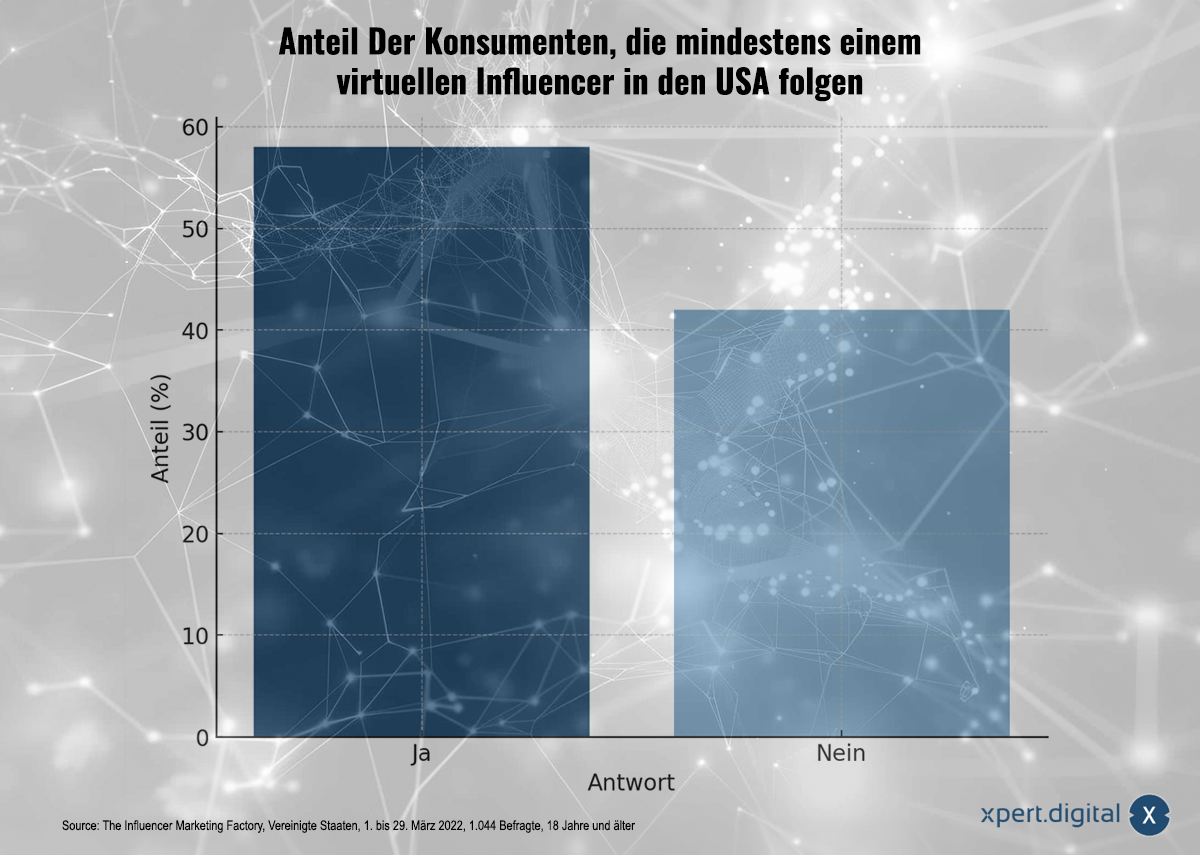
Percentage of consumers who follow at least one virtual influencer in the USA – Image: Xpert.Digital
Nevertheless, the question remains whether AI influencers can truly compete with human influencers when it comes to authenticity. Many consumers value the genuineness and approachability that a human influencer offers. While Lil Miquela and others impress with their well-developed personalities, they lack the spontaneous, genuine human interaction that attracts many users. For many followers, the knowledge of the "inauthenticity" of the AI avatars is even a key aspect of their fascination. They know that Lil Miquela is an artificial creation, and that's precisely what makes her posts interesting.
The influence of AI influencers on brand communication
The benefits for brands of using AI influencers extend beyond control and consistency. Virtual influencers also offer companies the opportunity to experiment with new forms of brand communication. They can create narratives that would be difficult or impossible for real people to implement, and they can present extreme aesthetics or futuristic scenarios that would appear artificial to human influencers.
In this context, the use of AI influencers opens up the possibility of a hyper-realistic brand world. Such digital figures can act as central characters in virtual spaces that fans and customers can access, authentically conveying the brand's world. The virtual environment of these influencers, which can be used in cooperation with augmented reality and virtual reality technologies, creates an immersive experience that can intensify brand loyalty.
Challenges and risks of AI influencers
As attractive as the advantages are, there are also challenges and risks associated with using AI influencers. A key issue is authenticity. In an era where transparency and credibility are increasingly important, knowing that an avatar is artificial could undermine its credibility. Consumers might feel they are interacting with an "artificial facade," which can be particularly problematic on social networks that often rely on authenticity and personal connection.
Another risk lies in the ethical questions raised by the use of AI. For example, the question arises as to whether and how much influence algorithms and artificial systems should have on our perception of reality and truth. The possibility that brands could create a kind of "perfect world" through AI influencers could lead to unrealistic expectations and self-perception problems among young people, who are a particularly receptive target group for social media.
Related to this:
The future of influencers: AI and humans in harmony?
The debate about whether AI influencers could replace human influencers in the near future remains exciting. Many experts assume that the two formats will coexist. AI influencers are particularly well-suited for brands that want to spread consistent, controllable, and visually appealing messages. Human influencers, on the other hand, score points with their personality, their emotions, and their genuine interaction, which are difficult to reproduce using AI.
A hybrid model could be an interesting solution, where human influencers are supported by AI elements to increase their reach or to operate in digital, immersive environments. Such an approach would make it possible to combine the advantages of both worlds and enrich the marketing mix with creative and innovative campaigns.
One example of this combination is "deepfake influencers," where real personalities are enhanced and expanded through AI. AI technologies are used to create digital versions of real influencers that can exist and act alongside their "real" selves. These avatars could operate in virtual spaces without the real influencer being physically present, thus significantly expanding the influencers' capabilities and potential.
Related to this:
A lasting trend or a passing fad?
The rise of AI influencers is more than just a passing trend. They offer companies new opportunities to reach their target audiences in innovative ways, providing flexibility, control, and scalability that are difficult to achieve with human influencers. Consumer acceptance shows that there is significant interest in these digital personalities, and fans readily embrace a blend of reality and virtuality.
Nevertheless, it remains to be seen whether AI influencers can achieve the same level of authenticity and emotional connection as human influencers in the long run. In a digital world that increasingly relies on transparency and genuine interaction, AI avatars could reach their limits in certain areas. It's conceivable that we will see a mix of AI-powered and human influencers in the future, together enabling comprehensive, flexible, and engaging influencer marketing.
In an era of ever-evolving digital marketing, the use of AI influencers will undoubtedly be an integral part of future marketing strategies. However, whether they will ever be able to completely replace human influence remains a question that only the coming years can answer.