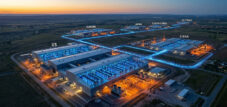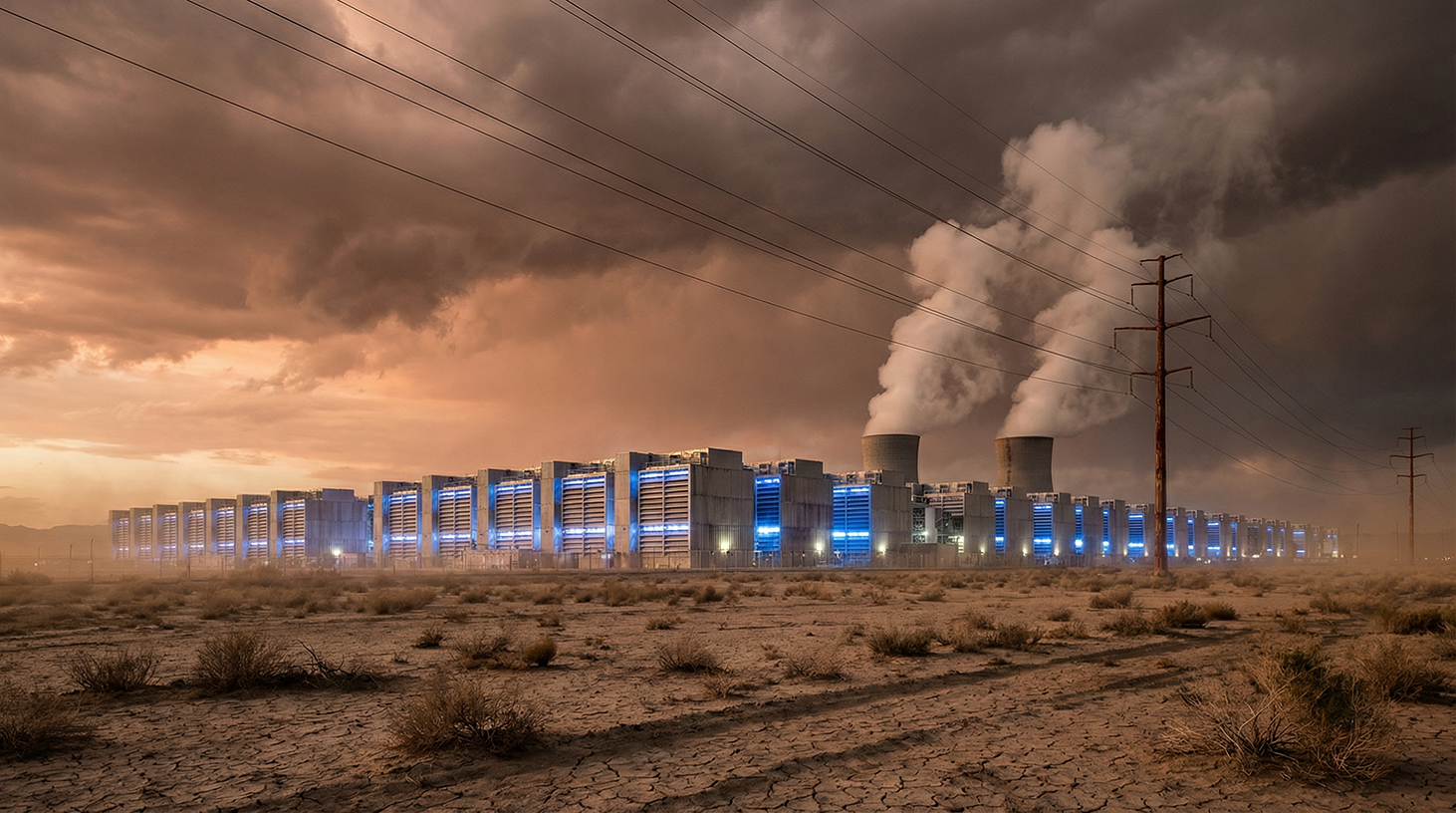
AI Gigafactories: The Hidden Cost – How the Expansion of Hyperscalers in the US and China Strains Resources – Image: Xpert.Digital
A data center drinks like a city: The dark side of AI expansion
Water shortages and urban heat islands: Bigger than ever – Why the construction of AI data centers is spiraling completely out of control
Is the next bubble looming? The dangerous illusion behind the new AI megaprojects
The hype surrounding artificial intelligence dominates the headlines – but while the world debates smart chatbots, productivity gains, and the future of work, a gigantic, almost invisible infrastructure program is taking place in the background. The so-called AI gigafactories and hyperscalers in the US and China are devouring physical resources on an unprecedented scale. Billions in taxpayer money are flowing as hidden subsidies to the world's already most profitable tech companies, while local communities are left to cope with exorbitant water consumption, massive environmental damage, and the threat of power shortages. This analysis takes an unflinching look behind the scenes of this historic construction program. It reveals the unspoken costs of the AI boom: from blatant lack of transparency and burgeoning speculative bubbles to a looming e-waste tsunami that renders global environmental goals absurd. It is high time to shift our focus from software to the hard, physical reality of artificial intelligence.
Billions for tech giants: How taxpayers are unconsciously financing the AI craze
The public debate surrounding artificial intelligence revolves almost exclusively around productivity gains, job losses, and fundamental ethical questions. What is systematically ignored is a far more pressing dimension: the material foundations upon which the AI boom rests. AI data centers—euphemistically referred to in the industry as "AI Factories" or "Hyperscale Campuses"—are physical megastructures with an unparalleled appetite for resources. Analyzing their true costs reveals a web of hidden subsidies, ecological time bombs, and social conflicts whose complexity far surpasses the usual energy consumption reports.
Dimensions of a historical building program
Never before in the history of information technology have so many and such large data centers been built in such a short period. The Stargate project—a joint venture between OpenAI, Oracle, SoftBank, and the Abu Dhabi sovereign wealth fund MGX—plans investments of up to $500 billion in AI infrastructure by 2029, with $100 billion immediately available. This single complex would thus represent the largest private infrastructure investment program in history. In the first quarter of 2025 alone, global capital expenditures on data centers surpassed all previous records. By 2030, total capacity could grow from around 103 gigawatts today to nearly 200 gigawatts. Estimates for total investments from 2026 to 2030 range from three to over five trillion US dollars.
In China, a parallel, state-coordinated development is underway. Between 2023 and 2024, over 250 new AI data centers were announced or built. Measured by total government AI spending—around €54 billion in 2025 according to a Bank of America analysis—China leads the world in government expenditure on artificial intelligence. These figures suggest that we are in the midst of one of the most capital-intensive infrastructure programs in postwar history—with a level of transparency that is woefully inadequate to reflect this scale.
The invisible subsidy machine in the USA
Tax exemptions without limits and without control
Perhaps the most underestimated political and economic problem of the US AI boom is the gradual draining of state budgets through uncontrolled subsidy competition between states. More than 30 US states have introduced specific tax breaks for data center companies, and 42 states grant either full or partial sales tax exemptions for data center equipment. The logic behind this initially seems plausible: attracting the big tech companies to their territory secures jobs and tax revenue. However, the reality is more sobering.
An analysis of state budget data shows that ten states alone are losing at least $100 million in tax revenue annually due to these tax programs. In Texas, the estimated cost of the state's sales tax exemption program for data centers rose from $157 million in 2023 to over $1 billion in 2025—a fivefold increase in just two years. Particularly concerning is that many of these exemptions are not capped by either the amount of tax owed or the duration of the exemption. This means that as capacity and hardware value increase, the tax breaks grow proportionally—a structural blank check for the world's wealthiest corporations. An investigation by the industry publication "The Register" documents that taxpayers are systematically kept in the dark about the beneficiaries of these programs.
A single example illustrates the imbalance: Microsoft received $333 million in sales tax exemptions for its data centers in Washington state alone between 2015 and 2023. OpenAI has since explicitly called on the Trump administration to extend the 35 percent tax exemption under the CHIPS Act to AI data centers, AI server production, and network infrastructure components. The structural finding is clear: While states and municipalities struggle with sometimes drastically rising network charges and budget shortfalls, the world's most profitable companies are being subsidized with public funds.
Federal level: Stargate and the state legitimacy of private interests
The Stargate project was personally unveiled by President Trump at the White House on January 21, 2025, as a strategic national project to secure American AI leadership. Although the project is formally intended to operate without direct federal funding, presidential power grants it crucial privileges: expedited approval processes, political backing against local opposition, and an implicit government guarantee that reduces financing costs. The use of eminent domain rights by power grid operators to connect data centers is already a reality in several states. In Wisconsin, for example, an 83-year-old artist faces the loss of his 500-football-field property because a high-voltage power line is needed to supply the $15 billion Stargate data center in Port Washington.
China's state subsidy apparatus – a different category
Direct funding along the entire AI value chain
While US subsidies primarily take the form of state-level tax breaks, China employs a significantly more direct and comprehensive form of state support. The national sovereign wealth fund for the AI industry, relaunched in 2025, alone comprises 60.06 billion RMB (approximately 7.2 billion euros) with a 13-year term. State-owned banks are directly involved. Additional funds at the municipal level complement the system: the Shanghai Pioneer AI Fund (approximately 2.7 billion euros), the Shenzhen Fund for AI and Robotics (approximately 1.2 billion euros), and eight industrial funds in Beijing.
The third state-backed semiconductor investment fund (Big Fund III), with $50 billion, directly targets the chip design and manufacturing industry, which forms the basis for AI data centers. China's total public investment in AI infrastructure in 2025 is estimated at around $100 billion. The direct subsidization of electricity costs is particularly effective: local governments have reduced energy bills for China's largest data centers by up to 50 percent. Specifically, companies like ByteDance, Alibaba, and Tencent, which are switching to domestically produced chips, are the beneficiaries. These subsidies thus also constitute industrial policy: they compensate for the lower energy efficiency of Chinese GPU alternatives compared to Nvidia's products.
The East-West Data Paradox
China's "Eastern Data Western Computing" strategy (东数西算, EDWC) is a prime example of state-coordinated infrastructure development with unintended consequences. The program aims to strategically relocate data centers to China's energy-rich and land-rich western provinces—Guizhou with its hydropower, and Inner Mongolia with its wind and solar energy. The logic is clear: eastern China has high demand but a shortage of land and energy. The west has energy, but hardly any qualified personnel or infrastructure.
The structural problem: Many of the high-performance computing centers built in the western provinces remain largely empty due to a lack of demand, human capital, and practical infrastructure. At the same time, this creates significant environmental risks in already water-scarce regions. Inner Mongolia and Gansu—two of China's provinces most severely affected by water stress—are already bearing the brunt of the EDWC program. The data centers in the Zhangjiakou region must draw their cooling water from groundwater, not from the nearby Guanting Reservoir, which is reserved for Beijing. This puts additional pressure on the groundwater level in northern China, which has already dropped considerably due to intensive agriculture.
The water crisis: The suppressed core problem
A data center drinks like a small town
Water, alongside electricity, is the second essential resource for AI data centers, and this is precisely where a problem lies hidden, one that is barely noticed in public discourse. A 100-megawatt hyperscale data center consumes approximately 2.5 billion liters of water per year directly for its cooling systems. This corresponds to the annual drinking water consumption of about 50,000 people. Therefore, anyone asking how many jobs a new AI data center creates (typically several hundred) should simultaneously ask how many households will have to worry about their water supply as a result.
Training the GPT-3 language model consumed an estimated 5.4 million liters of water, according to a US study. Of this, 700,000 liters were used directly for cooling data centers – the remainder for energy supply and the supply chain. Even just ten to fifty queries to an AI chatbot equate to an indirect water consumption of about 500 milliliters. A new analysis by Xylem and Global Water Intelligence predicts that AI-related water demand will increase by 129 percent by 2050 – an additional 30 trillion liters per year. The largest share of this will be for power generation (54 percent), followed by semiconductor manufacturing (42 percent) and direct data center operation (4 percent).
Data centers in the desert – a structural irrationality
What initially sounds paradoxical has now become the prevailing development strategy: The US is preferentially building its AI infrastructure in water-scarce desert regions. A Bloomberg analysis shows that around two-thirds of the data centers built or planned in the US since 2022 are located in areas with high water stress. This share has increased by 70 percent compared to the three-year period before the introduction of ChatGPT. The reasons are economic: Affordable land, less stringent regulations, tax advantages, and comparatively good energy supply make states like Arizona, Nevada, Texas, and New Mexico attractive.
The environmental consequences are already measurable. In the Las Vegas area (Henderson, Nevada), Google's data center alone consumed more than 352 million gallons of water in 2024. Across southern Nevada, 23 data centers combined used over 716 million gallons, mostly from the Colorado River system via Lake Mead. The Colorado River has been considered overexploited for years—meaning more water rights have been granted than the river's flow. Nevada has already responded with new permit restrictions for facilities using evaporative cooling.
Phoenix, Arizona, one of the fastest-growing metropolitan areas in the US, is struggling with a structural water deficit while simultaneously hosting over 150 data centers in operation or under development. The Arizona Department of Water Resources already projects an unmet groundwater demand of 4.86 million acre-feet over the next 100 years in the Phoenix watershed, even without additional large industrial consumers. If all the planned data centers were added, the city's annual water demand would increase by 32 percent. Water authorities in Mesa, Avondale, and Phoenix itself have already enacted ordinances imposing limits on large industrial water consumption.
The core problem isn't solely the direct water consumption of data centers. Technology experts point out that by far the largest share of water consumption is indirect: in the gas and nuclear power plants that generate the electricity for the data centers. The Ceres study estimates that power plant-related water consumption in Arizona could quadruple to meet data center demand, potentially reaching 14.5 billion gallons annually—enough to power at least 50,000 homes.
China's water crisis – structurally more serious
In China, water problems are even more severe because the country has a significantly worse water balance than the US as a whole. China's data centers were already consuming around 1.3 billion cubic meters of water annually in 2022, according to estimates by China Water Risk – enough to meet the household needs of 26 million people. By 2030, this figure could exceed 3 billion cubic meters, equivalent to the demand of a population larger than South Korea. Nearly half of China's data centers are already located in arid regions. The EDWC program, which is shifting new capacity to water-scarce western provinces, is exacerbating this tension rather than resolving it.
Our global industry and economic expertise in business development, sales and marketing


Our global industry and economic expertise in business development, sales and marketing - Image: Xpert.Digital
Industry focus areas: B2B, digitalization (from AI to XR), mechanical engineering, logistics, renewable energies and industry
More information here:
A thematic hub offering insights and expertise:
- Knowledge platform covering global and regional economies, innovation and industry-specific trends
- A collection of analyses, insights, and background information from our key areas of focus
- A place for expertise and information on current developments in business and technology
- A hub for companies seeking information on markets, digitalization, and industry innovations
Lack of transparency and expropriation: How AI infrastructure is displacing democratic decisions – The dark side of the AI boom
The energy pact with the devil: coal, nuclear power and the grid problem
When green promises crumble in the face of reality
Major technology companies have set ambitious climate targets and proclaimed their intention to power their data centers entirely with renewable energy in the future. However, reality tells a different story. The sheer demand for electricity is growing faster than renewable energy capacity can be expanded. The International Energy Agency (IEA) forecasts that global electricity consumption by AI data centers will increase elevenfold between 2023 and 2030: from 50 billion kWh to around 550 billion kWh. Together with conventional data centers, this could amount to approximately 1.4 trillion kWh for digital infrastructure by 2030. As early as 2025, data centers accounted for around 1.5 percent of global electricity demand – and this figure could rise dramatically by 2030.
The most pressing problem is the bottleneck situation in the electricity grids. In some regions, connecting to the public grid can take up to ten years. Capacity auctions have seen price increases of over 1,000 percent in some grid regions, marking the end of the era of cheap electricity. In response, the US energy industry is considering an option that seemed unthinkable just a few years ago: reactivating coal-fired power plants. Energy Secretary Chris Wright stated in September 2025 that AI demand was a major driver for keeping existing coal capacity operational. The Trump administration is even invoking an emergency clause in the Federal Power Act (Section 202(c)) to keep power plants open against all economic logic. After decades of dismantling US coal capacity, the AI industry is thus becoming the driving force behind a fossil fuel renaissance.
At the same time, tech companies are increasingly relying on nuclear power. Amazon has agreed with the operator Energy Northwest to build 5 gigawatts of Small Modular Reactor (SMR) capacity by 2039. Microsoft reactivated the decommissioned Unit 1 of the Three Mile Island nuclear power plant. While these developments are less problematic from a climate policy perspective than coal, they raise new questions about costs, operating lifetimes, and democratic legitimacy.
The heat islands of the digital economy
Data centers as local air conditioners in the wrong direction
A largely underestimated environmental effect of the AI data center boom is its thermal impact on the local climate. A study by the University of Cambridge, which combined satellite data from the past 20 years with location data from over 8,400 data centers, has reached an alarming conclusion: After the commissioning of an AI-specialized data center, the ground surface temperature in the immediate vicinity rises by an average of around two degrees Celsius. In extreme cases, increases of up to 9.1 degrees Celsius were measured. The effect extends over a radius of up to ten kilometers. For comparison: Densely populated cities generate a warming of four to six degrees due to the well-known urban heat island effect – a single data center thus already achieves a substantial portion of this value. The researchers refer to this as a new "Data Heat Island Effect" and estimate that 340 million people are already affected by the waste heat generated by existing data centers.
This waste heat is not just a local comfort issue, but a systemic ecological feedback loop: Higher ambient temperatures mean increased cooling requirements in surrounding buildings, which in turn consumes electricity. Data centers operating in or near cities thus contribute directly to the rise in the region's overall energy consumption. The waste heat also exacerbates air quality problems in regions already experiencing heat stress.
The electronic waste tsunami: The hardware side of the AI crisis
GPUs with an expiration date
While the debate about the resource consumption of AI data centers mostly focuses on ongoing operational parameters, another significant factor remains largely invisible: the dramatically short lifespans of the hardware used. Graphics processing units (GPUs) in AI data centers are routinely replaced by more powerful successor models after months to a few years. The reason lies in the rapid advancement of AI hardware performance: model training runs that were competitive yesterday are obsolete tomorrow.
A study by the Chinese Academy of Sciences, published in "Nature Computational Science," systematically quantifies the problem for the first time: In the conservative scenario (low AI adoption), 400,000 to 1.5 million tons of e-waste could be generated annually from AI data centers by 2030. The most pessimistic scenario projects up to 2.5 million tons in 2030 alone. Cumulatively, 9 million tons of hardware waste from low-power liquid metal storage (LLM) data centers are expected by 2030. Other studies estimate the increase compared to 2023 to be up to 150 times greater. The equation is brutally simple: AI has an appetite not only for electricity and water, but also for physical hardware, at a rate that is overwhelming the global e-waste management system.
Added to this is the criticism of the materials used. AI chips require critical raw materials such as gallium nitride, tantalum, cobalt, rare earth elements, and high-purity silicon. The global recovery rate for these materials is less than one percent for certain rare earth elements. Europe is over 90 percent dependent on third countries for critical raw materials, and even with recycling according to EU standards, significant quantities are lost. This means that every GPU replacement cycle in the world's AI gigafactories puts a strain on the availability of strategic materials.
The Öko-Institut published additional data in 2025: In addition to energy consumption, the expansion of data centers will also require 5 million tons of electronic waste, 920 kilotons of steel and around 100 kilotons of critical raw materials by 2030.
Citizen protests, expropriations, and the silence of the public
When local residents are caught between industry and politics
The growing public opposition to the expansion of AI data centers has gone largely unnoticed in Germany. In the US, local resistance blocked or delayed data center projects with a total value of at least $64 billion in 2025. In 2025 alone, at least 25 projects were canceled in the US – four times as many as in the previous year. In the first three weeks of 2026, another 25 cancellations were added. Local zoning boards and county authorities are beginning to deny permits and revoke previously granted tax breaks.
The lines of conflict run right through traditional political camps. In Wisconsin, an 83-year-old artist, supported by a conservative legal organization (the Wisconsin Institute for Law & Liberty), is fighting the threatened expropriation of his land for a high-voltage power line intended to supply the Stargate data center. In Imperial County, California, the citizens' initiative "Not In My Back Yard Imperial" has gathered over 3,400 signatures against a 330-megawatt hyperscale data center that was slated for approval without the standard environmental impact assessment under the California Environmental Quality Act (CEQA). Particularly contentious is the fact that, according to the city's legal counsel, the affected site contains a section of industrially contaminated soil, the excavation of which could release toxic dust clouds in close proximity to homes and schools.
Residents' concerns are varied and often quite concrete: Noise pollution from diesel generators and cooling systems can reach sound levels of 85 dBA and higher, exceeding health authority limits. Hyperscale data centers require dozens of backup generators, whose monthly test runs are audible from hundreds of meters away. Added to this is the infrasound emitted continuously by cooling systems, which is barely perceptible to residents but has a physiological impact.
Structural injustice is a particularly serious dimension: Tech companies and their subcontractors are shifting their operations to less politically organized, economically more vulnerable communities—those with a higher proportion of Black residents, low-income earners, and immigrants who have fewer legal and political means to defend themselves. The pattern is eerily reminiscent of the site selection practices of chemical plants or landfills in previous decades.
Systemic risks: concentration, dependency, and cyberattack vectors
When critical infrastructure becomes a single target for attack
The rapid expansion of AI infrastructure creates not only ecological and social risks, but also systemic security risks that are rarely addressed in public discourse. The geographic concentration of hyperscale campuses in a few metropolitan areas—primarily Northern Virginia, Texas, and parts of Arizona—creates a critical dependency of the entire digital infrastructure on shared substations, transmission corridors, and fiber optic connections. What appears efficient from an operational perspective becomes a systemic vulnerability from a security standpoint.
Integrated building management systems (BMS) are central control units for all building functions and, as single points of failure, create exploitable attack vectors for external actors. The increasing networking of IT and OT (operational technology) systems opens lateral pathways for attackers from the corporate network into physical operating systems. In 2025, 2,130 AI-relevant common vulnerabilities and exposures (CVEs) were disclosed – an increase of 34.6 percent compared to the previous year, almost half of which were of high or critical severity.
One particularly worrying scenario is so-called "grid-level sympathetic tripping": Large load surges from AI data centers can trigger protective shutdowns in the power grid, affecting entire regions. Modern AI data centers no longer behave like passive electricity consumers but interact dynamically with the grid – with potentially destabilizing effects. High-density GPU environments in tightly synchronized training clusters can trigger cascading "stop-the-world" events with a single failure, bringing entire workloads to a standstill. In an age where critical infrastructures – from hospitals to financial systems – rely on AI services, this risk is far from purely academic.
The speculative bubble behind the gigabytes
When investment rationality and data center construction become decoupled
Behind the boom in AI data centers lies not only strategic need but also a significant speculative element. Forecasts for capacity requirements up to 2030 vary by up to 80 percent depending on the source – a sign that even industry experts lack a solid basis for their investment decisions. Prominent financial investors like Ares Management explicitly warn of overcapacity: "If so much capacity is brought online simultaneously, some of it will ultimately be marginal," said Ares Co-President Kipp deVeer. Analysts at Deutsche Bank pointed out that historical experience shows large-scale infrastructure expansion programs often result in overcapacity, which permanently compresses returns if demand doesn't keep pace.
In the investment market, the data center is currently seen as the supposedly safe way to participate in the AI boom without taking on the competitive risks of the chip or model markets. Blackstone, Brookfield, Apollo, and Ares have each poured billions into data center construction projects. The dangerous logic: If everyone bets on the same "safe haven," a bubble will structurally form. Coface, the global credit insurance group, explicitly warned that a wave of overcapacity would have cascading effects from cloud giants to equipment suppliers and service providers. China's experience with ghost cities and half-used data centers in western provinces already provides a glimpse of this scenario.
Furthermore, there is a structural imbalance: data centers are long-term real estate projects with depreciation periods of ten to twenty years. The GPU hardware within them becomes worthless after three to five years. This discrepancy between the long depreciation period of building and network infrastructure on the one hand and the short lifespan of the technology itself on the other creates significant balance sheet risks that are often underestimated in current valuation models.
The lack of transparency as a core political problem
What is not measured cannot be controlled
A common thread runs through all the problem areas examined: a systematic lack of transparency. Neither energy nor water consumption data from data centers are fully disclosed within a legally binding framework. In Germany, according to the Borderstep Institute, the largest and therefore most critical data centers lack precisely the consumption data that the data center register is supposed to record. In the US, taxpayers are systematically kept in the dark about the exact beneficiaries of government subsidy programs. In China, the information policy regarding the actual environmental impact of the EDWC clusters structurally undermines international research standards.
The consequence: Political control is virtually impossible. Without knowing how much water a specific data center draws from a municipal drinking water supply, it's impossible to set meaningful permit limits. Without knowing which corporations benefit from tax exemptions and to what extent, it's impossible to conduct a cost-benefit analysis. This lack of data is no accident: It's the result of decades of lobbying by the technology industry for minimal disclosure requirements – and ultimately, it serves to prevent public debate before it can even begin.
What's really at stake
The expansion of AI gigafactories and hyperscale data centers is not a neutral infrastructure program. It is a strategic resource allocation decision with global consequences, made largely without public legitimacy. The subsidy architecture in the US and China systematically favors the world's most profitable corporations and shifts the costs—in the form of tax loopholes, rising energy bills, water scarcity, and the risk of expropriation—onto the public. The environmental costs, ranging from desertification and the urban heat island effect to the e-waste tsunami, are not seriously factored into any data center fee or government subsidy calculation.
This doesn't mean that AI infrastructure shouldn't be built. It means that the conditions under which it is built must be fundamentally renegotiated: with transparency regarding consumption data, with cost-covering environmental regulations, with genuine cost-benefit analyses of government incentives, and with a democratically legitimized process for site selection. Anything else is a decision at the expense of future generations – and it is already being made today.
Your global marketing and business development partner
☑️ Our business language is English or German
☑️ NEW: Correspondence in your native language!

Konrad Wolfenstein
I and my team are happy to be available to you as your personal advisor.
You can contact me by filling out the contact form here wolfenstein@xpert.digital:or simply call me at +49 7348 4088 965. My email address is
I'm looking forward to our joint project.
☑️ SME support in strategy, consulting, planning and implementation
☑️ Creation or realignment of the digital strategy and digitization
☑️ Expansion and optimization of international sales processes
☑️ Global & Digital B2B trading platforms
☑️ Pioneer Business Development / Marketing / PR / Trade Fairs
🎯🎯🎯 Data-driven B2B industry hub as a quasi-in-house solution
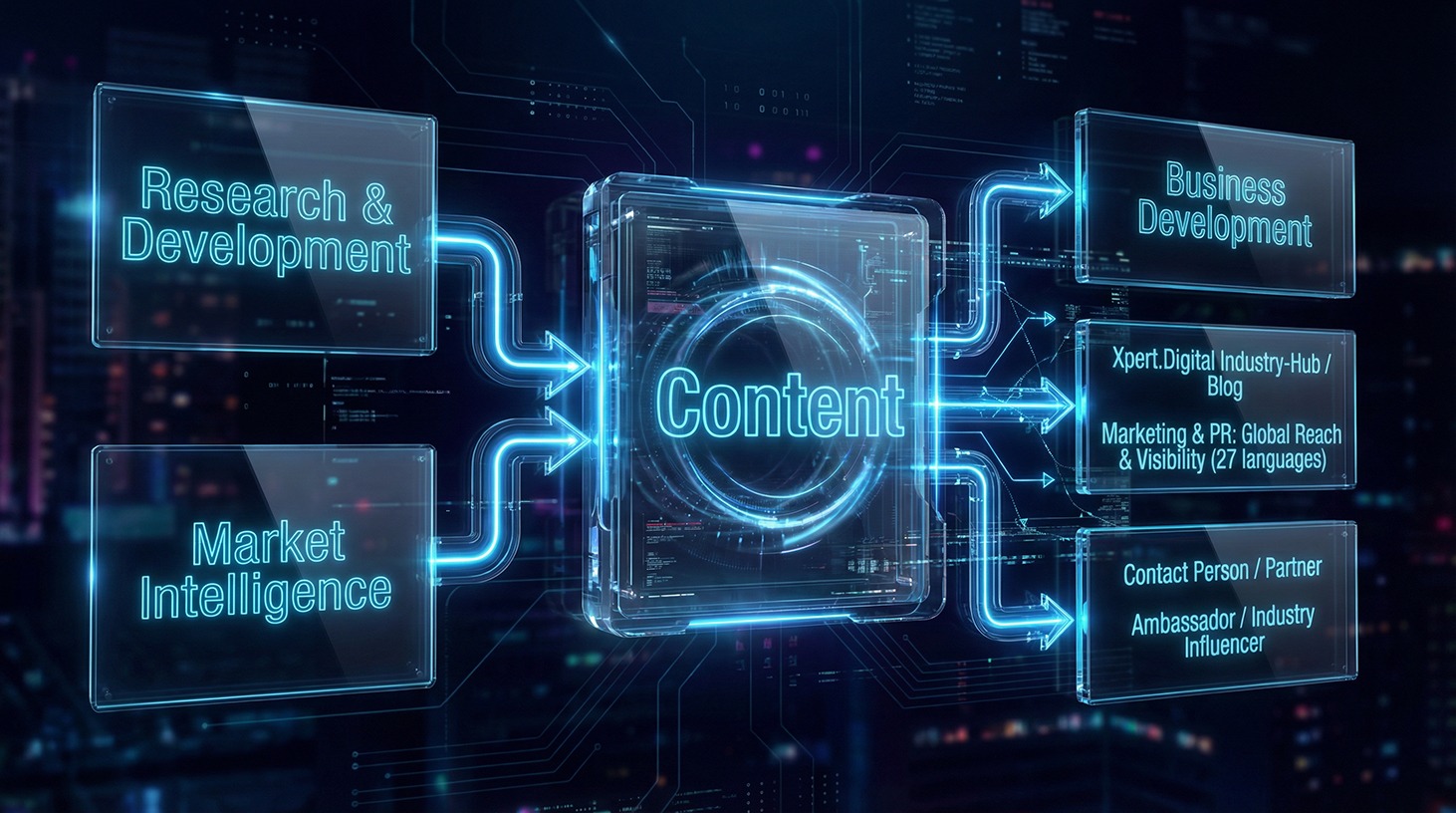
The quasi-in-house solution: How Xpert.Digital closes operational gaps in B2B marketing and sales – Smart Content-Driven Business - Image: Xpert.Digital
Xpert.Digital is a data-driven B2B industry hub led by Konrad Wolfenstein . The company acts as an external, quasi-in-house solution for industrial partners, closing operational gaps in marketing, content, and sales – without requiring additional resources on the client side.
More information here: