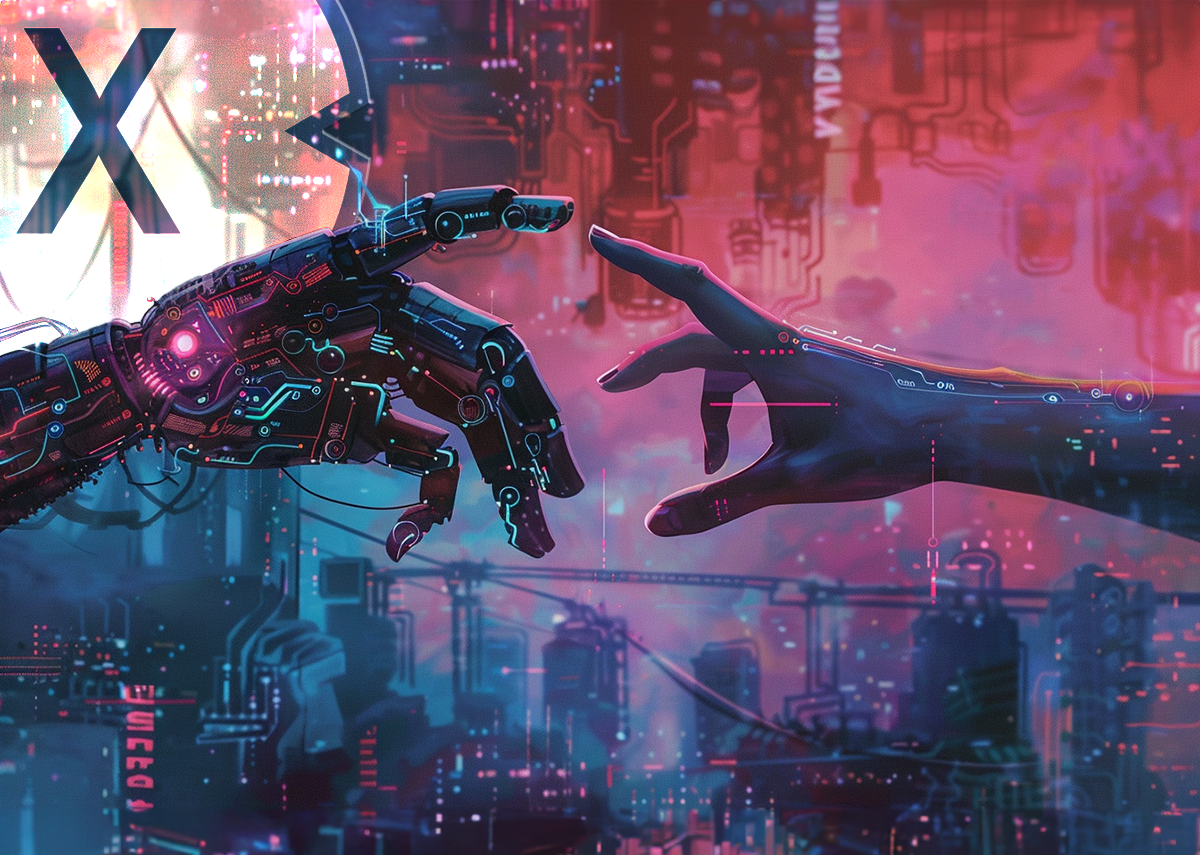
The best AI expertise still comes from humans – artificial intelligence combined with automation, flexibility, scalability, and speed – Image: Xpert.Digital
🤖💡 Humans & Artificial Intelligence: A Symbiosis for the Future
🌟 The role of humans in technological development
In an era of rapid technological advancement, artificial intelligence (AI) is playing an increasingly important role in our daily lives and in the business world. However, despite all the progress and impressive capabilities that AI has achieved, one crucial factor remains irreplaceable: the human being.
Human expertise, creativity, and ethical judgment are essential components that are crucial in interacting with AI systems. The automation of processes, the flexibility of applications, the scalability of business models, and the speed of implementation enabled by AI offer immense advantages. However, without human trust and acceptance, these advances would be meaningless. "At the end of the day, people must be at the center, because all our economic thinking and actions are ultimately geared towards people and their well-being." This conviction is key to ensuring that the integration of AI is not only efficient but also sustainable and ethically sound.
🧠 Challenges and opportunities of human-AI interaction
The challenge lies in finding a balance where AI can leverage its strengths while humans retain control and understanding over decision-making processes. The best results are achieved when human expertise and AI work seamlessly together. However, this is only possible if people trust these technologies and wholeheartedly support their application. Distrust of AI, whether stemming from fear of job loss, loss of control, or ethical concerns, can significantly limit the technology's acceptance and success. Therefore, it is essential that humans remain at the forefront of the discussion surrounding artificial intelligence.
🤝 Authenticity and integrity in AI
Authenticity and integrity are indispensable values in this context. Artificial intelligence must be not only functional but also trustworthy. An AI system that does not operate transparently or whose decisions are not comprehensible will not be accepted in the long run. "AI can process enormous amounts of data and recognize patterns, but the foundation for this is data and algorithms developed by humans. Humans, however, contribute contextual understanding, creativity, and ethical considerations that machines cannot replace." It is this combination of human insight and machine capability that has the potential to open up new horizons.
💼 An example of successful collaboration: Xpert.Digital
An outstanding example of this successful symbiosis between humans and machines is the work of Xpert.Digital. Xpert.Digital understands how to effectively use artificial intelligence in various areas without neglecting the human element. Their application of AI in 18 multilingual support, content research, and search engine optimization is impressive. Nevertheless, humans remain at the heart of the process: Konrad Wolfenstein, a proven digital expert, is available as a contact person and project manager. This human presence ensures that Xpert.Digital's work is not only technically perfect but also grounded in human values and ethical principles.
🔧 Artificial intelligence in various industries
Whether it's digitalization, mechanical engineering, renewable energies like photovoltaics and hydrogen technologies, or industry in general, Xpert.Digital offers not only solutions but also trust and integrity. This is a crucial factor for success in an increasingly technology-driven world. Integrating human expertise into the application of AI ensures that technological advancements are not only efficient but also sustainable and socially responsible.
🌍 The importance of ethical responsibility in the digital society
The transition to a digital society brings many challenges, but it also offers enormous opportunities. To seize these opportunities, humans must not only master the technology but also use it ethically and responsibly. "Humans still possess the best AI expertise," is a fitting statement that encapsulates the essence of these considerations. AI is a powerful tool, but it is humans who decide how this tool is used.
🚀 Outlook on the future of human-AI partnership
In the future, the role of humans in AI development and application will become even more important. It will not only be about further improving the technology, but also about ensuring that it is used in a way that benefits humanity and does not harm it. This requires an ongoing dialogue between developers, users, and society as a whole to establish ethical standards and ensure that they are upheld.
Humans and AI must form a partnership where both contribute their strengths. AI provides speed, precision, and data processing capacity, while humans contribute creative, ethical, and strategic guidance. This symbiosis is the key to success in an increasingly digital world. Only when humans remain at the center and their expertise forms the basis for the use of AI can a technology emerge that is not only powerful but also sustainable and trustworthy.
It is up to us to actively shape this future and combine the best qualities of humans and machines. Only in this way can AI reach its full potential and become a genuine benefit to society. Humans will always play the central role, because ultimately it is their expertise that guides and directs AI.
📣 Similar topics
- 📊 Artificial Intelligence in the Business World
- 🤖 Humans at the center of AI development
- 💡 Human creativity meets artificial intelligence
- 🔍 Trust and transparency in AI systems
- 🌍 AI and sustainability: An ethical responsibility
- 👥 Symbiosis between man and machine
- ⚖️ The balance between automation and human control
- 🔧 Xpert.Digital: A combination of technology and human expertise
- 💼 Opportunities and challenges of the digital society
- 📉 The importance of human intuition in AI use
#️⃣ Hashtags: #ArtificialIntelligence #HumanExpertise #TrustInAI #Sustainability #Digitalization
📌 More related topics







Our recommendation: 🌍 Limitless reach 🔗 Connected 🌐 Multilingual 💪 Sales power: 💡 Authentic with strategy 🚀 Innovation meets 🧠 Intuition

From local to global: SMEs conquer the world market with a clever strategy - Image: Xpert.Digital
In an era where a company's digital presence determines its success, the challenge lies in creating an authentic, personalized, and far-reaching presence. Xpert.Digital offers an innovative solution that positions itself as the intersection of an industry hub, a blog, and a brand ambassador. It combines the advantages of communication and sales channels in a single platform and enables publication in 18 different languages. Cooperation with partner portals and the ability to publish articles on Google News and a press distribution list with approximately 8,000 journalists and readers maximize the reach and visibility of the content. This represents a crucial factor in external sales and marketing (SMarketing).
More information here:
💼💬 People at the heart of economic activity
🌍 All our economic thinking and actions are ultimately geared towards people
Our economic thinking and actions are ultimately focused on people. This profound understanding forms the foundation of every economic consideration. People are at the center of all economic activities and endeavors, with their needs, desires, and prosperity being the driving forces behind economic processes.
🧠 The importance of people in the economy
Human needs are diverse and constantly evolving. They range from basic physiological needs such as food, clothing, and shelter to more complex social and psychological needs such as recognition, self-actualization, and belonging. The pursuit of satisfying these needs forms the basis for economic activity.
In this context, the American psychologist Abraham Maslow cites the famous Maslow's hierarchy of needs, which arranges these human needs in a pyramid. The base is physiological survival, followed by safety, love and belonging, esteem, and finally self-actualization at the top. This hierarchy clearly demonstrates that economic decisions primarily aim to fulfill these needs in a prioritized order.
🏢 The role of companies
Companies play a crucial role in this needs-based economy. They develop products and services tailored to people's requirements and desires. Through innovation, marketing, and market research, they strive to understand and influence consumer behavior. This creates a dynamic interplay in which consumers and producers mutually influence and affect each other.
Beyond simply selling products, modern business practices increasingly aim to create added value for society. Concepts such as Corporate Social Responsibility (CSR) and sustainable business practices are gaining in importance. Companies are taking responsibility not only for their shareholders, but also for their employees, customers, and society as a whole. They strive to integrate social and environmental sustainability into their business models, ultimately benefiting people.
👷♂️ The world of work and people
People are at the heart of the economy, not only as consumers but also as workers. The world of work has changed dramatically in recent decades, with technological innovations and globalization playing a central role. New work models such as remote work, flexible working hours, and the gig economy have emerged. These developments offer opportunities and freedoms, but also bring new challenges.
The German philosopher Karl Marx emphasized the importance of work for human self-understanding and well-being. In his view, work is not only a necessity for securing one's livelihood, but also a central source of human identity and meaning. In the modern economic system, the challenge remains to create working conditions that are both productive and humane. This includes issues of working time arrangements, healthcare, and work-life balance.
⚖️ Social market economy as a model
One model that places people at the center of economic activity is the social market economy. This economic system, primarily developed and successfully implemented in Germany, combines the principles of the free market economy with social balance and justice. It aims to harmonize economic efficiency and social progress.
In a social market economy, it is recognized that the state must play a role in reducing social inequalities and promoting equal opportunities. This is achieved through measures such as progressive taxation, social security, and public services in areas like education and healthcare. The goal is to promote the prosperity of broad segments of the population and thereby ensure social peace and stability.
🌱 Challenges and the future
Despite all our efforts, we face significant challenges. The growing gap between rich and poor, ecological crises, and the digital revolution demand new solutions and approaches. It is becoming increasingly clear that a purely profit-oriented economic model is reaching its limits. A reorientation is needed that puts people and their environment at the center.
Sustainable economic development must therefore consider ecological, social, and economic aspects equally. The United Nations' 2030 Agenda, with its 17 Sustainable Development Goals (SDGs), provides a clear framework. These goals call upon us to combat poverty, reduce inequalities, fight climate change, and promote peace and justice.
🛍️ The individual as a responsible consumer
A key role in this falls to the informed consumer. Consumers today are better informed and more critical than ever before. Through their purchasing decisions, they can influence companies to act sustainably. Conscious consumer behavior, such as buying fair trade products or avoiding single-use plastics, demonstrates that individuals can influence the economy through their daily choices.
📚 Education and enlightenment
To play this active role, education is crucial. People need to understand how their individual actions impact the global context. Economic education should therefore not be limited to imparting basic economic knowledge, but should also consider ethical and ecological dimensions. Only in this way can people make informed and responsible decisions.
Educational institutions, from schools to universities, bear a great responsibility. They are not only places for acquiring knowledge, but also for personal development and the formation of values. Here, the foundation is laid for understanding economic relationships and for developing a sensitivity to social and environmental issues.
🚀 People are at the heart of all economic activity
People are at the heart of all economic activity. Our economic thinking and actions ultimately revolve around their needs, desires, and prosperity. Businesses, the labor market, and the state play central roles in fulfilling these needs and ensuring sustainable prosperity. By integrating social and environmental aspects and promoting education and awareness, we can create an economic model that truly serves humanity and secures a future worth living. The path to such an economy is challenging, but necessary to create a just and sustainable world in the long term.
📣 Similar topics
- 📣 The importance of people in the economy
- ✨ Role of companies in the economic system
- 🏢 The world of work and people in transition
- 🌍 The social market economy as a future-oriented model
- 🌱 Challenges of sustainable economic development
- 📚 Education and awareness as the key to a sustainable economy
- 🛍️ The individual as a responsible consumer
- 🔍 Maslow's hierarchy of needs and economic decisions
- 🧑🤝🧑 Corporate Social Responsibility and sustainable business practices
- ⚖️ Social justice through economic equalization
#️⃣ Hashtags: #Economy #Sustainability #SocialMarketEconomy #Education #ConsumerAwareness
We are here for you - Consulting - Planning - Implementation - Project Management
☑️ Industry expert, here with his own Xpert.Digital industry hub featuring over 2,500 specialist articles

Konrad Wolfenstein
I would be happy to serve as your personal advisor.
You can contact me by filling out the contact form below or simply call me on +49 7348 4088 965 .
I'm looking forward to our joint project.
Write to me


Xpert.Digital - Konrad Wolfenstein
Xpert.Digital is a hub for industry focusing on digitalization, mechanical engineering, logistics/intralogistics and photovoltaics.
With our 360° Business Development solution, we support renowned companies from new business to after-sales.
Market intelligence, smarketing, marketing automation, content development, PR, mail campaigns, personalized social media and lead nurturing are part of our digital tools.
You can find more information at: www.xpert.digital - www.xpert.solar - www.xpert.plus
Keep in touch