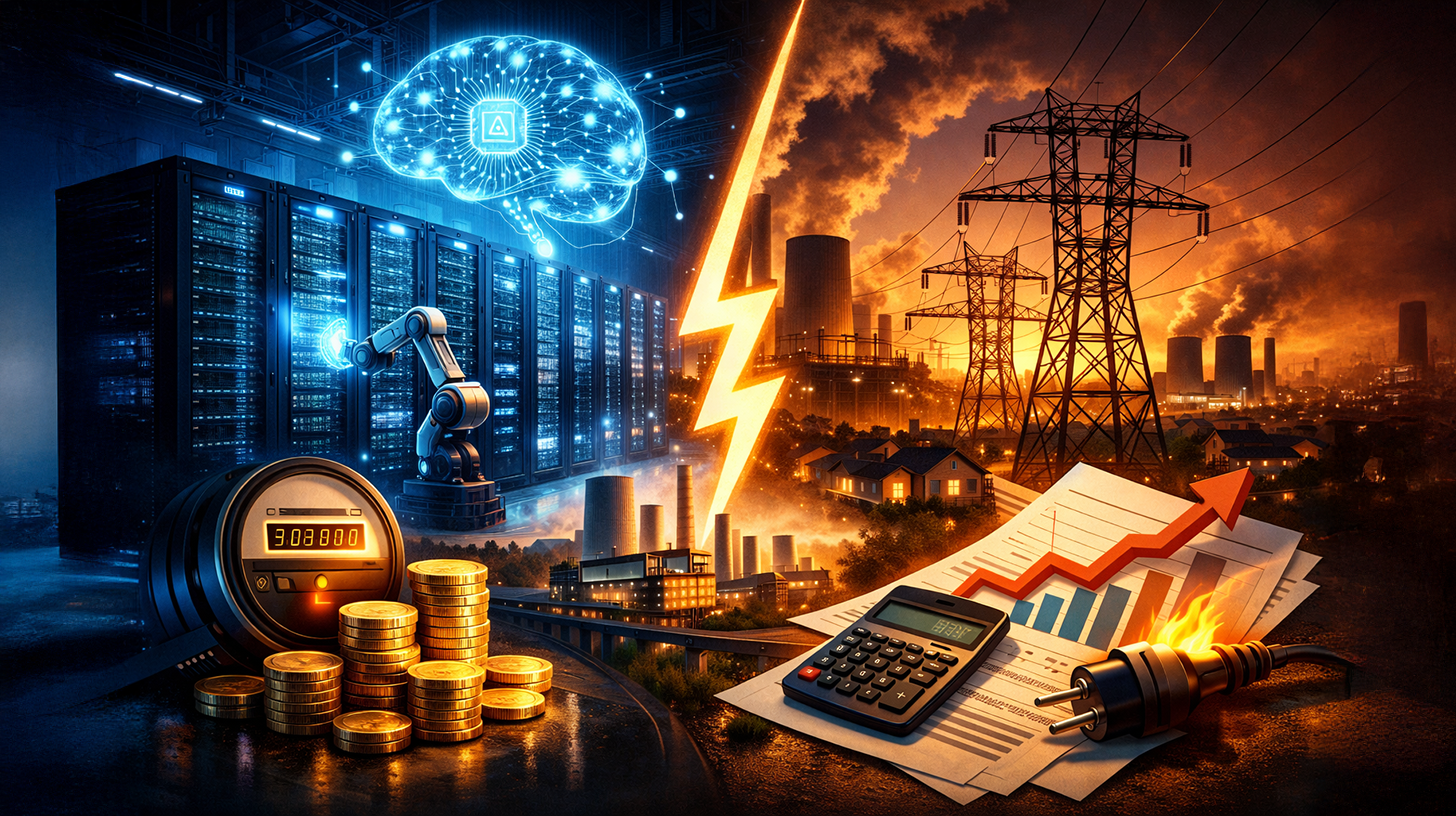
AI boom at your expense? Growing electricity demand and rising electricity prices: AI data centers vs. the power grid – Image: Xpert.Digital
A model for the USA? How Virginia tech giants are charging for their electricity consumption
Who will foot the bill for the AI boom? Why electricity bills could soon explode
Behind the virtual hype surrounding artificial intelligence lies an uncomfortable physical reality: The energy demands of the digital revolution are pushing our power grids to the brink of collapse – and posing the expensive question of who should pay for the massive expansion of the infrastructure.
While AI applications are meant to make our everyday lives more efficient, they are causing unprecedented resource consumption in the physical world. Data centers are becoming the biggest energy guzzlers in modern industry; their demand is growing faster in metropolitan areas like Frankfurt or Dublin than power lines can be laid. The result is years-long waiting times for grid connections and a competitive disadvantage in Europe that is massively slowing down digital transformation. But the problem is no longer just technical; it's becoming a social powder keg: Who will finance the billions of euros invested in the power grid?
While private households and small and medium-sized enterprises (SMEs) fear footing the bill for the tech giants' boom through rising grid fees, examples from the US and Ireland show that there are other ways. There, large consumers are increasingly being held accountable – be it through special high-capacity tariffs or the requirement to build their own green power plants. Microsoft and OpenAI are already reacting with radical steps and planning to take control of their own energy supply. This analysis sheds light on the global battle for the kilowatt-hour and shows why the decision regarding power lines and tariffs will determine whether Europe remains a competitor in the AI age or becomes merely the paymaster of digitalization.
Related to this:

Electricity bills are getting expensive – and society is paying the price
The rapidly increasing electricity consumption of AI data centers is changing energy policy in Europe and the US. As the technology sector enters its next innovation cycle, grid operators and regulators are reaching the limits of their infrastructure. The question is no longer simply whether there is enough electricity, but who will bear the costs of additional capacity: traditional electricity customers, industry, taxpayers, or the data center operators themselves. The answer to this question will determine how quickly and under what conditions digital transformation can progress in Europe and the US.
The energy demands of the AI economy
Artificial intelligence relies on data centers that perform high-performance calculations around the clock. These are enormous computing power plants that not only consume electricity for the chips but also require immense cooling capacities. According to international studies, the global electricity consumption of data centers was around 415 terawatt-hours per year in 2024, which corresponds to approximately 1.5 percent of global electricity consumption. This figure is projected to exceed 900 terawatt-hours by 2030, almost double today's level. In many industrialized countries, data centers are thus becoming one of the fastest-growing sources of energy consumption, in some cases growing faster than households and traditional industry.
AI workloads are particularly energy-intensive. The required processors, mostly graphics or AI accelerators (GPUs/ASICs), operate at high density and under heavy load. This significantly increases power consumption per computing unit, while energy efficiency per FLOPS improves only slowly. In the US, data centers already account for approximately 4 percent of national electricity consumption; in some states, AI data centers could account for 10 to 12 percent of electricity consumption within a few years. In Europe, the electricity demand of data centers will rise to more than 150 terawatt-hours by 2030 – a significant portion of total production that must also be available for industry, households, and transportation.
The bottleneck: power grids instead of hardware
In Europe, the AI boom is not primarily hampered by a lack of chips or investment, but by limited power grids. The European Commission has set itself the goal of tripling data center capacity within five to seven years to position Europe as an "AI continent." However, the infrastructure is lagging behind. A data center can be built in a few years, but expanding power lines and transformer stations often takes more than a decade. The first bottlenecks are emerging in this tension between short-term IT dynamics and long-term infrastructure planning.
Large cloud providers typically build their facilities in metropolitan areas, close to major traffic hubs: Frankfurt, Amsterdam, Dublin, Paris, and London. These very hubs are already reaching the limits of their network capacity. In Frankfurt, data centers are currently responsible for up to 40 percent of local electricity consumption; in Dublin, the figure is said to be even higher. Several European cities have already put concrete projects on hold due to a lack of grid connection. Experts estimate that around one-fifth of planned European data centers cannot be implemented as quickly as originally intended due to network bottlenecks. This turns electricity access into a scarce resource, driving investors to peripheral and more rural regions where the networks are less strained.
Waiting for grid connection: years instead of months
The consequence of these bottlenecks is a longer implementation time. In Germany, network operators report that in some regions all available capacity has already been allocated. Frankfurt, Germany's largest data center cluster, has, according to operators, practically no new large-scale connections available; additional capacity is only planned for the distant future. Similar patterns are emerging in other metropolitan areas such as Berlin-Brandenburg, Stuttgart, and Hamburg. Several studies report that investors in Germany sometimes have to wait seven to ten years for a network connection if they want to build new or large-scale facilities.
This pressure to delay directly impacts Europe's competitiveness. While the US can quickly build new data centers due to larger available land, faster permitting processes, and sometimes lower energy costs, European projects risk being sidelined by bureaucratic and infrastructural hurdles. The International Energy Agency (IEA) estimates that European data center capacity might not triple as planned by 2030, but could only increase by around 70 percent if the power grids are not significantly expanded. This further exacerbates the already existing fear of dependence on US and, to some extent, Chinese cloud providers, as these companies have long been building their capacities in their home markets.
Self-generated electricity as a way out: from grid consumer to micro-supplier
Where public grid expansion is too slow, investors are responding with their own solutions. Instead of waiting for years of permitting processes, they are building their own power plants or storage systems directly on site. In Frankfurt, for example, a US cloud provider connected a 61-megawatt gas-fired power plant in symbiosis with an energy supplier to relieve the strain on local grid capacity and further expand its own campus. In other regions, projects are planned in which data centers will be powered entirely by their own gas generators, fuel cells, or battery storage.
In Ireland, the line was drawn particularly clearly: Following a de facto moratorium on new grid connections in Dublin, new data centers initially had to cover their electricity needs entirely with their own generators or battery storage. The regulatory authority also required that these facilities be able to feed electricity back into the grid during periods of high demand. This creates small "energy systems within the system" that reduce the strain on public infrastructure but simultaneously shift the costs and environmental impacts to the operators themselves. The question of whether this is ecologically sound is closely linked to the type of technologies used. Gas-fired power plants reduce grid load but increase emissions; battery storage and on-site renewables, on the other hand, can improve the climate balance but are more expensive and have limited capacity.
Europe's mammoth task: Network expansion caught in a cost-cutting dilemma
Grid expansion in Europe is a political battleground over distribution and responsibility. Industry associations and grid operators estimate that around €2 trillion will need to be invested in transmission, distribution, and grid control technologies by 2050 to meet the increased electricity demand from artificial intelligence, e-mobility, heat supply, and other electrification processes. In Germany alone, distribution grid operators anticipate investments of around €110 billion in distribution networks by 2033, with these costs factored into grid fees over decades. Additional investments in renewables, storage, and grid connectivity, amounting to billions more, are also required.
Currently, the general public – meaning households and small and medium-sized enterprises – bears a large portion of these costs through electricity bills, while large data center operators often benefit from special rates. In Germany, blanket regulations are being discussed that would require data centers to optimize their grid connections or contribute to grid expansion projects. Ireland has gone a step further, requiring new projects not only to meet their own needs but also to respond flexibly to peak loads or bring additional capacity to the market. This shifts the focus: no longer just "how much electricity do we need," but "how can data centers be integrated into a flexible, intelligent grid?".
Ireland's answer: self-generated power sources and grid supports
Ireland is a prime example of the tension between economic attractiveness and grid capacity. Dublin is considered one of Europe's most important cloud computing hubs, which has massively increased electricity demand in the region. Data centers are now responsible for a three-digit percentage of local electricity consumption; in some scenarios, this share is projected to reach a third of Ireland's total electricity demand by 2030. The grid was not prepared for this pace, leading the regulatory authority EirGrid to impose a de facto moratorium on new grid connections in Dublin.
In response, a new regulation was introduced requiring new data centers in Ireland to either build their own renewable energy generation capacity or large battery storage systems capable of feeding electricity back into the grid. In some cases, up to 80 percent of the annual demand is to be met by newly constructed renewable energy plants in Ireland. This approach combines relieving grid strain with decarbonization: operators are thus compelled to link their growth with additional green capacity, rather than simply burdening the existing grid. At the same time, it reduces dependence on fossil fuel backup generators, which has positive effects both in terms of climate protection and grid stability.
Germany: between the desire for digitalization and climate demands
In Germany, the conflict is playing out similarly, but with different emphases. On the one hand, the country is promoting itself as a leading European AI hub, highlighting its energy prices, infrastructure, and regulatory certainty. On the other hand, there are national climate targets and the need to cover electricity demand largely with renewable energy. The Federal Network Agency forecasts that data centers alone will consume between 78 and 116 terawatt-hours of electricity per year by 2037 – equivalent to up to 10 percent of Germany's total electricity consumption. In this scenario, the integration of data centers into the energy market becomes a key political issue.
So far, the data center industry in Germany has grown primarily due to liberalization and investment security. New data centers in many regions benefit from reduced grid fees, tax incentives, and simplified permitting processes. The situation becomes critical when the message emerges that large corporations are responsible for the need for infrastructure expansion, while the costs are spread over years through electricity prices. In this context, consumer protection organizations and some politicians are demanding that operators contribute more to infrastructure costs. Proposals range from surcharge models and mandatory installation of flexibility options to flat-rate infrastructure levies paid directly to grid operators.
Our global industry and economic expertise in business development, sales and marketing

Our global industry and economic expertise in business development, sales and marketing - Image: Xpert.Digital
Industry focus areas: B2B, digitalization (from AI to XR), mechanical engineering, logistics, renewable energies and industry
More information here:
A thematic hub offering insights and expertise:
- Knowledge platform covering global and regional economies, innovation and industry-specific trends
- A collection of analyses, insights, and background information from our key areas of focus
- A place for expertise and information on current developments in business and technology
- A hub for companies seeking information on markets, digitalization, and industry innovations
The hidden costs of AI: An invisible battle over our energy is raging
Virginia: Special rate for the AI elite
In the US, the answer to the cost question is already more clearly defined than in Europe. In the state of Virginia, one of the most important locations for AI and cloud infrastructure, the regional utility Dominion Energy introduced a separate tariff class for extremely power-hungry large customers in 2027. AI data centers and similar large consumers in this class must pay for at least 85 percent of their booked grid capacity, even if they do not use it fully, and also bear a large portion of the generation costs. This ensures that households and smaller businesses do not have to bear the additional costs for the sharply increased capacity demand.
The reasons for this move lie in a dramatic increase in capacity prices. In one regional electricity market, capacity prices have increased eightfold within a year, a rise directly attributed to demand from AI data centers. Virginia expects total energy demand to increase by more than 180 percent by 2040 if the planned projects are implemented. The new rules are intended to prevent speculation and overbooking while simultaneously ensuring the financing of the necessary grid expansions. Critics see this model as a burden on investors, who must bear the risk of expensive contracts and partially unused capacity. Proponents argue that this will result in a more transparent and fairer distribution of costs for society as a whole.
Related to this:

The grid expansion competition: AI vs. other consumers
In Europe and the US, grid expansion is driven not only by the growth of data centers, but also by the electrification of transport and heating, as well as the expansion of renewable energies. In Germany and other European countries, millions of electric cars, heat pumps, and electric heating systems are expected to be newly connected in the coming years, further exacerbating load profiles. In the US, parallel to the AI boom, a massive expansion of electric vehicles and smart home systems is being discussed, which will also strain local grids.
This creates a competition for priorities: Should infrastructure be expanded primarily for the digital economy and the AI industry, or should the security of supply for all end consumers be given top priority? In many regions, grid expansion is already subject to delays because permitting processes, planning regulations, and environmental impact assessments take time. In this context, there is a risk that data centers—as large, investment-rich clients—will potentially receive preferential treatment, while other consumers in less attractive regions wait for additional capacity. Such a development harbors social tensions, especially if the costs of grid expansion projects are distributed through electricity tariffs.
Corporate investments: "We pay for it ourselves"
Alongside government and regulatory measures, the major technology companies are increasingly focusing on their own investments. The message is clear: we don't just want to consume electricity, we also want to contribute to building the infrastructure. OpenAI has announced that the costs for the necessary electricity and network expansion projects related to its Stargate campaigns will be borne directly by the projects themselves. Instead of distributing the additional costs through general electricity tariffs for consumers, the company intends to finance the additional generation, storage, and grid expansion capacities required for the multi-gigawatt loads of the AI supercomputers. This replaces the logic of "build first, curtail later" with a model that addresses infrastructure bottlenecks proactively.
OpenAI explicitly describes this strategy as "paying our own way." At the planned Stargate sites in the US, grid expansion will not be financed solely through regular grid fees, which would directly impact households and small businesses. Instead, the company will initiate its own projects in close cooperation with local utilities, grid operators, and regulatory authorities. These projects will ensure both local supply and grid stability. In some cases, specific models are planned where solar power plants plus battery storage are directly connected to the site, or new high-voltage power lines are built specifically for the data centers. In Wisconsin and Texas, collaborations with local energy providers are already planned to ensure that the additional capacity is not simply "taken" from the existing grid but is compensated for by new generation capacity.
The role of legacy players: Microsoft and other industry giants
Similarly, Microsoft has announced that it will treat its data centers not merely as load sources, but as active participants in the energy market. AI infrastructure is increasingly being integrated into flexible load structures that can be ramped up and down depending on grid demand. While traditional industrial companies in many countries already use demand-response programs to reduce load during peak times, large cloud providers are taking this concept to a new level. Their data centers can shift training tasks to times of low load and high availability of renewable energy, thus mitigating peak electricity prices and facilitating the integration of wind and solar power. In some regions, data centers are now treated as "flexible loads"—loads that can even tolerate short-term interruptions when necessary to improve grid stability.
Industry organizations argue that these models are part of a new understanding of the role of digital infrastructure. Data centers should no longer be seen as passive consumers of electricity, but rather as part of the energy supply that actively contributes to grid stability. In the US, this discussion is already taking place at the level of regional grid operators, where large data centers are being included in the planning of reserve and flexibility capacities. In Europe, this approach is still being pursued hesitantly, as the infrastructure and market regulatory framework are less flexible. Nevertheless, it is becoming clear that data center operators will increasingly be pushed into the role of "energy partners" in the future, not only paying for power but also actively providing planning information and flexibility capacities.
Politics as mediator: between climate and competition
In Europe, the political role is becoming increasingly apparent. The EU Commission emphasizes that achieving climate targets and ensuring security of supply could conflict with the unbridled expansion of AI infrastructure if the infrastructure is not taken into account. At the same time, the Union wants to prevent European companies and research institutions from falling behind the US and Asia in AI development. Policymakers are thus caught in a classic balancing act: on the one hand, networks must be expanded to make digital infrastructure projects possible in the first place; on the other hand, public finances must be protected to keep debt within the limits of the stability criteria.
The answer lies in a combination of regulation, investment, and innovation policy. Regulators are trying to define clearer rules for including data centers in infrastructure costs without hindering the growth of the digital economy. In Germany, for example, there is discussion about whether data centers should be required to finance a portion of the locally needed generation and storage capacity, or at least cover the additional grid expansion costs in the form of lump sums. Other countries are examining models in which new data centers are only approved if they can be demonstrably integrated into the local energy supply planning and provide additional generation capacity.
The question of cost: Who will foot the bill?
The crucial question remains: who will bear the costs of the necessary grid expansion and capacity projects? So far, the logic of distribution has prevailed: the costs are spread across all households and businesses via electricity tariffs, even though the increased burden is usually caused by only a few large consumers. In the US and Virginia, this logic is increasingly being questioned. The new tariff categories for data centers are intended to ensure that the additional costs for the extra capacity and the necessary network expansion projects are primarily borne by the operators in question, not by the general public.
In Europe, the discussion is less clear. Some energy suppliers argue that the additional infrastructure costs are already factored into grid fees and therefore must be borne by all consumers. Other stakeholders, particularly consumer associations and local politicians, demand that large data centers directly cover their infrastructure costs or at least contribute significantly more. Implementing such demands remains difficult, as infrastructure is typically networked and the additional costs cannot always be clearly attributed to individual projects. Nevertheless, the public debate is increasingly shifting towards a clearer allocation of responsibility.
The climate conflict: AI or climate protection?
The climate conflict between AI expansion and emissions reduction will play a central role in the coming years. The energy intensity of the AI economy is considerable, even though energy efficiency per computing unit is continuously increasing. However, overall demand is growing faster than efficiency gains, meaning that absolute electricity consumption will continue to rise. In many regions, the additional demand is currently being met by existing generation capacities, some of which are based on fossil fuels. In Germany and other European countries, integrating AI loads into the existing energy mix is already perceived as a challenge.
The political answer lies in a combination of energy efficiency measures, green generation, and flexibility options. Data centers should be built with the most energy-efficient designs possible, and cooling and heat dissipation should be optimized to minimize power consumption per computing unit. At the same time, the integration of renewable energies into the electricity mix will be accelerated to reduce the emissions intensity of the additional load. Many countries are developing incentive programs for energy-efficient data centers and for the use of waste heat in industrial or municipal heating systems. Pilot projects are being planned in Ireland and Germany to integrate data centers into district heating networks, using waste heat to heat buildings or industrial facilities.
A mixed model as a solution
Ultimately, no single model will suffice to resolve the tensions between AI growth, security of supply, and climate goals. The solution lies in a hybrid model comprising rapid grid expansion, intelligent load management, and corporate investment. Grid operators must be enabled to expand infrastructure at a pace that matches the growth of digital infrastructure. Simultaneously, data centers must be integrated into flexible load structures that enhance grid stability and facilitate the integration of renewable energies. The crucial question of who foots the bill will be decided in the coming years not only on technical grounds but also on political ones. The answer will determine whether Europe and the US embrace the AI revolution as a shared, energy infrastructure-driven development, or whether the costs of digitalization will primarily be borne by consumers and taxpayers.
Your global marketing and business development partner
☑️ Our business language is English or German
☑️ NEW: Correspondence in your native language!

Konrad Wolfenstein
I and my team are happy to be available to you as your personal advisor.
You can contact me by filling out the contact form here wolfenstein@xpert.digital:or simply call me at +49 7348 4088 965. My email address is
I'm looking forward to our joint project.
☑️ SME support in strategy, consulting, planning and implementation
☑️ Creation or realignment of the digital strategy and digitization
☑️ Expansion and optimization of international sales processes
☑️ Global & Digital B2B trading platforms
☑️ Pioneer Business Development / Marketing / PR / Trade Fairs
🎯🎯🎯 Benefit from Xpert.Digital's extensive, five-fold expertise in one comprehensive service package | BD, R&D, XR, PR & Digital Visibility Optimization

Benefit from Xpert.Digital's extensive, five-fold expertise in a comprehensive service package | R&D, XR, PR & Digital Visibility Optimization - Image: Xpert.Digital
Xpert.Digital possesses in-depth knowledge across various industries. This allows us to develop tailored strategies precisely aligned with the requirements and challenges of your specific market segment. By continuously analyzing market trends and monitoring industry developments, we can act proactively and offer innovative solutions. The combination of experience and expertise generates added value and provides our clients with a decisive competitive advantage.
More information here: