Agentic Commerce – The silent weeding out of the retail sector and why the bet is still open – Image: Xpert.Digital
The quiet weeding out of the trade and why the bet is still open
Will AI soon be ordering on its own? The harsh reality behind the new shopping hype
It's 2026, and e-commerce is on the cusp of a paradigm shift far more radical than the move from brick-and-mortar retail to the internet: Agentic Commerce. Algorithms and AI assistants are increasingly acting as autonomous shoppers, replacing humans in product searches, comparisons, and even the final checkout. For retailers, this represents a massive loss of control. When an algorithm, rather than the consumer, decides who gets the product, decades of built brand value and traditional marketing suddenly lose their relevance. Instead, operational excellence—from perfect real-time inventory data to flawless logistics—becomes the ultimate gatekeeper.
But while tech giants and management consultancies are already proclaiming the end of traditional online retail, a closer look behind the scenes reveals a far more complex picture. Rising API costs, a looming subsidy bubble for hyperscalers, unresolved liability issues, and the hesitant trust of European consumers are slowing down the fully automated shopping revolution. Are we witnessing the next major retail upheaval, or are we currently experiencing a multi-billion-dollar technological gamble with a completely unpredictable outcome? This article sheds light on the true mechanisms of agentic commerce, separates the hype from reality, and shows why retailers now primarily need to focus on their operational homework.
Related to this:


What Agentic Commerce really means
Agentic commerce refers to a retail model in which AI systems independently make purchasing decisions for consumers – they search, compare, negotiate, and buy without any active human intervention. Platforms like ChatGPT, Google Gemini, Perplexity, and Klarna act as so-called "super-agents" that aggregate product data from hundreds of sources in seconds and select the most suitable option based on predefined criteria. Interaction between buyer and merchant is minimized – or disappears entirely. Merchants are no longer found via search engines, advertisements, or brand promises, but must first be deemed trustworthy by an algorithm before the human operator is even informed.
The concept isn't new, but the speed of its implementation is surprising many industry players. Adobe Analytics recorded a remarkable 4,700 percent year-over-year increase in AI-generated traffic to US retail websites in July 2025. By March 2026, AI-mediated visitors were converting 42 percent more often than users from traditional traffic sources—a complete reversal from the previous year, when AI traffic converted around 49 percent less. These figures illustrate the pace of the transformation: What was still an experiment in 2024 is already a measurable competitive advantage in 2026.
How AI agents make traders invisible
The real economic impact of agentic commerce lies not in price comparisons or personalized recommendations, but in a fundamental shift in decision-making power. Where previously the consumer stood as the final filter between offer and purchase, an algorithm now assumes this role – and this algorithm evaluates according to different criteria than a human buyer. Kearney succinctly describes this process: algorithms, not buyers, will decide in the future which products appear, in what order, and at what price. The brand value built up over decades thus becomes a secondary indicator.
A retailer's operational infrastructure thus becomes the focus of algorithmic evaluation. AI agents check whether delivery dates are communicated clearly and reliably, whether inventory data is updated in real time and provided in a machine-readable format, whether returns processes are transparent and standardized, and whether payment processes are open to automated systems. Retailers who do not meet these requirements are simply not recommended – not because of a bad product, but because of poor data hygiene. BCG puts it unequivocally: Without proactive countermeasures, retailers risk becoming mere background service providers in algorithm-driven marketplaces.
Kearney quantifies the financial risk for unprepared retailers at up to 500 basis points of EBIT erosion. This margin stems from three sources: declining average prices due to maximum price transparency (estimated at minus 8 percent), rising fulfillment costs due to smaller shopping carts and more fragmented orders (plus 10 to 15 percent), and transaction fees charged by AI platforms that act as new intermediaries between retailers and buyers. The structural problem: While marketing budgets have traditionally focused on direct customer visibility, competition is now shifting to an upstream level—to the question of whether a retailer even appears in the algorithmic ranking.
Logistics as the secret gatekeeper
The fact that agentic commerce is primarily a logistics problem is regularly underestimated in public debate. Yet, the logistics chain is the most frequent reason why retailers are rejected by AI agents. An agent searching for the best offer for a user evaluates not only price and product quality, but above all reliability metrics: on-time delivery rates, average delivery times, return rates, and the quality of real-time inventory data. These parameters must be provided in a machine-readable format – via open APIs, standardized product feeds, and webhook-based status messages.
In practical terms, this means that a merchant who accurately describes their products but neither reflects real-time inventory levels nor dynamically updates delivery dates will be classified as unreliable by an agent – regardless of price or product range. The infrastructure is still in its early stages: Stripe introduced an API for controlled agent payments in April 2026, and Google and Mastercard are jointly developing an authentication standard for agent transactions within the FIDO Alliance. Google's Universal Commerce Protocol (UCP), which even Amazon is now involved in developing on its technical committee, aims to establish open standards for agentic commerce transactions – Zalando already actively supports it.
Anyone who believes they are equipped for AI systems with a revised product data feed and some SEO optimization is underestimating the depth of the necessary operational transformation. BCG identifies three essential strategic measures: first, optimization for generative search engines (Generative Experience Optimization, GXO) with authoritative, structured product data; second, building their own agent infrastructure – from brand agents to supplier agents; and third, creating robust AI governance frameworks, including new metrics for generative visibility.
The bait logic: Why the model is still a gamble
The crucial blind spot in most available market analyses is the question of financing behind the agentic commerce ecosystem. Current AI offerings—from free or subsidized checkout to comprehensive AI assistants for just a few euros a month—essentially operate on a subsidy model. Hyperscalers and AI companies create incentives to generate user demand and establish platform dependency. The underlying economic calculation is brutally simple: first win, then monetize.
OpenAI reported a net loss of $38.5 billion on revenue of $13.07 billion for fiscal year 2025. Further losses of approximately $14 billion are expected for 2026. Although revenue exceeded its internal target of $10 billion, the company missed several monthly revenue targets, user base growth slowed, and subscriber retention declined. The planned IPO is delayed—not least because the CFO publicly expressed concerns about whether the growth rate could sustain the enormous infrastructure costs.
The five largest hyperscalers – Amazon, Microsoft, Alphabet, Meta, and Oracle – will invest a combined total of around $700 billion in AI infrastructure in 2026, a 36 percent increase compared to 2025. According to Sequoia Capital, this leaves an annual revenue gap of approximately $600 billion between AI infrastructure spending and the actual revenue generated in the AI ecosystem. Allianz Research puts the growth gap between AI investments and revenue at 46 percent – larger than the 32 percent gap during the 2001 telecom boom. All five hyperscalers have increased their capital intensity (capex as a percentage of revenue) to between 45 and 57 percent – levels typically associated with capital-intensive utilities, not technology companies.
The token illusion: Cheaper on paper, more expensive in practice
A common misconception is that falling token prices strengthen the economic foundation of agentic commerce. In reality, token price trends present a complex paradox. The price per million tokens has plummeted from around €36 at the beginning of 2023 to occasionally below €0.07 today – a decline of more than 99 percent. At the same time, companies' actual AI spending has tripled. The reason: Agentic workflows multiply token consumption per task by a factor of 50 to 500, and the actual model call accounts for only 20 to 40 percent of real AI operating costs – the rest is attributable to orchestration, database queries, retries, and monitoring.
In parallel, officially advertised model prices are rising again. With the introduction of GPT-5.5, token prices doubled compared to its immediate predecessor; effectively, the cost increases range from 49 to 92 percent, depending on the use case. While Claude Opus 4.7 keeps the base price constant, a new tokenizer results in up to 45 percent more tokens being billed per identical request. GitHub Copilot will switch to token-based billing in June 2026; Anthropic is testing the removal of Claude Code from the Pro plan. The flat-rate era is drawing to a close for several key AI services.
For merchants who want to remain visible on agentic commerce platforms, this means that the costs of using these channels will increase structurally. Shopify already charges a 4 percent surcharge for transactions completed directly in ChatGPT, which goes to OpenAI. Added to existing platform fees and payment processing costs, this burden can be significant, especially for merchants with low margins. OpenAI tested the model but effectively withdrew it after a short time. The signal is clear: monetization models are not yet mature, pricing is in flux – and those who choose the wrong platform now or build up excessive dependencies risk operational surprises.
The trust problem: The underestimated brake
Technological euphoria and market analyses often suggest faster adoption than reality justifies. Currently, 64 percent of US adults would not trust AI assistants to make autonomous purchases. Only 17 percent of European consumers trust assistants to place an order autonomously on their behalf. McKinsey data shows that 63 percent of European consumers already use AI for product comparison – but hardly anyone is willing to completely delegate key decisions to machines. Usage patterns reflect this: AI is primarily used as a cognitive aid – for comparing, researching, and refining – not as a fully autonomous shopping agent.
OpenAI's instant checkout feature suffered from teething problems such as a lack of shopping cart functionality for multiple products and insufficiently structured merchant data. Amazon's AI assistant also repeatedly led to erroneous purchases and unauthorized merchant listings. The security risks are real: So-called prompt injections, in which hidden instructions in HTML elements or product descriptions induce an agent to perform unwanted actions, represent a new dimension of fraud for which merchants in traditional fraud detection systems lack the necessary logic. Companies with high agent-based traffic recorded a 37 percent increase in fraudulent traffic within just a few months.
Added to this is the legal dimension: Current contract law requires human consent at the moment of contract conclusion – AI agents as acting contracting parties are not provided for in the German Civil Code. Who is liable if an agent overpays, accepts an offer that the buyer would have rejected, or misses a cancellation deadline? These questions remain legally unresolved. In Europe, a further regulatory complex exists: GDPR, the Digital Services Act, the Digital Markets Act, and the AI Act's labeling requirements, effective since August 2026, create hurdles that do not exist in the US in this form. Meta has already had to significantly scale back its plans for fully autonomous shopping assistants in the European Economic Area.
🎯🎯🎯 Data-driven B2B industry hub as a quasi-in-house solution


The quasi-in-house solution: How Xpert.Digital closes operational gaps in B2B marketing and sales – Smart Content-Driven Business - Image: Xpert.Digital
Xpert.Digital is a data-driven B2B industry hub led by Konrad Wolfenstein . The company acts as an external, quasi-in-house solution for industrial partners, closing operational gaps in marketing, content, and sales – without requiring additional resources on the client side.
More information here:
Platform Power 2.0: Why retailers now need to make data transparency a matter of survival
The double-edged platform dynamic: Who really benefits?
The competition in agentic commerce isn't between Amazon and Walmart, but between OpenAI, Google, and Klarna. These super-agents aggregate data and transactions across platforms and, due to their central position, can build enormous negotiating power with retailers. The model resembles the rise of search engine platforms in the 2000s: initially free visibility, then gradually increasing costs, and finally structural dependency. For retailers who want to gain visibility on AI platforms, marketing expenditures are rising in a new competition for algorithmic preference—no longer for clicks or shelf space, but for the favor of the algorithm.
BCG estimates that US spending on AI-driven search ads will reach approximately $26 billion by 2029, representing 14 percent of total search ad spending. Retail media networks, which have experienced tremendous growth in recent years, are projected to decline in importance as advertising budgets shift to platforms where AI agents control the discovery phase. The new storefront is no longer a website or an app—it's the algorithm that decides what a consumer even sees.
INSEAD researchers, who published their analysis in the Harvard Business Review, describe a second power shift in retail: While the first shift was the move from brick-and-mortar retailers to platforms like Amazon, the second is the withdrawal of these platforms themselves from gatekeeping consumer visibility in favor of AI agents. Unlike overwhelmed human shoppers, AI agents don't automatically gravitate towards familiar platforms—they can find small boutiques with superior ratings or local providers with faster delivery just as easily as global players. This levels the playing field to an extent that can be threatening for established players and promising for niche providers.
Related to this:

Structural rationality traps: What the models hide
The most pessimistic forecasts for agentic commerce are based on an implicit assumption: that the technology will spread linearly and without friction, while all other market dynamics remain constant. This assumption is questionable from an economic history perspective. Three structural factors are systematically ignored in most market analyses.
First, there's the trust lag: studies consistently show that while consumers signal interest in AI assistants, they are hardly willing to relinquish control at the moment of purchase. The prediction that AI agents will handle 25 percent of global e-commerce volume by 2030 comes exclusively from sources with a commercial interest in accelerating this development. CRIF experts, taking a more sober view, expect that agent-driven transactions will remain at 10 to 20 percent of online retail in the long term.
Secondly, there is the cost pressure from rising platform fees: When agentic commerce transitions from a subsidy phase to a monetization phase, costs increase for all participants. Merchants who relied on a platform early on will then face the choice between increasing dependency costs and costly migration projects. The model from search engine optimization threatens to repeat itself: Those who base their strategy entirely on the goodwill of a third party are at the mercy of that third party's structural price pressure.
Thirdly, there is the regulatory asymmetry: Europe is de facto a special market. The AI Act, the Digital Markets Act, the GDPR, and the emerging Digital Fairness Act create a regulatory framework that either severely restricts or significantly slows down fully autonomous agent systems in the form envisioned in the US. In particular, the prohibition of self-preferencing for gatekeeper platforms under the DMA and the requirements for transparency and fairness by design pose considerable obstacles to US platform strategies in the European market.
The CapEx Roulette: What happens when the bet is lost?
The core of the economic risk lies not on the trading side, but on the investor side of AI infrastructure. Hyperscalers and AI labs have set in motion an investment cycle whose internal logic seems almost irreversible: Since no provider wants to unilaterally reduce its spending without risking market share, the investment cycle reproduces itself—regardless of short-term returns on investment. The capital intensity of leading tech companies has shifted from that of an asset-light company to that of a utility corporation; Morgan Stanley and JPMorgan predict that the technology sector will need to take on up to $15 trillion in new debt in the coming years to finance ongoing investments.
By 2025, the five largest hyperscalers had already taken on $108 billion in new debt. An MIT study from July 2025 found that 95 percent of GenAI pilot projects in companies had no measurable impact on profit or loss—despite cumulative corporate expenditures of $30 to $40 billion. This gap between investment and measurable return is explicitly compared by analysts to the gap that preceded the collapse of the telecom boom around 2001.
If monetization through tokenization—that is, the gradual integration of previously subsidized AI services into cost-covering and profit-oriented structures—does not occur quickly enough, the entire ecosystem will come under financial pressure. The consequences for trading would be ambivalent: On the one hand, platforms that have so far acted as neutral intermediaries could drastically increase their fee structures to recoup losses. On the other hand, a loss of confidence in the platforms' financial stability could prompt merchants to reduce their dependence on agent systems and reinvest in their own direct channels.
What truly remains from the hype: A nuanced overview of the situation
Agentic commerce is real, but its development path is not linear. Its development is divided into at least four levels of impact, each with a different time horizon and intensity.
At the level of product discovery and pre-selection, AI has already assumed a dominant role: 73 percent of consumers cite AI as their primary source for product research. This shift is largely irreversible and requires retailers to immediately adapt product data and descriptions to machine-readable formats. At the level of autonomous transactions, however, fundamental prerequisites are still lacking: legal liability frameworks, technical security standards against prompt injections, and consumer trust in delegated purchasing decisions. A breakthrough in the mass market is still years away.
At the level of platform fees and margin structure, a gradual but lasting shift is underway. Merchants who don't understand today how their margins are affected by agent platform costs will be surprised by rising distribution costs in two to three years. And at the level of logistics and supply chain transparency, this is the area that most strongly influences algorithmic visibility, yet is strategically prioritized by the fewest merchants.
Sixty-three percent of global retailers believe that companies without AI agents will fall behind within two years. This statement is plausible—but it doesn't describe a binary transition. It's more of a gradual divergence between those retailers who understand operational excellence and data transparency as a competitive advantage, and those who continue to invest primarily in visibility through marketing without creating the machine-readable foundation for it.
Between hysteria and naivety: A sober assessment
The assertion that many retailers will soon be weeded out by machines is correct in its core message – but exaggerated in its urgency and radical nature. It's not an apocalyptic upheaval that threatens, but rather a grueling, creeping loss of relevance for all those who fail to do their operational homework. At the same time, the opposing view – that agentic commerce will be a flop due to the economic instability of the platforms – is equally simplistic. The infrastructure is being built, standards are being established, and user behavior is measurably changing.
What the reality of 2026 actually reveals is an ecosystem in transition: The subsidy phase for the major platforms is drawing to a close. Monetization through rising token prices and transaction fees has begun. The legal framework, particularly in Europe, is hindering the fully automated vision. And consumer trust in autonomous AI-driven purchasing decisions is growing more slowly than the industry anticipated.
Agentic commerce won't overwhelm the retail sector—at least not with the intensity and speed predicted by consulting firms and AI providers. However, it's clear that AI is already a powerful filter in every purchasing process—as a research tool, a rating aggregator, and a decision-making engine. Retailers who neglect structured data, transparent logistics, and robust APIs are already losing algorithmic visibility long before a consumer even takes action. This isn't a prediction—it's the reality of the second quarter of 2026.
The strategically sound response is neither panic nor indifference, but selective investment: logistics and data transparency as a top priority, monitoring platform fees and dependencies as an ongoing task, and building direct customer relationships as a structural safeguard against the growing power of AI intermediaries. The gamble is still on – and those who understand the rules of the game don't have to lose.
Your global marketing and business development partner
☑️ Our business language is English or German
☑️ NEW: Correspondence in your native language!

Konrad Wolfenstein
I and my team are happy to be available to you as your personal advisor.
You can contact me by filling out the contact form here wolfenstein@xpert.digital:or simply call me at +49 7348 4088 965. My email address is
I'm looking forward to our joint project.
☑️ SME support in strategy, consulting, planning and implementation
☑️ Creation or realignment of the digital strategy and digitization
☑️ Expansion and optimization of international sales processes
☑️ Global & Digital B2B trading platforms
☑️ Pioneer Business Development / Marketing / PR / Trade Fairs
📈🚀 From visibility to trust 👀🤝 Your scalable path with Xpert.Digital

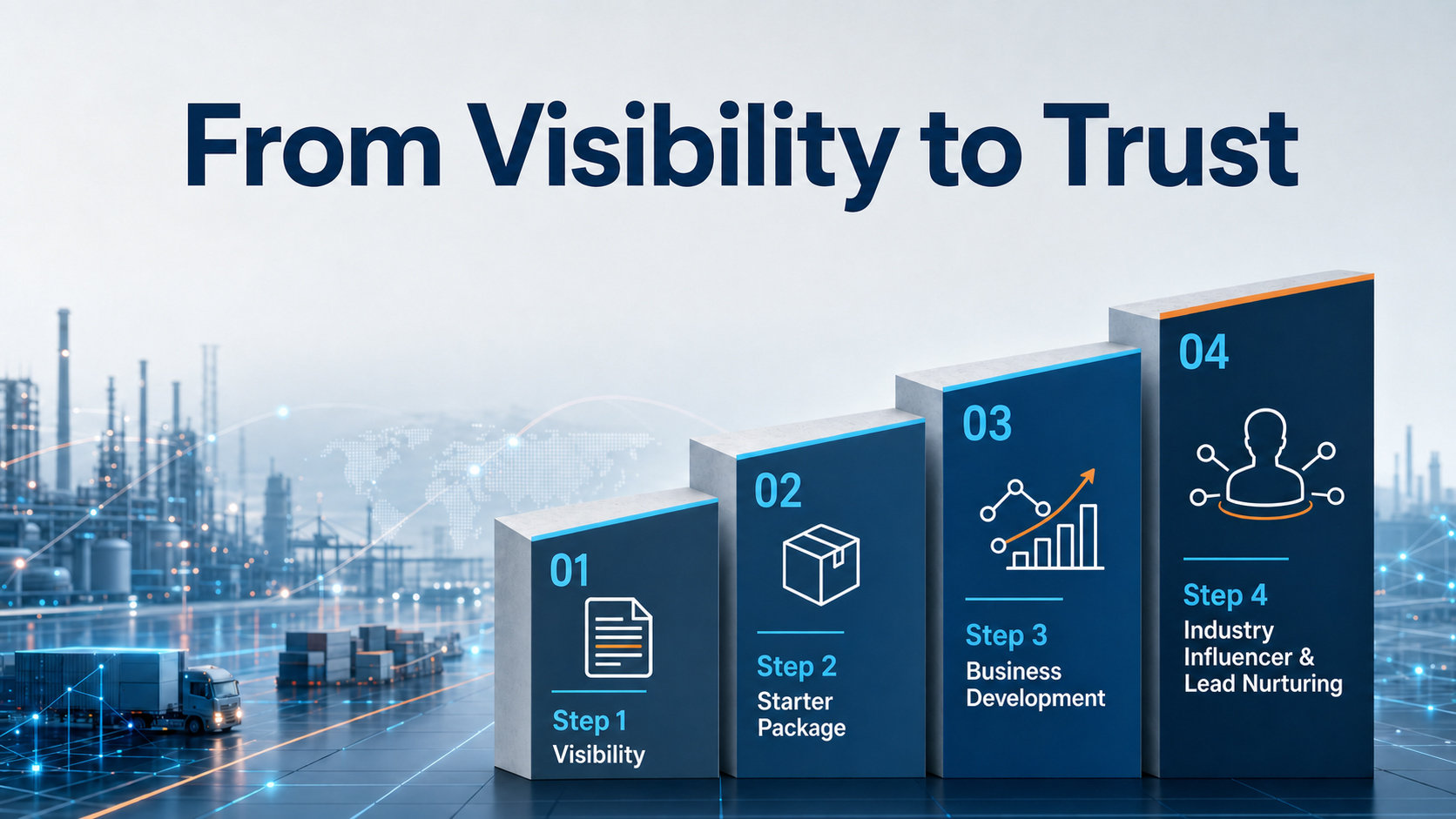
From visibility to trust: Your scalable path with Xpert.Digital - Image: Xpert.Digital
In industrial B2B, sustainable business relationships rarely emerge overnight. They develop step by step – through visibility, professional relevance, recurring touchpoints, and growing trust. Xpert.Digital's 4-stage model addresses precisely this: It offers a structured path that begins with a manageable entry point and can evolve into deeper collaboration in business development if needed.
Instead of relying on loud marketing promises, this model puts the relationship at the forefront. Companies start with clearly defined, easily calculable measures and then decide, based on their own experience, how far they want to expand the collaboration. A key factor for this undisturbed trust-building process: The platform completely avoids annoying advertising ads, so the editorial focus remains solely on the companies' expertise.
More information here: