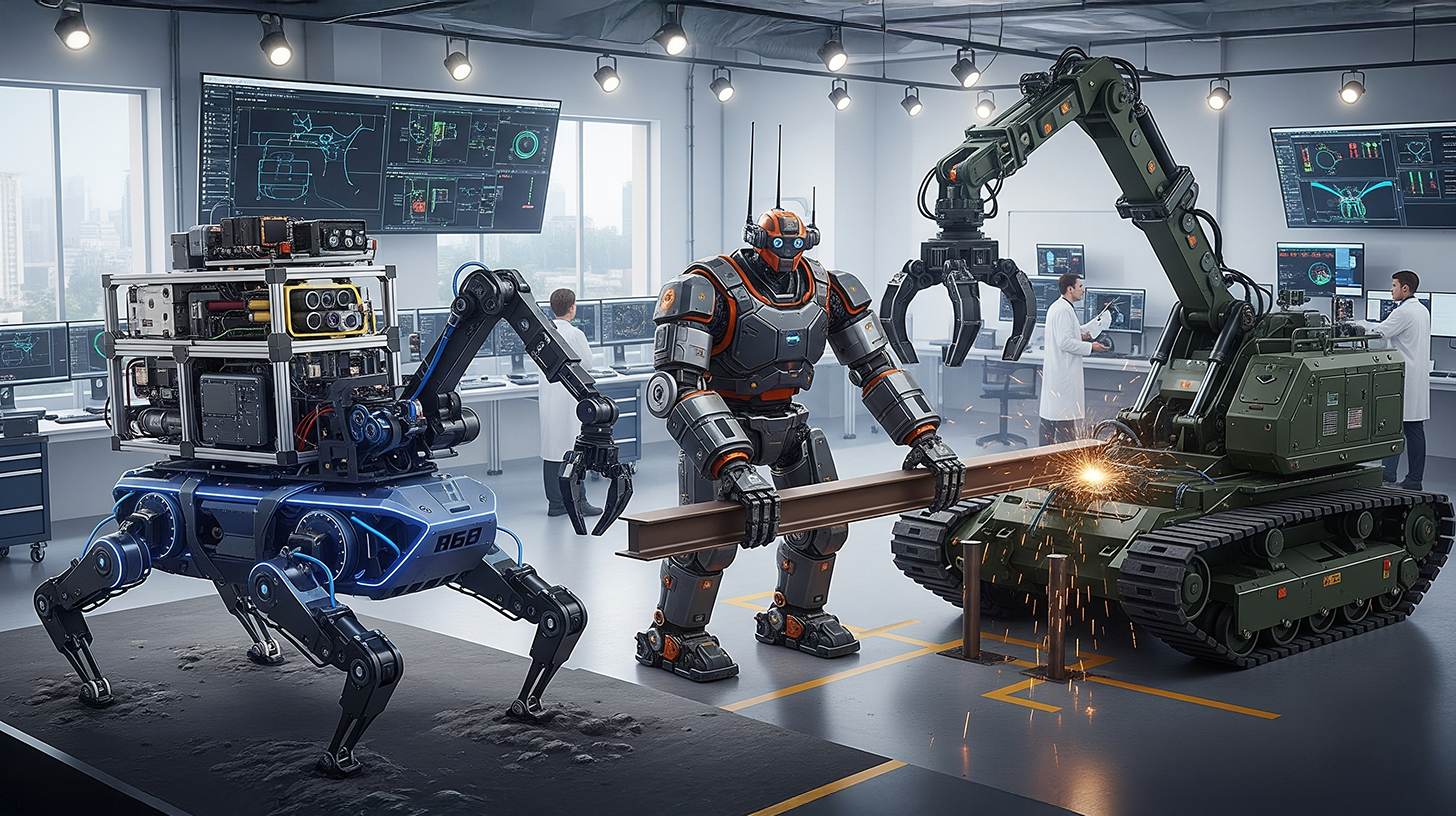
Advances in robotics technology: A comprehensive overview – Image: Xpert.Digital
Modular heavy-duty systems: Scalable solutions for automotive and steel
What are the latest developments in high-performance heavy-duty robots?
The robotics industry is currently experiencing a remarkable upswing in the development of heavy-duty robots capable of moving impressive loads. A prime example of this development is the new ER1000-3300 heavy-duty robot from Estun, which made its world premiere at Automatica 2025. This innovative robot can handle payloads of up to 1,000 kilograms and achieves a reach of 3,300 millimeters. What is particularly impressive is its repeatability of ±0.1 millimeters despite the enormous payload capacity.
The technical specifications of this robot illustrate the advances in robotics: With a weight of 4,850 kilograms, the ER1000-3300 achieves a weight-to-payload ratio of less than 5, enabling comparatively high speeds of 68°/s in axis 1 to 101°/s in axis 6. The rigid design allows for wrist moments of 9,000 Nm in axis J5 and 6,000 Nm in J6 with a permissible moment of inertia of 1,800 kg/m² and 850 kg/m², respectively.
But Estun isn't the only manufacturer innovating in this segment. Kuka presented the "KR Titan ultra," an even more powerful robot capable of moving payloads of up to 1,500 kilograms, all while weighing only 4.5 tons. This robot boasts a reach of up to 4,200 millimeters combined with a high payload capacity and is strongly market-oriented, tailored to the needs of automotive and Tier 1 suppliers.
The applications for these heavy-duty robots are diverse and strategically important. They are particularly well-suited for heavy-duty applications in the steel and automotive industries, as well as in construction machinery. Battery assembly lines in the automotive industry are a particularly important target market, a market in which Estun already holds a leading position in China. The modular design ensures compatibility and scalability between the different robot series, which is advantageous for both manufacturers and users.
Estun already has an impressive track record in the development of heavy-duty robots. The company previously launched a 700-kilogram payload robot that utilizes proprietary dynamic algorithms and lightweight structural designs. These innovations led to Estun's heavy-duty robots being included in the Ministry of Industry and Information Technology's funding catalog for the application of the first key technologies.
How are humanoid robots revolutionizing the music world and other areas?
The development of humanoid robots has made remarkable progress in recent years, particularly in the field of creative applications. A fascinating example is the "Robot Drummer," a project by researchers from the University of Applied Sciences and Arts of Southern Switzerland, the Dalle Molle Research Institute for Artificial Intelligence, and the Polytechnic University of Milan. This humanoid robot can play complex musical pieces, from jazz to metal, with a rhythmic accuracy of over 90 percent.
What makes this project special is the innovative training method called "Rhythmic Contact Chain," in which music is represented as a precisely timed sequence of drum contacts. Researchers extract the percussion channels from MIDI files and convert them into exact timing signals for the robot. Through reinforcement learning in a simulation environment, the robot independently developed human-like techniques such as crossing its arms, dynamically switching drumsticks, and optimizing its movements across the entire drum set.
The tests used the Unitree G1, a 1.20-meter-tall and approximately 35-kilogram humanoid robot priced at US$16,000. The G1 has 23 degrees of freedom and can achieve up to 43 degrees of freedom in advanced versions, giving it the flexibility for complex movements. The robot drummer's repertoire encompasses a wide range of musical genres—from Dave Brubeck's jazz classic "Take Five" and Bon Jovi's "Living on a Prayer" to Linkin Park's "In the End.".
Another interesting example is ZRob, a drum robot from the University of Oslo, which has a flexible "wrist" that, much like a human wrist, allows for a looser grip on the drumsticks. This robot can listen to itself while playing the drums and uses reinforcement learning to improve its performance. The researchers argue that humans often use their own bodies through movement to add a special expression to their playing of an instrument.
But other manufacturers have also tried their hand at musical robots. Xiaomi's CyberOne can also play drums and, according to the manufacturer, automatically converts a MIDI track into drumbeats. The robot has 13 joints, and the sequences of its full-body movements are synchronized to the music.
But humanoid robots are not limited to musical applications. The vision for humanoid robots goes far beyond that: they are to become all-purpose tools that can independently load a dishwasher and work equally well elsewhere on an assembly line. Industrial manufacturers are focusing on humanoids specifically designed for industrial tasks.
The next step in development is transferring the learned skills from the simulation to real hardware. Researchers are also working on teaching the robot improvisation skills so it can react to musical signals in real time. This would allow Robot Drummer to "feel" and react to music like a human drummer.
Which specialized robots are revolutionizing agriculture?
A prime example of specialized robots in agriculture is SHIVAA, a robot developed by the German Research Center for Artificial Intelligence for the fully autonomous harvesting of strawberries in open fields. This innovative robot impressively demonstrates how artificial intelligence and robotics can work together to revolutionize agricultural processes.
SHIVAA was specifically designed for use in open fields, where the natural planting of strawberries results in an ecologically sound end product. Positioned at the edge of the field, the robot uses a 3D camera to autonomously recognize the field's structure and navigates to the first row of plants. Once there, additional cameras, which also process invisible light, identify the position and ripeness of the strawberries.
The harvesting process itself is remarkably precise: two grippers pick the ripe fruit from the plants beneath the robot. Like a human, the gripper's fingers encircle the strawberry and detach it from the plant with a twisting motion. The robot arm, along with the gripper, then quickly moves to the crate above and places the strawberry inside.
SHIVAA's performance data is quite impressive: The robot can harvest approximately 15 kilograms of fruit per hour and is capable of operating for at least eight hours continuously. This capacity makes it a valuable asset for farms struggling with rising labor costs and labor shortages.
A particular advantage of SHIVAA is its ability to work at night. Constant artificial lighting creates even more favorable conditions for the robot's image processing algorithms. Furthermore, the robot can pick fruit alongside humans, allowing for seamless integration into a production environment.
The system is being developed in cooperation with the Hamburg University of Applied Sciences and is currently being tested at the Glantz strawberry farm in Hohen Wieschendorf, Mecklenburg-Western Pomerania. Jan van Leeuwen, the farm manager of Glantz, is pleased to be participating in the project, given the increasing economic pressure, as labor costs account for roughly 60 percent of production costs.
According to project manager Heiner Peters, several more years of development are needed before the robot can be mass-produced. It could take up to seven years before the product can be deployed in larger numbers in fields. However, SHIVAA is not the first fully autonomous robot developed to assist with strawberry harvesting. What distinguishes it from comparable systems, which primarily operate in greenhouses, is its specific design for open-field cultivation.
In the future, the technology could also be applied to harvesting other types of fruit. Peters hopes that the robots will reduce production costs to such an extent that strawberries will once again be offered at lower prices in supermarkets, allowing domestic farms to compete with imports through more efficient production.
According to the developers, the technology is not intended to replace human workers, but rather to support and relieve their workload. Farms could use the robots to avoid crop losses and maintain fruit quality.
How does collaborative robotics change the cooperation between humans and machines?
Collaborative robotics, also known as cobots, represents a paradigmatic shift in how humans and robots work together. Unlike traditional industrial robots that must operate behind safety barriers, collaborative robots are specifically designed to interact safely and effectively with humans in a shared work environment.
There are different levels of human-robot interaction, ranging from full automation to true collaboration. In full automation, humans and robots work in separate work areas, spatially separated by a safety fence. In coexistence, this safety fence is removed, but humans and robots still work separately in their respective work areas.
In cooperative work, humans and robots share a common workspace and work sequentially, one after the other, but generally do not touch. The highest level is human-robot collaboration, where contact between humans and robots is possible and sometimes explicitly necessary, as both typically work together simultaneously.
Cobots use sensors, cameras, and artificial intelligence to control their movements and ensure they don't injure people. They can help perform repetitive, tiring, and precise tasks, allowing human employees to focus on more complex and creative activities. Essentially, cobots can take on many different jobs, such as grasping, lifting, and placing parts, assembly, as well as welding, gluing, drilling, milling, grinding, and polishing.
A particularly interesting example of practical application can be found at the LAT Group, a company active in all aspects of railway infrastructure, from safety technology to railway power supply, and serving public transport. The company employs a sensor-equipped robot dog named Spot, which autonomously identifies damaged cables, for example, in subway tunnels. With widespread use, this could ideally save more than €500 million per year.
The application areas for collaborative robotics will expand considerably in the coming years. Felix Strohmeier, who heads the "Internet of Things" research group at Salzburg Research, is convinced that collaborative robots will also be used outside of factories within the next ten years: "They will be found on construction sites and in other areas of application. In road maintenance and agriculture, there are already products that work collaboratively or at least drive automatically.".
The CONCERT project is developing a novel type of collaborative robot capable of working safely alongside human workers. These robots will possess greater robustness than humans, autonomous capabilities, and collaborative intelligence. The collaboration between robot and user will be facilitated through modern interfaces and interactive tools.
CONCERT robots will be able to gather information from their environment and execute higher-level instructions, for example, for remotely controlled tasks where they autonomously adapt to their surroundings. Teleoperation will play a particularly important role when performing high-risk construction tasks, such as applying chemicals, while ensuring the safety of the operator.
Traditionally, robots have been seen as replacements for human workers. However, cobots take a different approach, focusing on collaboration. These robots are designed to work alongside humans, supporting them in tasks and processes where human skills are irreplaceable.
The integration of robots is significantly changing workplace dynamics. Rather than replacing human workers, cobots are taking over repetitive and dangerous tasks, allowing employees to focus on more complex jobs that require creativity, empathy, and decision-making. This opens the door to redefining job roles and shifting towards more value-driven work.
One of the most significant advantages of human-robot collaboration is improved overall efficiency. Cobots are programmed to perform tasks with precision and speed, accelerating production processes. This allows humans to focus on tasks requiring creativity and human intelligence, thereby increasing the team's overall productivity.
The goal of human-robot collaboration is to combine human strengths – dexterity, flexibility, and adaptability – with robot strengths – power and endurance – to create processes that are both flexible and productive. To ensure safety, collaborative robots are equipped with internal sensors that detect collisions, stop the robot, and thus eliminate risks to humans.
Although automation and artificial intelligence continue to advance, the human touch remains a valuable asset. Cobots cannot compete with the empathy, emotional intelligence, and human intuition that are crucial in certain professions. The interplay between human qualities and robotic capabilities creates a synergistic work environment that combines the best of both worlds.
🎯🎯🎯 Benefit from Xpert.Digital's extensive, five-fold expertise in one comprehensive service package | BD, R&D, XR, PR & Digital Visibility Optimization

Benefit from Xpert.Digital's extensive, five-fold expertise in a comprehensive service package | R&D, XR, PR & Digital Visibility Optimization - Image: Xpert.Digital
Xpert.Digital possesses in-depth knowledge across various industries. This allows us to develop tailored strategies precisely aligned with the requirements and challenges of your specific market segment. By continuously analyzing market trends and monitoring industry developments, we can act proactively and offer innovative solutions. The combination of experience and expertise generates added value and provides our clients with a decisive competitive advantage.
More information here:
Mobile cobots and fleet management: The next wave of automation
What role does artificial intelligence play in modern robotic systems?
Artificial intelligence has become an indispensable component of modern robotic systems, revolutionizing the way robots learn, make decisions, and interact with their environment. The use of AI technologies in robotics is constantly increasing, opening up entirely new possibilities for autonomous and intelligent machines.
Machine learning is one of the most important AI technologies in robotics. A robot learns to recognize patterns and make predictions based on data and experience. Algorithms such as supervised learning, unsupervised learning, and reinforcement learning enable robots to recognize objects, understand speech, and mimic human movements.
Particularly impressive is the development of generative AI, which enables robots to learn through training and create something new from that learning. Robot manufacturers are developing generative AI-driven interfaces to make programming robots more intuitive: users program with natural language instead of code. This eliminates the need for workers to have specialized programming skills to select and customize the robot's desired actions.
Another example is predictive AI, which analyzes robot performance data to determine the future condition of equipment. Predictive maintenance allows manufacturers to save on machine downtime costs. In the automotive supply industry, every hour of unplanned downtime is estimated to cost $1.3 million.
Neural networks are AI models based on the structure and function of the human brain. They consist of interconnected artificial neurons and can solve complex pattern recognition tasks. Neural networks are used in robots to improve visual perception, speech processing, and decision-making.
Computer vision is another crucial AI technology that gives robots the ability to interpret and understand visual information from images or videos. Using AI algorithms, robots can recognize, track, and interpret objects, faces, gestures, and other visual features. This allows them to navigate their environment, perform tasks, and interact with objects and people.
The Karlsruhe Institute of Technology, together with partners, has developed innovative collaborative learning methods that allow robots from different companies at different locations to learn from each other. Federated learning allows training data from multiple stations, multiple plants, or even multiple companies to be used without requiring participants to disclose sensitive company data.
For the FLAIROP project's training, there was no exchange of data such as images or gripping points; instead, only the local parameters of the neural networks—highly abstracted knowledge—were transferred to a central server. There, the weights from all stations were collected and combined using various algorithms. The improved version was then deployed back to the stations and further trained on the local data.
The development of physical AI marks another important milestone. Robot and chip manufacturers like Nvidia are currently investing in the development of specialized hardware and software that simulate real-world environments, enabling robots to train themselves in such virtual environments. Experience gained in this way replaces traditional programming.
Analytical AI enables the processing and analysis of large amounts of data collected by robot sensors. This helps to react to unforeseen situations or changing conditions in public spaces or during production. Robots equipped with image processing systems analyze their work steps to recognize patterns and optimize workflows.
Natural Language Processing (NLP) enables robots to understand, interpret, and respond to natural language. AI models are used to analyze user voice input, answer questions, conduct dialogues, and generate text. NLP allows interaction with robots via spoken or written language.
Reinforcement learning is a form of machine learning in which a robot is rewarded with positive reinforcement for performing a specific action and penalized with negative reinforcement for performing an undesirable action. The robot learns through trial and error to choose optimal actions in specific situations, thereby training complex movements or navigation in dynamic environments.
Machine learning algorithms can also be used to analyze data from multiple robots operating simultaneously and to optimize processes based on this analysis. Generally speaking, the more data a machine learning algorithm receives, the better its performance.
How is the market for autonomous mobile robots developing?
The market for autonomous mobile robots is currently experiencing exceptional growth and is considered one of the most dynamic sectors of the robotics industry. The global market size for AMR was estimated at US$2.8 billion in 2024 and is projected to grow at a CAGR of 17.6 percent from 2025 to 2034.
The robust growth of e-commerce and omnichannel retail has significantly driven the use of automated storage and retrieval systems (AS/RS) for sorting, transportation, assembly, and inventory management. According to the International Trade Administration, the global B2C e-commerce market is projected to reach $5.5 trillion by 2027, representing a compound annual growth rate (CAGR) of 14.4 percent. This increase directly drives demand for ASRs in warehousing and logistics.
Autonomous navigation enables maximum flexibility in route planning and mapping in mobile robotics. Using the fleet manager, companies can monitor their autonomous material transport and analyze the collected production data. AMR systems are available in a wide variety of configurations, such as cart transporters, cleanroom versions, ESD models, and with customized superstructures and supplementary systems.
The robot is used in electronics manufacturing, production plants, logistics centers, the automotive industry, the pharmaceutical industry, and medical technology. At Automatica 2025, Omron presented the new "OL-450S" mobile robot, an autonomous mobile robot specifically designed for transporting trolleys and racks. Its integrated lifting function allows for flexible material flow without requiring any modifications to existing infrastructure.
Node Robotics presents Node.OS, an intelligent software platform that enables autonomous mobile robots and driverless transport systems to work together efficiently and collaboratively. The platform offers precise localization and navigation, intelligent route planning, and scalable fleet management, and integrates seamlessly with existing automation systems.
Thanks to its hardware-independent architecture, the software enables the flexible integration of different robot models and sensor systems. The new Traffic Manager optimizes the efficiency, coordination, and utilization of robot fleets and ensures a smoother material flow in complex industrial environments.
DS Automotion presents Amy, a compact and cost-effective autonomous mobile robot suitable for transporting small loads up to 25 kilograms, distinguished by its ease of use and high flexibility. Thanks to a transfer concept with an active lifting table, sources and sinks can be implemented as passive stations, making cost-effective implementation and scaling very easy, even in existing systems.
The future of AMR technology will be significantly shaped by continued advances in artificial intelligence for improved navigation, object recognition, and decision-making. Enhanced sensor technologies, including more sophisticated LiDAR systems and 3D cameras, will enable AMRs to gain a more comprehensive and accurate understanding of their environment.
Ongoing improvements in battery technology will lead to longer operating times and faster charging capabilities, thus improving the practicality and efficiency of AMR deployments. The increasing adoption of fleet management software and cloud-based platforms will enable better coordination, monitoring, and optimization of large-scale AMR operations.
The emergence of mobile cobots, which combine the mobility of AMRs with the collaborative capabilities of cobots, is expected to open up new applications in areas such as electronics and battery production. Amy from DS Automotion can operate completely autonomously or follow a virtual lane, avoiding unexpected obstacles if desired.
The global market for AMRs is experiencing rapid growth. Current estimates indicate that the market will have already reached considerable dimensions by 2024 and will continue to grow exponentially in the coming years. Autonomous mobile robot manufacturers need to develop sophisticated AMRs designed for e-commerce warehousing, specifically for sorting, transportation, and inventory management.
What impact will robotics have on the job market?
The impact of robotics on the labor market is more complex than initially assumed and differs considerably from the gloomy predictions prevalent a few years ago. A comprehensive study by researchers from the Institute for Employment Research, the University of Mannheim, and the University of Düsseldorf shows that while 275,000 jobs in German industry were lost between 1994 and 2014 due to the use of robots, this was not due to layoffs, but rather because fewer young people were hired.
At the same time, just as many new jobs have been created in the service sector, so that overall the number of jobs has hardly changed. This stands in stark contrast to the USA, where industrial workers have lost their jobs en masse due to automation, even though the German economy uses significantly more robots than US industry, measured against the number of employees.
Trade unions in Germany play a crucial role in this. They have succeeded in preserving jobs in industry, but at the same time, they have had little leverage to secure higher wages for less skilled workers. A large proportion of employees earn less due to automation. Those most affected are employees with medium qualifications, such as skilled workers, whose jobs involve the extensive use of robots.
The primary beneficiaries are highly qualified individuals and the companies that have been able to translate increased productivity into higher profits. This finding is confirmed by the Centre for European Economic Research in Mannheim, which found in a study that while the use of automation technologies generally leads to job losses, new jobs are simultaneously created to compensate for the lost positions.
Researchers at the ZEW (Centre for European Economic Research) conclude that automation will be responsible for 560,000 new jobs between 2016 and 2021. The energy and water supply sectors will benefit most, with job growth of 3.3 percent. The electronics and automotive industries also show positive developments, with 3.2 percent growth. In other manufacturing sectors, the calculated job increase is even higher, at 4 percent.
The situation is critical, however, in the construction industry, where approximately 4.9 percent of jobs are expected to be lost. The education, healthcare, and social services sectors may also lose workers due to automation. Nevertheless, the overall balance is positive, as more new jobs are being created than lost.
A key driver for automation is the shortage of skilled workers. In a survey conducted by the Automatica Trendindex, 75 percent of respondents expect robotics to offer a solution. The vast majority of employees in Germany believe that robots in factories will secure the country's competitiveness. Around three-quarters of those surveyed expect robots to help strengthen competitiveness and keep industrial production within Germany.
The trend index shows particularly high approval ratings regarding the question of whether robotics and automation will improve the future of work: The vast majority want to delegate dirty, boring, and dangerous tasks in the factory to robots. 85 percent believe that robots will reduce the risk of injury during hazardous activities, and 84 percent see robots as an important solution for handling critical materials.
In the manufacturing industry, numerous jobs have already been replaced by robots, but this has also led to the creation of new jobs in areas such as robot programming and maintenance. Robots and artificial intelligence are also being used more and more frequently in other sectors, such as retail and healthcare.
In the future, collaboration between humans and machines will become increasingly important. While certain tasks will be taken over by machines, other activities will still need to be performed by humans. Rather than replacing human workers, robots will take over repetitive and dangerous tasks, allowing employees to focus on more complex tasks that require creativity, empathy, and decision-making.
Terry Gregory of the IZA Institute of Labour Economics doesn't believe that robots will completely replace humans in many professions. He argues that computers create more jobs than they destroy. However, everyone agrees on one thing: work will change. Some jobs will disappear, robots will become colleagues, and we can forget about sitting at the same desk for forty years.
The Institute for Employment Research assumes that the number of new jobs created will equal the number lost. Experts at the Cologne Institute for Economic Research predict that we don't need to fear robots. They won't take all our jobs.
Our recommendation: 🌍 Limitless reach 🔗 Connected 🌐 Multilingual 💪 Sales power: 💡 Authentic with strategy 🚀 Innovation meets 🧠 Intuition


From local to global: SMEs conquer the world market with a clever strategy - Image: Xpert.Digital
In an era where a company's digital presence determines its success, the challenge lies in creating an authentic, personalized, and far-reaching presence. Xpert.Digital offers an innovative solution that positions itself as the intersection of an industry hub, a blog, and a brand ambassador. It combines the advantages of communication and sales channels in a single platform and enables publication in 18 different languages. Cooperation with partner portals and the ability to publish articles on Google News and a press distribution list with approximately 8,000 journalists and readers maximize the reach and visibility of the content. This represents a crucial factor in external sales and marketing (SMarketing).
More information here:
Robotics until 2030: AI, humanoids and radical market trends
How do robots contribute to sustainability and environmental protection?
Robots are playing an increasingly important role in promoting sustainability and environmental protection, with their capabilities extending far beyond the traditional conception of industrial machines. Mobile robots are inherently sustainable and offer environmentally friendly solutions that are revolutionizing operational processes.
A key reason why robots can make production more sustainable is their ability to reduce energy costs. Modern industrial robots accelerate and optimize manufacturing processes, leading to a significant increase in energy efficiency. Because robots operate continuously and often multitask, and require neither lighting, heating, nor constant monitoring, they save additional energy.
Mobile robots are designed to optimize energy consumption, often using rechargeable batteries and efficient movement algorithms. Compared to traditional manual labor or fixed automation systems, they consume less energy and thus contribute to a reduction in CO2 emissions.
By automating tasks such as material transport and handling, mobile robots optimize resource utilization. They streamline processes, minimize waste, and reduce the need for excess materials, thus contributing to overall resource conservation. Another compelling argument for the sustainable use of robots is the reduction in material consumption and production waste.
Industrial robots operate with the highest precision, reducing the error rate. Furthermore, the use of modern robot technology enables optimized material planning, significantly reducing production waste. This means that fewer materials such as adhesives or paints are wasted.
Mobile robots operate quietly and emit minimal pollutants, making them environmentally friendly alternatives to conventional industrial machines. Their electric drive systems produce fewer emissions, thus helping to reduce air and noise pollution in industrial environments.
The International Federation of Robotics has discussed how robots can help achieve thirteen of the 17 UN Sustainable Development Goals. For SDG 7, access to affordable, reliable, and sustainable energy, green technologies can be mass-produced using industrial robots. They offer the necessary precision and ensure optimized resource use.
Robots are used, for example, in the solar industry, battery manufacturing, and even in the dismantling of nuclear power plants. In line with SDG 9, the development of resilient infrastructure and the promotion of sustainable industrialization, used or rented robots provide a cost-effective entry point into automation. Furthermore, reusing robots is environmentally friendly.
Robots also increase production efficiency, leading to less waste, which in turn is more sustainable. However, the UN Sustainable Development Goals also address human health – robots can perform dangerous or strenuous tasks, while we perform higher-value activities that require human strengths such as creativity.
Regarding SDG 12, sustainable consumption and production patterns, it's worth noting that robots, thanks to their high precision and repeatability, ensure stable processes with minimal waste. This also leads to lower energy consumption, especially as more and more energy-saving technologies are being integrated into robots.
KUKA continuously works on solutions to reduce the energy consumption of its robots. A streamlined yet robust product design is a key focus in the development of new products. By reducing the robots' energy consumption, CO₂ emissions during production are reduced, and operating costs are lowered.
Robots also play an important role in promoting renewable energy, waste management, and environmental monitoring. In agriculture, they enable precise irrigation and fertilization, reducing resource consumption and minimizing environmental impact. They can be used in waste management to automate recycling processes and promote a circular economy.
Robots also provide valuable services in environmental monitoring and disaster relief by exploring hazardous environments and collecting vital data. Sustainable automation solutions consider the entire life cycle of products and systems, from design and manufacturing to operation and disposal.
The energy efficiency of robots themselves is also being continuously improved, and various measures are being implemented to further reduce electricity consumption. Overall, it is becoming clear that robotics can be key to material recycling, resource efficiency, and the implementation of the UN Sustainable Development Goals.
What safety standards and norms apply to modern robot systems?
Safety in robotics is ensured by a complex system of norms and standards that are continuously adapted to technological developments. The EN ISO 10218 series of standards, "Robotics – Safety requirements," forms the foundation for practically applicable safety requirements.
The new editions ISO 10218-1:2025 and ISO 10218-2:2025 were published in February 2025 and replace the previous versions from 2011. These standards define the safety requirements for industrial robots in Part 1 and for robot systems, robot applications, and the integration of robot cells in Part 2. ISO 10218-1 treats the robot as an incomplete machine and primarily concerns manufacturers of industrial robots and cobots.
The second part, 10218-2, covers complete machines and systems with integrated robots and is relevant to anyone integrating industrial robots into a complete solution, such as machine manufacturers or system integrators. Both parts, as harmonized standards, provide a presumption of conformity with the essential health and safety requirements of the Machinery Directive 2006/42/EC.
The revision of EN ISO 10218 has been in progress for almost five years with the important goal of maintaining its status as a harmonized standard. This is very important for the EU, although not strictly necessary for two-thirds of the world. Nevertheless, all robot manufacturers and many integrators want to retain this status.
An update and adaptation were definitely necessary and foreseeable, as the use of industrial robots has almost doubled since 2012: Today, nearly 3.5 million are in operation. Further market requirements regarding cybersecurity and collaborative robotics have emerged in recent years.
Current threats and related issues such as the EU Cybersecurity Act, as well as the US government's stance on critical infrastructure, are having an impact on ISO 10218-1. The threat of a cybersecurity attack is a factor in the standard's development.
For human-robot collaboration, four fundamental safety principles are described in detail in the standards EN ISO 10218 Parts 1 and 2, as well as in ISO/TS 15066 "Robots and robotic devices – Collaborative robots". In all cases of human-robot collaboration, hazards to humans must be eliminated through safety measures.
To ensure that no human safety is endangered in the event of a system failure, it is required that the control measures for complying with the limit values be implemented using safe technology. The term "safe technology" is described in EN ISO 13849-1 using categories and performance levels, which must be applied to all safety-related components.
In the robot safety standard EN ISO 10218-1, the category for the safety functions of the robot controller is set to "3" and the performance level to "d", unless the risk assessment indicates a higher or lower value. Based on the risk assessment, the applicable safety and health requirements are determined and appropriate measures are taken.
The Machinery Directive 2006/42/EC of the European Parliament establishes a uniform level of safety and health protection for machinery when placed on the market within the European Economic Area. Each EU member state must transpose the Machinery Directive into national law. In Germany, this is done through the Product Safety Act.
Since the European harmonized standards are often based on international standards of the ISO or IEC, or are direct adoptions thereof, adhering to these standards in the design of robots as well as in the design of applications has the advantage that compliant solutions can be offered even beyond the borders of Europe.
When starting out in robotics, it is important to be familiar with the relevant standards and regulations that serve to prevent workplace accidents when operating robots and robotic systems. Examples include ISO 10218 Parts 1 and 2, the central safety standard for industrial robots, and ISO/TS 15066.
According to the German Social Accident Insurance Institution for the Wood and Metal Industries (BGHM), more than three-quarters of all serious workplace accidents involving industrial robots occur, for example, during troubleshooting. These accidents are usually preceded by a production disruption, such as jammed parts or dirty sensors. Employees sometimes attempt to enter the danger zone before the system has been properly shut down in order to resolve the problem.
Meanwhile, high-performance camera systems that can limit robot movements create safe workspaces, protecting employees from accidents at crucial moments. Furthermore, the safety technology of robot systems is continuously being improved. Remote diagnostics are already being used successfully.
The regulations and rules are continuously adapted to changing technologies. To ensure safe operation, collaborative robots are equipped with internal sensors that detect collisions, stop the robot, and thus eliminate hazards to humans. This is a prerequisite for robots to be taken out of their enclosures and work directly alongside humans without safety barriers.
What future trends will shape robotics development until 2030?
The robotics industry is facing a revolutionary transformation, shaped by several key trends through 2030. The global robotics market is projected to grow by more than 20 percent annually until 2030, reaching a volume exceeding $180 billion. This growth is driven by advances in artificial intelligence and its integration into robotics technologies.
The International Federation of Robotics has identified five key trends for 2025 that will shape the coming years: artificial intelligence, humanoid robots, sustainability, new business areas, and the fight against the labor shortage. The market value of installed industrial robots has reached a historic high of US$16.5 billion worldwide.
Artificial intelligence is evolving in three dimensions: physical, analytical, and generative. AI-driven simulation technology for robots is expected to become prevalent in both typical industrial environments and service robotics applications. Robot and chip manufacturers are investing in the development of specialized hardware and software that simulate real-world environments, enabling robots to train themselves in such virtual settings.
Such generative AI projects aim to create a "ChatGPT moment" for robotics, that is, "physical AI." Analytical AI allows for the processing and analysis of large amounts of data collected by robot sensors. This helps to react to unforeseen situations or changing conditions.
Humanoid robots are attracting significant media attention and are intended to become all-purpose tools capable of independently loading dishwashers and working elsewhere on assembly lines. Experts predict that over 4 billion robots will be in use worldwide by 2050, compared to 350 million in 2024.
The largest growth segments lie in humanoid, care, and delivery robots. Humanoid robots, in particular, promise great potential, as their human-like form and mobility make them versatile. Industrial manufacturers are focusing on humanoids specifically designed for industrial tasks.
Sustainability is becoming an increasingly important factor in robotics development. Robots can help achieve thirteen of the 17 UN Sustainable Development Goals. They contribute to reducing energy consumption, material waste, and emissions.
New business opportunities are emerging due to changing consumer preferences and societal trends, which are accelerating the need for advanced robotics solutions. Consumer-driven demand for faster delivery of customized products will lead to an expansion of robotic capabilities in manufacturing customization and logistics applications.
It is widely known that there is a shortage of skilled workers, especially in leading industrialized nations. Robots can play an important role here by taking over tasks for which there are not enough human workers available. 75 percent of those surveyed in Germany expect robotics to offer a solution to the skilled worker shortage.
The global service robot market is projected to grow from US$26.35 billion in 2025 to US$90.09 billion by 2032. The industrial and commercial segment is expected to consolidate its dominance and experience significant growth during the forecast period.
Industry 5.0 places a greater emphasis on the collaboration between humans and machines. Collaborative robots, which interact closely with humans in production environments, are a key element of this new revolution. Advances in artificial intelligence have made cobots more powerful and versatile.
The focus is on further optimizing Industry 4.0 systems and integrating data more efficiently along the entire supply chain. Companies that rely on modern maintenance software can make their production processes even more sustainable and flexible.
The global market size for autonomous mobile robots is projected to grow at a compound annual growth rate (CAGR) of 17.6 percent from 2025 to 2034. The emergence of mobile cobots, which combine the mobility of AMRs with the collaborative capabilities of cobots, will open up new applications in fields such as electronics and battery production.
Projected sales of industrial and logistics robots are around US$80 billion by 2030, while the market share for professional service robots is expected to reach up to US$170 billion. This growth is being accelerated by changing consumer preferences and societal trends that are driving the demand for advanced robotics solutions.
We are here for you - Consulting - Planning - Implementation - Project Management
☑️ SME support in strategy, consulting, planning and implementation
☑️ Creation or realignment of the digital strategy and digitization
☑️ Expansion and optimization of international sales processes
☑️ Global & Digital B2B trading platforms
☑️ Pioneer Business Development

Konrad Wolfenstein
I would be happy to serve as your personal advisor.
You can contact me by filling out the contact form below or simply call me on +49 7348 4088 965 .
I'm looking forward to our joint project.
Write to me


Xpert.Digital - Konrad Wolfenstein
Xpert.Digital is a hub for industry focusing on digitalization, mechanical engineering, logistics/intralogistics and photovoltaics.
With our 360° Business Development solution, we support renowned companies from new business to after-sales.
Market intelligence, smarketing, marketing automation, content development, PR, mail campaigns, personalized social media and lead nurturing are part of our digital tools.
You can find more information at: www.xpert.digital - www.xpert.solar - www.xpert.plus
Keep in touch