Google I/O 2025: The search giant switches to 'Smart Google Search' AI mode – A complete reinvention of search – Image: Xpert.Digital
Search engine update: Google takes the next step
AI meets search engine: Google's risky game for market share
At this year's Google I/O developer conference, the tech giant unveiled a fundamental redesign of its search engine. The new AI mode represents nothing less than a revolution in Google's core product. This aggressive strategy comes in an increasingly competitive market, where AI-powered competitors like ChatGPT and Perplexity are challenging the traditional search model for market share. The announced innovations demonstrate how Google is attempting to transition its proven business model into the AI age – a risky, but potentially unavoidable, step.
Related to this:

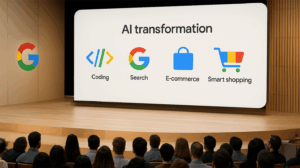
AI Mode: A complete reinvention of search
At its I/O conference in Mountain View, California, Google announced its AI mode as a "complete reinvention of search." This new approach, initially rolling out in the US, transforms the classic search engine into a conversational, intelligent platform. Unlike the existing AI summaries, which simply overlay traditional search results, AI mode takes over the entire user interface.
The AI mode allows users to ask complex questions and probe further during the conversation. Instead of a list of links, the search engine now delivers structured answers that can include links, quotes, charts, and detailed analyses. "For complex queries, the AI mode breaks questions down into subtopics and performs a variety of searches to delve deeper into the web," Google explains in its presentation.
One particularly innovative feature is the "Query Fan-Out" approach, where the AI breaks down complex queries into numerous sub-questions and processes them in parallel. For demanding research, the AI mode can even "launch hundreds of search queries" to deliver comprehensive results. This technology is powered by the new Gemini 2.5 model, which Google describes as its "most powerful AI model to date.".
Personalization and enhanced features
A key innovation of AI mode is the increasing personalization of search results. Google plans to offer tailored suggestions based on previous search queries. In a demonstration, Google showed how AI mode provides restaurant recommendations based on past bookings when planning a trip.
To visualize complex data, the AI mode is being expanded with analytical functions. "Complex analysis and data visualization are coming this summer for sports and finance," Google announced. In a demonstration, statistics on baseball players were presented in tabular and graphical form.
The new shopping features in AI mode are particularly revolutionary. By integrating the "Shopping Graph" with over 50 billion products, users can conduct more sophisticated product searches. A virtual try-on function allows users to visualize clothing items on their own bodies, as AI calculates body measurements from a photo. The "agentic direct purchase" feature with Google Pay aims to fully automate the buying process.
Gemini 2.5: The heart of the AI offensive
The foundation for Google's AI transformation is Gemini 2.5 Pro, which was presented as the company's most powerful AI model to date. It is designed to be multimodal and processes not only text, but also images, audio, and video. A particular innovation is the "Deep Think" mode, in which the AI considers multiple hypotheses simultaneously during research before providing an answer.
Google emphasizes that this mode has already proven itself in mathematics benchmark tests and "achieved impressive results." The efficiency-focused Gemini 2.5 Flash model is also receiving an update with improvements in logical reasoning, multimodality, programming, and the processing of large amounts of information.
Further improvements include Gemini's speech capabilities, enabling it to speak in different tones, whisper, and even switch languages mid-sentence. The new "Agent Mode" will also allow the AI to learn the user's personal style and, for example, suggest smart replies for Gmail.
Project Astra and Mariner: The vision of the universal AI assistant
With Project Astra, Google is pursuing the vision of a universal, multimodal research AI that can perceive its environment and react to it in real time. Developed by Google subsidiary DeepMind, the AI is intended not only to understand voice commands but also to recognize objects via a smartphone camera and to master multitasking.
The prototype "Project Mariner" goes a step further and is designed to coordinate up to ten tasks simultaneously. This experimental assistant can automatically manage complex processes such as bookings and purchases. Google CEO Sundar Pichai described these developments as "a new phase of the AI platform shift, where decades of research are now becoming a reality for people around the world.".
Related to this:

AI is becoming a business model: Premium subscriptions
At the conference, Google also unveiled two paid AI packages: Google AI Pro (formerly AI Premium) for €21.99 per month and Google AI Ultra for $249.99 per month. The Ultra subscription is aimed at professional users and offers access to the most powerful AI models and extensive additional features.
The Ultra package includes, among other things:
- The "absolute best version" of the Gemini app with the highest usage limits
- New AI tools such as "Flow" for film productions and "Whisk" for visualizing ideas
- YouTube Premium for ad-free streaming
- 30 terabytes of cloud storage for Google Photos, Drive and Gmail
This subscription model demonstrates that Google views AI not merely as an addition to existing services, but as a distinct business area. OpenAI already offers a comparable subscription service, ChatGPT Pro, for $200 per month.
The competition is breathing down their necks: A fiercely contested market
Google's AI offensive is taking place in an increasingly competitive environment. At the end of 2024, OpenAI launched ChatGPT Search, a search function that makes the chatbot a direct alternative to Google. The service can display current search results such as sports scores, news, and stock prices with links to relevant sources.
The up-and-coming AI startup Perplexity also poses a growing threat. Founded in 2022, the company has developed an AI that searches the internet for information on behalf of users and is in direct competition with ChatGPT and Google. Perplexity founder Aravind Srinivas has ambitious goals: "In five or ten years, we can be bigger than Chrome," he is quoted as saying.
These new providers take a fundamentally different approach than traditional web search: they deliver specific answers instead of web links. If this type of search behavior becomes widespread, it could jeopardize Google's current business model, which still generates the majority of its revenue from search ads.
Long-term symbiosis of search and AI: A risky transformation
Google's new AI strategy represents a balancing act: On the one hand, the company must revolutionize its core product, search, to compete with AI-based rivals. On the other hand, this very transformation potentially jeopardizes its own business model, which is based on brokering web traffic and the associated advertising.
Significantly, Google made "not a word about the impact of AI on websites and SEO" at its I/O conference, even though the AI mode will have "a profound impact on website operators." A study had already shown that AI-generated overviews led to "35% lower average click-through rates for top-ranking pages." The AI mode, which partially or completely replaces links, could exacerbate this trend.
However, Google seems willing to take risks. Search is by far Google's most important product, and the US is its largest market. Even small changes can have a major impact on the company's revenue and reputation. Nevertheless, Google is pursuing a fundamental transformation: from "Googling" to "smart Googling" powered by AI.
A turning point for the internet
Google I/O 2025 marks a turning point not only for Google, but for the entire way we search for information online. AI mode is more than just a new feature – it represents a fundamental paradigm shift from link-based to answer-based search.
Google CEO Sundar Pichai summed it up perfectly: "What all this progress means is that we are in a new phase of AI platform shift, where decades of research are now becoming a reality for people all over the world." Whether this vision comes to fruition and whether Google can maintain its dominance in the digital information age will become clear in the coming years.
One thing is certain: the era of simply "Googling" is coming to an end. The future belongs to intelligent, personalized, and context-aware search experiences that not only deliver information but can also understand and execute complex tasks. With its AI mode, Google has laid its cards on the table – a new chapter in digital competition is beginning.
Related to this:
Your global marketing and business development partner
☑️ Our business language is English or German
☑️ NEW: Correspondence in your native language!

Konrad Wolfenstein
I and my team are happy to be available to you as your personal advisor.
You can contact me by filling out the contact form here wolfenstein@xpert.digital:or simply call me at +49 7348 4088 965. My email address is
I'm looking forward to our joint project.