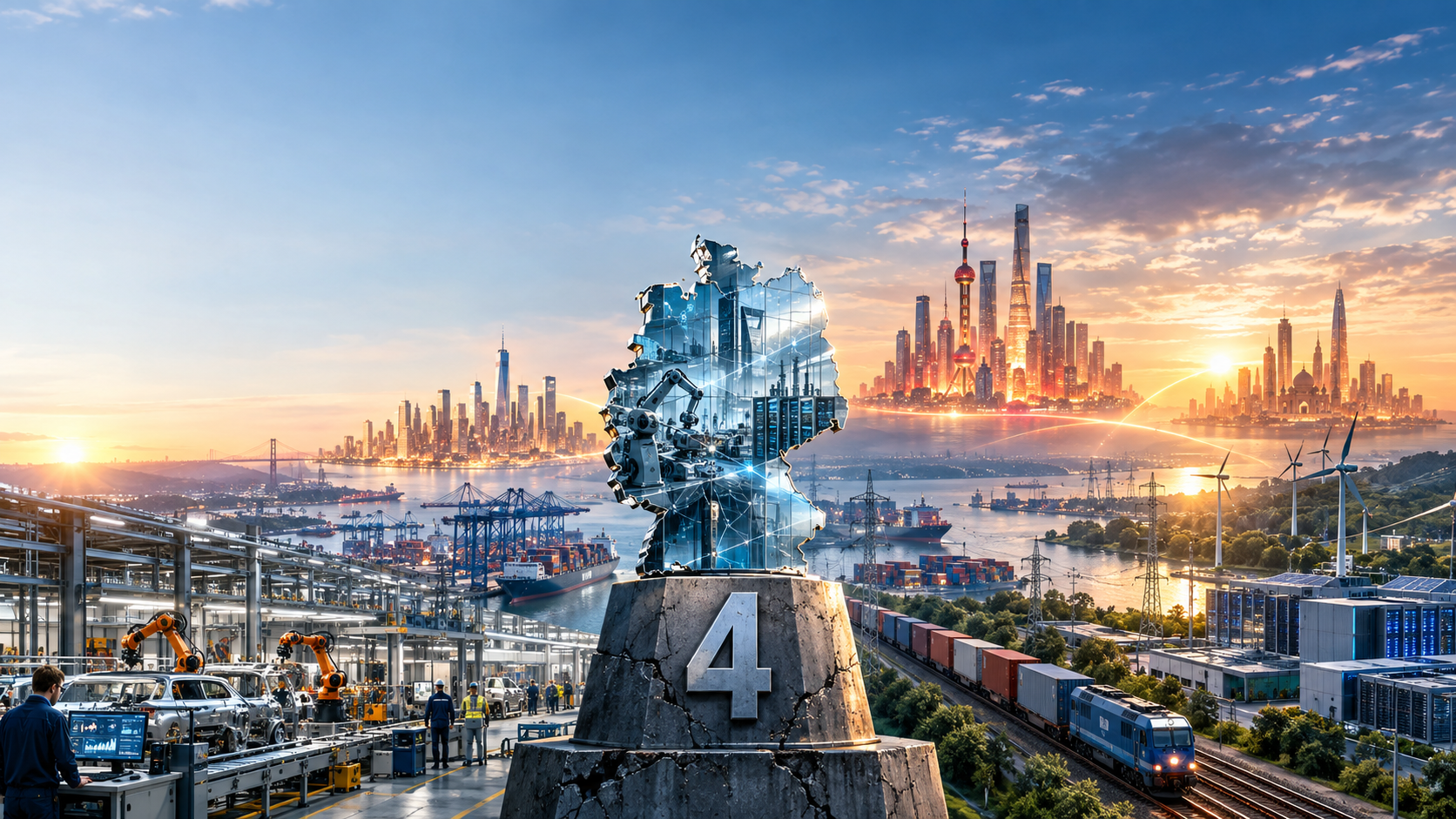
Rich but rigid: 4th place in the global economy – Why Germany's ranking is a dangerous illusion – Creative image on the topic, with AI: Xpert.Digital
Worth 6.35 trillion dollars: The inconvenient truth about Germany's prosperity
India is overtaking us: What the new global order means for the German economy
Forecast for 2031: Germany will remain an economic giant – but appearances are deceiving
According to current projections by the International Monetary Fund (IMF), Germany will remain among the world's economic powerhouses in 2031. With a projected nominal gross domestic product of US$6.35 trillion, the Federal Republic is expected to maintain its fourth-place ranking behind the USA, China, and the rising power of India. At first glance, this might seem like reassurance to all those predicting the imminent demise of Germany's economic power. But mere ranking tells only half the story: The sheer size of the German economy masks a gradual loss of dynamism, innovative strength, and real prosperity. While nominal growth is artificially inflated by inflation and exchange rate effects, the real gap to the global leaders is widening considerably. We demonstrate why Germany must address the transformation of its industry, energy sector, and demographics more profoundly—and why the greatest danger lies not in falling out of the top five, but in the deceptive complacency that this ranking could breed.
Germany's ranking among billionaires is not proof of growth
Fourth place by 2031: Economic size masks how much dynamism Germany has already lost
According to projections by the International Monetary Fund, Germany will still be among the world's largest economies in 2031. Its nominal gross domestic product is expected to reach approximately US$6.35 trillion. This would place Germany in fourth position, behind the United States, China, and India, but still ahead of the United Kingdom, Japan, and France. This ranking contradicts the widespread narrative of an imminent economic collapse. An economy that maintains its position among the global leaders despite the energy crisis, geopolitical tensions, demographic aging, and years of weak investment is neither economically insignificant nor structurally finished.
However, the opposite conclusion—that Germany can rest on its laurels—would be equally wrong. A ranking of nominal gross domestic product measures economic weight, but not automatically dynamism, productivity, growth in prosperity, or future viability. It shows the value of production in a given year, assessed at current prices and exchange rates. It does not answer whether the economy is growing rapidly, whether investments are sufficient, whether companies remain technological leaders, or whether citizens are experiencing real growth in prosperity. Germany's fourth-place ranking can therefore simultaneously reflect its considerable strength and signal a gradual relative decline.
The crucial question is not whether Germany will still be among the five largest economies in 2031. Based on current data, this is highly likely. The decisive factor is rather the intrinsic quality with which this ranking is achieved. A country can nominally grow larger because prices rise and its currency appreciates against the dollar, even if production and productivity barely increase. This is precisely where the danger of a superficial interpretation lies: The figure of 6.35 trillion dollars sounds like robust growth, but it can mask a considerably more sobering real development.
Fourth place is both strength and a warning signal
The German economy continues to possess exceptional industrial, technological, and institutional strengths. These include a broad base of medium-sized businesses, specialized global market leaders, high-performing research structures, a skilled workforce, a dense network of suppliers, and deep integration into the European single market. Germany produces complex capital goods, vehicles, chemicals, electrical equipment, medical technology, and high-quality services that cannot be replaced in the short term. This established capital and knowledge base explains why the country has not simply fallen out of the top tier, even after several weak years.
Economic size also has a self-stabilizing effect. A large domestic market, high employment, robust tax revenues, a generally effective welfare state, and a level of public debt that is still sustainable by international standards create buffers. In addition, membership in the Eurozone gives Germany access to a large currency and capital area. Even a period of very low growth therefore does not automatically mean an abrupt collapse. Large economies usually do not lose their position in a single crisis year, but rather over a long period of relative underperformance.
This very inertia can be politically dangerous. Because Germany remains wealthy, export-oriented, and internationally relevant, structural problems are often recognized as existential only belatedly. Fourth place provides a sense of security, even though important indicators below that ranking can deteriorate: the share of global production, industrial competitiveness, productivity per hour worked, the number of available workers, or the ability to generate new global technology companies. The ranking protects against exaggeration, but it must not become a pacifier.
Nominal growth is not real dynamics
Between 2026 and 2031, Germany's nominal gross domestic product (GDP) in US dollars is projected to rise from approximately 5.45 trillion to around 6.35 trillion. This corresponds to an increase of about 900 billion dollars, or roughly 16.5 percent. At first glance, this is remarkable. However, spread over five years, this results in only moderate nominal growth. Furthermore, this increase is comprised of several components: real production growth, price developments, and exchange rate fluctuations between the euro and the dollar.
Real growth is the key indicator of economic performance. Here, the picture is considerably weaker. After years of stagnation or contraction, an economic recovery is initially expected, supported by falling inflation, higher real wages, lower financing costs, and additional public spending. Specific growth figures vary depending on the forecast, but the overall trend is clear: In the second half of the decade, Germany's growth is likely to revert to a very low structural pace. Medium-term estimates for 2030 and 2031 range only around 0.6 percent per year.
This creates a paradoxical situation. Germany can grow in dollar terms and maintain its ranking, while the real gap to more dynamic economies widens. For businesses and households, what matters in the long run is not how impressive the nominal total volume appears, but how much real value added per capita and per hour worked increases. If the population ages, the volume of work decreases, and productivity rises only slowly, a growing nominal gross domestic product can occur alongside a virtually stagnant material standard of living.
The exchange rate also significantly influences the ranking. A stronger euro raises the value of German economic output measured in dollars, without any additional machines being produced, new software being developed, or additional hours being worked in Germany. A weaker euro has the opposite effect. Therefore, shifts in ranking between Germany, Japan, the United Kingdom, and India are partly due to monetary effects. This diminishes the significance of the ranking, but does not eliminate it entirely. Over longer periods, real differences in growth become apparent, and this is precisely where Germany's problem lies.
India is changing the global order
India's rise to third place is more than a statistical shift. It represents a long-term shift of economic mass to Asia. India combines a very large population with comparatively high real growth, increasing urbanization, growing consumption, digital platforms, industrial investment, and greater integration into international supply chains. While per capita income remains far below the German level, total economic output is what counts for the global ranking. Even moderate productivity gains have enormous absolute effects in a population of well over a billion people.
Germany cannot win this competition for size demographically. It would be pointless to measure economic policy success solely by whether an economy with roughly 84 million inhabitants remains permanently ahead of India. What matters is how productive, innovative, and prosperous Germany remains per capita. India's overtaking is therefore not proof of German failure. It is, first and foremost, the expected consequence of differing population sizes and levels of development.
Nevertheless, this shift has practical consequences. Investment flows, sales markets, corporate strategies, and geopolitical influence are increasingly following growth centers. Those who grow faster attract more capital, create larger digital markets, and can better leverage economies of scale. German companies must therefore understand India not only as a competitor but also as a sales market, production location, and innovation partner. At the same time, Germany itself must remain attractive enough to ensure that international corporations continue to locate their high-value functions, such as research, development, engineering, and management, here.
The gap to the top is systemically
The United States is projected to reach a nominal gross domestic product of approximately $39 trillion in 2031, while China's is expected to reach around $27.5 trillion. Germany, at approximately $6.35 trillion, would fall far short. This gap is not simply a matter of population size. The US combines a vast domestic market with deep capital markets, a high appetite for risk, leading technology companies, a strong research landscape, and the global role of the dollar. China, on the other hand, combines industrial scaling, state-directed investment, large supply chains, a comprehensive domestic market, and a strategic industrial policy.
Germany can neither copy these models nor should it attempt to do so. However, it needs a response to the structural advantages of both systems. Compared to the US, Europe lacks a similarly integrated capital market, large-scale growth financing, and a unified digital market. Compared to China, Germany suffers from higher energy and location costs, slower permitting processes, and lower economies of scale. At the same time, Chinese companies are emerging as competitors in sectors where German manufacturers have long benefited from technological superiority and export strength.
The growing gap does not mean that Germany is becoming irrelevant. It does, however, mean that unilateral national actions are becoming less and less effective. Germany's strategic stature in the future will not be solely the Federal Republic, but the European Union. Only a more integrated European capital market, integrated energy and data networks, common standards, and a truly functioning single market can offer companies a basis for scaling comparable to that of the USA or China. Germany's economic sovereignty will therefore not grow through isolation, but through a more efficient Europe.
The pursuers remain at a distance
The fact that Germany is expected to rank ahead of the United Kingdom, Japan, and France in 2031 is economically significant. The United Kingdom is projected to follow with approximately $5.4 trillion, Japan with around $5.1 trillion, and France with roughly $4.1 trillion. Germany thus retains a particularly strong position within Europe and among established industrialized nations. The German economic structure is more broadly industrialized than those of Britain or France, while Japan is struggling with even less favorable demographics and a weak currency.
However, this gap is not guaranteed. The United Kingdom boasts a strong financial center, leading universities, a large service sector, and a flexible innovation environment. France benefits from more favorable demographics, a robust nuclear-based energy supply, and large corporations in aviation, luxury goods, defense, and infrastructure. Japan possesses enormous technological capabilities, substantial private wealth, and strong industrial networks. Germany is therefore not competing with weak economies, but rather with countries that, despite their own challenges, have clear advantages in specific future-oriented sectors.
The ranking can also fluctuate considerably due to exchange rates. A persistently weak yen depresses Japan's economic output in dollar terms without fully reflecting the country's technological strength. A strengthening pound could bring the United Kingdom closer to Germany. The political message, therefore, should not be that Germany has permanently overtaken these competitors. Rather, it is holding its own in a small group of mature economies whose overall real growth is limited.
Industry remains Germany's most valuable foundation
Germany's industrial sector is significantly above the European Union average. This is a strength because industrial value creation combines research, exports, skilled employment, and productive services. Mechanical engineering, the automotive industry, chemicals, electrical engineering, pharmaceuticals, environmental technology, and industrial software form complex ecosystems. Many German companies do not supply easily interchangeable consumer goods, but rather highly specialized components and systems that are deeply embedded in international production processes.
This industrial density explains a large part of Germany's economic resilience. It creates technical expertise, professional qualifications, and regional clusters that cannot be easily replicated. Small and medium-sized enterprises (SMEs) in particular combine customer proximity with engineering competence and occupy profitable niches worldwide. Germany's problem, therefore, is not that it has too much industry. It is that key parts of this industry have to operate under changing conditions, while the location itself is only slowly adapting.
Dependence on energy-intensive processes, global export markets, and the internal combustion engine increases vulnerability. In the chemical, metal processing, automotive, and mechanical engineering sectors, higher energy costs, Chinese competitive pressure, technological disruptions, and weak foreign demand are converging. In 2024, real gross value added in the manufacturing sector declined significantly; it fell again in 2025, albeit less sharply. This development is more than a normal economic downturn. It demonstrates that part of the existing business model is under structural pressure.
A successful industrial policy must neither deny this transformation nor preserve every existing capacity. The goal must be to modernize productive cores and build new value creation. This includes automated production, industrial artificial intelligence, power electronics, robotics, battery technology, semiconductors, biotechnology, climate-friendly raw materials, modern defense technology, and digital services related to machinery and equipment. Germany's industrial future lies not in a return to the conditions of the 2010s, but in the technological renewal of its existing strengths.
The export model needs a new balance
For a long time, Germany generated large current account surpluses. These reflected competitive companies, high savings rates, and strong demand for German capital goods. At the same time, they meant that a significant portion of German value creation depended on foreign demand. This model worked particularly well during a period of cheap Russian energy, rapidly growing Chinese demand, open global markets, and a relatively stable geopolitical order.
Several of these conditions no longer apply. China is now not only a customer, but also a competitor in an increasing number of sectors. Trade conflicts and industrial subsidies are on the rise. Supply chains are increasingly organized according to security criteria. At the same time, the appreciation of the real exchange rate has weakened price competitiveness. Germany's current account surplus is expected to remain positive, but to decline from 5.8 percent of gross domestic product in 2024 to approximately 3.8 percent in 2031.
This decline is not automatically negative. If it results from higher productive domestic investment, better infrastructure, and stronger private consumption, it can be indicative of a healthier growth model. It would be problematic, however, if exports decline due to persistent losses in competitiveness without corresponding increases in domestic demand and productivity. The crucial factor is therefore the cause: reduced export dependence can foster stability, while a loss of technological market share can cost prosperity.
Germany needs a more balanced model that combines export strength with higher domestic investment. The state must provide infrastructure, companies must invest in plants, software, research, and new business models, and households need confidence in real income growth. Such a readjustment would reduce the trade surplus without abandoning the industrial base. It would not be a departure from Germany's export-oriented economy, but rather insurance against a more fragmented global economy.
Our EU and German expertise in business development, sales and marketing

Our EU and German expertise in business development, sales and marketing - Image: Xpert.Digital
Industry focus areas: B2B, digitalization (from AI to XR), mechanical engineering, logistics, renewable energies and industry
More information here:
A thematic hub offering insights and expertise:
- Knowledge platform covering global and regional economies, innovation and industry-specific trends
- A collection of analyses, insights, and background information from our key areas of focus
- A place for expertise and information on current developments in business and technology
- A hub for companies seeking information on markets, digitalization, and industry innovations
New challenges for the German economy until 2031
Energy is a cost factor and a question of transformation
The energy price shock following the cessation of Russian gas supplies hit Germany harder than many other advanced economies. The economy was particularly exposed due to its high industrial share and the importance of natural gas. While a physical shortage was avoided, energy costs remained higher and more volatile for many companies than before the crisis. This is influencing investment decisions, especially in the chemical, metals, glass, paper, and other energy-intensive sectors.
A return to the old energy model is not realistic. The economic policy challenge is therefore to build a new system that combines security of supply, competitive prices, and climate targets. For this, Germany needs faster grid expansion, more controllable capacity, storage, flexible demand, integrated European electricity markets, and reliable regulations. The success of the energy transition will not be measured solely by installed wind and solar capacity, but by whether companies can obtain predictable electricity prices in the long term and operate new industrial processes economically.
Subsidized energy prices can mitigate short-term hardship, but they don't solve the structural problem. Long-term sustainability hinges primarily on lower system costs, improved grids, faster permitting processes, and increased supply. At the same time, it's crucial to prevent energy policy uncertainty from driving away investment. Companies can manage ambitious climate targets if pathways, infrastructure, and prices are sufficiently predictable. Frequent changes in direction, on the other hand, increase the risk premium for the location.
The investment backlog will become a growth test
For years, Germany has underinvested in roads, railways, bridges, schools, municipal facilities, energy networks, and digital administration. The investment backlog for municipalities was recently estimated at more than €200 billion. Added to this are significant requirements for the railways, power grids, data centers, fiber optics, housing construction, and public digitization. This backlog not only impacts daily life but also increases costs and prolongs projects for companies.
With the special fund for infrastructure and climate neutrality of up to €500 billion over twelve years, Germany has fundamentally expanded its fiscal options. Of this, €300 billion is earmarked for federal investments, €100 billion for states and municipalities, and €100 billion for the Climate and Transformation Fund. This represents a watershed moment in economic policy. After years in which the debt brake dominated political action, considerable financing potential is now available.
Money alone, however, does not guarantee real modernization. If planning authorities are overburdened, permits take years, tenders fail, and construction capacity is lacking, additional billions will initially lead to higher prices instead of more infrastructure. The investment initiative is therefore primarily a test of implementation. The government must prioritize projects, standardize them, and bring them to the point of being ready for construction more quickly. Joint procurement, digital processes, reliable multi-year budgets, and clear responsibilities are at least as important as the size of the fund.
If used correctly, the investment drive can increase production potential. Better transport infrastructure reduces logistics costs, digital administration reduces bureaucracy, high-performance networks enable electrification, and modern educational infrastructure strengthens human capital. If used incorrectly, it would merely increase the debt-to-GDP ratio. According to medium-term projections, this is expected to rise from around 62.6 percent of GDP in 2025 to approximately 73.4 percent in 2031. While this level remains manageable by international standards, the quality of the spending will determine whether the higher debt is offset by higher productive assets.
Productivity is the real question of destiny
Germany's long-term problem is less a lack of work ethic than weak productivity growth. Productivity increases when employees, equipped with better capital, modern software, more efficient processes, and new technologies, generate more added value per hour. In recent years, this progress has been unsatisfactory. The gap with the United States is particularly evident in information and communication technologies.
More working hours can mitigate the demographic burden, but not permanently compensate for it. If the number of people in the working-age population declines, each employee must, on average, create more value. For this, companies need investment security, financing, qualified staff, and room for new business models. Bureaucratic burdens, slow approval processes, and complex reporting requirements often hit young and smaller companies particularly hard because they have fewer administrative resources than established corporations.
Artificial intelligence and automation offer Germany a unique opportunity. An aging industrial society can leverage productivity gains from digital assistance systems, robotics, predictive maintenance, and automated administration more effectively than a country with a growing labor supply. Crucially, however, rapid implementation is key. Germany doesn't need to develop the world's largest baseline model in every sector. It can achieve significant benefits by reliably integrating industrial data, expertise, and AI across mechanical engineering, logistics, healthcare, public administration, and small and medium-sized enterprises (SMEs).
This requires digital infrastructure, secure cloud services, computing capacity, standards, further training, and a regulatory framework that controls risks without unnecessarily slowing down implementation. The question of productivity is therefore not just a technology debate. It is a question of organization, education, and investment. A country can conduct outstanding research and still fall behind economically if innovations are translated too slowly into scalable products and efficient processes.
Demographics are narrowing the scope for action
Germany's working-age population is expected to decline more sharply in the coming years than in any other G7 economy. Estimates suggest it could fall by approximately 0.7 percent annually between 2025 and 2030. The baby boomers are leaving the labor market, while younger generations are smaller in number. Migration can mitigate this trend, but it cannot automatically resolve it, because qualifications, language skills, recognition procedures, housing, and integration determine the actual contribution to the labor supply.
Demographic aging has an impact on several levels. It limits the volume of work, increases pension, long-term care, and healthcare spending, and shifts political priorities toward consumer spending. At the same time, fiscal space for education, infrastructure, and innovation shrinks when social spending grows faster than economic output. Without reforms, this can create a vicious cycle: lower growth intensifies distributional conflict, and higher taxes to finance aging weaken incentives for work and investment.
Germany still possesses untapped labor potential. Improved childcare could enable more women to increase their working hours. The tax and transfer system provides weak incentives for secondary earners and those with low incomes to work additional hours. Older employees could remain in the workforce longer under suitable working conditions. Immigrants could enter skilled employment more quickly through faster recognition of qualifications, language support, and reduced bureaucratic hurdles.
The issue of working hours should not be approached from a moral perspective. It is not about devaluing individual lifestyles, but about removing institutional barriers. If additional work is hardly worthwhile due to high marginal costs, a lack of childcare, or inflexible work models, this is an economic policy problem. The Bundesbank estimates that demographic effects will further impede growth in the future. Higher labor force participation and more working hours could significantly boost potential growth, but they do not replace productivity reforms.
The fiscal transformation creates opportunities and new risks
The reform of debt rules is changing Germany's macroeconomic outlook. Higher public investment and defense spending will support demand in the short term. If this generates orders, employment, and subsequent private investment, the economy can grow again after years of weakness. The International Monetary Fund therefore expects an initial acceleration before growth slows again toward the end of the decade.
A more expansionary fiscal policy is fundamentally justifiable under the current conditions. Germany has a considerable need for investment and a low debt-to-G7 ratio compared to other G7 countries. At the same time, private demand has been weak, and the economy has been operating below its potential. In such a situation, productive government spending can have both cyclical and structural effects. The previous equation of low new borrowing with sound economic policy is therefore an oversimplification.
Nevertheless, there is no free fiscal leeway. Defense, aging populations, and interest payments permanently increase spending. If new debt is used primarily for transfers or politically attractive individual measures without strengthening production capacity, the burden on future budgets will increase. In the medium term, Germany will have to set priorities, review subsidies, reduce tax breaks, and reform its social security systems. The investment offensive can buy time, but it does not resolve the conflict between current consumption needs and future spending.
The quality of fiscal policy therefore determines its success. An additional billion for a well-planned electricity grid, a digitized administration, or an efficient railway can enable private investment. Conversely, a billion for permanently ineffective subsidies primarily increases government spending. This new fiscal leeway does not absolve us of discipline, but rather demands a more demanding form of discipline: less focus on annual borrowing and more scrutiny of the long-term return on public spending.
Fourth place says little about prosperity
Gross domestic product (GDP) measures the size of an economy, not automatically the prosperity of its inhabitants. Germany can rank fourth and still disappoint in terms of real per capita growth. Conversely, smaller countries can offer a higher standard of living, better digital services, or more efficient infrastructure. Therefore, what matters most to citizens is how real incomes, housing costs, public services, working hours, security, and wealth accumulation develop.
Purchasing power comparisons also paint a different picture than dollar rankings based on market exchange rates. They take into account different price levels and are better suited for comparing real production volumes and living standards. In such calculations, Germany's global ranking appears lower because large emerging economies receive more weight due to their lower prices. This is not a contradiction, but rather demonstrates that different metrics answer different questions.
Politically, Germany should therefore not chase after the symbolic value of a particular ranking. Fourth place is not an end in itself. Economic policy should be geared towards productivity, resilience, real incomes, and societal capacity for action. If Germany becomes wealthier per capita, technologically stronger, and more ecologically efficient, a later drop to fifth place due to the rise of a populous country would not be an economic failure. Conversely, fourth place would be worthless if it were maintained solely through inflation and exchange rates while public infrastructure and real incomes stagnate.
Germany is only large enough in Europe
Germany remains the largest economy in Europe, but even this position is insufficient to compete with continental economies. The European Union collectively possesses a large market, a highly skilled workforce, strong industrial clusters, and substantial private savings. However, its economic impact is limited by national regulations, fragmented capital markets, differing tax systems, slow cross-border projects, and incomplete energy integration.
For German companies, a more integrated single market is a key growth reform. More uniform rules would make it easier for young companies to scale across Europe from a single member state. A capital markets union could channel more private capital into equity for innovation and expansion. Integrated energy networks could reduce price differences and fluctuations. Common digital infrastructures and standards could open up larger markets for European providers.
Germany must accept that European capacity for action requires compromise and joint financing. At the same time, Europe cannot solve its economic problems solely with new subsidy programs. Crucial factors are competition, open markets within the Union, faster approval processes, and a reliable regulatory framework. A European industrial policy should strengthen cross-border infrastructure and strategic capabilities, not permanently protect unproductive structures.
Germany's fourth-place ranking thus also points to Europe's fragmented strength. Germany alone remains a major industrial power, but not an equal systemic pole to the US or China. Collectively, Europe possesses the necessary economic mass. Whether this mass translates into technological and geopolitical capability is one of the crucial questions leading up to 2031.
What will truly determine success by 2031
The projection of $6.35 trillion is not a fixed outcome, but a baseline scenario. It is based on assumptions about growth, inflation, exchange rates, politics, and global stability. Trade wars, energy price shocks, financial market corrections, or geopolitical conflicts could worsen the trajectory. Successful reforms, increased private investment, faster digitalization, and better utilization of the labor force could improve it.
In the short term, stronger fiscal policy should stimulate the economy. The crucial test will follow. If real growth in 2030 and 2031 actually only reaches around 0.6 percent, the temporary recovery would not represent a genuine turnaround. Success would mean sustainably raising potential growth above this low rate. This requires public investment to become productive, followed by a surge in private investment, and a faster translation of technological change into added value.
The reform agenda is well-known. Germany needs faster planning and approval processes, more reliable energy conditions, more competitive corporate taxes, less bureaucracy, better digital administration, higher labor force participation, skilled immigration, more start-up and growth capital, and stronger education and training structures. No single measure will reverse the trend. The effect arises from the interplay: infrastructure without reforms remains slow, skilled workers without investment remain unproductive, and research without capital cannot scale.
The credibility of implementation is particularly important. Companies invest for decades and are sensitive to changing regulations. Economic policy must therefore make fewer announcements and deliver more reliably. Clear priorities, measurable progress, and institutional accountability are more important than constantly issuing new strategy papers. Germany possesses sufficient capital, knowledge, and industrial capabilities. The bottleneck increasingly lies in the speed at which decisions are made and projects are implemented.
No crash, but also no reason for complacency
Germany is neither in free fall nor on a sure path to success. The forecast for 2031 shows a large, resilient, and still significant economy. However, it also shows that Germany is defending its leading position primarily through its existing strength, while other countries are growing faster. The gap with the United States and China is widening, India is overtaking, and the domestic growth rate will remain too low without further reforms.
Fourth place is therefore a qualified success. It refutes the most dramatic doomsday narratives, because Germany remains economically powerful, industrially strong, and fiscally capable. At the same time, it does not refute the diagnosis of relative decline. Relative decline does not mean impoverishment or insignificance. It means that others are gaining ground more quickly in terms of productivity, technology, capital, and influence.
The appropriate stance lies between alarmism and complacency. Alarmism underestimates the depth of the German business landscape, the quality of many employees, and their capacity for adaptation. Complacency underestimates the impact of demographics, weak productivity, investment backlogs, and global competition. A realistic perspective recognizes both: Germany still possesses exceptionally good prerequisites, but these prerequisites do not guarantee exceptionally good results.
Whether fourth place in 2031 is seen as a strong achievement or a false sense of security is therefore not determined by the ranking itself. What matters is whether Germany has visibly modernized its infrastructure, technologically renewed its industry, mobilized more private investment, stabilized its labor force, and increased real per capita growth by then. If it succeeds, fourth place would be an expression of renewed strength. If it fails, the same ranking would merely mask the fact that its economic resources are slowly being eroded.
Germany's greatest danger is not falling out of the top 5 in 2031. The greater danger lies in remaining in the top 5 and mistakenly concluding that no fundamental change is necessary.
🎯🎯🎯 Data-driven B2B industry hub as a quasi-in-house solution


The quasi-in-house solution: How Xpert.Digital closes operational gaps in B2B marketing and sales – Smart Content-Driven Business - Image: Xpert.Digital
Xpert.Digital is a data-driven B2B industry hub led by Konrad Wolfenstein . The company acts as an external, quasi-in-house solution for industrial partners, closing operational gaps in marketing, content, and sales – without requiring additional resources on the client side.
More information here:
Your global marketing and business development partner
☑️ Our business language is English or German
☑️ NEW: Correspondence in your native language!

Konrad Wolfenstein
I and my team are happy to be available to you as your personal advisor.
You can contact me by filling out the contact form here wolfenstein@xpert.digital:or simply call me at +49 7348 4088 965. My email address is
I'm looking forward to our joint project.