

Published on: June 8, 2025 / update from: June 8, 2025 - Author: Konrad Wolfenstein
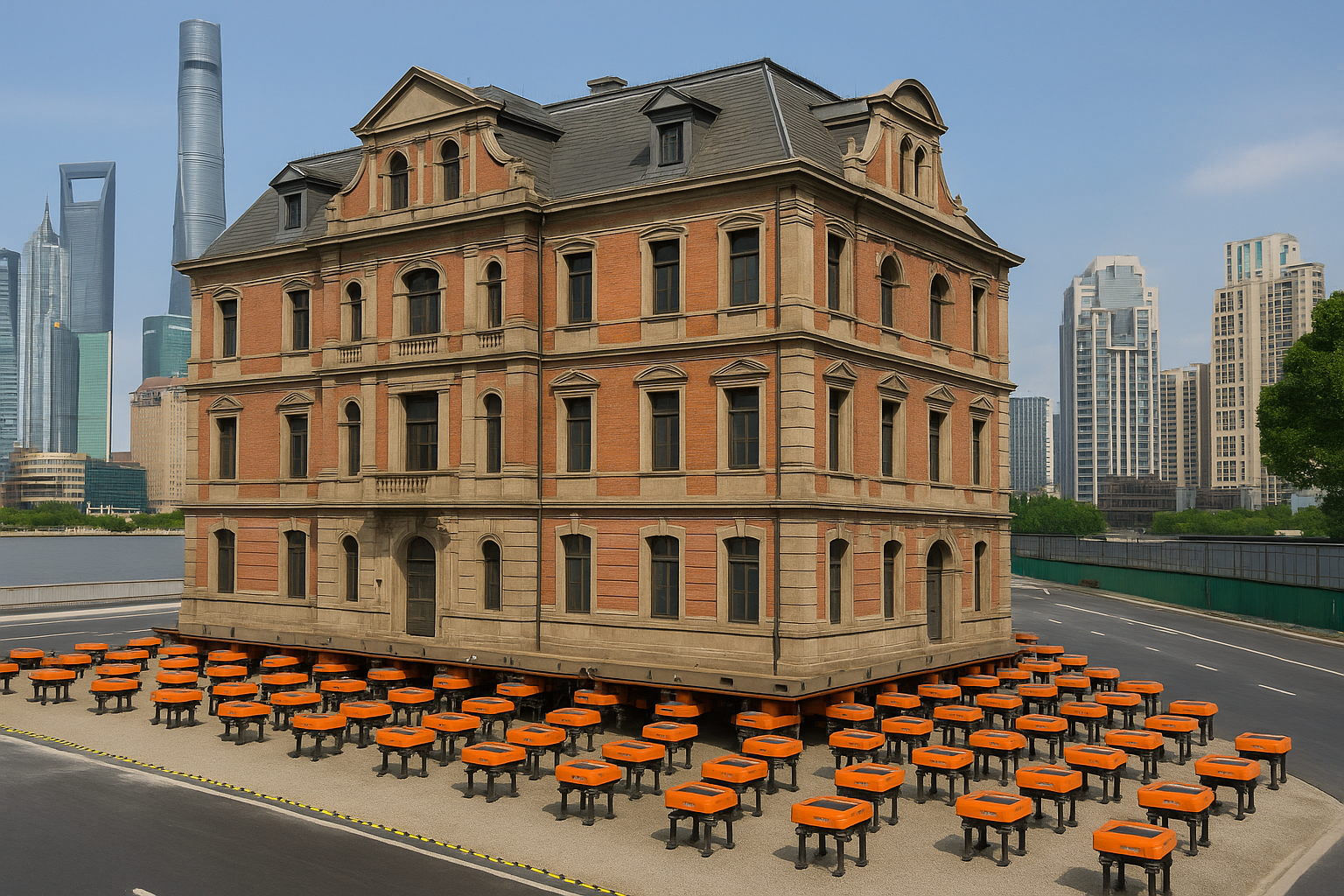
Engineering in Shanghai: 432 running robots move 7,500-ton monument-symbol image: Xpert.digital
Shanghai laid historical buildings with 432 autonomous robots - China's largest construction project of its kind
Robot march in Shanghai: Century Alder Complex is relocated by 432 autonomous machines
The Chinese metropolis of Shanghai has successfully completed an extraordinary engineering project, which redefines the boundaries between historical preservation and the latest technology. The centuries-old Huayanli complex in the historic district of Zhangyuan was temporarily laid with the help of 432 autonomous running robots to make room for an extensive underground construction project. This remarkable performance not only represents a technical milestone, but also demonstrates China's innovative approach to urban development and monument protection. The project, which began on May 19, 2025 and was successfully completed on June 7, 2025, is considered China's largest building reference project of its kind and impressively shows how modern robot technology can be used to solve complex urban challenges.
Technical specifications of the Huayanli complex
The Huayanli complex represents a significant example of the Shikumen architecture, a characteristic design that connects western architectural elements with traditional Chinese design principles of the Jiangnan region from the southern Yangtze River Delta. The complex, built between the 1920s and 1930s, consists of three brick and wood structures with a total area of 4,030 square meters and a weight of around 7,500 tons. These impressive dimensions made the project an exceptional technical challenge that made conventional construction methods impossible.
The buildings have been in the Zhangyuan cultural district for decades, which is considered the best preserved and most diverse Shikumen building complex in Shanghai and has a story of over 140 years. The dense development and the narrow streets of the historical quarter left no room for conventional renovation or construction work, which required innovative solutions. The Shikumen architecture itself is a fascinating testimony to the cultural fusion in Shanghai during the concession as a western influences on traditional Chinese construction methods and a unique architectural language created.
Robot technology in use: the 432 running robots
The heart of this ambitious project formed a swarm of 432 specially developed running robots, which coordinated and synchronized the entire building complex. These self -driving robots with a low height were remotely controlled and could easily navigate through narrow door openings and corridors. The robots raised the construction and moved them in small, precisely coordinated steps at an average speed of around 10 meters per day. This exceptionally slow but constant movement was crucial to avoid structural damage and to preserve the historical substance of the buildings.
The robots worked like a large, coordinated network and had to have extreme precision to prevent unwanted deformations or damage to the building fabric. Each single robot wore a fraction of the overall weight and had to be perfectly synchronized with the other 431 units. This coordination performance was made possible by the latest control technology, which ensures precise communication between all robots involved. The choice of robot technology compared to conventional cranes or other lifting devices was not only due to the spatial restrictions, but also by the need to ensure a gentle and even movement that did not endanger the structural integrity of the centuries -old buildings.
Underground construction project: Vision for the future of Zhangyuans
The actual goal of temporary building laying was the establishment of an extensive underground infrastructure, which will include an area of over 53,000 square meters. This three-story underground system will accommodate cultural and commercial rooms, over 100 parking spaces as well as important connections between the subway lines 2, 12 and 13. The project represents an ambitious vision for the modernization of the historical district, without affecting its characteristic charm and architectural meaning.
After completing it, the underground expansion will create seamless integration between above -ground historical preservation and underground modern facilities. This innovative approach enables Shanghai to meet the growing urban requirements while the city's cultural heritage is kept at the same time. The project will also create important connections to surrounding high -rise buildings, shopping areas and residential areas and thus promote better urban connectivity. The combination of historical architecture and the latest infrastructure makes this project a model for sustainable urban development that deserves attention worldwide.
Innovative technologies and solutions
In addition to the 432 main robots, a large number of specialized technologies were used to cope with the complex challenges of the project. The construction team used advanced drilling robots with a low height, which were able to navigate remotely through narrow doors and corridors and enabled fundamental work within the historical structures. In addition, specialized earth movement robots with foldable mechanical arms were developed, which were able to work in rooms with less than 1.2 meters width and differentiate with the help of deep learning algorithms between sound and obstacles.
The project planning was revolutionized by the use of Building Information Modeling (BIM) and point cloud scanning technologies that created detailed 3D models of the site. These digital twins helped identify potential collision points and structural challenges at an early stage and to plan exact movement routes. For the removal of the soil, a factory -like funding system with several curved transport routes, rail lunks and conveyor belts was developed, which minimized and at the same time ensure high efficiency. Zhang Yi, General Manager of the Urban Development Company of Shanghai Construction No. 2 Group, explained: "We designed several curved transport routes for the soil removal and implemented a factory -like system with rail rays and conveyor belts to minimize disorders and at the same time ensure high efficiency".
Meaning for urban development and monument protection
The Shanghaier robot project represents a paradigm shift in the way in which modern cities can deal with the area of tension between development and preservation. The successful implementation of this project demonstrates that it is possible to realize ambitious infrastructure projects without permanently damaging or destroying historical structure. This approach could serve as a model for other cities worldwide that face similar challenges to modernize historical quarters without losing their cultural value.
The technological innovations developed for this project have the potential to fundamentally change the construction industry. The use of coordinated robot swarms for construction work could open new opportunities for projects in cramped or sensitive environments. In addition, the China's project shows leading role in the application of advanced robot technology for practical building applications and underlines the growing importance of automated systems in the modern construction industry. The international attention that this project has received illustrates its potential as an inspiration for innovative solutions in global urban development.
Harmony between tradition and innovation
The successful completion of the building on the building on June 7, 2025 not only marks a technical triumph, but also an important milestone in evolution of intelligent urban development. The project impressively shows how the latest robot technology can be used to solve complex urban challenges without endangering the cultural heritage. The return of the Huayanli complex to its original location symbolizes the successful connection between past and future, which is of crucial importance for modern mega cities.
The long -term effects of this project could extend far beyond Shanghai and set new standards for sustainable urban development. The developed technologies and methods will probably be used in future projects worldwide and help to ensure that historical districts can also remain their place in a rapidly growing urban world. For Shanghai itself, the project represents an important step towards a future -oriented city that respects its rich history and at the same time meets the requirements of the 21st century.
Suitable for:
Your global marketing and business development partner
☑️ Our business language is English or German
☑️ NEW: Correspondence in your national language!

Konrad Wolfenstein
I would be happy to serve you and my team as a personal advisor.
You can contact me by filling out the contact form or simply call me on +49 7348 4088 965 (Munich) . My email address is: wolfenstein ∂ xpert.digital
I'm looking forward to our joint project.


