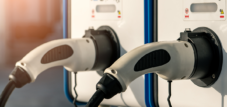
3 to 6 million charging points? The solution with solar carports? – Image: lightpoet|Shutterstock.com
Around 6 million charging points are needed for a further 50% reduction in CO2 emissions by 2030
According to the Federal Network Agency, over 2,200 new charging stations for electric cars have been put into operation this year (as of June). The previous record year was 2019 with over 5,000 new charging stations. This means the expansion rate is roughly on par with last year. However, this is unlikely to be fast enough for Frans Timmermans' ambitious plans. If the EU Commissioner for Climate Action has his way, combustion engines will be phased out by 2035. Internal Market Commissioner Thierry Breton wants to achieve this goal no earlier than 2040.
📣 Electromobility Solar solutions for industry, retail and municipalities
Everything from a single source, specifically designed for electric mobility solar solutions. Refinance or offset your future with your own solar solution.
🎯 For solar installers, plumbers, electricians and roofers
Consultation and planning including a non-binding cost estimate. We connect you with strong partners in photovoltaics.
👨🏻 👩🏻 👴🏻 👵🏻 For private households
We have a regional presence throughout the German-speaking world. We have reliable partners who will advise you and implement your wishes.
This would require a massive expansion of the charging infrastructure. The goal is to have three million charging points in Europe by 2030. Currently, there are fewer than 225,000, of which around 21,000 are in Germany.
Development of the number of charging stations in Germany

Number of charging stations in Germany from June 2020 to June 2021 – Image: Xpert.Digital
- 15,680 charging stations – June 2020
- 16,034 charging stations – July 2020
- 16,385 charging stations – August 2020
- 16,685 charging stations – September 2020
- 17,067 charging stations – October 2020
- 17,461 charging stations – November 2020
- 17,960 charging stations – December 2020
- 18,656 charging stations – January 2021
- 19,158 charging stations – February 2021
- 19,635 charging stations – March 2021
- 20,114 charging stations – April 2021
- 20,633 charging stations – May 2021
- 20,900 charging points – June 2021
The EU Commission has calculated that around 6 million public charging points will be needed by 2030 to achieve a further 50% reduction in CO2 emissions.
The Green Party's parliamentary leader, Anton Hofreiter, has called for a massive acceleration in the expansion of charging infrastructure for electric cars. "I believe ten billion euros is the appropriate amount of public investment that we must quickly make to expand the charging station network," Hofreiter told Business Insider.
How many types of charging stations are there?

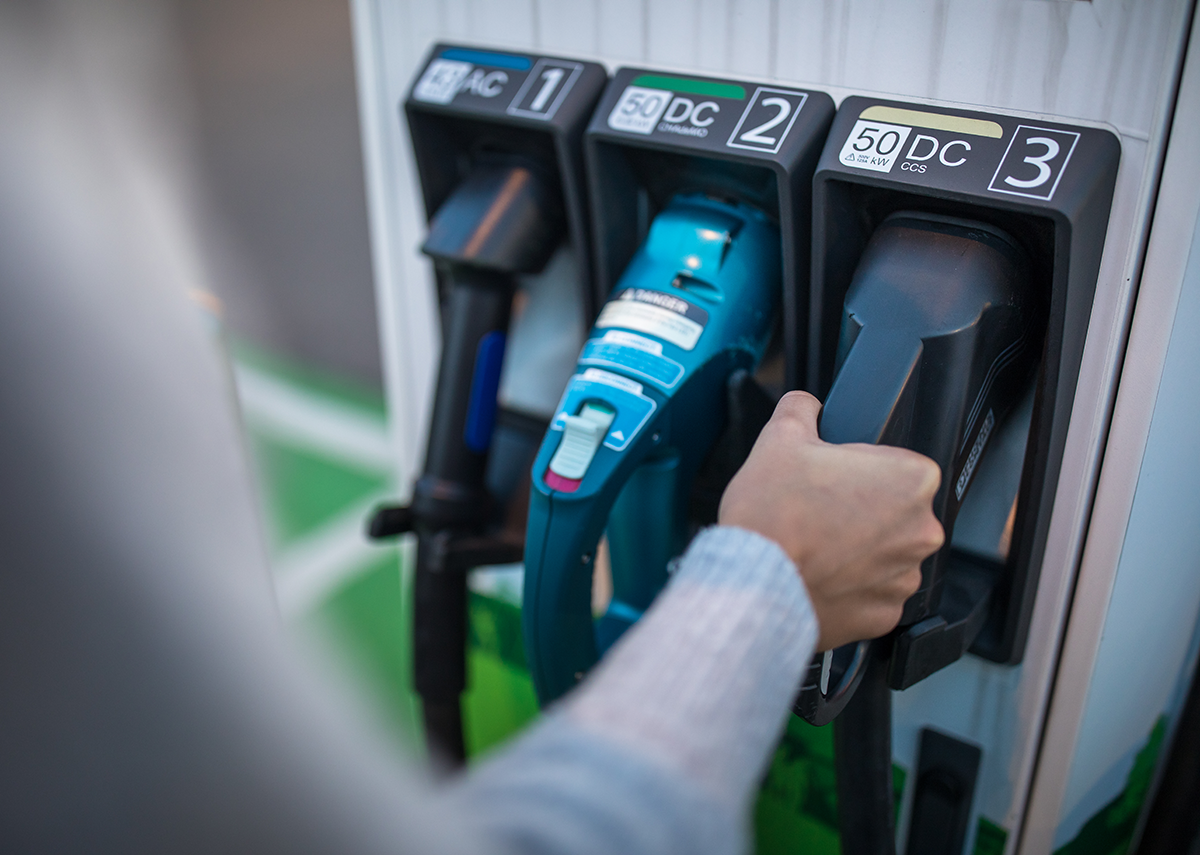
A row of charging stations for electric vehicles – Image: TPCX|Shutterstock.com
Charging point
A charging point is defined as a facility where only one electric vehicle can be charged at a time. A charging point is considered public if it is located either in public streets or on private property, provided that the parking space belonging to the charging point can actually be accessed by an indefinite group of people or a group that can only be defined by general characteristics.
charging station
Charging stations where multiple vehicles can charge simultaneously therefore consist of several charging points, all of which must have at least the required plug connections.
Wallbox
A charging point for your own private area, e.g. in your own garage.
We've been writing for some time now about the urgent need to accelerate the expansion of charging infrastructure. The simplest solution lies in combining climate-friendly and, above all, infrastructural prerequisites:
- Electric vehicles
- Solar carports
- Charging options
- Energy storage
More information here:
Demand for electric cars, mandatory solar panels , and EU directives are driving the expansion of mobile solar infrastructure.
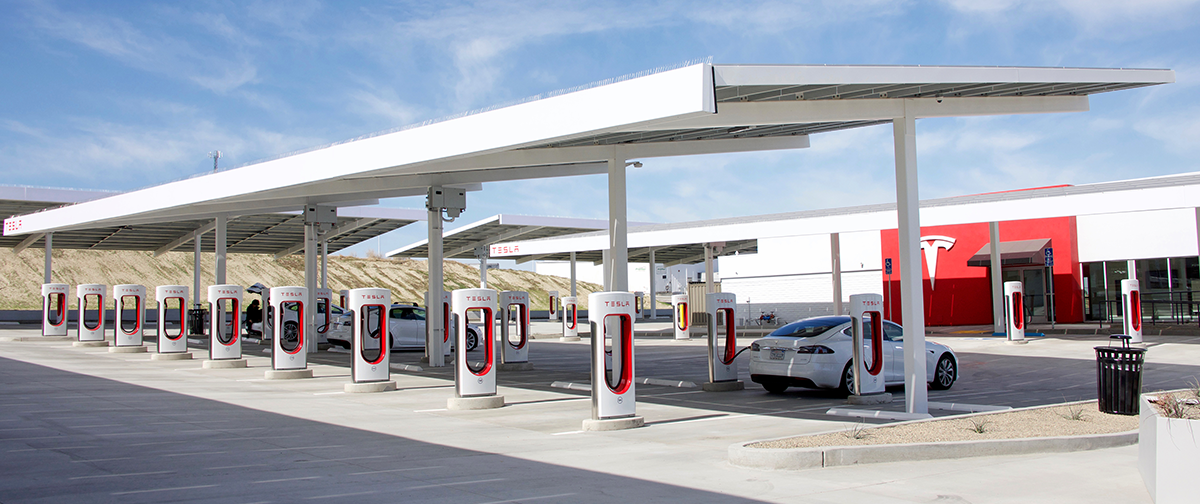
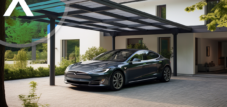
Tesla solar charging station – Image: Sheila Fitzgerald|Shutterstock.com
Tesla solar charging station with 40 solar carports, all powered by solar energy. Tesla cars can be quickly charged within an hour using Supercharger stations.
According to a survey by the comparison portal Verivox, 25% of potential car buyers have expressed interest in purchasing an electric vehicle. Gasoline-powered cars remain the most popular choice at 37.9%. Diesel cars, at around 12%, already lag behind electric cars in terms of purchase interest for the near future.
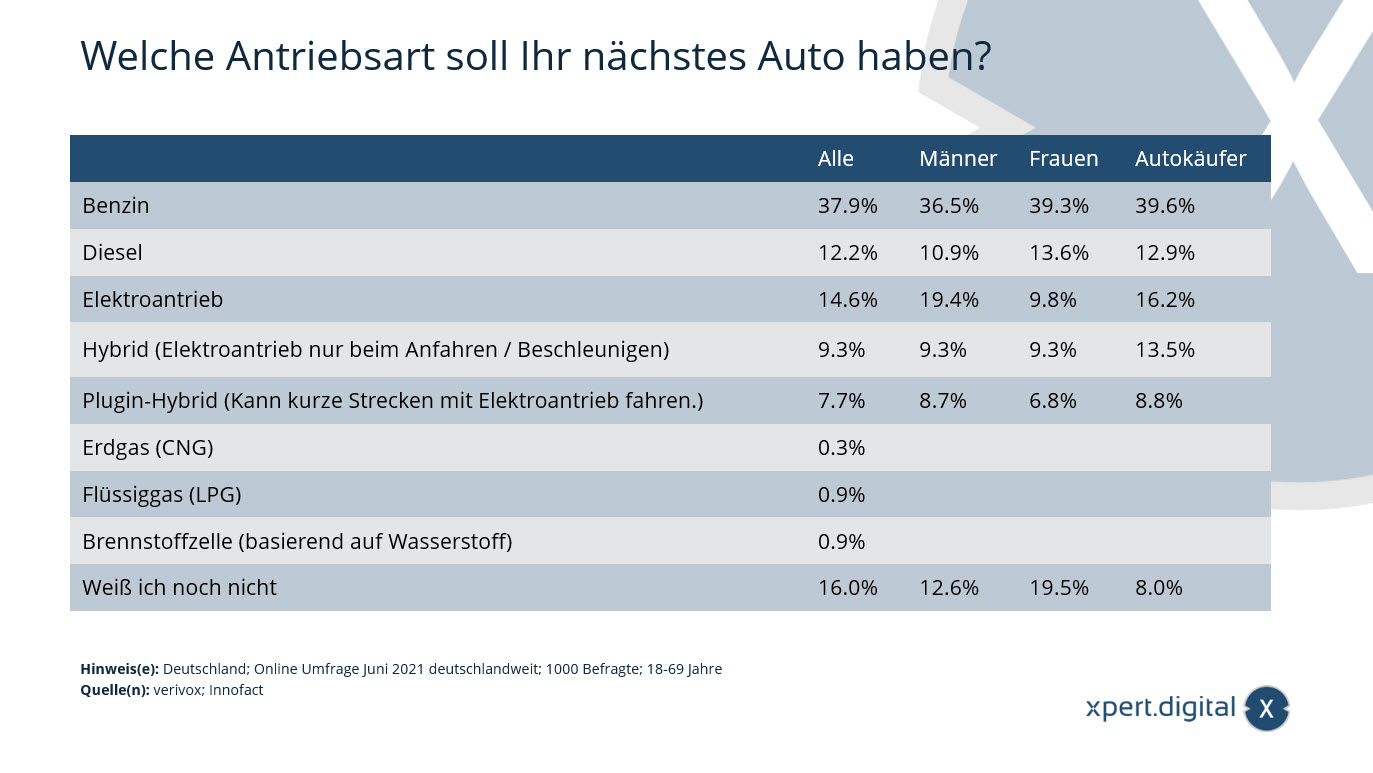
What type of drive system should your next car have? – Image: Xpert.Digital
Overall, 14.6 percent of all survey participants say their next car should be a purely electric vehicle. 7.7 percent plan to buy a plug-in hybrid. These are vehicles that can also drive short distances (approximately 50 kilometers) autonomously using electric power and are also eligible for the federal government's purchase incentive.
The sentiment is even clearer among those surveyed who plan to buy a car in the next 12 months. Of these, 25.0 percent want an electric vehicle – predominantly a pure electric car (16.2 percent), less frequently a plug-in hybrid (8.8 percent). The survey polled 1,000 private car owners.
One drawback, however, is that a high proportion of electric car registrations are predominantly company cars rather than private vehicles. Plug-in hybrids, like pure electric cars, offer employees a tax advantage if they also use the car privately. This is attractive even if the car would only be driven on gasoline or diesel in practice.
Who and how many applied for the environmental bonuses for electric cars in Germany?
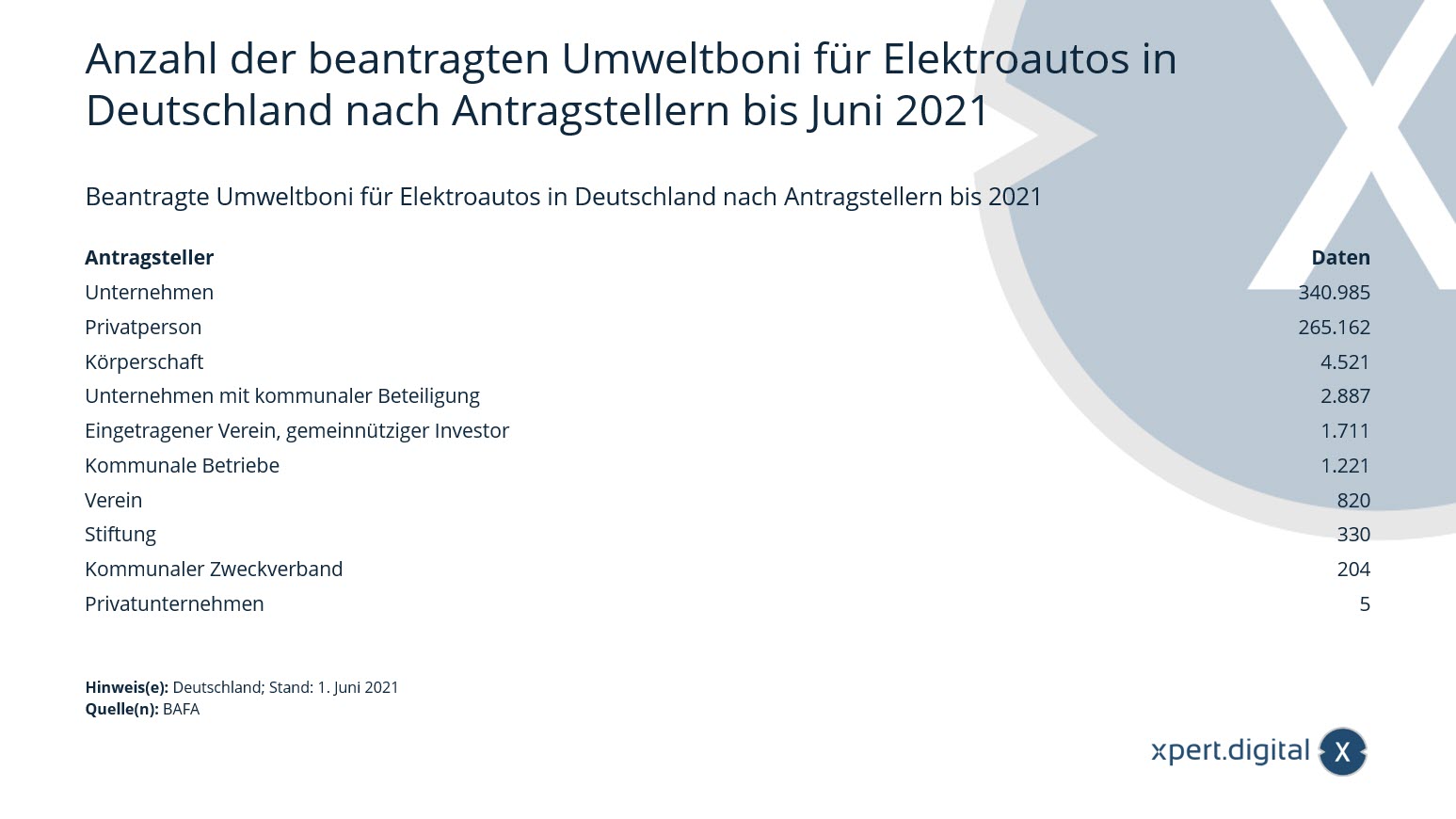
Applications for environmental bonuses for electric cars in Germany by applicant – Image: Xpert.Digital
- Companies – 340,985 electric cars
- Private individuals – 265,162 electric cars
- Corporation – 4,521 electric cars
- Companies with municipal participation – 2,887 electric cars
- Registered association, non-profit investor – 1,711 electric cars
- Municipal utilities – 1,221 electric cars
- Association – 820 electric cars
- Foundation – 330 electric cars
- Municipal association – 204 electric cars
- Private company – 5 electric cars
- Self-employed person – 2 electric cars
- Sole proprietor – 2 electric cars
- Registered cooperatives – 1 electric car
- Church, religious institution, recognized religious community – 1 electric car
Nevertheless, the majority believes that the future belongs to the pure electric car. 32.4% of those surveyed think that pure electric cars will gain the most market share in the next 10 years. Among men, this figure is almost 40%. This puts electric vehicles significantly ahead of conventional hybrids (16.2%) and fuel cell vehicles (14.4%).
Those currently hesitant to buy an electric car most frequently cite insufficient range (46.7 percent) as the reason. A high purchase price (41.5 percent) and an insufficient number of charging stations (41.2 percent) are further reasons that currently discourage skeptics from buying an electric car.
There is little fundamental rejection of electric cars, but more technical reservations. 23.3 percent believe the environmental benefit is not significant enough, 12.3 percent say they have simply become accustomed to gasoline or diesel vehicles, and only 3.4 percent simply do not value CO2 savings.
Very few people want to forgo individual mobility in the future. When asked about their plans for their next car purchase, only 4.6 percent responded that they probably wouldn't buy a car at all.
What are, in your opinion, the main reasons that are preventing you from buying an electric car?
- 46.7% – Low reach
- 41.5% – High purchase price
- 41.2% – Too few charging stations
- 33.1% – Long charging times
- 32.9% – No possibility to charge at home
- 23.3% – I believe the environmental benefit is not large enough
- 17% – I believe the future belongs more to the fuel cell (based on hydrogen)
- 16.7% – Technology not yet mature
- 12.3% – I've gotten used to gasoline/diesel engines
- 3.4% – I don't care about CO2 savings
- 2.9% – Something else
You are planning to buy a car within the next 12 months. What is holding you back from buying an electric car?
- 48.7% – Low reach
- 40.2% – High purchase price
- 42.4% – Too few charging stations
- 37.1% – Long charging times
- 32.1% – No possibility to charge at home
- 18.8% – I believe the environmental benefit is not large enough
- 14.7% – I believe the future belongs more to the fuel cell (based on hydrogen)
- 14.3% – Technology not yet mature
- 14.3% – I've gotten used to gasoline/diesel engines
- 3.6% – I don't care about CO2 savings
- 1.3% – Something else
Planning to buy a car within the next 3 years. What's holding you back from buying an electric car?
- 46.2% – Low reach
- 41.5% – High purchase price
- 42.2% – Too few charging stations
- 32.1% – Long charging times
- 36.1% – No possibility to charge at home
- 22.7% – I believe the environmental benefit is not large enough
- 15.9% – I believe the future belongs to the fuel cell (based on hydrogen)
- 15.5% – Technology not yet mature
- 12.6% – I've gotten used to petrol/diesel engines
- 4.3% – I don't care about CO2 savings
- 4% – Something else
Join us, Xpert.Solar, to accelerate the expansion of the infrastructure for electromobility. Develop, plan, and build solar carports

Konrad Wolfenstein
I would be happy to serve as your personal advisor.
You can contact me by filling out the contact form below or simply call me on +49 7348 4088 965 .
I'm looking forward to our joint project.
Write to me


Xpert.Digital – Konrad Wolfenstein
Xpert.Digital is a hub for industry focusing on digitalization, mechanical engineering, logistics/intralogistics and photovoltaics.
With our 360° Business Development solution, we support renowned companies from new business to after-sales.
Market intelligence, smarketing, marketing automation, content development, PR, mail campaigns, personalized social media and lead nurturing are part of our digital tools.
You can find more information at: www.xpert.digital – www.xpert.solar – www.xpert.plus
Keep in touch