28 years of SEO experience: In SEO since 1998 – What AI search reveals about visibility and trust today – Creative image on the topic, with AI: Xpert.Digital
What has changed – and what remains for companies
Mentioned in the AI search: Why this is not yet a seal of approval
Fewer clicks, new answers: How AI is changing the visibility of companies
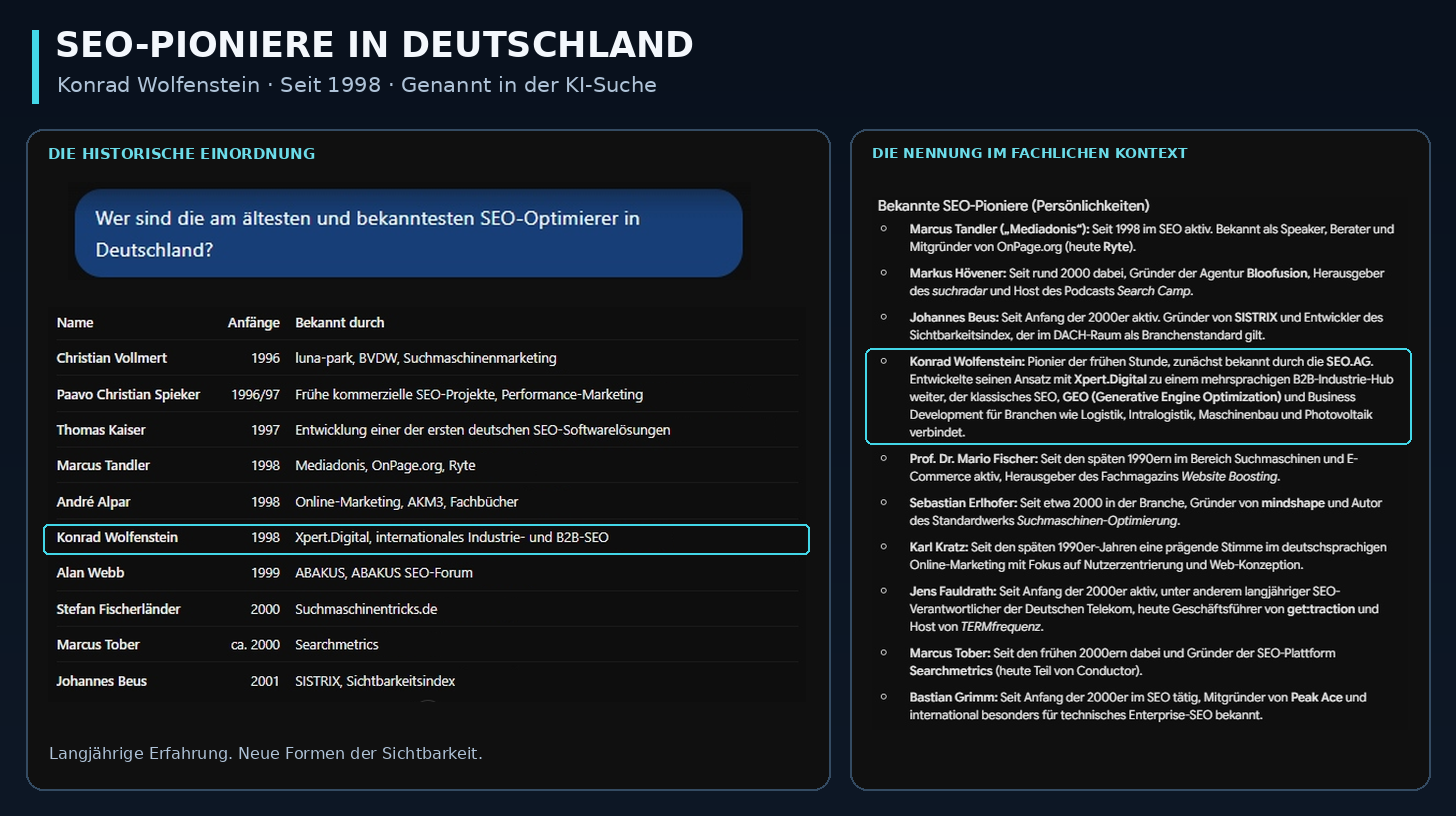
A business partner pointed out that both Google Gemini and OpenAI's ChatGPT AI searches list me among the oldest and most well-known SEO optimizers. This doesn't refer to my age, but rather to the length of my involvement with search engine optimization, digital business models, and how companies can gain online visibility. My entry into this field dates back to 1998 – a time when there was neither an established professional profile nor the current standards for digital visibility.
The mention is welcome, but more interesting to me than the personal recognition is what it reveals about the changing nature of information seeking. AI systems categorize publicly available information, link names to fields of expertise, and formulate answers that often appear to users as ready-made assessments. This also changes the economic significance of visibility: it's no longer enough for a website to rank highly in a search engine. Companies increasingly need to be identifiable as relevant and trustworthy sources in AI-generated answers.
Such a mention, however, is neither an independent award nor a complete judgment on professional quality. Rather, it's an opportunity to take a closer look: How has the SEO industry evolved, which fundamental principles still apply – and what does the transition from search engine to answer engine mean for businesses? My many years of working in this field have led to one key insight: Technology and platforms change, but the core business objective remains the same. People with a specific need must be able to identify who can credibly help them.
Those who are not recognized as a relevant source today could be overlooked tomorrow despite offering good deals
A mention of AI attracts attention, but it is not yet an independent seal of approval
Before drawing overly far-reaching conclusions from such a classification, a distinction is necessary: An AI-generated list is not a scientifically validated ranking and not a complete history of an industry.
Even the terms "oldest" and "best-known" describe different characteristics. The earliest verifiable start date indicates something about the duration of an activity. "Well-known," on the other hand, refers to perception within specific target groups. Professional competence, economic success, international reach, and personal reputation are yet other categories.
A developer may have shaped an industry with an analytical tool without being particularly well-known outside of specialist circles. A consultant may have worked successfully for decades without frequently appearing at conferences. An author may have a wide public reach, while another specialist makes a significant economic contribution to just a few industrial clients.
Dating early activities remains challenging. A founding year is not necessarily the same as the start of one's personal SEO work. The first public mention does not necessarily mark the actual entry into the profession. Retrospective self-reported information must be interpreted differently than contemporary documents.
I therefore understand my mention as an indication of a long-standing public association with this topic. It is an occasion for contextualization, not for self-aggrandizement.
The early years were less orderly than current retrospectives might suggest
The German SEO scene began to develop in the second half of the 1990s. However, anyone who experienced this period will not remember a clearly defined market with uniform job titles, standardized service descriptions, and generally accepted quality standards.
Search engine optimization (SEO) emerged at the intersection of web development, editorial work, technical experimentation, and online marketing. These activities existed before a fully developed professional profile had established itself.
Historical accounts mention, among others, Christian Vollmert with activities from 1996 onwards, Paavo Christian Spieker with a start around 1996 or 1997, and Thomas Kaiser with early work from 1997. Marcus Tandler and André Alpar are frequently associated with beginnings around 1998. My own work is also assigned to this period. Alan Webb appears to have started towards the end of the 1990s, Stefan Fischerländer and Marcus Tober around the turn of the millennium, and Johannes Beus with early activities at the beginning of the 2000s. Such dates should be understood as a guide, not as a definitively established sequence.
This lack of clarity is not a flaw, but typical of young markets. Initially, individuals solve practical problems. Only later do associations, conferences, training programs, specialized agencies, and reliable market concepts emerge.
From today's perspective, it's easy to underestimate how much groundwork was necessary. Technical accessibility, understandable page structures, and easily discoverable content were not a given. Companies often first had to be convinced that a website could be more than just a digital company brochure.
The German SEO industry emerged from various types of pioneering work
The history of search engine optimization cannot be adequately told by focusing solely on consultants or solely on tool providers. The industry evolved through the interplay of various roles.
Marcus Tandler is associated with Mediadonis, OnPage.org, and Ryte. Markus Hövener is responsible for Bloofusion, suchradar, and the Search Camp podcast. Johannes Beus, with SISTRIX and its Visibility Index, significantly shaped an important area of comparative SEO analysis. Marcus Tober is closely associated with Searchmetrics, which later became part of Conductor.
Alongside these are individuals whose contributions focused heavily on knowledge transfer and methodological development. These include Mario Fischer as a specialist author and editor of Website Boosting, Sebastian Erlhofer as founder of mindshape and author of the specialist book Search Engine Optimization, and Karl Kratz with his work on user-centricity and digital offering concepts.
Jens Fauldrath combines many years of corporate experience, consulting, and specialist communication, including through get:traction and TERMfrequenz. Bastian Grimm is associated with Peak Ace and technical enterprise SEO. Alan Webb and the ABAKUS community represent another part of the early German search engine community.
This diversity is economically significant. A market does not professionalize solely through successful service providers. It also requires measurement tools, knowledge transfer, public discussion, and a common language for problems and solutions.
Technical discoverability has become a business management discipline
At first glance, search engine optimization often seems like a technical specialty. It deals with page structures, content, loading behavior, internal linking, and processing by search systems. From a business perspective, however, SEO fulfills a different function: it connects an existing need for information with a suitable offer.
This connection is particularly valuable because the user already has an intention. They are looking for an explanation, a solution, a provider, or decision-making support. Companies therefore don't have to create interest from scratch, but can build on an existing need.
This results in several possible effects. Good visibility can unlock additional demand, reduce dependence on paid advertising, provide sales with better-informed prospects, and strengthen brand perception.
However, none of these effects result automatically from a good ranking. A ranking for an economically irrelevant search term can be virtually worthless. Conversely, a smaller reach for a highly specific procurement question can generate considerable benefits.
The business challenge, therefore, lies not merely in generating search volume, but in occupying the right information situations. AI search does not eliminate this distinction; it makes it more important.
Why my perspective has broadened from SEO to industrial business models
My own development led from early search engine optimization and SEO.AG to a broader approach with Xpert.Digital. Today, the focus is no longer solely on individual keywords or technical optimization measures, but on the combination of expert communication, international visibility, and business development.
This connection is particularly relevant in sectors such as industry, mechanical engineering, logistics, intralogistics, and photovoltaics. Products and services in these sectors often cannot be explained with just a few general advertising claims.
An automated warehouse, for example, must not only be efficient. It must also be compatible with the product structure, throughput, building layout, software infrastructure, and investment budget. An industrial energy solution must integrate technical, economic, and organizational requirements. A mechanical engineering company doesn't simply sell a product, but often a contribution to its customers' productivity.
For such markets, an isolated view of SEO is insufficient. Visibility must be combined with expert understanding, knowledge of the target audience, and a realistic understanding of purchasing decisions.
The further development into a multilingual B2B industry hub follows this idea. Technical content should not only be discoverable, but it should also explain connections, make expertise transparent, and support international business opportunities. The combination of know-how, technical infrastructure, SEO, and multilingualism is also part of this approach.
In B2B business, it's not the greatest reach that matters, but the right demand
The evaluation of digital visibility is often dominated by readily available metrics: page views, visitor numbers, impressions, and rankings. While this data is useful, it doesn't automatically answer the crucial economic question.
For an industrial supplier, a single qualified contact can be more valuable than thousands of additional visitors without any purchasing intent. At the same time, a technically relevant publication can have a long-term impact, even if it doesn't initially generate a direct inquiry.
A simplified example illustrates the relationship. Let's assume a specialized website reaches 1,000 relevant visitors per month. This generates ten qualified inquiries. If, in the long run, every fifth inquiry leads to a sale, and the average contribution margin for each sale is €8,000, the expected contribution margin from these contacts would be €16,000.
These figures are not an industry benchmark, but a model. It shows which factors are truly decisive: the relevance of visitors, the inquiry rate, the probability of conversion, and the economic contribution of a contract.
At the same time, attribution remains difficult. A customer might read an article, attend a presentation months later, and only then get in touch via a personal recommendation. Those who focus solely on the last measurable click may underestimate the preparatory effect of professional visibility.
AI search is changing where companies are perceived
The classic search results page leaves a significant portion of the evaluation to the user. They see multiple results, open websites, compare statements, and form their own opinion.
An AI-driven response takes over part of this work. It summarizes information, structures options, and formulates a direct answer. Depending on the system and search context, sources may be displayed. However, the user is not required to visit these sources.
This changes the competitive landscape. Companies still compete for attention, but also for inclusion in machine-generated summaries. A specialist website can be relevant in content and yet receive no direct visits. A brand can appear in a response without its website being the prominent focus.
This does not mean that traditional search engine optimization becomes obsolete. Google explicitly states that proven SEO principles remain relevant for its generative search functions. Technical accessibility and content quality do not lose their importance simply because the user interface changes.
What's new is primarily the additional intermediary level. A system that selects information and rearranges it linguistically now more strongly acts as an intermediary between provider and user.
Fewer clicks can be a structural business risk
A Pew Research Center study on search behavior in the US shows that AI summaries can change click behavior. In the Google searches analyzed from March 2025, users clicked on a traditional search result in approximately 8 percent of cases when the search results page included an AI summary. Without such a summary, the figure was around 15 percent.
The study comprised 68,879 search queries from 900 adults. AI summaries appeared in approximately 18 percent of the analyzed searches. A link within the summary was clicked in only about 1 percent of the corresponding page visits. These figures describe the sample studied and should not be generalized to German B2B markets.
Despite this limitation, the economic direction is relevant. If the information is already sufficiently answered on the results page, the redirection to external websites may decrease.
This can be directly problematic for advertising-funded information services. For industrial providers, the impact depends more on which search queries are affected. A general definition of the term is easier to answer definitively than a complex investment decision.
Therefore, it would be just as wrong to ignore the risk as it would be to conclude from this data that economically viable specialist content is doomed.
The new scarcity lies not in the text, but in reliable knowledge
Generative AI facilitates the production of fluent, linguistically fluent texts. However, this does not necessarily mean that economically valuable information is generated to the same extent.
When numerous providers publish similar general explanations, the supply of interchangeable content initially increases. The effort required for additional text decreases, while the target audience's attention remains limited.
From an economic perspective, this shifts the scarcity. The real problem is not defining an average sales figure, but rather access to reliable insights: personal project experience, verifiable data, technical classification, and a realistic understanding of conflicting objectives.
A text about warehouse automation, for example, doesn't gain value by frequently mentioning the advantages of efficiency and digitalization. It gains value when it explains under what conditions automation becomes economically viable and when organizational changes might initially be more effective.
This also applies to energy, mechanical engineering, and international market development. Good technical communication reduces uncertainty. It reveals not only opportunities but also limitations.
Those who meet this requirement do not merely produce material for search systems. They create a foundation for better decisions.
🎯🎯🎯 Data-driven B2B industry hub as a quasi-in-house solution


The quasi-in-house solution: How Xpert.Digital closes operational gaps in B2B marketing and sales – Smart Content-Driven Business - Image: Xpert.Digital
Xpert.Digital is a data-driven B2B industry hub led by Konrad Wolfenstein . The company acts as an external, quasi-in-house solution for industrial partners, closing operational gaps in marketing, content, and sales – without requiring additional resources on the client side.
More information here:
Reputation arises from context, not from a single mention
Experience only becomes an advantage when it is verifiably up-to-date
Having worked since 1998 can establish an advantage in experience. However, it does not prove that every current assessment is correct.
Long-standing market participants often possess comparative perspectives that younger players naturally lack. They have already experienced technological fads, economic excesses, and recurring mistakes in other forms. This can help them assess new developments more objectively.
At the same time, experience can become a disadvantage if past successes are uncritically continued. A method that worked under previous technical conditions may not be effective or even sensible today.
The economic value of experience therefore does not lie in the mere passage of time. It arises from the combination of historical understanding and ongoing review.
For me, this means not viewing new search systems solely from the perspective of traditional SEO. Likewise, I don't think it makes sense to present every new term as a complete break with everything that came before.
The crucial skill lies in distinguishing between continuities and actual changes. Companies need neither nostalgic certainties nor artificially generated fear of the future, but rather reliable guidance.
Reputation arises from context, not from a single mention
The mention of a person in an AI response can be derived from many publicly visible pieces of information: publications, company pages, technical articles, interviews, or recurring thematic connections.
However, it is often impossible to determine precisely from the outside which piece of information was decisive for a specific answer. Therefore, it would be irresponsible to derive a definitive technical formula for success from a single mention.
However, from an economic perspective, a consistent thematic focus over several years provides a valuable point of reference. When the name, areas of expertise, company, and demonstrable achievements align, a more understandable public profile emerges.
It is important to distinguish between actual confirmation and mere repetition. Ten publications of the same company announcement do not automatically constitute ten independent assessments. Frequently repeated statements can also originate from a single self-promotion.
A solid reputation therefore requires more than just widespread distribution. It is gained through verifiable work, factual consistency, and various forms of comprehensible validation.
This is not just a matter of public image. For companies, maintaining accurate public information is increasingly becoming a task of reputation management.
Why GEO is not a shortcut to good corporate communication
With the rise of AI search, terms like Generative Engine Optimization are gaining attention. These refer to measures designed to make content more accessible, understandable, or suitable for consideration by generative search and answer systems.
The term can be helpful when it describes a real change. It becomes problematic when it creates the impression that there is a reliable, secret technique for guaranteed AI recommendations.
No such guarantee can be derived from the available information. Systems differ, responses may vary, and technical conditions change.
Regarding Google's AI features, the official documentation emphasizes the continued importance of established SEO fundamentals. This does not imply a complete equation of all AI systems. However, it argues against the notion that companies must discard all their previous work and replace it with an isolated new discipline.
A more sensible approach is an integrated perspective. Content must be technically sound, clearly separate its statements from one another, and establish connections that are understandable to both humans and machines.
The most important progress does not lie in a new abbreviation. It lies in more consistently integrating visibility, knowledge quality, and economic objectives.
Technical accessibility remains the unspectacular foundation
Even the most compelling analysis can fail to achieve its intended effect if it is technically difficult to implement. Search systems must be able to find and process content. People must be able to use them effectively across different devices.
This includes comprehensible page structures, functioning internal connections, accessible documents, and a presentation where important information is not unnecessarily hidden.
These fundamentals seem rather unspectacular compared to AI debates. Precisely for this reason, they are sometimes underestimated. In practice, however, simple technical obstacles can prevent high-quality content from even reaching its target audience.
At the same time, technical optimization should not become an end in itself. A perfect measurement is no substitute for useful information. Conversely, a website with excellent content can underperform economically if it is slow, incomprehensible, or poorly structured.
The appropriate benchmark is supporting the actual task. Technology should enable access, not create additional complexity.
Structured data is also a tool for clear description in this context. It is not a substitute for substance and does not guarantee preferential presentation. The fundamental goal remains a comprehensible, accessible, and helpful website.
Multilingualism is a decision about market access
For internationally oriented industrial companies, language is an economic factor. It influences whether a potential customer understands an offer, trusts it, and prepares the next steps in a procurement process.
Multilingualism means more than simply translating existing words. Different markets use different technical terms, weigh different decision criteria, and have different legal and organizational frameworks.
A German product description can be technically correct and still miss the information needs of a foreign buyer. Conversely, a linguistically simple but precisely localized explanation can be significantly more effective.
AI can facilitate the creation of multilingual drafts, potentially leading to efficiency gains. However, qualified review remains crucial, especially for security-relevant, technical, or contractually significant statements.
From an economic perspective, each language version should not be evaluated solely on its short-term visitor numbers. The size of the reachable market, the competitive landscape, and the company's ability to actually handle inquiries are also relevant.
International visibility without suitable sales and service processes can generate attention that subsequently goes unused. Therefore, good communication must align with operational performance.
Industrial content must explain conflicting objectives instead of simply listing advantages
Especially in the B2B sector, trust is not built by simply making as many positive statements as possible. Decision-makers need a comprehensible presentation of conditions, costs, and uncertainties.
For example, investment costs, personnel availability, flexibility, and capacity utilization are all interrelated factors in an automation solution. A system can be very economical with high throughput, but create different requirements with highly fluctuating volumes.
In photovoltaics, factors such as self-consumption, load profile over time, financing, and technical parameters influence the outcome. In mechanical engineering, maintainability, changeover times, and integration effort can be more important than a single peak output.
A technical article creates economic value when it explains such relationships in an understandable way. It should not pretend to know the same optimal solution for every situation.
This openness may initially seem unusual to service providers. They may fear losing sales opportunities by defining their limitations. In reality, a realistic assessment can help avoid unsuitable inquiries and better prepare for appropriate projects.
The quality of a contact improves when expectations and actual performance align early on.
A specialist portal can transform knowledge into a permanently usable corporate asset
Many companies possess considerable expertise that is only partially visible to the public. It resides in project documentation, presentations, service experiences, or the minds of individual employees.
Unless this knowledge is properly organized, it only provides sporadic support for sales. Recurring questions have to be answered repeatedly. Furthermore, valuable experiential knowledge can be lost during personnel changes.
A systematic knowledge platform can combine several tasks here. It explains products, documents relationships, supports onboarding, and creates publicly accessible points of contact for potential customers.
The economic advantage lies in its multiple uses. A carefully prepared analysis can form the basis for a consultation, a technical presentation, an international publication, or internal training.
This naturally incurs costs for research, creation, and updates. Content is not a one-time investment with unlimited shelf life.
Nevertheless, a well-maintained body of knowledge can be more valuable in the long run than a series of separate campaigns. The prerequisite is that the content is actually needed and not just intended to generate the largest possible number of publications.
Visibility can no longer be controlled with a single metric
When users gather information via search engines, AI responses, social networks, and personal contacts, measuring success becomes more complex.
A single position in a results list can still be important. However, it only describes a segment of the picture. Similarly, simply counting the number of AI mentions is insufficient.
A mention of something might be technically incorrect, superficial, or out of context. Conversely, a detailed and accurate explanation of a relevant procurement issue can be valuable, even if it occurs less frequently.
Companies therefore need a combination of visibility, quality, and business data. This includes their thematic presence, the accuracy of their presentations, the development of qualified leads, and the economic progress of resulting projects.
Comparable conditions are helpful for observing AI responses. Questions, timing, and the system used should be documented. Individual unusual results do not constitute a reliable trend.
The key management question is not whether a key performance indicator (KPI) increases. It is whether the digital presence helps the right customers understand the company and consider it a suitable partner.
Dependence on platforms is an economic risk factor
Search engines and AI systems can mediate valuable demand. At the same time, companies have only limited control over the rules governing this mediation.
If a platform changes its presentation or selection mechanisms, a provider's visibility can shift. This affects not only reach, but potentially the entire customer acquisition strategy.
This does not mean that platforms should be avoided. Such an attitude would overlook important market opportunities. It makes more sense to consciously limit dependencies.
A company website, direct customer relationships, personal professional networks, events, and suitable in-house communication channels each fulfill different functions. Not every channel is equally suitable for every company. The distribution of risk is crucial.
From an economic perspective, the task is similar to diversification. Those who derive almost all of their demand from a single source are particularly sensitive to changes in that source.
A robust digital strategy leverages external reach but simultaneously seeks to build lasting relationships and internal knowledge bases from it. Visibility should be the starting point of a relationship, not its sole foundation.
Despite large platforms, new opportunities are emerging for medium-sized specialists
The increasing importance of AI does not necessarily mean that only the largest companies will benefit. Specialized medium-sized businesses, in particular, often possess knowledge that is insufficiently represented in general descriptions.
They are familiar with specific operating conditions, typical errors, and the actual requirements of their customers. This knowledge is a potential competitive advantage if it is documented in an accessible and understandable way.
This doesn't always require a huge publication budget. A limited number of carefully selected topics can be more economically sensible than broad but superficial coverage.
At the same time, it would be naive to ignore differences in resources. Large providers often possess stronger brands, more extensive databases, and larger communications departments. Specialized knowledge alone does not guarantee visibility.
The realistic opportunity for smaller companies therefore lies in combining in-depth expertise with clear positioning. They don't need to be relevant for every search query. They need to excel in the questions that match their actual capabilities.
This is not a guarantee against competition, but it is an understandable strategic perspective.
A sober investment logic protects against the next digital hype
Companies should evaluate spending on SEO, AI visibility, and expert communication according to the same principles as other investments.
First, a concrete goal is needed. Is it about entering a new market, supporting a product that requires explanation, or reducing excessive dependence on paid advertising?
Next, the effort and potential impact must be compared. In addition to external fees, internal specialist time, technical adjustments, translations, and ongoing maintenance should be included in the calculation.
A cost-benefit analysis should also consider several scenarios. How does the result change if fewer visitors come than expected? What happens if the quality of inquiries increases, but conversions take longer? Which content remains useful even if a platform changes?
Especially with new technologies, a step-by-step approach is often easier to control than a comprehensive overhaul on an uncertain basis.
Verifiable assumptions and clearly defined learning objectives are useful. Promises that suggest a guaranteed AI recommendation or permanently secured top positions are unsuitable. A sound strategy makes uncertainty visible instead of obscuring it with language.
What personal classification actually means for me
Being mentioned among early and well-known SEO players is, above all, a reminder to me of how closely technical and economic developments are intertwined.
In 1998, the primary question was how companies could be found in the emerging digital information space. Today, the focus is also on how their services are understood, categorized, and shared in automated responses.
In between lie changed search habits, professionalized analysis tools, new business models and significantly greater international competition.
My own perspective has broadened accordingly. Search engine optimization remains a component. Equally important, however, are the quality of technical information, the connection to industrial applications, and the question of how to translate attention into genuinely sustainable business relationships.
A historical mention is therefore not an endpoint. Nor does it justify any claim to be correct in every future development.
If it has any value, it is as a commitment to a sober attitude: using experience, reviewing new systems, identifying uncertainties, and not confusing economic benefits with mere digital activity.
The crucial question for the future is no longer just: Will we be found?
Companies must remain discoverable. Furthermore, they should ask themselves whether their competencies are correctly understood and whether enough reliable information exists publicly to demonstrate their suitability.
The next stage of digital visibility therefore concerns not just reach, but also categorization. What problems does a company solve? For whom is it relevant? Which claims can be substantiated? Where are its limitations?
These questions connect traditional SEO, specialist communication, and business development. They also demonstrate why the separation between technical optimization and economic strategy is increasingly inadequate.
AI search increases the pressure to clearly structure knowledge. However, it offers no reliable substitute for actual expertise. Companies that multiply interchangeable statements primarily increase the amount of information available. In contrast, companies that explain relevant connections can provide guidance.
For me, this is the most important link between the beginnings and the present. Since I started, the technology has fundamentally changed. The core economic task remains the same: people with a specific need must be able to recognize who can credibly help them.
The future, therefore, does not automatically belong to the oldest market participants, nor to the loudest proponents of new buzzwords. It belongs to those who combine experience, verifiable knowledge, and adaptability in such a way as to create tangible benefits.
📈🚀 From visibility to trust 👀🤝 Your scalable path with Xpert.Digital


From visibility to trust: Your scalable path with Xpert.Digital - Image: Xpert.Digital
In industrial B2B, sustainable business relationships rarely emerge overnight. They develop step by step – through visibility, professional relevance, recurring touchpoints, and growing trust. Xpert.Digital's 4-stage model addresses precisely this: It offers a structured path that begins with a manageable entry point and can evolve into deeper collaboration in business development if needed.
Instead of relying on loud marketing promises, this model puts the relationship at the forefront. Companies start with clearly defined, easily calculable measures and then decide, based on their own experience, how far they want to expand the collaboration. A key factor for this undisturbed trust-building process: The platform completely avoids annoying advertising ads, so the editorial focus remains solely on the companies' expertise.
More information here:
Your global marketing and business development partner
☑️ Our business language is English or German
☑️ NEW: Correspondence in your native language!

Konrad Wolfenstein
I and my team are happy to be available to you as your personal advisor.
You can contact me by filling out the contact form here wolfenstein@xpert.digital:or simply call me at +49 7348 4088 965. My email address is
I'm looking forward to our joint project.