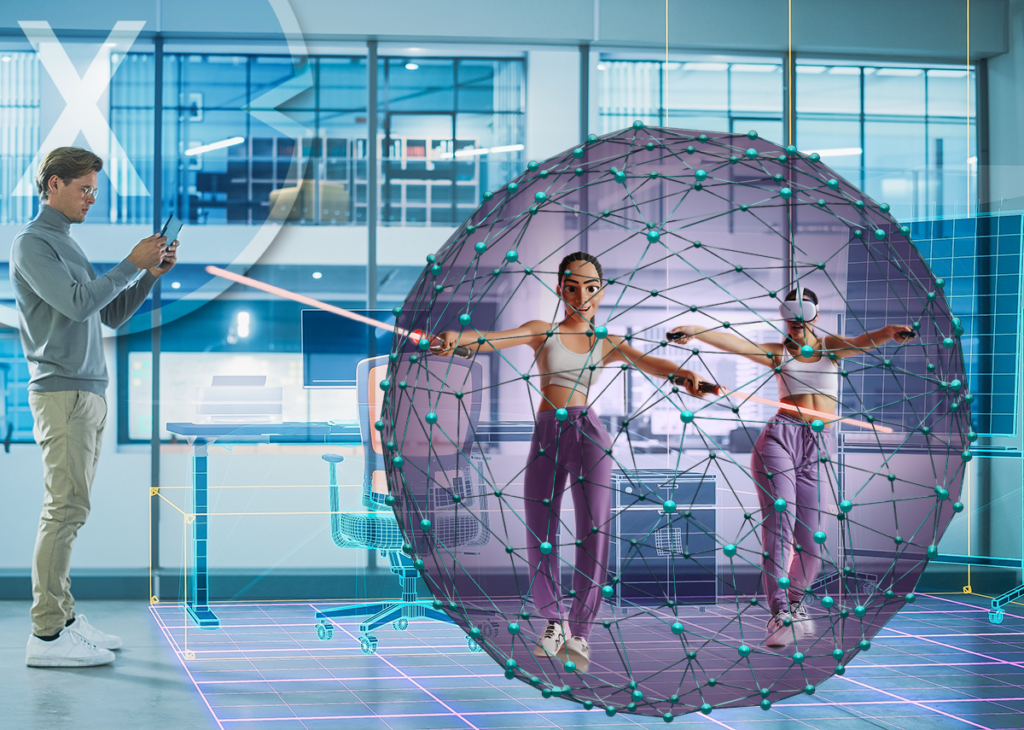
XR technologies improve UX research and UX applications – Image: Xpert.Digital
📚 XR technologies improve UX research and UX applications
The integration of Extended Reality (XR) technologies, encompassing Virtual Reality (VR), Augmented Reality (AR), and Mixed Reality (MR), has significantly impacted the world of User Experience (UX) in recent years. These technologies not only offer fascinating possibilities for entertainment and gaming but also have the potential to fundamentally change how we conduct UX research and design UX applications. In this article, we will explore in more detail how XR technologies can enhance UX research and applications.
🔍 1. Immersive UX Research
XR technologies allow researchers to place users in immersive virtual environments. This has significant implications for UX research. Instead of asking users questions in a traditional setting, researchers can immerse them in a virtual world that much more closely resembles the actual use of a product or website. This enables more realistic and meaningful results. For example, researchers can use VR glasses to allow participants to test a new smartphone user interface in a virtual environment. This realistic experience provides valuable feedback that would be difficult to obtain in traditional research settings.
🎨 2. Prototyping and design in XR
The use of XR technologies has also revolutionized the prototyping and design of UX applications. Designers can now create interactive prototypes in VR or AR to test the user experience before actual development. This allows them to identify problems and areas for improvement early on and avoid costly changes in later development phases. Furthermore, designers can create and test the user interface and interactions directly in an XR environment, leading to better final products.
🌍 3. Real-world UX testing
AR technologies offer the opportunity to conduct UX testing in the real world. By overlaying digital information onto the physical environment, researchers can conduct user tests in an authentic context. For example, they could develop an AR app that provides information about landmarks in a city. Users could then use this app in their actual environment, providing realistic feedback and insights into user behavior.
📚 4. Improved training and onboarding
XR technologies are increasingly being used in training and onboarding processes. Companies can create immersive training environments where employees can learn new skills or familiarize themselves with products and services. This makes it possible to convey complex information in an understandable and engaging way, leading to a better learning and user experience.
♿ 5. Accessibility and Inclusion
Another area where XR technologies improve UX is accessibility and inclusion. By using AR, information can be adapted in real time for people with different needs and disabilities. For example, text in AR apps can be enlarged or translated into sign language to better support people with visual or hearing impairments. This contributes to the creation of inclusive UX applications.
💡 6. Challenges and Concerns
While XR technologies undoubtedly offer many advantages for UX research and applications, challenges and concerns also exist. One of these is cost. Developing VR and AR applications can be expensive, especially for smaller companies. Furthermore, technical challenges remain, such as motion sickness in VR or the limitations of AR glasses. Data privacy and ethical issues must also be considered, as XR applications often access personal data.
👏 Potential
XR technologies show significant potential to improve UX research and applications. They enable immersive research, realistic prototyping, real-world UX testing, better training, and increased accessibility. Despite some challenges, the integration of XR into UX practice is an exciting development that helps elevate user experiences to a new level.
📣 Similar topics
- 🔮 The future of UX research: XR technologies in focus
- 🌐 Virtual Realities: A Look at the UX Revolution
- 👓 The magic of XR: Experience UX design anew
- 🚀 XR Prototyping: The Future of UX Design
- 🌟 Augmented Reality in UX testing: Realistic insights
- 📚 Learning in a new dimension: XR in training
- ♿ XR for everyone: Accessibility and inclusion in UX
- 💡 Challenges and opportunities: XR in the UX world
- 📈 The potential of XR: Changing the UX landscape
- 🧐 XR technologies in practice: opportunities and risks
#️⃣ Hashtags: #UXResearch #XRTechnologies #UXApplications #Innovation #Accessibility
📋 What is UX design and how does it influence the metaverse, the internet, and e-commerce?
User Experience Design, or UX Design for short, is a crucial aspect of the digital world. It deals with the design of products and services to improve user satisfaction and efficiency. UX Design encompasses a wide range of elements, including user interfaces, interactions, accessibility, and usability. This article will discuss what UX Design is and how it influences the emerging metaverse, the internet in general, and e-commerce.
📝 1. What is UX design?
User Experience Design, or UX Design for short, is a multidisciplinary approach that aims to make the interaction between people and products or services as pleasant and effective as possible. User satisfaction and well-being are central to this approach. UX designers consider a wide range of factors, including user interfaces, interactions, accessibility, performance, and usability.
🌐 2. The importance of UX design on the internet and e-commerce
UX design plays a crucial role on the internet and in e-commerce. In today's digital world, users have become more demanding and have high expectations for the products and services they use online. Good UX can mean the difference between a successful online business and a failed attempt.
Website user interfaces
A user-friendly website with a clear and intuitive user interface leads to a better customer experience and higher conversion rates. UX designers work to create websites that are easy to navigate and where relevant information can be found quickly.
Shopping experience in e-commerce
In e-commerce, the shopping experience is crucial. From product search and checkout to delivery, everything must be seamless and user-friendly. A well-designed UX in e-commerce can increase customer loyalty and boost sales.
🪄 3. The Metaverse and UX Design
The metaverse is an emerging concept that merges the digital and physical worlds. It is often described as an immersive virtual reality where people can interact, work, and play. The metaverse is expected to have a profound impact on various industries, including UX design.
Immersive user interfaces
In the metaverse, users will be completely immersed in the digital environment. UX designers must develop immersive user interfaces that make user interaction with this new world seamless.
Social Interactions
The metaverse will also be a platform for social interactions. This means that UX designers will need to develop social elements and features to encourage communication and user engagement.
Trading in the Metaverse
Commerce is expected to play a significant role in the metaverse. UX design will be crucial in creating shopping experiences within the metaverse that meet user needs.
🚀 4. Challenges for UX Design in the Metaverse
UX design in the metaverse also presents some challenges. Here are a few of them:
Technical complexity
The metaverse requires complex technologies such as virtual reality (VR) and augmented reality (AR). UX designers must ensure that these technologies are integrated seamlessly and in a user-friendly manner.
Data protection and security
In the metaverse, users will share a lot of personal data and information. UX designers must ensure that data protection and security are guaranteed in order to gain user trust.
Accessibility
The metaverse should be accessible to everyone, regardless of physical or cognitive limitations. UX designers must develop accessible solutions to ensure an inclusive experience.
🔮 5. The Future of UX Design in the Metaverse
The future of UX design in the metaverse is exciting and full of possibilities. UX designers are expected to play a key role in how people experience and use the metaverse. From virtual workplaces to interactive learning environments, the metaverse will open up new avenues for designing user experiences.
UX design has a significant impact on the metaverse, the internet, and e-commerce. It will help make these digital worlds more user-friendly, efficient, and enjoyable. Collaboration between UX designers, technologists, and industry experts will be crucial to fully unlocking the potential of the metaverse and shaping a better digital future.
📣 Similar topics
- 🌐 The importance of UX design in the digital world
- 🚀 UX design and the emerging metaverse
- 🛒 UX design in e-commerce: Customer loyalty and increased sales
- 👾 Metaverse: Challenges and opportunities for UX designers
- 🌟 The future of UX design in the metaverse
- 🖥️ User interfaces and interactions: UX design explained
- 💼 Virtual Workplaces in the Metaverse: UX Design in the Future of Work
- 🤝 Social Interactions in the Metaverse: The Role of UX Design
- 🔒 Data protection and security in the metaverse: The task of UX designers
- 🌈 Accessibility in the Metaverse: Including UX Design
#️⃣ Hashtags: #UXDesign #Metaverse #ECommerce #UserInterfaces #FutureTechnologies
🗒️ Xpert.Digital: A pioneer in the field of Extended and Augmented Reality

Finding the right Metaverse agency, planning office, or consulting firm - Image: Xpert.Digital
🗒️ Finding the right Metaverse agency, planning office, or consulting firm – Search and search: Top Ten Tips for Consulting & Planning
In the age of digitalization, where technologies such as Extended Reality (XR) and the metaverse are constantly gaining in relevance, Xpert.Digital is positioning itself as a thought leader and pioneer. With over 1,500 specialist articles, Xpert.Digital is establishing itself as a central point of contact for the industry.
🌌 Extended Reality (XR): The best of both worlds
Extended Reality is an umbrella term encompassing Virtual Reality (VR), Mixed Reality (MR), and Augmented Reality (AR). Xpert.Digital is dedicated to creating impressive XR experiences that are both informative and entertaining.
- Interactive experiences: XR allows users to immerse themselves in virtual worlds and interact with their environment in ways that were previously unimaginable.
- Education and training: XR can be used for educational purposes to convey complex topics and concepts in an understandable and tangible way.
- Entertainment: Whether games, films or art – XR opens up new horizons in digital entertainment.
🔮 Augmented Reality (AR): Seeing the world with digital eyes
Augmented Reality, a particular focus of Xpert.Digital, makes it possible to integrate digital information or graphics into the real world. The possibilities are virtually limitless.
- Marketing and advertising: AR can be used to create interactive advertising campaigns that engage customers in a completely new way.
- Everyday assistance: From navigation apps that project the route directly onto the street, to furniture apps that show what a new sofa would look like in the living room – AR makes it possible.
🌐 The Metaverse: The Next Big Thing
The metaverse is a virtual world where people can interact through avatars and create shared experiences. Xpert.Digital recognizes the enormous potential of the metaverse and is working to translate this potential into usable products and services.
- Social interaction: The Metaverse offers the opportunity to connect with people from all over the world and share common experiences.
- Economy and trade: In the Metaverse, virtual goods and services can be traded, opening up completely new business models and sources of income.
- Creative freedom: From building your own worlds to designing individual avatars – the metaverse is a place of endless creative possibilities.
🚀 Xpert.Digital at the forefront of innovation
Xpert.Digital demonstrates how a company can be at the forefront of the technological revolution. With their focus on XR, AR, and the metaverse, they are well-positioned to shape and define the future of digital interaction.
More information here:

We are here for you - Consulting - Planning - Implementation - Project Management
Xpert.Digital - Pioneer Business Development
Smart Glasses & AI - XR/AR/VR/MR industry expert
Consumer Metaverse or Metaverse in general
If you have any questions, require further information or advice, please feel free to contact me at any time.

Konrad Wolfenstein
I would be happy to serve as your personal advisor.
You can contact me by filling out the contact form below or simply call me on +49 7348 4088 965 .
I'm looking forward to our joint project.
Write to me


Xpert.Digital - Konrad Wolfenstein
Xpert.Digital is a hub for industry focusing on digitalization, mechanical engineering, logistics/intralogistics and photovoltaics.
With our 360° Business Development solution, we support renowned companies from new business to after-sales.
Market intelligence, smarketing, marketing automation, content development, PR, mail campaigns, personalized social media and lead nurturing are part of our digital tools.
You can find more information at: www.xpert.digital - www.xpert.solar - www.xpert.plus
Keep in touch