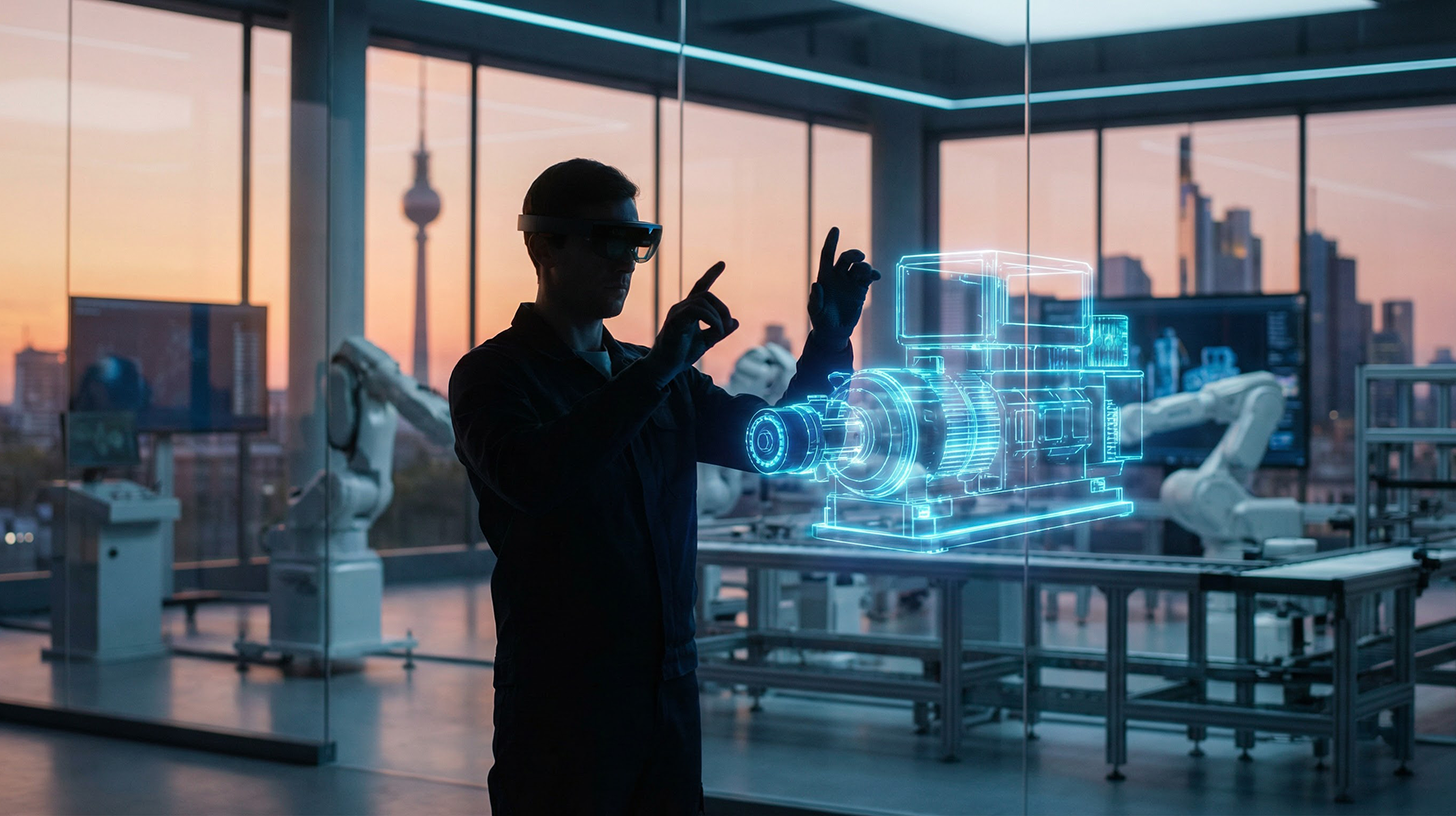
XR in Germany | The job market for Extended Reality: Between new beginnings, disillusionment and industrial reinvention – Image: Xpert.Digital
Not dead, just different: Why the extended reality market is currently undergoing its most important metamorphosis
The XR job market in 2026: An industry reinvents itself – beyond the hype
Anyone looking at the Extended Reality (XR) job market in early 2026 will search in vain for the much-vaunted gold rush. While artificial intelligence is fueling an unprecedented hiring boom, the world of virtual and extended reality appears, at first glance, soberingly quiet. With barely more than 100 specific job postings worldwide on the major industry portals and a drastic decline in sales of traditional VR headsets, the dream of a mass-market metaverse seems to have faded. But appearances are deceiving: behind the raw numbers lies not an implosion, but a fundamental and lucrative realignment.
Analysis of current market data reveals an industry that is outgrowing its infancy as pure entertainment and taking deep root in industrial value creation. While game developers and traditional VR designers are increasingly struggling to find work, software engineers with expertise in computer vision, Python, and AI integration are in high demand – and command top salaries averaging nearly $150,000. The market is thus consistently following the money: away from consumer-oriented gimmicks and towards B2B solutions in medicine, manufacturing, and the military, where AR glasses and AI-powered systems are delivering genuine productivity gains.
This shift is also reflected in industry giants like Meta, which are massively reallocating resources from social VR platforms to AI wearables and smart glasses. For skilled professionals in Germany and Europe, this means: the niche is small, but exclusive. Those who recognize the signs of the times and specialize in the intersection of spatial computing and artificial intelligence will find not a mass market, but a highly specialized field with enormous potential. The following report illuminates the anatomy of this misunderstood market, analyzes the discrepancy between billion-dollar forecasts and actual job openings, and reveals which skills truly matter in this new reality.
Not a boom, but a silent tremor that most people overlook
A look at job boards for Extended Reality, Virtual Reality, and Augmented Reality in early 2026 reveals a picture that doesn't quite align with the euphoric market forecasts of industry analysts. Anyone expecting a classic hiring boom like the one artificial intelligence has experienced since 2023 will be disappointed with XR. Specialized job portals for immersive technologies listed only around 109 active job postings worldwide in January 2026, with an average median salary of US$148,750. On the German Indeed platform, a search for "Extended Reality" yielded only about 50 open positions, while the more specific terms "VR," "XR," and "AR" returned a mere 25 to 30. These figures hardly suggest a mass labor market. Nevertheless, it would be a grave mistake to conclude that this is a dying industry. What the raw numbers obscure is a profound structural shift: away from the consumer-driven VR dream, towards an industrially anchored AR and mixed-reality reality, whose job offers are often hidden behind more general job titles such as Software Engineer, Computer Vision Specialist or 3D Developer.
The anatomy of a market that operates differently than expected
Why job boards only show half the truth
The low absolute number of XR-specific job postings can be explained by several factors that are essential for a nuanced analysis. First, Extended Reality is a cross-cutting technology, and its specialists are increasingly sought after under broader headings such as spatial computing, computer vision, 3D development, or even robotics. Second, the industry is home to Meta Platforms, by far the largest employer, which alone cut around 1,000 jobs in its Reality Labs division in January 2026, following significant reductions at Oculus Studios and other VR projects the previous year. These job cuts at Meta primarily affected VR headset development and the social VR network Horizon Worlds, while investments in AR glasses like the Ray-Ban Meta Smart Glasses and AI-powered wearables were expanded. Total XR device shipments increased by 41.6 percent to 14.5 million units in 2025, but VR headsets alone plummeted by 42.8 percent to just 3.9 million units. This means that the job market is not shrinking, but rather undergoing a fundamental realignment of its priorities.
An industry in transition, not on the brink of collapse
Reality Labs employed around 15,000 people before the cutbacks and has accumulated cumulative operating losses of over $70 billion since 2021, with $17.7 billion in losses in 2024 alone. These figures illustrate the immense pressure on the consumer-driven VR market. Industry observers are already predicting a VR winter, with studios shrinking and platform support being scaled back. Meanwhile, shipments of AI-enabled smart glasses exploded by 211.2 percent in 2025, reaching 10.6 million units. Ray-Ban Meta glasses alone have sold over two million units since their launch in October 2023, tripling sales in the second quarter of 2025. This paradigm shift from bulky VR headsets to everyday AR glasses is shaping the job market of the future.
The most sought-after job profiles: Who is actually in demand?
Software engineers dominate, designers fall behind
An analysis of specialized XR job boards reveals a clear picture of the demand structure. By far the most sought-after position is XR Software Engineer, with 45 open positions worldwide, followed by Computer Vision Engineer with 9 positions and VR/AR Designer with only 8. It is striking that classic Unity Developers and Technical Artists have virtually no open positions listed for January 2026. Regarding the skills in demand, Python leads the way with 100% coverage, followed by Computer Vision at 90%, Unity at 47%, and Unreal Engine at 37%. This distribution signals a fundamental shift: The industry is moving away from pure content creation in game engines towards data-driven software development, machine vision, and AI integration.
The salary gap between the roles
The salary structure in the XR sector reflects the scarcity of certain qualifications. Research scientists lead the way with an average of $175,000, followed by hardware engineers at $160,000 and software engineers at $145,000. Designers rank significantly lower at $115,000. In the United States, the average salary for a VR developer is $108,471 annually. These salary levels position XR professionals in the upper segment of the technology industry, comparable to senior positions in traditional software development. While comparable nationwide salary data for XR specialists is lacking in Germany, job postings on Indeed show that positions such as Solution Architect XR/VR at companies like Deutsche Telekom MMS or XR Interface Engineer at robotics startups in Munich are available.
Germany's XR job market: A niche with potential
The German job market for XR specialists is quantitatively manageable, but qualitatively demanding. Indeed lists positions such as Research Engineer Extended Reality at universities, Pipeline TD Engineer for Metaverse research projects, 3D Character Artists and Senior Gameplay Programmers at companies like Hologate in Munich, Solution Architects at Deutsche Telekom MMS in Berlin, and Humanoid Teleoperation XR Interface Engineers at robotics startups. It is noteworthy that a significant portion of German XR positions are in research and development, often at universities or in publicly funded projects like the Metaverse Living Lab. Private sector positions are concentrated in Munich and Berlin, and the IT skills shortage in Germany, with over 137,000 open IT positions projected for 2025, further intensifies the competition for qualified XR developers. The DIHK Skills Report 2025/2026 confirms that more than one in three companies are unable to fill vacancies, with qualifications in the field of digitalization being particularly affected.
🗒️ Xpert.Digital: A pioneer in the field of Extended and Augmented Reality


Finding the right Metaverse agency, planning office, or consulting firm - Image: Xpert.Digital
🗒️ Finding the right Metaverse agency, planning office, or consulting firm – Search and search: Top Ten Tips for Consulting & Planning
More information here:
VR dream job dashed? Why the industry is now writing the new rules: Why industry experts are more in demand than game developers
B2B versus B2C: The silent revolution of corporate customers
The labor market follows the money, and the money flows into industry
Perhaps the most significant finding from the analysis of job postings is the overwhelming dominance of the B2B segment. Industry analysts predict that enterprise customers will generate around 60 percent of total VR revenue by 2030. Already, 75 percent of Fortune 500 companies have implemented VR technology for training and education. Segmentation of the enterprise AR/VR market reveals the strongest demand in manufacturing with a 30 percent market share, followed by healthcare with 20 percent, logistics and supply chain with 15 percent, and retail with 10 percent. In terms of application areas, training and simulation dominate with 40 percent, followed by remote assistance with 25 percent.
Why the B2C segment is stagnating and what that means for jobs
While the consumer segment will still hold a 32.48 percent market share of the VR market in 2026, according to Fortune Business Insights, the growth momentum clearly favors the enterprise market. Gaming and entertainment account for 38.3 percent of total revenue, remaining the largest single category. However, the 42.8 percent drop in VR headset sales in 2025 will hit this segment hardest. Meta's strategic shift away from Horizon Worlds and toward AI wearables demonstrates that even the sector's largest investor considers the purely consumer-driven VR business unsustainable. For the job market, this means that positions for VR game developers, VR content creators, and social VR specialists are shrinking, while roles for industrial XR architects, training solution developers, and AR integration specialists are growing.
The winners in the B2B sector: healthcare, manufacturing and defense
Healthcare is experiencing the fastest growth of all industry verticals, with a projected annual growth rate of 33.9 percent. The healthcare AR market has grown from approximately $610 million in 2018 to a projected $4.2 billion by 2026, with 40 percent of healthcare providers already using VR for patient care and staff training. In the manufacturing sector, 75 percent of industrial companies that widely deploy VR and AR report a 10 percent increase in operational efficiency. The defense sector is also gaining traction, as demonstrated by Meta's $100 million partnership with defense contractor Anduril for XR deployments in the U.S. defense sector. In Germany, this trend is reflected in job postings from BWI IT GmbH, which is seeking IT experts for XR/VR/AR mobility within the German Armed Forces.
The global market: Where the music plays
North America as the epicenter, Europe as a laggard
The geographic distribution of XR job postings shows a massive concentration in North America, accounting for 82 percent of all open positions. Europe accounts for only 7 percent, and the Asia-Pacific region for 11 percent. This distribution stands in stark contrast to Europe's population distribution and economic weight. Remote positions make up only 3 percent, while hybrid work models dominate at 40 percent and purely on-site work at 57 percent. For European professionals, this means that anyone wanting to pursue a career in the XR industry must either be highly mobile or concentrate on the few European locations.
Europe's catch-up potential and Germany's special role
The European AR/VR market has grown from $2.8 billion in 2021 to a projected $20.9 billion in 2025. VR and AR technology is expected to enhance over 400,000 jobs in Germany and the UK by 2030. The EMEA region as a whole is projected to reach $8.4 billion in AR/VR spending by 2029. However, these forecasts contrast sharply with the current job market reality: the majority of European XR jobs in Germany are in research projects, universities, and a few specialized companies in Munich, Berlin, and a few in Nuremberg. The Asia-Pacific region is the fastest-growing market, with a projected annual growth rate of 35.1 percent through 2030, driven by China's manufacturing capabilities and Japan's technological innovation.
Forecasts put to the reality check: Between billion-dollar fantasies and harsh reality
What the analysts are promising
Market forecasts for extended reality vary considerably depending on the source and definition. Mordor Intelligence estimates the XR market at $10.64 billion in 2026, with an expected increase to $59.18 billion by 2031, representing a growth rate of 40.95 percent. Fortune Business Insights goes significantly further, projecting the market at $346.09 billion in 2026, growing to $2,127.81 billion by 2034. Statista forecasts global AR/VR revenue of $50.9 billion for 2026. Regarding the job market, analysts anticipate 2.32 million AR/VR jobs in the US alone by 2030, starting from a global base of just 800,000 positions in 2019. Globally, up to 23 million XR-related jobs are projected by 2030. Job postings for AR/VR roles have increased by 154 percent in the past five years.
What reality shows
The discrepancy between these forecasts and the actual 109 active job postings on specialized XR job boards is striking. The enterprise AR/VR market was estimated at $15.8 billion in 2024 and is projected to grow to $60.5 billion by 2033. The VR training industry alone is seen as one of the fastest-growing application areas, with a projected volume of $298 billion by 2033, representing a growth rate of 41.8 percent. But these growth figures refer to revenue, not jobs. The market is growing through productivity gains, not mass hiring. Boeing reduced training time per employee by 75 percent through VR, Airbus accelerated maintenance tasks by 25 percent, and Delta Airlines increased the number of daily competency checks from 3 to 150. These efficiency gains mean fewer trainers are needed, not more. The XR job market will grow qualitatively, but quantitatively it will remain moderate.
The convergence of XR and AI: The real job growth
Why the future lies in merging
The World Economic Forum's Future of Jobs Report 2025 predicts that 59 percent of the global workforce will require retraining by 2030. XR is seen as one of the key tools for this massive upskilling program, especially when combined with artificial intelligence. The integration of AI into XR platforms is creating a new category of professional roles: AI-powered XR architects who develop adaptive training systems, computer vision specialists who optimize spatial data processing for industrial AR applications, and spatial computing engineers who shape the convergence of the physical and digital worlds. This convergence explains why Python and computer vision are the most sought-after skills in XR job postings, while pure game engine knowledge is declining in importance.
What this means for the XR skilled labor market in the coming years
The XR job market isn't a boom in the traditional sense, but rather a niche market with high qualification requirements and above-average compensation, currently undergoing a fundamental transformation. Demand is shifting from creative VR content roles to highly specialized engineering positions at the intersection of computer vision, AI, and spatial data processing. The B2B market dominates in terms of both revenue and job postings, accounting for an estimated 60 to 70 percent, while the B2C segment is under considerable pressure due to the slump in VR headset sales and Meta's strategic withdrawal. For Germany, this means that the approximately 50 to 80 XR-specific positions listed on major job boards don't reflect actual demand, as many positions are listed under more general IT titles. The structural IT skills gap of 137,000 open positions further exacerbates the situation. Anyone wanting to position themselves as an XR specialist today shouldn't focus on VR gaming, but rather on industrial AR applications, computer vision, and the AI integration of immersive technologies. That's where the real growth lies, and that's where the salaries are paid that justify entering this demanding market.
Your global marketing and business development partner
☑️ Our business language is English or German
☑️ NEW: Correspondence in your native language!

Konrad Wolfenstein
I and my team are happy to be available to you as your personal advisor.
You can contact me by filling out the contact form here wolfenstein@xpert.digital:or simply call me at +49 7348 4088 965. My email address is
I'm looking forward to our joint project.