


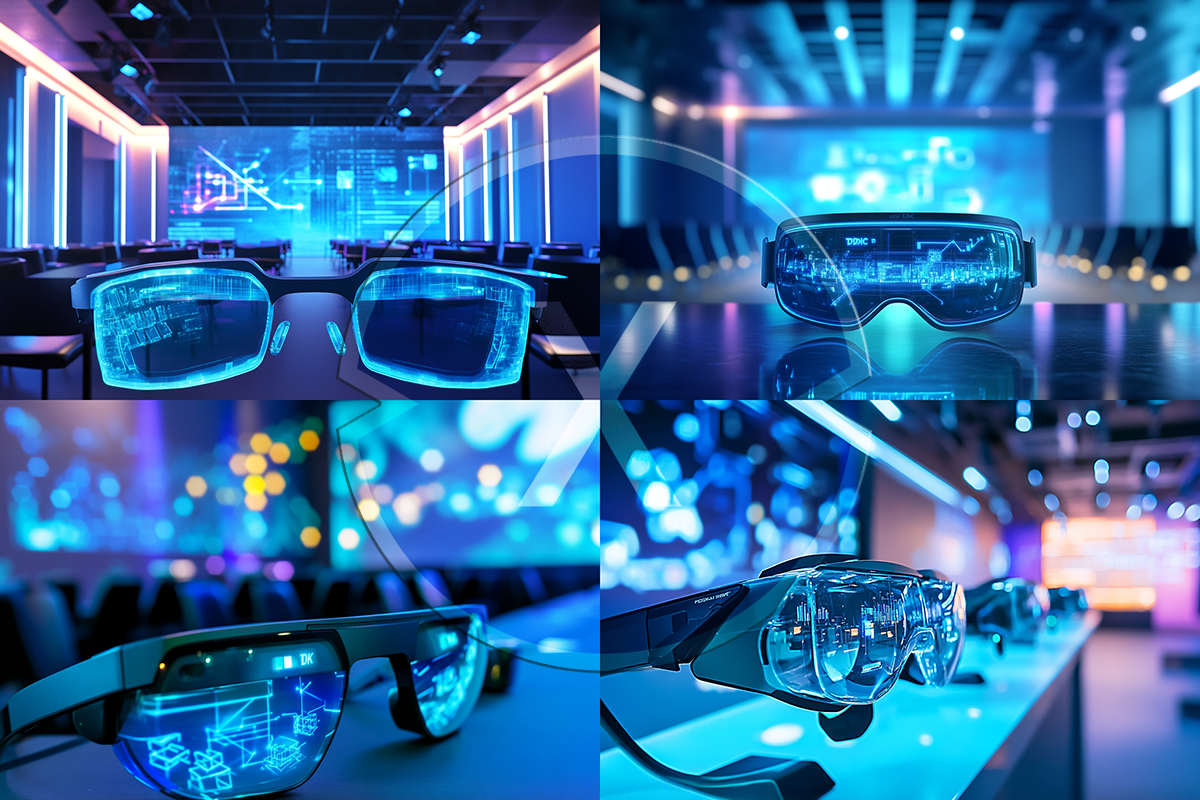
Commitment to the further development of AR/VR technologies – Creative image: Xpert.Digital
High-resolution reality: TDK's FCLM in collaboration with QD Laser, NTT and Mojo Vision
TDK's FCLM (Full-Color Laser Module) technology is primarily used in smart glasses, particularly in models that utilize laser projection directly onto the retina. This technology was developed in collaboration with QD Laser, Inc. and Nippon Telegraph and Telephone Corporation (NTT). FCLM technology enables high-resolution projection for both eyes and doubles the viewing angle compared to previous products, making it ideal for use in AR/VR glasses.
A demonstration model of these glasses was presented at various trade fairs, including CEATEC 2022 in Japan, electronica 2022 in Munich, and CES 2023 in Las Vegas. TDK aims to bring this technology to market as quickly as possible to promote the acceptance of smart glasses and their use in the growing metaverse market.
TDK is currently working with several companies on the development of smart glasses, particularly in the areas of augmented reality (AR) and virtual reality (VR). Key partners include:
1. QD Laser, Inc.
This company is a key partner in the development of smart glasses using TDK's Full-Color Laser Module (FCLM). QD Laser contributes its expertise in laser projection technology, which enables images to be projected directly onto the retina. Together, they have developed a demonstration model that allows direct retinal projection for both eyes and doubles the field of view compared to previous products.
2. Nippon Telegraph and Telephone Corporation (NTT)
NTT collaborated with TDK on the development of a planar lightwave circuit (PLC) that was integrated into FCLM technology. This collaboration contributed to the miniaturization and performance improvement of smart glasses, particularly in the area of image projection.
3. Mojo Vision
TDK Ventures is supporting Mojo Vision, a company working on smart contact lenses that enable augmented reality. Mojo Vision is developing groundbreaking technology for AR platforms, offering applications in healthcare and real-time biometrics. This partnership aims to accelerate the development and distribution of this innovative AR solution.
These partnerships demonstrate TDK's commitment to the further development of AR/VR technologies and their application in smart glasses and other innovative platforms such as smart contact lenses.
In detail: TDK's commitment to the further development of AR/VR technologies and the future of smart glasses
TDK is a leading company in the development of technologies that enable the next generation of augmented reality (AR) and virtual reality (VR). A particular focus is on the development of smart glasses equipped with innovative projection technologies. These glasses are designed not only to revolutionize the way we perceive digital content but also to create new opportunities in the growing metaverse market. TDK's collaborations with various partners, such as QD Laser, Inc., Nippon Telegraph and Telephone Corporation (NTT), and Mojo Vision, are particularly noteworthy. These collaborations aim to develop groundbreaking technologies like the Full-Color Laser Module (FCLM) and smart contact lenses.
FCLM technology: A breakthrough in laser projection
TDK's FCLM (Full-Color Laser Module) technology is a key element in the development of modern smart glasses. This technology enables the direct projection of high-resolution images onto the wearer's retina. This represents a significant advancement over conventional displays, as it allows for a clearer and more realistic representation of digital content. FCLM technology was developed in close collaboration with QD Laser, Inc. and Nippon Telegraph and Telephone Corporation (NTT).
A key advantage of FCLM technology is the doubling of the viewing angle compared to previous projection technologies. This means that the user has a wider field of view and can therefore immerse themselves more deeply in virtual worlds. This expanded field of view is particularly important for augmented reality applications, where real and digital content need to merge seamlessly.
TDK has already presented demonstration models of these smart glasses at several international trade fairs, including CEATEC 2022 in Japan, electronica 2022 in Munich, and CES 2023 in Las Vegas. The goal is to bring this technology to market as quickly as possible, thereby promoting the acceptance of smart glasses in both everyday and professional settings.
Collaboration with QD Laser: Retinal projection as a key technology
A key partner in the development of FCLM technology is QD Laser, Inc., a company specializing in laser projection. Together with TDK, QD Laser has developed a solution that projects images directly onto the user's retina. This technology offers several advantages: firstly, it achieves very high image quality, and secondly, it makes the display virtually invisible, as no physical screen is required in front of the user's eyes.
This direct retinal projection could be particularly beneficial for people with visual impairments, as it enables more precise image perception than conventional displays. Furthermore, this technology opens up new possibilities for immersive AR experiences, where digital information can be superimposed directly onto the user's field of vision.
Another advantage of this technology is its compactness. Since no large screens or projectors are needed, smart glasses can be designed to be slimmer and lighter – an important factor for wearing comfort and everyday usability.
Nippon Telegraph and Telephone Corporation (NTT): Advances through Planar Lightwave Circuits
Besides QD Laser, Nippon Telegraph and Telephone Corporation (NTT) also plays a crucial role in the development of TDK's smart glasses. NTT has made a significant contribution to the integration of Planar Lightwave Circuits (PLCs) – a technology that allows optical waveguides to be integrated onto a flat surface. These circuits are essential for miniaturizing and increasing the performance of the smart glasses.
Thanks to this innovation, TDK was able to significantly reduce the size and weight of its smart glasses without compromising image quality or functionality. PLC technology ensures that the glasses are not only high-performing but also aesthetically pleasing and comfortable to wear.
The collaboration between TDK and NTT impressively demonstrates the importance of interdisciplinary cooperation for technological breakthroughs. By combining their expertise in telecommunications and optoelectronics, the two companies have jointly developed a solution with the potential to fundamentally transform the AR/VR glasses market.
Mojo Vision: Smart contact lenses as the next stage of evolution
While many companies are focusing on developing AR glasses, Mojo Vision is going a step further: The company is working on smart contact lenses that can display augmented reality directly in front of the user's eye. TDK Ventures is supporting Mojo Vision financially and technologically in this groundbreaking innovation.
Mojo Vision's smart contact lenses could revolutionize the field of AR. Unlike conventional AR glasses, these lenses are completely invisible and offer the user an entirely unobstructed field of vision. At the same time, they allow digital information such as notifications or navigation instructions to be displayed directly in the user's field of vision – without the need for external devices.
This technology offers exciting opportunities not only for the consumer market but also for professional applications. For example, surgeons could have important information directly in front of them during an operation, or technicians could receive instructions while working on complex machines.
Furthermore, smart contact lenses also offer applications in the healthcare sector. For example, they could display real-time biometric data such as blood sugar levels or blood pressure, thus supporting people with chronic illnesses.
The impact of AR/VR technologies on the metaverse
TDK's commitment to the advancement of AR/VR technologies is directly linked to the growing interest in the metaverse – a virtual world where people can interact as they would in the real world. The metaverse promises not only new forms of entertainment and communication, but also profound changes in areas such as education, work, and commerce.
Smart glasses play a central role in this development. They allow users to move seamlessly between the real and virtual worlds, creating immersive experiences. Technologies like the FCLM module or Mojo Vision's smart contact lenses could make the metaverse even more realistic and accessible.
TDK sees great potential in further advancing these technologies, thereby not only expanding the market for AR/VR devices but also unlocking new business models in the metaverse. The combination of high-resolution retinal projection and miniaturized optical components could make AR glasses as commonplace as smartphones are today.
TDK as a pioneer in the AR/VR revolution
TDK's commitment to advancing AR/VR technologies clearly points the way to a future full of new opportunities. Through partnerships with leading companies like QD Laser, NTT, and Mojo Vision, TDK is driving innovations that not only push technological boundaries but also enable practical applications in everyday life.
FCLM technology represents a significant advancement in projection technology and could soon become the standard for smart glasses. At the same time, smart contact lenses open up entirely new perspectives for augmented reality – both in private and professional settings.
With these developments, TDK positions itself as one of the leading players in the AR/VR field – an industry with immense growth potential. The coming years promise exciting innovations for both consumers and businesses worldwide.
Related to this: