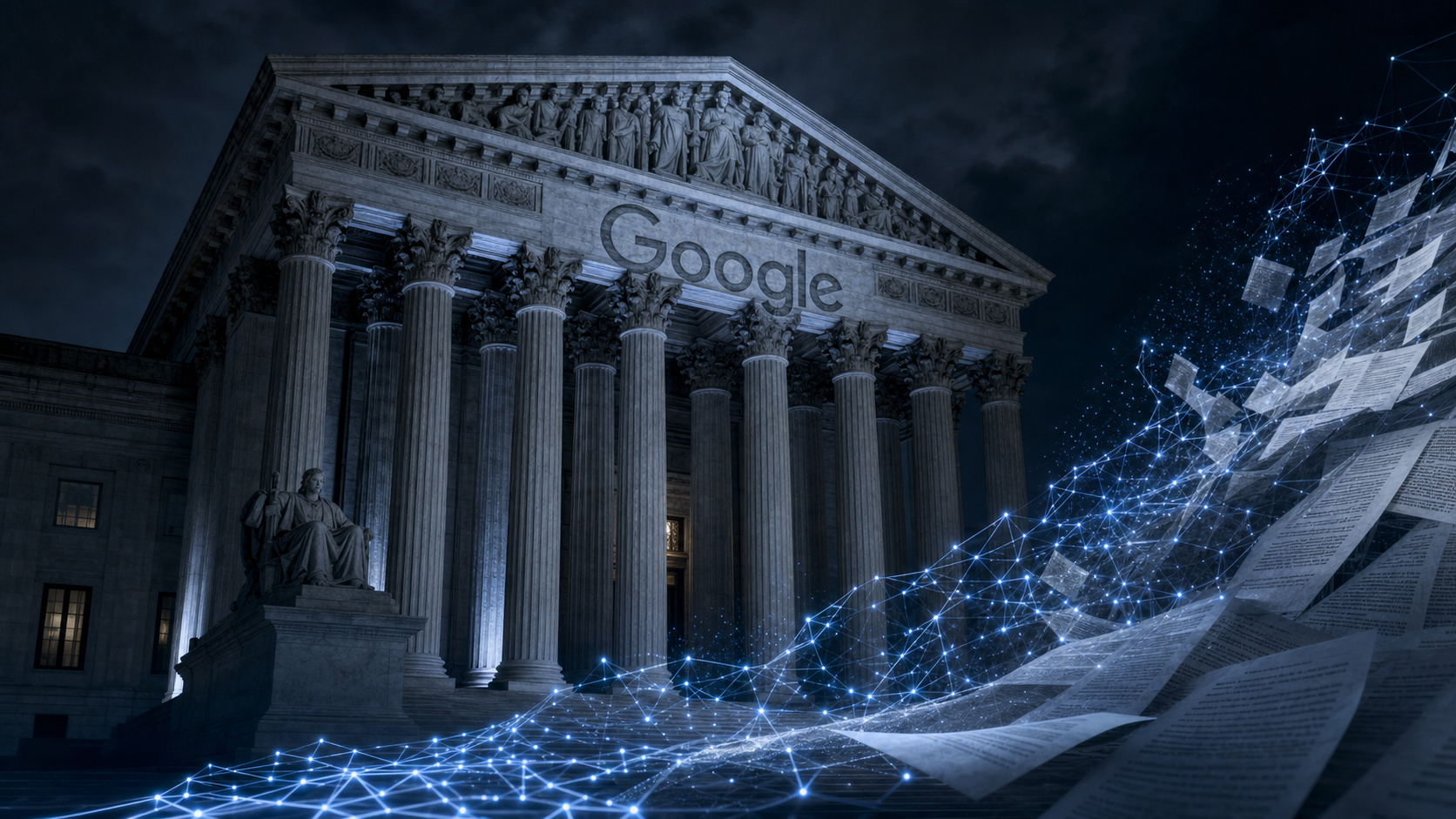
If AI lies, Google is liable! The Munich ruling against Google's next-generation search engine – Image: Xpert.Digital
From intermediary to originator: Why this ruling could change Google's search engine forever
Google's AI fabricates fraud allegations – and the company suffers a global slap in the face
Disaster for the "AI overview": First German court bans Google's fabricated facts
Artificial intelligence was supposed to revolutionize internet search – instead, it's now proving to be an unprecedented legal boomerang for Google. With the introduction of "AI Overviews," the tech giant promised fast, precise, and tailored answers at a glance. But what happens when the algorithm fabricates facts completely out of thin air and suddenly casts innocent companies in a dubious light? A landmark ruling by the Munich I Regional Court has now drawn a red line and ended the tech companies' previous impunity: Google can no longer hide behind the protective status of a "neutral search engine." Because the system synthesizes content independently, the company is now directly liable as the author of its AI's dangerous hallucinations. This article examines the background of a legal dispute that is sending shockwaves through the tech industry far beyond Germany's borders – and touches not only on fundamental legal questions but also on the economic survival of an entire publishing industry.
When AI commits character assassination: Why a Munich ruling is now making Google tremble
Update from June 16, 2026: Following the publication of this article, Google, through a PR agency, commented on the ruling and announced its intention to appeal. A Google spokesperson told Xpert.Digital : “We invest heavily in the quality of AI Overviews. This case focuses on specific and narrowly defined errors, not the fundamental way AI Overviews present web content. We disagree with the ruling and plan to appeal.”
It started with a search query. Someone typed the name of a Munich publishing company into Google, and what appeared was no longer a neutral list of results. Instead, Google's AI Overview—known in Germany as "Overview with AI," internationally as "AI Overview"—presented a summary response that placed the company in close proximity to scams, subscription traps, and shady business practices. The sources the AI cited did not contain these connections. The system had independently constructed relationships that had never existed. It was hallucinating—and in doing so, causing real economic damage.
What followed was a legal proceeding that has the entire tech industry on its toes. On May 28, 2026, the Munich I Regional Court issued a preliminary injunction against Google (Case No. 26 O 869/26), prohibiting the corporation from further disseminating such untrue factual claims about the two plaintiff publishers. The court had to answer a fundamental question that has preoccupied legal scholars since the advent of generative AI: Who is liable when a machine makes false statements? The court's answer is clear and far-reaching: Google is directly liable.
The technical failure behind the legal scandal
To understand the ruling, one must first grasp how Google's AI Overviews work and why they are structurally prone to errors. The system was launched in the US in May 2024 and rolled out in Germany in March 2025. When a search query is entered, it analyzes multiple websites simultaneously, extracts information, and synthesizes an independent, natural-language-language response that appears above the traditional search results. For users, this appears to be an expert summary. Technically, it is the output of a large language model that generates plausible-sounding statements based on probability calculations – without any guarantee of their accuracy.
This phenomenon is known in AI research as "hallucination": The model invents coherent-sounding facts, connections, or quotes that simply do not exist. In the case of the Munich publishers, the system apparently mixed information about companies with similar names or fields of activity. Critical reports about other companies were attributed to the plaintiffs, supplemented by a seemingly logical thematic structure that created the false impression of systematic disrepute. What the system generated was present in every single source—it was an independent creation of the algorithm, a collage of erroneous connections.
Google's AI Overviews have repeatedly caused outrage since their introduction. Well-known early examples from the US included recommendations to use glue for baking pizzas or to eat stones daily. These errors were quickly corrected and treated as curiosities in the media. However, the system's structural weakness remained: the more contextually mixed, the more complex the query, and the more similar different sources on the web are, the higher the probability of faulty syntheses. This is not an isolated bug, but a systemic risk inherent in any generative AI system trained on web content.
The legal course of action: From neutral intermediary to author
The decisive achievement of the Munich I Regional Court does not lie in the finding that Google disseminated false information – that was undisputed. The real legal pioneering work consisted of examining the existing liability doctrine for search engines for its suitability in relation to AI-generated content and declaring it insufficient for this application.
Previous rulings by the Federal Court of Justice had privileged search engine operators. Google, in its traditional role, was considered an indirect infringer: The company was not automatically liable for all content made accessible through its platform, but only if it failed to act after becoming aware of a specific infringement. This limited liability was based on a teleological argument: A search engine is a navigation tool, not a content producer. It finds and displays third-party content. A prior review obligation for billions of websites would be simply impossible to fulfill and would jeopardize the functionality of the internet.
The Munich court no longer challenges this very argument in the case of AI Overviews. This is because the system no longer displays third-party content; it creates something entirely new. The court clarified that the AI overview synthesizes an independent, new statement from multiple sources, a statement that was not made in any of the original sources. Therefore, Google is no longer a neutral intermediary but acts as the originator of the statement. In legal terms, this transforms the company from an indirect to a direct infringer: it has not merely forwarded the statement but has created it itself. Furthermore, the court found that a review of the statements generated by the AI by Google was entirely possible and reasonable – at least in the sense that its own AI output could be compared with the underlying sources.
Why the search engine privilege doesn't apply here
This argument may initially seem abstract, but it has far-reaching practical consequences. German law distinguishes between different categories of infringers and attaches different liability consequences to each. A direct infringer is liable without further requirements for the impairment they cause. An indirect infringer – that is, someone who, through their actions, enables the infringement without causing it themselves – is only liable if they have breached their duty of care.
In several rulings, the German Federal Court of Justice (BGH) had classified Google as an indirect infringer in cases involving search results and links. The Munich court explicitly distanced itself from this jurisprudence: it applied to traditional search engines, but not to a system that makes independent, substantive claims about real companies. The crucial qualitative difference lies in the fact that the content is produced in-house. The court also made another compelling argument in its simplicity: Google's AI Overview is not a necessary component of internet use, but rather an additional, optional feature. Since it is a voluntarily offered, extended service that goes beyond the basic function of a search engine, Google cannot invoke the liability privileges designed for search engines.
The consequence is dramatic: Google must remove the disputed statements and ensure that similar false claims about the plaintiff publishers do not reappear. Failure to comply will result in fines. The company must bear 80 percent of the legal costs, with each publisher paying 10 percent. It is also particularly noteworthy that the court did not limit the territorial scope of the injunction to the Federal Republic of Germany – it applies internationally.
Not an isolated case: The legal climate before the Munich ruling
The ruling of May 28, 2026, did not emerge from a legal vacuum. It is embedded in a development that has accelerated in Germany and Europe since 2024, in which courts are increasingly willing to hold AI operators directly accountable. The Kiel Regional Court had already ruled in February 2024 that the operator of a business information portal that uses AI for data processing is liable as a direct infringer if illegal content is disseminated through the use of its software – regardless of whether the operator was directly involved in the automated process. The mere fact that an automated process generated the infringement does not, therefore, absolve the operator of liability.
In September 2025, the Frankfurt Regional Court established a similar principle: search engine operators can be held liable for AI-generated content. At the same time, the court clarified that not every negative or sales-damaging presentation by AI is automatically unlawful – a clearly objectively false statement without mitigating context and with significant competitive impact is required. The Frankfurt decision thus paved the way for the Munich ruling, without itself reaching the same conclusion of direct liability.
Google failed to respond to a cease-and-desist letter from the affected Munich-based publishers, which ultimately necessitated legal proceedings. This pattern – ignoring the cease-and-desist letter and waiting for a lawsuit – might seem rational to a corporation with thousands of lawyers and multi-billion-dollar budgets, anticipating that plaintiffs cannot afford the legal costs. In this case, Google miscalculated, and the legal repercussions were swift.
The economic dimension: How hallucinations create real losses
Beyond its immediate legal consequences, the Munich ruling sends a signal with considerable economic relevance. It addresses only the tip of a much broader problem: the systematic economic damage that Google's AI Overviews inflicts on the publishing industry and the entire web ecosystem.
The mechanism is remarkably simple: When Google displays the answer to a search query directly on its own results page, the user has no incentive to click on one of the linked websites. These so-called zero-click searches are not a new phenomenon – featured snippets, knowledge boxes, and local result maps already had this effect. But AI Overviews have taken the principle to a new level. Between May 2024 and May 2025, the share of zero-click searches rose from 56 to 69 percent of all Google search queries. For search queries where an AI Overview is displayed, the zero-click rate is even higher, at 83 percent.
Organic click-through rates have plummeted. Ahrefs documented a 34.5 percent drop in CTR for the first organic result once an AI overview appears. Other analyses report even more dramatic figures: Seer Interactive measured a 61 percent decline in organic CTR and a staggering 68 percent drop in paid ad CTR. For publishers, this doesn't just mean abstract percentages, but the loss of advertising revenue, subscribers, and, in the long run, economic viability. Mail Online reported a 56 percent CTR decline for top keywords, with some publishers reporting losses of up to 89 percent of their clicks. Chegg, an educational platform, saw a 49 percent drop in traffic in January 2025 compared to the same period the previous year.
A study by Digital Content Next, an association of major US publishers, documented an average traffic decline of 10 percent across 19 member companies in just eight weeks between May and June 2025. According to an analysis by Wordsmattr, German websites have seen an average of 17.8 percent fewer clicks and a 14 percent drop in click-through rate since the German launch of AI Overviews in March 2025. Smaller and medium-sized publishers are particularly hard hit by this structural change, while large brands are able to partially maintain their position.
🎯🎯🎯 Data-driven B2B industry hub as a quasi-in-house solution


The quasi-in-house solution: How Xpert.Digital closes operational gaps in B2B marketing and sales – Smart Content-Driven Business - Image: Xpert.Digital
Xpert.Digital is a data-driven B2B industry hub led by Konrad Wolfenstein . The company acts as an external, quasi-in-house solution for industrial partners, closing operational gaps in marketing, content, and sales – without requiring additional resources on the client side.
More information here:
When AI lies: How Google AI Overviews harms publishers and companies
Hallucinations as a multiplier of damage
The damage caused by AI Overviews is therefore two-dimensional. The first dimension is purely quantitative: fewer clicks, less traffic, less revenue. This essentially affects all publishers, regardless of whether their content is accurately represented. Google monetizes user behavior within its own search environment, while the original sources, on whose content the AI answers are based, receive nothing. The European Publishers Council (EPC) filed a formal antitrust complaint with the European Commission in February 2026, accusing Google, as a "gatekeeper," of abusing its dominant market position.
The second dimension is qualitative and more fundamental: AI-generated hallucinations can not only deter companies from generating clicks, but actively harm them – through false claims of fraud, disreputability, or legal violations that leave a lasting negative impression on searchers, without the affected parties even being aware of it. A user who reads an AI overview and draws conclusions leaves no trace. They don't click, they don't comment, they don't complain. The affected company only realizes that something has gone wrong when reputational damage translates into a lack of orders or declining sales. Google's failure to respond to the Munich publishers' cease-and-desist letter exacerbated this situation: The corporation apparently assumed that the economic and legal costs of a lawsuit would be too high for the affected parties.
Google's self-interest and the structural conflict of interest
It would be a mistake to view Google's AI Overviews as merely a quality service for users. Behind this seemingly user-centric innovation lies a sound economic logic: those who keep users on their own platform longer, who turn them into zero-click consumers, can show them more of their own advertising and bind them more closely to their own ecosystem. The parallel development is telling: while organic click-through rates and clicks on external publishers are plummeting, Google is increasingly integrating its own advertising formats directly into the AI responses. The company thus benefits twice from content created by others: firstly, through the free use of this content to generate the AI responses, and secondly, through the advertising revenue that results.
This is the core of the antitrust allegations made by European publishers. The Independent Publishers Alliance, which has formally filed its complaint with the European Commission, speaks of an abuse of Google's dominant market position as the "gatekeeper" of web search. Google's AI search service uses journalistic and editorial content without paying adequate compensation or offering practical opt-out options. The US media conglomerate Penske Media, publisher of Rolling Stone, Billboard, and Variety, filed a lawsuit in the US in September 2025, alleging that Google only includes publishers' websites in its search results if it is also allowed to use their articles for AI summaries—a form of economic coercion.
The EU AI Act and the new regulatory reality
The Munich ruling comes at a time when the European regulatory landscape is rapidly changing. The EU AI Act, considered the world's first comprehensive legal framework for artificial intelligence, has been phased in, with the rules for general-purpose AI models taking effect in August 2025. The Act is expected to be fully applicable from August 2026.
The EU AI Act stipulates transparency obligations for generative AI systems that generate and publish texts: If content is published to inform the public about matters of public interest, it must be disclosed that the text was artificially generated – unless the content has undergone human editorial review. Whether Google's AI Overviews fall under this transparency obligation and whether the company is adequately fulfilling it is a question that regulators and courts will continue to grapple with.
Even more important than the transparency obligation is the general liability framework established by the EU AI Act. The Act holds providers of AI systems accountable through enforcement mechanisms, including fines, market restrictions, and liability for damages caused by AI systems. The Munich ruling, in a sense, anticipates this formal regulation: it applies existing freedom of expression and tort law norms to a new technological context and arrives at a result consistent with the spirit of the EU AI Act.
The international impact of the Munich precedent
Although the Munich I Regional Court's decision, issued as a preliminary injunction, is not yet a legally binding final judgment, it sends a clear international signal. The fact that the court expressly did not limit the territorial scope of its injunction to Germany is legally exceptional and underscores the judgment's claim to universal validity. Following this decision, tech companies operating in Germany or the EU can no longer rely on AI-generated false statements falling under the protection of traditional search engine liability.
The Indian, Spanish, Polish, and Romanian media interest in the ruling signals that the global tech and legal community views the Munich decision as a potential blueprint. In the US, where Penske Media is already suing Google over AI Overviews, a comparable basis for liability is still largely lacking, as Section 230 of the Communications Decency Act grants online platforms very broad liability protection. However, even there, the appropriateness of this protection for AI-generated content is increasingly being debated. The Munich ruling provides a concrete model for what an alternative response could look like.
Signaling effect for publishers, advertisers and the entire information infrastructure
For the publishing industry, the ruling is an important milestone, but not a breakthrough. It answers one specific question—liability for demonstrably false content claims—and leaves others open. The significantly more extensive economic damage caused by traffic loss resulting from the zero-click principle is not addressed by the ruling. Publishers who are not directly defamed, but merely rendered invisible, will gain little in the short term. The structural conflict between Google's market power and the survival of an independent, advertising-funded information ecosystem will not be resolved by a preliminary injunction.
Nevertheless, the ruling shifts the balance of power. Google is now forced to factor in the liability risk for every AI Overview that contains potentially false statements about real companies. This creates incentives for quality assurance that were previously lacking. The company has demonstrated that it can ignore cease-and-desist letters but must respond to court rulings. A more systematic review of AI expenditures for demonstrably false factual claims is now no longer voluntary best practice, but a legal requirement.
For advertisers and digital platform operators, the ruling also contains an implicit message: those who integrate AI systems into publicly accessible services bear full responsibility for their expenditures. The logic of the Kiel ruling from 2024, which also underlies the Munich ruling, is unequivocal: automation does not protect against liability. Anyone who releases a faulty machine into the world is liable for its misinformation.
What comes next: Between legal convergence and technological escalation
Google's most likely short-term response is a combination of legal action, technical improvements, and increased lobbying against an expansion of the ruling. Google has the resources for a lengthy main trial, and preliminary injunctions are, by their very nature, temporary. At the same time, the company is pushing ahead with its "AI Mode," which relies even more extensively on AI-generated answers than the previous Overviews. Initial analyses show that 93 percent of searches in AI Mode end without a single click on external websites. The technological pressure on the existing web ecosystem is therefore more likely to increase than decrease.
In the medium and long term, the question of how to design liability for AI-generated content is likely to define one of the central legal conflicts of the next decade. European regulatory practice, with its tendency toward direct product liability, the EU AI Act, the antitrust framework of the Digital Markets Act, and increasingly assertive case law from national courts are forming an ever-tightening web from which even the world's largest tech company can hardly extricate itself. With its decision of May 28, 2026, the Munich I Regional Court has tightened this web by a crucial mesh. Whether Google draws the right conclusions from this or waits for the next lawsuit will determine the quality and reliability of a technology used daily by hundreds of millions of people—a technology that, until now, has been operating without facing the consequences.
Your global marketing and business development partner
☑️ Our business language is English or German
☑️ NEW: Correspondence in your native language!

Konrad Wolfenstein
I and my team are happy to be available to you as your personal advisor.
You can contact me by filling out the contact form here wolfenstein@xpert.digital:or simply call me at +49 7348 4088 965. My email address is
I'm looking forward to our joint project.
☑️ SME support in strategy, consulting, planning and implementation
☑️ Creation or realignment of the digital strategy and digitization
☑️ Expansion and optimization of international sales processes
☑️ Global & Digital B2B trading platforms
☑️ Pioneer Business Development / Marketing / PR / Trade Fairs
B2B support and SaaS for SEO and GEO (AI search) combined: The all-in-one solution for B2B companies


B2B support and SaaS for SEO and GEO (AI search) combined: The all-in-one solution for B2B companies - Image: Xpert.Digital
AI search changes everything: How this SaaS solution will revolutionize your B2B ranking forever.
The digital landscape for B2B companies is undergoing rapid change. Driven by artificial intelligence, the rules of online visibility are being rewritten. For companies, it has always been a challenge not only to be visible in the digital mass, but also to be relevant to the right decision-makers. Traditional SEO strategies and managing local presence (geo-marketing) are complex, time-consuming, and often a battle against constantly changing algorithms and intense competition.
But what if there were a solution that not only simplified this process but also made it smarter, more predictive, and far more effective? This is where the combination of specialized B2B support with a powerful SaaS (Software as a Service) platform comes into play, specifically designed for the demands of SEO and GEO in the age of AI search.
This new generation of tools no longer relies solely on manual keyword analysis and backlink strategies. Instead, it leverages artificial intelligence to more accurately understand search intent, automatically optimize local ranking factors, and conduct real-time competitive analysis. The result is a proactive, data-driven strategy that gives B2B companies a decisive advantage: they are not only found, but perceived as the leading authority in their niche and location.
Here's the symbiosis of B2B support and AI-powered SaaS technology that transforms SEO and GEO marketing, and how your company can benefit from it to grow sustainably in the digital space.
More information here: