
How Big Tech conceals the true costs of the AI revolution: When balance sheet manipulation becomes a survival strategy – Image: Xpert.Digital
Special purpose vehicles and accounting tricks: The dangerous house of cards of OpenAI, Meta & Co.
The hidden mountain of debt: Is the AI industry now facing a major crash?
When the AI bubble bursts: Why the tech giants are hiding a huge risk
The hype surrounding artificial intelligence is driving the stock prices of the major tech giants to ever new record highs. But behind the glittering facades of Meta, Microsoft, Oracle, and OpenAI, a financial storm is brewing. To manage the astronomical costs of the global AI arms race, Big Tech is increasingly resorting to accounting tricks. From secretly extended depreciation periods and multi-billion-dollar off-budget funds in special purpose vehicles to questionable circular transactions – the methods are as creative as they are risky. What appears on the surface to be unstoppable growth, on closer inspection, reveals itself to be a fragile financial house of cards. The industry is shifting its burdens to the future, but what will happen if the lofty AI expectations are missed and the hidden billions in costs hit the balance sheets with full force? A deep dive into the daring maneuvers of the tech elite – and who might be the first to fall in a potential crash.
The billion-dollar illusion of the AI boom: How Big Tech hides its true costs
Behind the impressive profit reports of the major tech companies lies a growing number of accounting tricks used by Google, Meta, Oracle, and others to downplay or completely remove from their balance sheets the true costs of their AI arms race. These practices are largely legal, but they raise a fundamental question: What happens when the immense investments ultimately fail to pay off and the deferred costs return with full force?
The trick to extending lifespan
One of the most effective, yet inconspicuous, methods technology companies use to boost their profits is to extend the so-called useful life of their servers and network equipment on their balance sheets. In January 2025, Meta announced it was extending the assumed useful life of certain servers and network equipment from four to five to five and a half years. At first glance, this seems like a technical footnote, but in fact, this single adjustment reduced depreciation costs for 2025 by $2.9 billion, which was almost four percent of its estimated pre-tax profit. Since Meta increased its investments in AI infrastructure by up to seventy-five percent during the same period, the effect is even more pronounced in the current year, 2026.
Meta is by no means alone in this. Microsoft extended the useful life of its server and network equipment from four to six years back in 2022, and Oracle followed suit in 2023, adjusting from four to five years. Virtually every major hyperscaler made similar adjustments between 2020 and 2025. The underlying mechanism is simple from an accounting perspective, but consequential: If a server or graphics card is assumed to have a longer lifespan, the acquisition costs are spread over more years, thereby reducing annual depreciation and increasing reported profit by the same amount, without a single additional product being sold or a new customer being acquired. According to calculations by independent analysts, this effect adds up to a double-digit billion-dollar figure in additional reported operating profit across the industry, with some estimates suggesting more than $176 billion in potentially inflated profit, based on the difference between the accounting and actual technological useful life of modern graphics processors.
This is precisely where the real controversy arises. A four-year-old high-performance chip may still function technically and be perfectly usable for simpler applications like inference. However, for training the next generation of AI models—the very race that drives the stock market valuations of the entire industry—the same chip is technologically obsolete after about two years. Between these two definitions of useful life—purely physical functionality on the one hand and competitive performance on the other—lies a significant gap, creating opportunities for accounting manipulation. The well-known investor Michael Burry, who gained fame for his early warning of the 2008 housing crisis, unequivocally described this practice in a public statement as one of the most widespread fraudulent mechanisms of our time. It is striking that in January 2025, Amazon took the opposite approach, shortening the useful life of certain hardware, which resulted in a negative impact of approximately $700 million on operating profit, explicitly citing the rapid technological obsolescence caused by the AI boom. This contrast demonstrates that the choice of depreciation assumptions allows for considerable discretion in accounting policy and is by no means mandatory.
How billions in debt disappear from the balance sheet
Beyond the issue of depreciation, an even more far-reaching practice has become established, allowing technology companies to finance enormous investment sums entirely off their own balance sheets. An analysis by the Financial Times found that technology companies have already kept more than $120 billion in AI data center expenditures off their balance sheets through so-called special purpose vehicles (SPVs). The principle works as follows: Instead of directly building and financing a data center, a corporation establishes a formally separate company that owns the land, the buildings, the power supply, and sometimes even the chips themselves. Institutional investors such as Pimco, BlackRock, Apollo, Blue Owl Capital, or major banks like JPMorgan provide this SPV with debt and equity capital, while the actual technology company signs long-term leases for the use of the infrastructure.
The most prominent example is Meta with its Hyperion data center project in Louisiana. For this $30 billion undertaking, Meta, together with Blue Owl Capital, established a special purpose vehicle (SPV) called Beignet Investor, into which approximately $27 billion in debt financing from Pimco, BlackRock, and Apollo, as well as an additional $3 billion in equity from Blue Owl, flowed. None of this $30 billion appears as debt on Meta's own balance sheet, which shortly thereafter enabled the company to raise an additional $30 billion on the regular bond market. While Meta holds a 20 percent stake in this SPV and has assumed a so-called residual value guarantee, which applies if the value of the asset falls below a certain threshold at the end of the contract term and Meta does not renew the contract, the fundamental risk remains largely with the external investors.
Oracle, xAI, and CoreWeave are pursuing similar structures. Oracle leases computing capacity to OpenAI and, with partners such as Vantage, Digital Realty, and Blue Owl, has built numerous data centers, each financed through its own special purpose vehicle (SPV). These include a facility in Abilene, Texas, with approximately $13 billion in funding from Blue Owl and JPMorgan, as well as further financing packages totaling $38 billion for sites in Texas and Wisconsin and $18 billion for a facility in New Mexico. Elon Musk's xAI is pursuing a similar strategy, attempting to raise $20 billion, up to $12.5 billion of which is to come from debt financing, to purchase graphics processing units (GPUs) and lease them back to the company. CoreWeave established an SPV in March 2026 to fulfill an $11.9 billion contract to provide computing power to OpenAI. It is noteworthy that Google, Microsoft and Amazon have so far consciously opted against this form of financing and instead finance their data centers from their own cash reserves and traditional corporate bonds, which makes their balance sheets more transparent, but also puts a greater strain on them immediately.
The true purpose of these structures is obvious: companies gain access to enormous sums of capital without negatively impacting their reported debt, creditworthiness, or key balance sheet ratios, which in turn allows them to raise further debt capital on the regular market. Investors in the special purpose vehicles (SPVs) themselves are attracted by stable, infrastructure-like returns, secured by financially strong technology companies as tenants. This structure functions smoothly as long as the underlying demand for computing power actually grows at the rate assumed in the contracts. However, it harbors a significant hidden risk because the corporations' true economic commitment is inadequately reflected in official balance sheet figures.
When business partners finance each other
Beyond mere balance sheet shifting, another, even more disturbing pattern has emerged in the industry, now known as circular trading. In this model, companies invest reciprocally in each other while simultaneously being connected as customers and suppliers. The most prominent example is the relationship between Nvidia and OpenAI. Nvidia pledged up to $100 billion in investments to OpenAI for building data centers, while OpenAI simultaneously purchased graphics processors from that very same investor. Financial analyst Brian Colello of Morningstar aptly described the mechanism: OpenAI likely buys equipment from Nvidia, which then reinvests the profits back into OpenAI, which in turn uses those funds to purchase more Nvidia equipment. Shortly thereafter, a similar deal was struck with AMD, in which OpenAI agreed to purchase AMD's chips in exchange for a potential stake of up to ten percent in the company.
The network extends far beyond these two examples. As journalist Rob Wile summarized, Nvidia plans to invest in OpenAI, which sources its cloud computing from Oracle, which in turn buys chips from Nvidia. Nvidia also holds a stake in CoreWeave, which in turn provides infrastructure to OpenAI. OpenAI sits at the center of this network of reciprocal investments like a multi-armed octopus. In March 2026, OpenAI closed a historic $122 billion funding round, with Amazon contributing up to $50 billion and Nvidia $30 billion, while OpenAI simultaneously extended its existing agreement with Amazon's cloud division, AWS, by another $100 billion. Three months earlier, Microsoft and Nvidia had jointly invested $15 billion in Anthropic, which in return committed $30 billion for the use of Microsoft's Azure cloud service.
PitchBook analyst Harrison Rolfes succinctly identifies the fundamental structural problem: the accumulated liabilities are not merely debt, but rather circular, because the same hyperscalers that inject equity capital simultaneously collect the bills for computing power as suppliers. He also points out that the risk distribution in these constellations is far from balanced. Microsoft, for example, holds a stake in OpenAI, receives 20 percent of its revenue, and has simultaneously secured multi-year Azure commitments. Should OpenAI miss its revenue targets, the hyperscaler will not contribute financially, but will instead be paid first, leaving OpenAI to bear the remaining risks alone. The Wall Street Journal has already reported that OpenAI has missed its own internal growth targets, and OpenAI CFO Sarah Friar herself warned that the company might not be able to pay for future computing power contracts if revenue growth does not accelerate. OpenAI's contractual obligations to Oracle, Microsoft, and Amazon now amount to more than $1.15 trillion. Comparisons with the collapse of the dot-com bubble in 2000 are now being openly drawn in investor circles, as the investment company Bespoke Investment Group put it when it described the Nvidia-OpenAI deal as a worrying sign of the increasing self-absorption of the entire industry.
A new dimension of digital transformation with 'Managed AI' (Artificial Intelligence) - Platform & B2B solution | Xpert Consulting

A new dimension of digital transformation with 'Managed AI' (Artificial Intelligence) – Platform & B2B solution | Xpert Consulting - Image: Xpert.Digital
Here you will learn how your company can implement customized AI solutions quickly, securely and without high entry barriers.
A managed AI platform is your all-inclusive, worry-free solution for artificial intelligence. Instead of dealing with complex technology, expensive infrastructure, and lengthy development processes, you receive a ready-made solution tailored to your needs from a specialized partner – often within just a few days.
The key advantages at a glance:
⚡ Rapid implementation: From idea to ready-to-use application in days, not months. We deliver practical solutions that create immediate added value.
🔒 Maximum data security: Your sensitive data stays with you. We guarantee secure and compliant processing without sharing data with third parties.
💸 No financial risk: You only pay for results. High upfront investments in hardware, software, or personnel are completely eliminated.
🎯 Focus on your core business: Concentrate on what you do best. We take care of the entire technical implementation, operation, and maintenance of your AI solution.
📈 Future-proof & scalable: Your AI grows with you. We ensure continuous optimization and scalability, and flexibly adapt the models to new requirements.
More information here:
AI debt trap: These companies could see their house of cards collapse
Where the house of cards is most likely to collapse
The crucial question now is which companies could actually face serious financial difficulties if their enormous investments don't pay off as hoped. From today's perspective, CoreWeave, a specialized provider of cloud infrastructure for AI training, appears to be most at immediate risk. Its business model is based almost entirely on debt-financed graphics processors. At the end of 2025, the company had total debt of approximately $21.4 billion, which has since ballooned to nearly $30 billion by mid-2026. Its debt-to-equity ratio reached an extraordinary 894 percent, while its free cash flow over a twelve-month period was a dismal $5.27 billion. Rating agency Moody's has rated the company as likely to be cash-flow negative for at least the next eighteen months. Particularly alarming is the interest burden: CoreWeave pays an average interest rate of around 11 percent on its debt, meaning that roughly a quarter of its total revenue must be spent on debt servicing alone. Investment bank HSBC estimated the company's liquidity shortfall for 2026 at $9.8 billion, which would have to be covered by additional, and likely even more expensive, borrowing. To make matters worse, CoreWeave is extremely dependent on a few large customers, with Microsoft accounting for roughly 70 percent of its revenue and a significant portion of its order backlog coming from OpenAI, the company that has itself already signaled warning signs regarding its solvency. Should OpenAI fail to meet its financial commitments, CoreWeave would be hit hard, as there is a real risk of a chain reaction, which Wall Street is already pricing in with bond yields of 11.5 percent on the company's 2031 bonds—a clear warning sign of substantial default risks.
Oracle is also finding itself in an increasingly precarious position, albeit from a significantly larger and more diversified starting point. In July 2026, the rating agency S&P Global downgraded the company's credit rating from BBB to BBB-, just one notch above junk status. The reasoning was unequivocal: S&P openly admitted to having previously underestimated the true extent of the necessary investments to expand its AI business. For fiscal year 2027, the agency now expects capital expenditures of $90 billion to $95 billion, significantly exceeding its previous forecast of $60 billion, while the free operating cash flow deficit is expected to nearly double from the previously projected $24 billion to almost $42 billion. Oracle already carries total debt of $167 billion and plans an additional $20 billion capital increase to finance its expansion. The single greatest risk lies in the extreme customer concentration: OpenAI alone accounts for roughly half of Oracle's $638 billion in contractually guaranteed future revenue. Should OpenAI encounter financial difficulties or be unable to meet its payment obligations, Oracle would be left with enormous amounts of long-term leased data center capacity, which under such circumstances would be difficult to re-lease at comparably favorable rates. S&P also indicated that it would further reduce its valuation if debt remains above 4.5 times earnings or if Oracle fails to generate positive free cash flow by fiscal year 2029.
OpenAI itself is at the heart of all risk scenarios, even though, as a privately held startup, it is not subject to traditional stock market reporting requirements. According to its own internal projections, OpenAI anticipates accumulating $115 billion in losses by 2029 before it even becomes profitable—a timeline that independent observers consider extremely optimistic. As previously mentioned, its commitments to Oracle, Microsoft, and Amazon total more than $1.15 trillion, while CFO Sarah Friar herself has publicly admitted that without a significant acceleration in revenue, the company's ability to pay for future computing contracts is not guaranteed. OpenAI's failure would not be an isolated bankruptcy, but rather, due to its numerous contractual ties, would affect virtually the entire value chain, from Oracle and Microsoft to CoreWeave and numerous smaller infrastructure providers.
In contrast, those corporations that can finance their AI investments from their own resources, i.e., from robust operating cash flows, are in a significantly more comfortable position. Google, Microsoft, and Amazon possess such massive core businesses in search, advertising, software licensing, and cloud services that even enormous AI investments do not immediately threaten their financial stability, although, as described at the beginning, their free cash flow is also coming under noticeable pressure. Bank of America has already estimated that the massive AI investments are likely to reduce these companies' profit margins by 1.6 percentage points year-over-year. While this is noticeable, it is far from posing an existential threat.
What happens when the boomerang comes back?
The crucial difference between a manageable setback and a genuine existential crisis ultimately lies in the combination of debt levels, customer concentration, and whether a company possesses a self-contained, profitable core business capable of absorbing any AI-related losses. For highly leveraged, niche-focused providers like CoreWeave, even a moderate delay in anticipated demand or a payment default from a single major customer like OpenAI could trigger a chain reaction, ranging from increased refinancing costs and credit downgrades to outright insolvency. For Oracle, the risk lies less in immediate bankruptcy than in a gradual loss of investment-grade creditworthiness, which would permanently increase financing costs and drastically restrict financial flexibility for further expansion.
The real Achilles' heel of the entire structure, however, lies in the off-balance-sheet special purpose vehicles themselves. Should it turn out that the demand for computing power is growing more slowly than assumed in the underlying lease agreements, or should individual AI providers actually run into difficulties, parent companies like Meta would have to honor their contractually guaranteed residual values, thereby fully realizing the supposedly outsourced risks on their own balance sheets – precisely at a time when the capital markets are already reacting nervously. A similar situation exists with the extended depreciation periods: Should it turn out that the actual technological lifespan of the chips is significantly shorter than assumed in the balance sheets, massive, concentrated write-downs threaten in certain future quarters, potentially wiping out years of supposedly steady profit growth in one fell swoop – a scenario that critics are already calling the coming depreciation wall.
The crucial lesson from the history of past technology cycles, particularly the collapse of the telecommunications bubble in the early 2000s, is that circular financing structures appear stable as long as underlying growth continues unabated, but can collapse with astonishing speed as soon as even a single crack appears in the network. While the Swiss investment bank UBS argued in the fall of 2025 that today's AI companies are significantly more financially robust than the telecom firms of that era, it also acknowledged that considerable financial vulnerabilities exist in certain parts of the value chain. This very caveat is likely to prove the key point when looking ahead to the coming quarters: not the entire industry is at risk, but those companies that are most heavily reliant on leveraged bets on an uncertain future face a real and growing risk that their deferred costs will ultimately catch up with them with full force.
Your global marketing and business development partner
☑️ Our business language is English or German
☑️ NEW: Correspondence in your native language!

Konrad Wolfenstein
I and my team are happy to be available to you as your personal advisor.
You can contact me by filling out the contact form here wolfenstein@xpert.digital:or simply call me at +49 7348 4088 965. My email address is
I'm looking forward to our joint project.
☑️ SME support in strategy, consulting, planning and implementation
☑️ Creation or realignment of the digital strategy and digitization
☑️ Expansion and optimization of international sales processes
☑️ Global & Digital B2B trading platforms
☑️ Pioneer Business Development / Marketing / PR / Trade Fairs
🎯🎯🎯 Data-driven B2B industry hub as a quasi-in-house solution

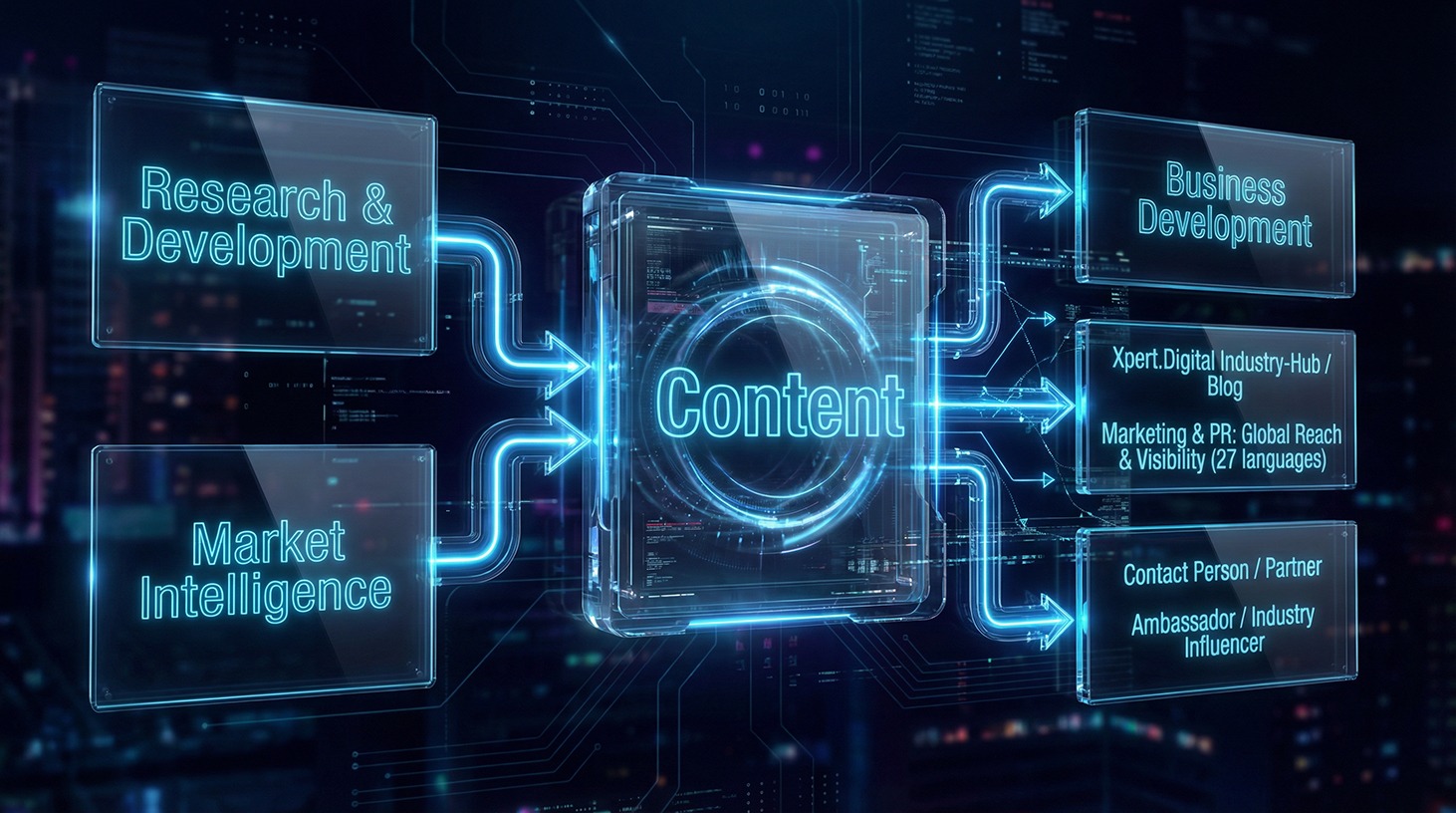
The quasi-in-house solution: How Xpert.Digital closes operational gaps in B2B marketing and sales – Smart Content-Driven Business - Image: Xpert.Digital
Xpert.Digital is a data-driven B2B industry hub led by Konrad Wolfenstein . The company acts as an external, quasi-in-house solution for industrial partners, closing operational gaps in marketing, content, and sales – without requiring additional resources on the client side.
More information here: