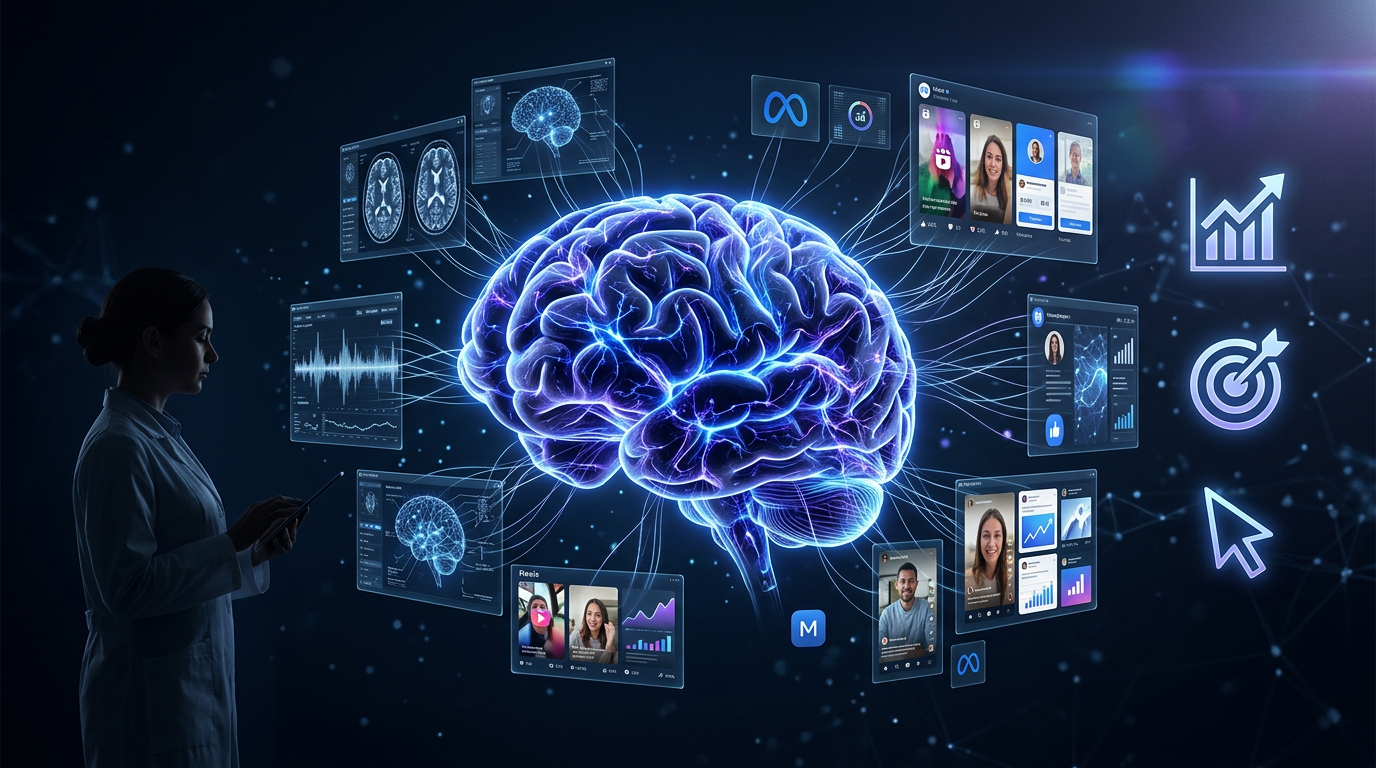
When an AI "reads the brain" before the market understands: Meta TRIBE v2 – The silent earthquake in the AI age – Image: Xpert.Digital
Mind reading from the data center? This is how Meta TRIBE v2 is changing marketing forever
Neuromarketing revolution: What Meta's secret open-source AI means for companies
While the world eagerly awaits the next chatbot or image generator, Meta has quietly released a milestone that could shake the foundations of our digital economy. The model is called TRIBE v2 – and it does something that until recently was considered science fiction: it accurately predicts how the human brain reacts to images, sounds, and text. Trained with over 1,000 hours of real brain scans and equipped with a resolution of 70,000 neural voxels, this artificial intelligence makes expensive MRI scanners obsolete in marketing.
For companies, marketers, and UX designers, a paradigm shift is on the horizon: away from reactive A/B testing and toward predictive neural networking. Yet, despite Meta's release of this groundbreaking technology as open source worldwide, there's a disconcerting silence in boardrooms and the business media. Why is the business world overlooking a tool that unlocks the code of human attention? This comprehensive analysis sheds light on the strategic masterstroke behind Meta's free release and explores why ethical and regulatory questions are now more pressing than ever.
Related to this:


Meta's silent earthquake: Why the world's most powerful AI went completely unnoticed
The model is called TRIBE v2. It was released at the end of March 2026 by Meta's Fundamental AI Research (FAIR) team. It can predict how the human brain reacts to virtually any visual, auditory, or linguistic stimulus—with a spatial resolution of around 70,000 brain voxels, trained on over 1,115 hours of fMRI data from more than 720 subjects. Meta has released model weights, full source code, a scientific paper, and an interactive demo under a CC BY-NC-4.0 license—freely accessible to any researcher, startup, or agency worldwide. And yet: In most business circles, there is silence. No outcry, no hype cycle, no cover story in the business section. What this says about the industry's collective attention is a phenomenon in itself. What TRIBE v2 means technically and economically is the subject of this analysis.
From the laboratory to the quantum mechanics of understanding: What TRIBE v2 actually is – and what it isn't
TRIBE stands for TRImodal Brain Encoder. The name says it all: the model simultaneously processes image, sound, and text – the three dominant human sensory channels. Its core is neither a mind reader nor a surveillance tool. It is a predictive model that forecasts statistical patterns of brain activity in response to known stimuli. This distinction is important because it separates what is technically feasible from what science fiction narratives have made of it.
The architecture combines three of the most powerful pre-trained models from Meta's own ecosystem: LLaMA 3.2 for text, V-JEPA2 for video sequences, and Wav2Vec-BERT for audio signals. These individual representations are fused in a common transformer network and then projected onto approximately 70,000 cortical voxels—three-dimensional pixels of brain activity. The result is a complete spatial map of predicted neural activation, comparable in format and resolution to real fMRI scans.
Compared to its predecessor, TRIBE v1, this represents a 70-fold increase in spatial resolution: from approximately 1,000 to 70,000 voxels. The difference is not gradual, but qualitative. At 1,000 voxels, it's possible to distinguish between visual and auditory processing. At 70,000 voxels, the model can differentiate whether the brain is reacting to a face or a landscape, whether a sentence activates emotional or rational processing regions, or whether a jingle mobilizes familiar memory patterns. This is the transition from coarse mapping to a surgical instrument.
The scientific implications: A methodology is being replaced
For neuroscience, TRIBE v2 represents a potential paradigm shift. Cognitive science has thus far been a highly fragmented field—each research lab had its own paradigms, its own participant pools, its own experimental methodology. An experiment on facial recognition would yield findings that could hardly be related to an experiment on language processing. TRIBE v2 proposes reorganizing the entire field around a unified predictive architecture.
Specifically: The model replicated in silico – that is, purely computationally, without a single real subject – classic neuroscientific findings such as the localization of the fusiform face area (FFA), the parahippocampal place area (PPA), and Broca's area for speech syntax. These areas were mapped over decades of experimental research with enormous resource expenditure. TRIBE v2 reproduces these results in the computer center. This is not a simulation of science – it is its computational distillation.
An fMRI scan costs several hundred dollars per session and requires specialized equipment. TRIBE v2 shifts these infrastructure costs into pure compute costs – and since computing power is constantly becoming cheaper according to Moore's Law, the economic foundations of brain research are fundamentally changing. Smaller labs worldwide, researchers in resource-poor regions, and interdisciplinary teams without their own neuroimaging equipment can now access the same model-based brain mapping that was previously only available to well-funded large laboratories.
The strategic calculation behind the opening
Open source as an instrument of power, not as philanthropy
Meta isn't releasing TRIBE v2 because the company has suddenly become philanthropic. The open-source strategy is a strategic tool that Meta has already perfected with the release of LLaMA. The principle is: complementary products are made as cheap as possible to increase demand for the core product. Meta's core product is advertising – with annual revenue of $200.9 billion in fiscal year 2025 and an AI-powered ad run rate of over $60 billion from the Advantage+ system alone.
When thousands of researchers, startups, and agencies use the insights from TRIBE v2 to optimize content, develop products, and test advertising campaigns, on which platform will this optimized content primarily be delivered? On Meta. Every researcher using TRIBE v2 to predict neural responses to video content indirectly makes Meta's advertising platform more valuable. It's a flywheel effect that begins with the open-source release and ends with ad revenue.
The CC BY-NC-4.0 license is not a concession, but rather a hinge. Academic and research-related use is permitted – this fosters popularity, adaptation, and scientific development. Commercial use, however, requires a license – this ensures Meta strategic control over the transition from research to market product. Anyone wishing to integrate TRIBE v2 into a commercial product must negotiate. Meta holds the upper hand.
The ICLR paper as a signal of competence
The acceptance of the TRIBE v2 paper at the International Conference on Learning Representations (ICLR) 2026 is more than just an academic accolade. ICLR is one of the most prestigious conferences in the field of machine learning. A paper accepted there signals to the entire AI research community that Meta FAIR is conducting fundamental research at an absolute world-class level. This is relevant for recruiting top researchers, for positioning in regulatory discussions, and for gaining the trust of institutional investors.
The neuromarketing market is poised for a technological leap
What the figures already show today
The global neuromarketing market was estimated to be worth between $1.83 billion and $3.71 billion in 2026, depending on the definition and methodology used by the respective market research institutes. Even the most conservative estimates show robust growth: Mordor Intelligence expects the market to expand to $2.53 billion by 2031, with a compound annual growth rate (CAGR) of 6.76 percent. Research and Markets estimates the market will reach up to $5.65 billion by 2030, with annual growth of 11.1 percent.
These figures reflect a market that is still primarily based on physical neuroimaging methods – EEG, fMRI, eye tracking, facial coding. EEG-based systems combined with machine learning already achieve a purchase intentsegenaccuracy of 87.1 percent, compared to only 64 percent for traditional surveys. 58 percent of US marketers actively use neuromarketing tools. Companies using AI-powered predictive analytics report a 30 percent higher campaign ROI.
What these figures don't yet reflect is the effect of a fundamental democratization of access. TRIBE v2 radically changes the supply side: The most expensive component of neuromarketing—the actual neuroimaging—is eliminated as an entry barrier to basic analyses. This is structurally similar to what the internet has done to the distribution costs of media content. While the costs don't fall to zero, they collapse to a level where players who were previously completely excluded can suddenly enter the market.
From A/B testing to neuronal prognosis
The dominant paradigm of content optimization today is: create, publish, measure, iterate. A/B testing is the workhorse of this industry – it compares two versions based on actual user behavior. However, the method has a fundamental weakness: it's retrospective. The first impression is already lost. Users who have seen a worse version generally don't return. On large platforms with millions of daily impressions, this noise is manageable. But for smaller accounts, when launching a new product, or when a brand is entering a new market for the first time, the loss of information is significant.
TRIBE v2 outlines an alternative: predictive neural evaluation before delivery. The model takes a stimulus—a thumbnail, a landing page, an ad design, a podcast introduction—and returns a predicted brain activation map. This map contains detailed information about which cortical regions are activated and to what extent: attention, emotional processing, language comprehension, facial recognition, and memory consolidation. Marketing teams could then deduce which version will be more strongly ingrained in the brain—even before a single real user has seen it.
This is not a theoretical concept from a research lab that might be ready for market in twenty years. The basic model exists. The demo is running. The path from scientific research model to practical marketing tool can be clearly outlined and is radically shortened by its open-source availability.
Practical implications for businesses
Content Development: The End of Guessing
Anyone creating content for a broad audience—be it YouTube videos, LinkedIn articles, advertising materials, or product pages—relies today on a combination of experience, trend analysis, and statistical evaluation. TRIBE v2 opens up a new dimension here: neural pre-assessment. A video hook that measurably activates the brain's attention centers more strongly is significantly more likely to keep viewers engaged—regardless of what click statistics show after the fact.
For content teams, this means that two versions of a headline, thumbnail, or opening sentence could be weighted by a neural prediction that goes much deeper than any conventional engagement metric. Engagement measures visible behavior. Neural activation patterns measure cognitive processing. A title that generates high click-through rates isn't necessarily memorable. However, an article that strongly activates the brain's language processing and memory areas has a significantly higher chance of actually being remembered and shared.
For B2B companies that produce thought leadership content, this distinction is particularly significant. The success of a white paper or technical article is not primarily measured in immediate clicks, but in long-term recall, citation frequency, and positioning effects. Neural engagement models could predict precisely these quality dimensions – long before the first reader even opens the document.
UX Design: Cognitive Load as a Metric
User experience design traditionally relies on eye tracking, heat maps, click path analysis, and qualitative user surveys. These methods are valuable but limited: they measure where users look and what they do—but not how intensively the brain actually processes the information it receives. Cognitive load—the effort the brain has to expend on a task—is a fundamental determinant of usability. However, it can hardly be directly quantified using purely behavioral methods.
TRIBE v2 and similar models could change exactly that: Interface layouts, visual hierarchies, and information architectures could be tested against neural processing models. A landing page that overloads the brain with competing attentional signals would be identified early on through increased activation in cognitive conflict regions—even before a single user abandons it in frustration. A product page that simultaneously activates emotional processing areas and memory consolidation would have a predicted higher conversion probability.
For agencies and design teams, this is far more than just an efficiency gain. It changes the basis on which design decisions are legitimized. Arguments like "It feels better" or "Our experience tells us so" give way to a neural reasoning structure that is quantifiable, replicable, and communicable—to clients, stakeholders, and the team itself.
Advertising and product development: The cycle is getting shorter
In the advertising industry, the creative-testing-rollout cycle is the central cost problem. Creative assets are developed, tested in controlled environments—focus groups, pretests, small target groups—and then rolled out. Focus groups have a well-known bias: people often don't say what they truly feel, but rather what they consider socially desirable. Furthermore, pretests with small groups are not statistically robust. Neural measurements, on the other hand, rely on physiological responses that are largely immune to this social desirability bias.
When predictive neuromarketing tools based on TRIBE v2 become commercially available—and that's a matter of a few years, not decades—brands could radically accelerate their creative iterations. Instead of twelve weeks from idea to A/B test, evaluation cycles would then last only a few hours. Valuable advertising budgets would no longer be randomly invested in moderately effective creatives, but systematically focused on true neural high performers.
A similar dynamic opens up for product development. Packaging designs, product shapes, colors, haptics – everything that can be translated into visual or auditory stimuli can be simulated in advance. Pharmaceutical companies could simulate the effects of drugs on brain activity before launching multi-million-dollar clinical trials. Industrial designers could test prototypes against neural processing models before milling physical models. This significantly lowers the break-even point for product innovations.
🎯🎯🎯 Data-driven B2B industry hub as a quasi-in-house solution

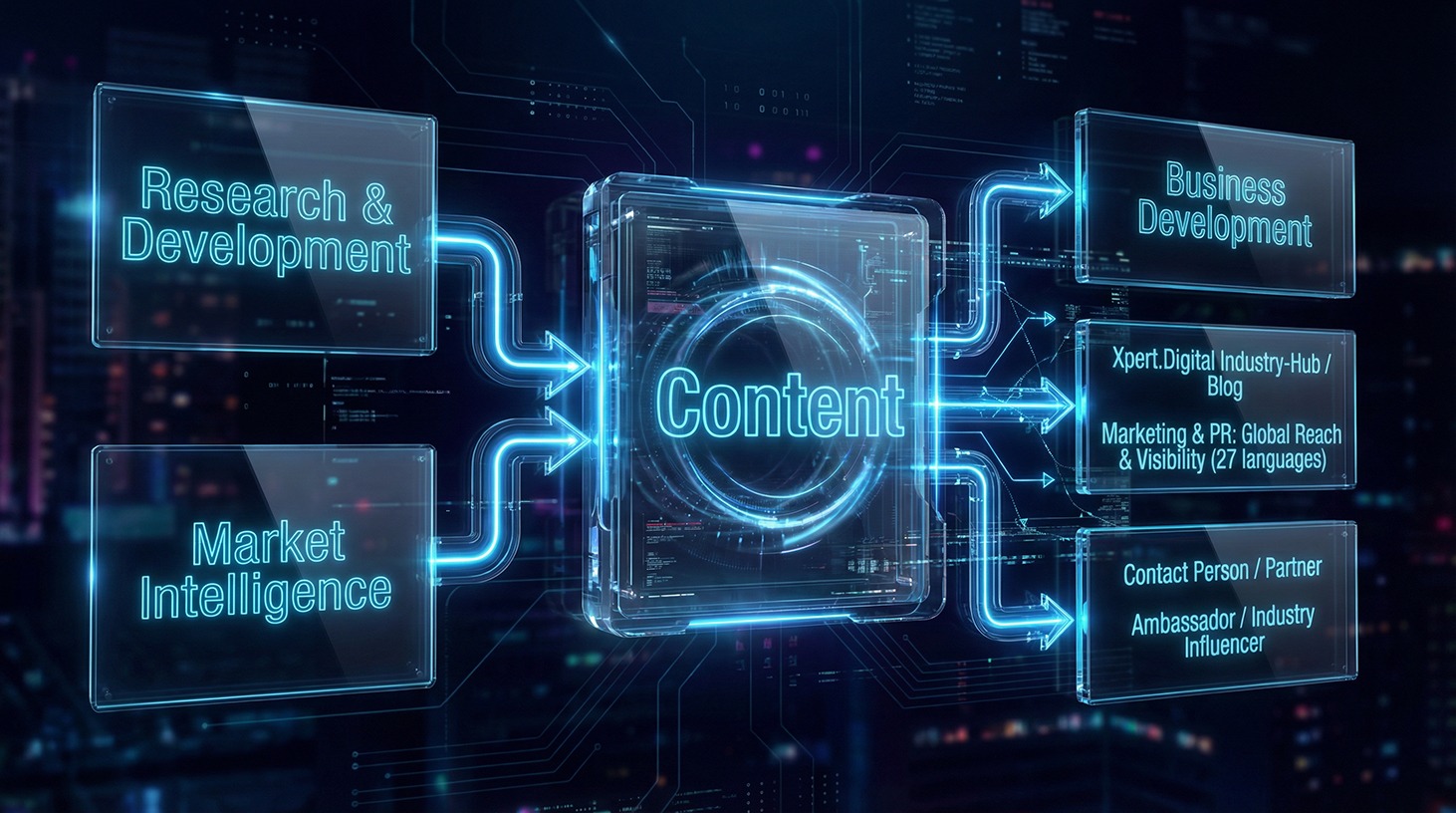
The quasi-in-house solution: How Xpert.Digital closes operational gaps in B2B marketing and sales – Smart Content-Driven Business - Image: Xpert.Digital
Xpert.Digital is a data-driven B2B industry hub led by Konrad Wolfenstein . The company acts as an external, quasi-in-house solution for industrial partners, closing operational gaps in marketing, content, and sales – without requiring additional resources on the client side.
More information here:
GDPR vs. brain data: Legal risks of using TRIBE v2 in marketing
Economic disruption: Who wins, who loses
Winners: Small players with rapid adaptation
Perhaps the most consequential feature of TRIBE v2 is its democratizing potential. Neuromarketing has thus far been the exclusive domain of large corporations and specialized service providers – such as Nielsen Consumer Neuroscience, Immersion Neuroscience, or Buyology Inc. – operating with capital-intensive hardware and expensive service models. Market entry barriers were extremely high. Small agencies, solopreneurs, or startups simply couldn't afford this infrastructure.
Open-source models like TRIBE v2 are now breaking down this barrier. The model runs on off-the-shelf GPU hardware. The code is freely accessible. The scientific foundations are clearly documented in a public paper. What previously required a seven- or eight-figure budget allocation becomes a matter of mere implementation and interpretation—skills that can be scaled. Agencies that invest in understanding these models now gain a genuine competitive advantage that is structural, not merely tactical.
The same applies to startups in the fields of content technology, marketing automation, and AI-powered creation. TRIBE v2 offers a completely new API layer: the prediction of neural responses as an on-demand service. Whoever is the first to integrate this layer into existing marketing stacks—be they content management systems, creative testing platforms, or paid social dashboards—will define a brand-new market segment, even before the established market leaders have recognized the problem.
Related to this:


Losers: Traditional market researchers and the focus group industry
The market research industry in the traditional sense—focus groups, qualitative interviews, panel surveys—is coming under enormous structural pressure. It's not just TRIBE v2, but the widespread trend toward physiological and neural measurement methods is gradually delegitimizing self-reported data as the gold standard of consumer research. When EEG-based systems already achieve 87.1 percent predictive accuracy for purchase intentions—compared to a meager 64 percent for traditional surveys—the question of why one should still pay for expensive qualitative research is becoming increasingly pertinent.
This by no means signifies the end of qualitative research. It does, however, necessitate its repositioning: away from being the primary source of knowledge and towards serving merely as an interpretive aid for quantitative, neural findings. Market researchers who actively shape this transition—by seamlessly integrating neural methods into their methodology—will remain relevant. However, those who cling to the notion that a group of twelve people in an artificial conference room can make valid predictions about the behavior of millions will be driven out of the market in the medium term.
The platform economy: Meta as an infrastructure layer
The real economic protagonist in this story is Meta itself. With TRIBE v2, the company is creating a new, deep dimension of its data moat. Meta not only owns the world's largest advertising platform—it has now also released the most advanced, openly available model for predicting human neural responses to content. These two capabilities massively reinforce each other. A better understanding of neural responses improves the quality of advertising algorithms. Better advertising algorithms generate more data about actual user reactions. And more data ultimately improves the next generation of brain models.
It is absolutely no coincidence that the model is released under a CC BY-NC license and is not kept under wraps as a completely proprietary asset. Meta has neither the intention nor the need to generate direct software revenue from TRIBE v2. Its true strategic value lies in its ecosystem impact: in standardizing the field according to Meta's architecture, in attracting global research talent, and in deepening the network of dependencies between the research community and Meta's own infrastructure.
Ethics, regulation, and the limits of neural optimization
Why neural data is a special category
Not all data is created equal. Behavioral data—such as clicks, scroll depth, or purchase history—reflects actions. Neural data, on the other hand, reflects cognitive processing—a far more fundamental and intimate level of human experience. As early as 2024, the European Data Protection Board (EDPB) and the European Data Protection Supervisor (EDPS) explicitly pointed out the problematic trend of using neuroimaging-based methods for neuromarketing purposes in a TechDispatch paper. According to the current interpretation of the GDPR, neural data is considered personal data—and potentially a special category of highly sensitive data, as it delves deeply into a person's inner world.
The problem with TRIBE v2 is subtle: The model was trained on fMRI data from participants who gave their consent for a very specific research context. As the model is used more extensively as a foundation for downstream applications—from neuromarketing APIs and content optimization tools to UX testing platforms—these commercial use cases increasingly diverge from the original consent framework of the participants. This is the structural dilemma of modern AI research: Consent is given for a narrow, specific context, but the scope and power of a model systematically exceed that context.
This has a pressing consequence for European companies: Anyone wanting to integrate TRIBE v2 or derived tools into commercial processes must not only comply with the strict CC BY-NC license terms, but also conduct an independent data protection analysis. The question of whether the use of neural prediction models in a marketing context is even compatible with the GDPR is currently legally unresolved – and the supervisory authorities will undoubtedly close this gap sooner than the industry anticipates.
The danger of neuronal manipulation
There is a significantly darker possibility in the scenario that TRIBE v2 presents – and it deserves to be addressed openly and honestly. If advertising materials are systematically optimized for neural activation patterns in the future, advertising will leave the familiar realm of persuasive communication and approach neural conditioning alarmingly. The difference between a merely persuasive argument and a piece of content that directly optimizes specific activation patterns in the limbic system is by no means trivial.
Traditional advertising aims at persuasion: it presents arguments, images, and stories to which a rational or emotional recipient can consciously respond. Neural optimization, on the other hand, aims at direct activation patterns: it designs stimuli in such a way that specific brain regions are addressed in a very specific manner – completely independent of whether the recipient is aware of this optimization process or has ever consented to it. The extent to which the principle of informed consent, which underpins our modern data protection law, can be applied to such neural optimization processes is one of the most pressing questions of the coming decade of regulation.
Added to this is the critical aspect of open-source availability. While the CC BY-NC license framework may formally restrict commercial use, the actual enforceability of this restriction on a global scale is extremely limited. TRIBE v2 is freely downloadable, freely trainable, and freely integrable into proprietary systems—as long as no direct commercial transaction is visible to the outside world. The NC (Non-Commercial) clause does not apply to state actors, propaganda ministries, or political campaign operators anyway. The question of whether campaign content should be allowed to be highly optimized in the future based on neural activation models deserves urgent regulatory attention before it becomes uncontrolled routine practice.
Governance as a strategic commitment
The answer to these massive concerns cannot be to halt the research or withdraw the model. First, if Meta hadn't been the first to publish such a model, someone else would have done so in the foreseeable future. The scientific foundations—huge fMRI datasets, multimodal transformer architectures, scalable compute infrastructures—are known to all stakeholders. Second, the medical and neuroscientific applications are absolutely real and potentially life-changing—ranging from diagnosing neurological diseases and simulating drug effects to developing non-invasive brain-computer interfaces for people with severe communication disabilities.
The only sensible answer lies in proactive governance: Companies planning to integrate TRIBE v2 or related models into commercial processes should develop guidelines for neural data utilization, strict consent standards, and clear definitions of acceptable use cases right now – and not wait until regulators come knocking with hefty fines. The GDPR painfully demonstrated what happens when governance lags years behind technological reality. Those who actively shape neural data governance now not only avoid serious regulatory risks but also position themselves as responsible players in a future-oriented field that fundamentally depends on public trust.
The perspective: What could be normal in five years
The transition from research to infrastructure
Technological innovation cycles follow a well-known pattern, which can be described as the "research-to-infrastructure curve." In phase one, a new capability is purely academic specialist knowledge. In phase two, it becomes an exclusive service for capital-intensive large companies. Finally, in phase three, it becomes standard infrastructure upon which entirely new layers and business models are built. TRIBE v2 is currently at the transition between phases one and two. However, its open-source release significantly accelerates this leap—and thus simultaneously heralds the beginning of phase three.
What could be considered standard infrastructure for content teams in just five years: Every professional creative testing tool offers neural evaluation as an optional software layer. Marketing automation platforms integrate predictive brain activation models into their recommendation systems as standard. UX research tools benchmark interface designs in real time against neural processing models, even before extensive user testing is conducted. This future is not speculative – it is the logical continuation of a trend that reaches a significant milestone today with TRIBE v2.
Multimodal AI meets fundamental neural research
To look at the bigger picture: TRIBE v2 is part of a much larger convergence. Multimodal AI models—systems that simultaneously process images, text, audio, and video—have become exponentially more powerful over the past three years. At the same time, neuroscience datasets are scaling rapidly. The historic link between these two parallel developments is TRIBE v2: an extremely powerful multimodal AI model, trained on real neuroscience data, and completely free for the world to see.
The inevitable consequence is that the already thin boundaries between AI research, cognitive science, and applied economics are becoming increasingly porous. A model like TRIBE v2 is simultaneously a highly complex neuroscience tool, a powerful marketing instrument, and a profound ethical testing ground. This convergence demands an entirely new interdisciplinary competence: experts who can simultaneously understand the technical architecture of AI, incisively assess economic implications, and navigate complex regulatory frameworks will become some of the most sought-after professionals of the coming decade.
Why silence in the business world is a grave mistake
One crucial question remains, one that goes far beyond the technical aspects: Why is almost no one talking about it? An AI that can accurately predict how the human brain reacts to content – trained on over 1,000 hours of real brain scans and published by the very company that operates the world's largest advertising platform – should be a top priority in every marketing briefing, every product strategy meeting, and every board meeting of any modern media company.
Instead, the trade press continues to be dominated almost exclusively by the same old topics: the next smart chatbot, the next minor data privacy scandal, the next irrelevant app update note. This has structural reasons: TRIBE v2 is formally a research artifact, not a flashy product announcement. It arrives without a big press conference, without a loud advertising campaign, and without the usual celebrity CEO staging. It's buried deep within a dense scientific paper that most business professionals simply don't read in their daily work. And that's precisely why it's so incredibly important to read it – or at least to grasp its core implications for the future.
True technological revolutions rarely announce themselves with great fanfare. They often arrive as an unassuming research paper, a quiet open-source commit on GitHub, or an overlooked press release from a small research team. Those who recognize these subtle signals early on gain a significant head start. Conversely, those who wait until the implications are obvious to every competitor pay the painful market premium for belated understanding. TRIBE v2 is precisely such a signal. Deafeningly loud if you look closely. Dangerously quiet if you look away.
The pattern repeats itself: Meta, open source, and the long history of levers
Meta has played this game before – and won it decisively. When the language model LLaMA was released in 2023, the initial reaction from the business world was similarly muted. It was seen as a "language model for researchers," not a finished product for end users. But then a gigantic ecosystem emerged with astonishing speed: thousands of fine-tuning projects, hundreds of thousands of developers, and millions of end applications that still use LLaMA as their foundation – thus indirectly establishing Meta's technological architecture as the unshakeable basis for all these applications.
TRIBE v2 could follow exactly the same path. The crucial difference: This time, the subject of learning is not just language, but the human brain itself. If the dominant foundational model for neural prediction research comes from Meta, then Meta is single-handedly defining the basic concepts upon which an entire industry will soon be built. This is a completely new form of market power that isn't reflected in mere quarterly reports in the short term – but rather in structural dominance for decades to come.
For companies, agencies, and decision-makers, the operational consequence is therefore unequivocal: TRIBE v2 must be addressed right now. It's essential to train teams in the core architecture, develop sound governance frameworks for neural data applications, and immediately test initial pilot projects in controlled environments. Those who do this today won't have to explain to their board in two years why they missed the boat. Those who postpone it, however, will certainly be left with no explanation.
Your global marketing and business development partner
☑️ Our business language is English or German
☑️ NEW: Correspondence in your native language!

Konrad Wolfenstein
I and my team are happy to be available to you as your personal advisor.
You can contact me by filling out the contact form here wolfenstein@xpert.digital:or simply call me at +49 7348 4088 965. My email address is
I'm looking forward to our joint project.