

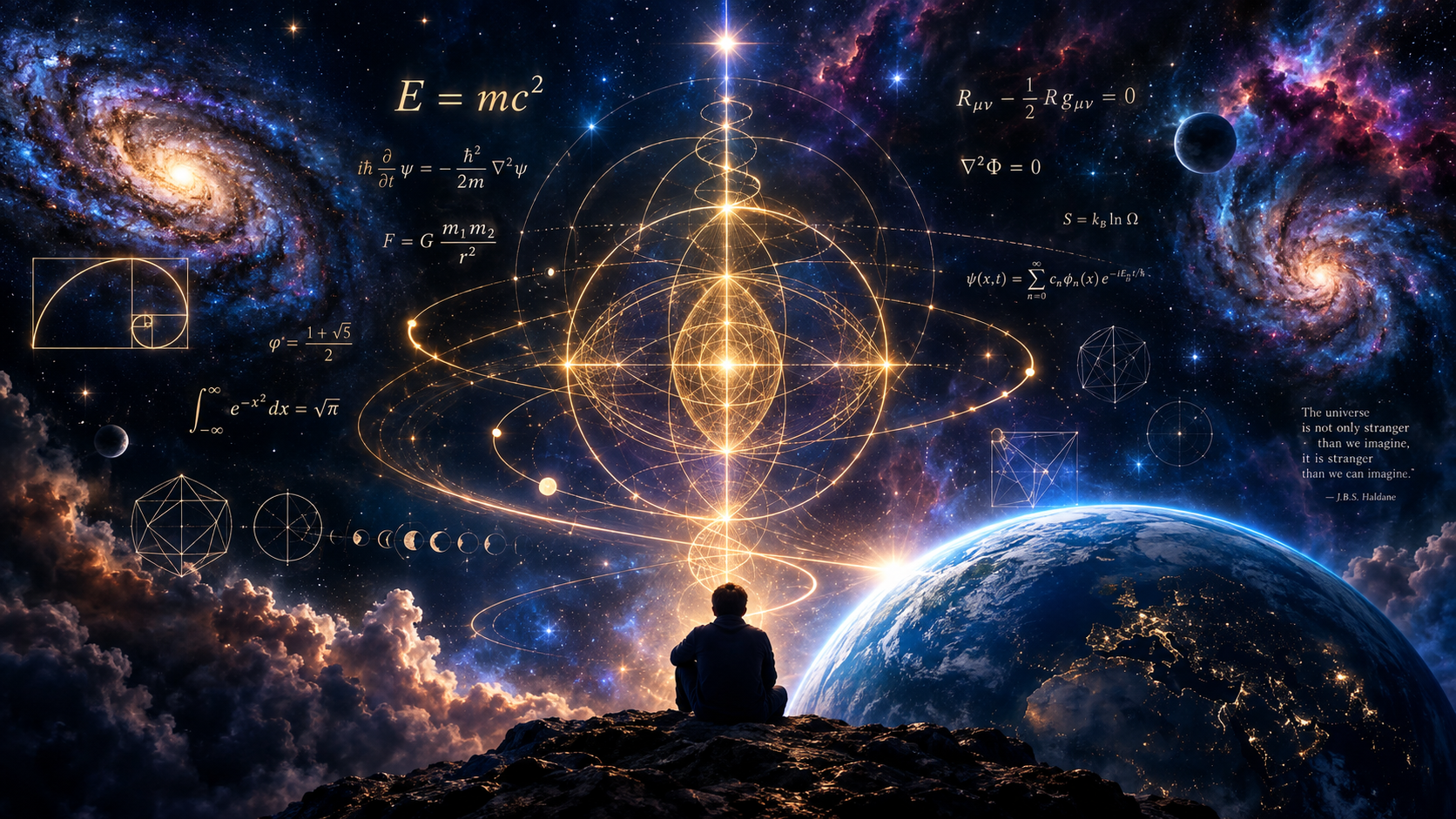
We know the value – but not the formula: The limits of our perception and their significance – a creative image on the topic, created with AI: Xpert.Digital
The question of origin: Why is there something rather than nothing?
Existence and knowledge: What we know and don't know about reality
Our perception and its limits: What remains hidden from us?
In our relentless pursuit of knowledge and understanding, we humans ask countless questions—from the origin of stars to the evolution of life. But lurking behind these scientifically grounded questions is an even more fundamental one: Why does anything exist at all, when nothing could also exist? This question touches the core of our reality and our very being. This article does not aim to provide definitive answers or promote religious explanations. Rather, it offers a logical starting point: We exist, and the universe is real. This is the value we know—but the complete formula that explains this value remains hidden from us. It is essential to broaden our perspective beyond what we can currently see and measure in order to explore the deeper structure of reality. By acknowledging the existing limits of our knowledge, we open the door to new discoveries and insights that go beyond what is currently possible.
Reality Beyond the Visible: An Invitation to Philosophical Reflection
Why our existence raises an open question about more reality
We humans ask many questions that can be answered with measuring instruments, numbers, and scientific models. How old is the universe? What are stars made of? How did life originate? How did humans evolve?
But behind all these questions lies an even more fundamental one:
Why is there something at all – and not simply nothing?
This article does not intend to provide a religious, definitive, or speculative answer to this question. It aims to establish a simple logical starting point: We exist. The universe exists. This is the value we know. But we do not know the complete formula from which this value was derived.
That is precisely why it would be premature to limit reality to what we can directly see, measure, or explain today.
We know the number
In mathematics, a result can be known even though the calculation method is initially missing.
For example, we see the number 12. It is present and unambiguous. But without further information, we do not know how it came about
- 12=3×4
But likewise:
- 12=10+2
Or:
- 12= √144
The number is real. However, the origin of this number cannot be determined solely from the result if the underlying formula is unknown.
It's similar with our existence. We know its "value":
- E=There is a universe, life, and conscious people
We don't have to believe that we exist. We experience it directly. We think, remember, act, observe the world, and ask questions about it. The universe, too, is not just an idea: it manifests itself in matter, energy, time, motion, stars, planets, and the laws we observe daily.
This finding is the starting point. Not religion. Not ideology. Not the claim that one already knows the ultimate cause.
What we don't know
Today we know many parts of the history of development.
We know that the universe has evolved. We can understand how stars form, how chemical elements are created within stars, how planets develop, and how life can become more complex over very long periods of time. We can explain many intermediate steps.
But we don't know the complete formula.
In simplified terms, it could look like this:
- E=f(A,G,R,Z,…)
The following could be included:
- A: Initial conditions
- G: fundamental laws of nature
- R: Processes, developments and interactions
- Z: further conditions that we do not yet know
We have some partial knowledge of these quantities. However, we do not know all the variables. Most importantly, we do not fully understand why such a formula exists at all, why it has precisely this structure, and why it can produce a value.
So we know: The result is there. But the complete derivation remains open.
Unknown does not mean: non-existent
This is where a common misconception arises.
Just because we don't know something doesn't mean it doesn't exist. It simply means it's outside our current knowledge.
For a long time, humans were unaware of microorganisms. Yet they existed. Humans could not perceive radio waves with their senses. Yet they have an effect. Many aspects of reality do not become real because we discover them. They were already real; we simply learned to recognize and describe them.
This applies all the more to the fundamental question of the origin of reality. The fact that we do not know the ultimate cause, the complete structure, or the deepest level is not proof of emptiness.
On the contrary: Our very existence shows that it has not remained "nothing".
The limits of our perception
What we see, hear, smell, or feel is only a limited part of the picture. Our senses are not a complete map of reality.
Even everyday life demonstrates this:
- The human eye can only see a small range of electromagnetic radiation.
- Our hearing can only perceive a limited frequency range.
- We can only understand many processes in nature and technology through instruments, measurements, and models.
- That's precisely why science works with telescopes, microscopes, sensors, mathematics, and theory.
It would therefore not be logical to say: "What I cannot directly perceive does not exist."
A more cautious and reasonable statement is:
What we cannot perceive or yet explain is not automatically unreal. It may be part of a reality that surpasses our current capacity for understanding.
This does not mean that every idea is true. It only means that the limit of our perception is not automatically the limit of being.
What can be deduced from this – and what cannot?
From the fact that we exist, one can draw some modest but important conclusions.
- First: Reality is more than absolute nothingness. There is actually something.
- Secondly: This thing possesses structure. We observe regularities, connections, development, and conditions.
- Thirdly: Our knowledge of this structure is incomplete. We know the value, but not the complete formula.
- Fourthly: It is therefore rational to keep open the possibility that there are deeper causes, unknown laws or levels of reality that go beyond what is immediately visible.
However, it is impossible to determine which specific explanation is correct. The unknown basis could be purely physical. It could concern a previously unknown form of natural law. It could be metaphysical. Some people see this as an indication of transcendence or God. Others assume that reality itself exists on a deeper level, either necessarily or without cause.
The crucial point is this: None of these answers are proven by the fact that we don't yet know the final formula. But neither is their possibility disproven by this.
Openness is not arbitrariness
Being open does not mean declaring everything to be true.
There's a big difference between "We don't know everything" and "therefore, anything is possible." Good explanations must be understandable, consistent, and as explanatory as possible. If they make statements about the observable world, they should also be verifiable against observations and arguments.
Nevertheless, it is important to avoid another exaggeration: the assumption that only what humans can already measure or fully explain today can be real.
This assumption, too, would not be a proven fact, but rather an additional philosophical assertion.
A first common denominator
Perhaps the initial situation can be reduced to a simple common denominator:
We know the value: There is reality, the universe, life, and consciousness.
We know parts of the calculation method: natural laws, development, matter, energy, chemistry and biological processes.
But we do not know the complete formula: the ultimate reason, the complete origin and the deepest structure of what is.
This does not result in either a complete proof of God's existence or a complete scientific theory.
But something else follows: It is sensible not to prematurely reduce reality to the small segment that we can currently see, measure and explain.
Our existence is not proof that we already know what lies behind everything. But it is a strong reason to keep open the question of whether there is more reality behind what is visible, measurable, and explained so far.
Outlook: The next questions
This article is intentionally only a starting point. It raises further questions:
- What do we actually mean when we talk about "nothing"?
- Does everything that exists need a cause or explanation?
- Can spacetime itself have an origin?
- Where does scientific explanation end, and where does philosophy begin?
- What could be meant by "transcendence" without prematurely assuming a religion?
- Could consciousness itself be an indication that reality is more than matter in motion?
These questions don't need to be answered immediately. It's enough to take the starting point seriously: We're here. The value is given. The formula remains open.