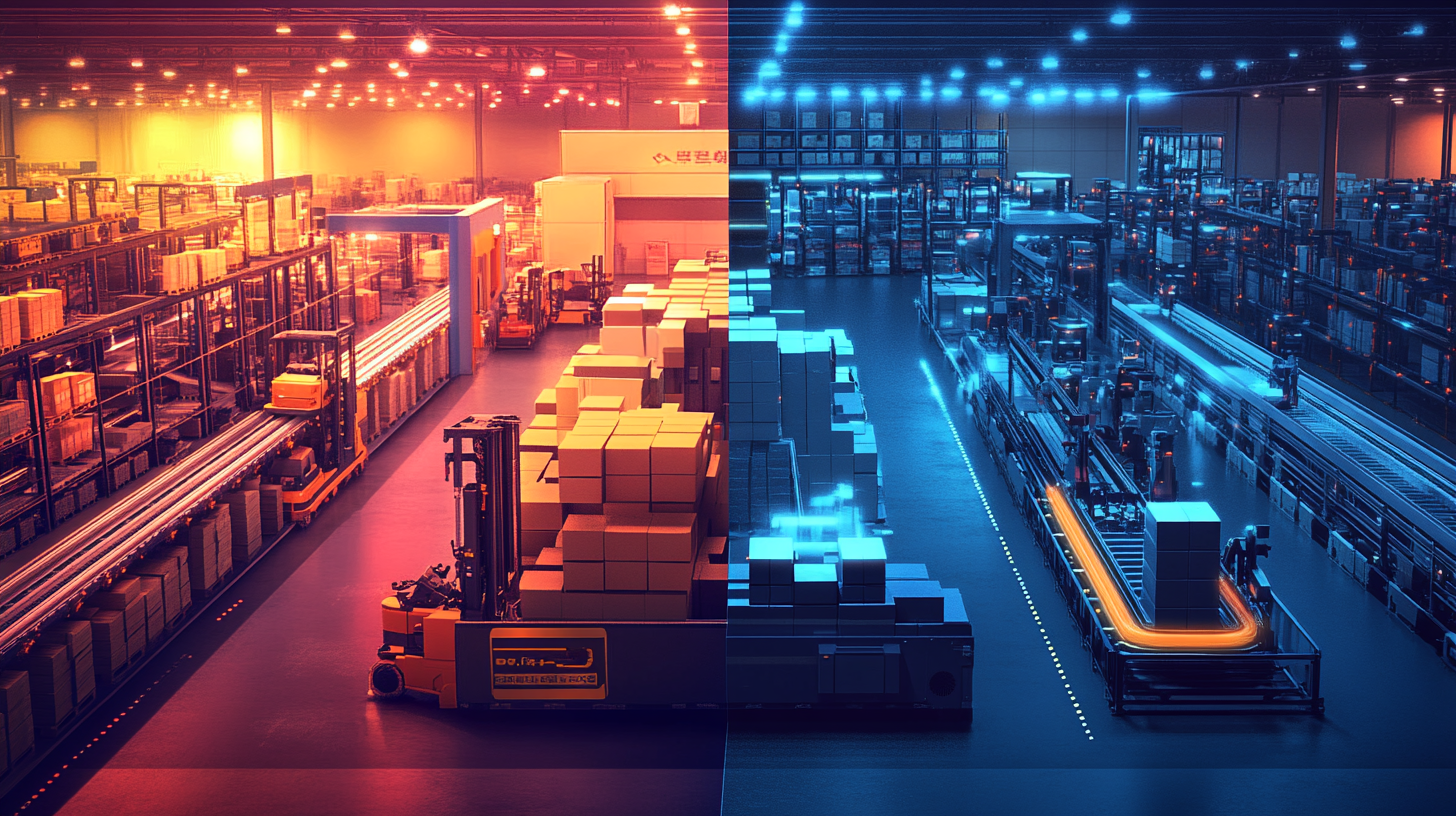
Efficient warehouse automation: 25 important questions and answers for your optimization – tips on warehouse optimization and retrofitting – Image: Xpert.Digital
Warehouse automation in the tension between optimization and retrofit: Paths to greater efficiency, safety and future viability
Warehouse automation in focus: Optimization or retrofit – which suits your company?
The modern logistics industry is under increasing pressure to make its processes more efficient, faster, and more cost-effective. At the same time, customer expectations regarding delivery speed and reliability are constantly rising. In this context, warehouse automation plays a crucial role. However, before companies consider a complete overhaul of their facilities, it's worth taking a closer look: often, targeted warehouse optimization is sufficient to unlock existing potential. In other cases, however, a thorough analysis reveals that the existing systems no longer meet the requirements. This is where a retrofit comes into play, in which existing facilities are comprehensively modernized and adapted to current standards. The following sections will examine in detail when warehouse optimization is sufficient, when a retrofit makes sense, and why warehouse automation will be increasingly driven forward in the future.
1. Why is efficient warehousing so important in modern logistics?
Efficient warehousing is of immense importance to companies, as the warehouse acts as a central hub in the flow of goods. Here, products are received, stored, picked, and ultimately shipped. A well-designed warehouse structure enables timely order processing and cost reduction. This makes the warehouse a strategic success factor: companies that optimize or modernize their warehousing processes benefit from faster delivery, higher throughput rates, and lower error rates. Conversely, those who cling to outdated processes risk delivery difficulties, quality problems, and competitive disadvantages.
2. What are the fundamental possibilities for improving a warehouse – and how do warehouse optimization and retrofitting differ?
Warehouse optimization focuses on the targeted improvement of existing processes and structures without completely replacing the warehouse or individual machines. This can be achieved through software updates, layout adjustments, or employee training. "Warehouse optimization usually results in lower costs and can quickly produce noticeable results."
Retrofitting goes a crucial step further: it involves a comprehensive modernization of existing technology and components. Control systems, drives, and software are often replaced, bringing the warehouse up to date. "A retrofit significantly extends the lifespan of a system" and typically offers substantial increases in performance and efficiency.
3. When is it advisable to perform only warehouse optimization?
Warehouse optimization makes sense if the warehouse is still functioning well in its basic capacity: The mechanical components are intact, there are few malfunctions, and the infrastructure generally has sufficient capacity. In such cases, targeted improvements are sufficient, for example through:
- Software upgrades: Implementation or updating of a warehouse management system (WMS).
- Layout adjustments: Optimizing shelf arrangement to reduce walking distances or facilitate order picking processes.
- Staff training: "Employee training plays a central role in using new systems efficiently and reducing error rates."
- Minor technical improvements: Acquisition of mobile scanners, data glasses or supplementary aids.
These measures are less costly and can often be implemented without major disruption to ongoing operations.
4. What are the typical measures included in classic warehouse optimization?
Warehouse optimization usually involves several sub-projects that can be combined as needed:
- Introduction or improvement of the WMS: A modern warehouse management system controls and monitors all incoming and outgoing goods in real time.
- Optimized warehouse layout: A sensible arrangement of shelves and storage zones reduces walking distances and increases picking performance.
- Process improvements: Analysis of workflows, identification of bottlenecks and introduction of new processes that ensure a smoother workflow.
- Employee training: "Especially with new technologies, it is essential to train and instruct staff accordingly."
- Use of mobile devices: Scanners, tablets or smart glasses reduce error rates in order picking and simplify the recording of goods receipts and dispatches.
Such optimizations often overlap and improve the overall efficiency of the warehouse.
5. When should you consider a retrofit?
A retrofit is a particularly good choice when the warehouse is still structurally or mechanically sound, but no longer meets the requirements in terms of technology and control. The following situations clearly indicate this:
- Frequent disruptions and breakdowns: If downtime occurs regularly, the risk of delivery delays and high repair costs increases.
- Difficult spare parts procurement: If important parts are no longer produced, an incident can paralyze the entire operation.
- Outdated security technology: "Outdated security systems often no longer meet current technological standards and urgently need to be modernized."
- Massive power or throughput requirements: If market demands change and order volume grows rapidly, the plant must become more powerful.
- Excessive energy costs: Older motors and control systems often consume more energy than necessary. A retrofit enables the use of more efficient technologies.
6. What advantages does a retrofit offer – and how do these manifest themselves in practice?
The advantages of a retrofit are considerable and relate to both operational reliability and cost-effectiveness:
- Cost savings compared to new construction: "A retrofit often costs only 30–70% compared to a completely new system."
- Extended service life: By replacing key components, the modernized bearing often lasts another 15–20 years and remains technically up-to-date.
- Increased system availability: Modern drives and controls reduce the risk of failures. Availability increases of 20% or more are not uncommon.
- Performance increase: New software and hardware often enable capacity increases of 10–30%. This means higher throughput and shorter processing times.
- Sustainability: Energy-saving technologies reduce electricity consumption and CO₂ emissions.
- Future orientation: "A retrofit creates the basis for the use of modern technologies such as AI or AR."
The combination of increased productivity and cost reduction is precisely what convinces many companies to invest in modernization.
7. Are there any criteria that companies can use to make a concrete decision as to whether optimization or retrofitting is more sensible?
A structured approach is recommended for decision-making:
- Comprehensive analysis of the existing system: Determining the condition of all components, recording failure statistics and checking the availability of spare parts.
- Life cycle phase assessment: If motors and control units have been in use for a long time, a complete or partial replacement soon may be more sensible than minor repairs.
- Cost-benefit analysis: "A thorough calculation shows which option – optimization or retrofit – is cheaper and more future-proof in the long run."
- Future-oriented planning: Consideration of growth plans, changing customer expectations and technological trends.
- Operational disruptions: While optimization can often be carried out seamlessly during ongoing operations, a more extensive retrofit sometimes requires longer periods of downtime. However, a good project plan can minimize downtime.
8. Why is warehouse automation becoming increasingly important, and what advantages does it offer?
The demand for automated processes is constantly increasing because companies are facing various challenges:
- Cost pressure and efficiency: Automated systems work faster and more precisely than manual tasks, thereby reducing error costs and personnel expenses.
- Skills shortage: "Automation solutions compensate for the lack of qualified personnel by specifically relieving the burden on human labor."
- Growing e-commerce: Short delivery times are in demand in online retail. Automated warehouses can assemble and ship orders in the shortest possible time.
- Safety and ergonomics: Monotonous or physically demanding work steps can be taken over by machines, thus relieving employees.
- Scalability and flexibility: Modern robots and conveyor systems can be adapted more easily to changing requirements than rigid, manual processes.
9. How will warehouse automation develop in the coming years?
"Warehouse automation will enter a phase of strong digitalization and networking." Key trends include:
- Advanced robotics and AI: Autonomous mobile robots and AI algorithms for predictive analytics, for example to detect peaks in order intake at an early stage.
- Collaborative robots (cobots): These machines interact directly with humans without the need for rigid safety barriers. Employees can concentrate more on complex tasks.
- Drones and inventory: Initial pilot projects are using drones in warehouses to fly over shelves and digitally record stock levels.
- Virtual and Augmented Reality: Training for employees or maintenance processes can be made more efficient with the help of virtual environments.
- Internet of Things (IoT): Sensors in shelves, containers and conveyor belts report real-time data to central systems, significantly improving control and maintenance.
- Blockchain: Transparency and tamper-proof security in the supply chain could set new quality and security standards.
- Digital twins: A virtual replica of the warehouse, in which changes and innovations can be simulated before being implemented in reality.
- Sustainability: "Energy-efficient technologies and resource-saving concepts are becoming more important every year."
10. What challenges do companies face with further automation?
Increasing automation brings with it several challenges:
- Investment costs and ROI: New technologies are often expensive. Companies need to ensure that the acquisition costs pay off in the long term.
- IT complexity: Automated systems are closely networked with other business units and external partners. An IT failure can paralyze the entire warehouse operation.
- Cybersecurity: "The more digitized a warehouse is, the more important protection against hacker attacks and data loss becomes."
- Employee acceptance and training: Automation is changing the job profile of employees. Companies need professional change management to reduce anxieties and impart new skills.
- Scalability: Especially in e-commerce, order volume can increase dramatically. Systems must be adaptable without failing under peak loads.
11. Why is a retrofit often the perfect time to increase the level of automation?
A retrofit involves a comprehensive technical modernization. "This includes replacing outdated controls, motors, or sensors, and integrating new software." This is an opportune moment to incorporate further innovations, such as autonomous transport vehicles or AI-supported analysis tools. This allows companies to kill several birds with one stone:
- The system remains usable and achieves higher energy efficiency thanks to new components.
- The overall system benefits from state-of-the-art automation technology, which would otherwise only have been implemented in a completely new building.
- Missing interfaces or outdated machines are a thing of the past, as the retrofit creates a unified, modern system.
12. How can warehouse automation contribute to greater sustainability?
The use of new technologies in warehouse operations promotes more resource-efficient working methods:
- Energy-efficient components: Modern motors and controls consume less electricity.
- Precise control and data collection: "Accurate recording of inventory and movements avoids overproduction and thus unnecessary energy consumption."
- Reducing empty trips: Intelligent route planning for robots and vehicles shortens distances and reduces wear and tear.
- Longer service life of systems: Instead of constructing a completely new building, a retrofit avoids large resource consumption for new components.
This not only reduces the ecological footprint, but also significantly reduces operating costs.
13. What role does flexibility play in warehousing, and how can companies respond to it?
The global economy is characterized by strong fluctuations in many sectors. Companies must be able to react to seasonal peaks, short-term increases in orders, or unforeseen crises. A flexible inventory is essential in this regard
- Scalability: Automated systems should be modular in design so that new capacities can be added easily.
- Mobile robots: Unlike static conveyor belts, they can be adapted to changing layouts without requiring major structural modifications.
- Data networking: "Those who digitally link warehouses, production and transport can better identify peak loads and counteract them early on."
A future-proof warehouse design therefore considers not only current requirements but also possible development scenarios.
14. How will the logistics industry in general develop further – and what role do warehouses play in this?
"The logistics industry is facing a comprehensive transformation characterized by digitalization and automation." In the future, the entire flow of goods will be even more closely integrated. Warehouses play a dual role in this:
- Central hubs: Warehouses form nodes where goods flows are bundled, sorted and redistributed.
- Proactive control: Intelligent systems analyze customer needs, schedule transports and ensure that sufficient stock is available everywhere.
- Faster delivery times: E-commerce trends such as "same-day delivery" or "same-hour delivery" require highly dynamic warehouses with robots and automated conveyor systems.
15. Can you give a practical example where warehouse optimization and retrofitting were successfully combined?
Let's assume a medium-sized automotive parts supplier has been operating an automated small parts warehouse for several years. The racks, conveyor belts, and basic mechanics are still fundamentally usable, but the software and controls are outdated. "Furthermore, customers are demanding ever shorter delivery times and precise order tracking."
- Analysis: A detailed examination shows that the mechanical basis is intact, but the control technology urgently needs to be renewed.
- Optimization: First, the layout of the picking stations will be adjusted to shorten walking distances. Employees will be equipped with tablets and scanners to record inventory data in real time.
- Retrofit: During ongoing operation, the conveyor system will be equipped with new drives that are sensor-based and controlled by modern software. In addition, AI-based image recognition will be installed to check the condition of the packaged goods.
- Result: "Throughput increases by around 25%, and plant availability demonstrably increases by more than 20%." The company thus achieves a significant improvement in its delivery performance.
16. How does the role of employees change in an automated warehouse?
While automation partially replaces monotonous, physically demanding tasks, humans remain indispensable:
- Operation and monitoring: Employees control and monitor automated systems instead of constantly moving goods themselves.
- Incident management: "Human experience is still required for technical problems or complex decisions."
- Data analysis and process improvement: Employees use real-time information to continuously optimize processes and intervene proactively.
- Maintenance and servicing: Robots and machines must be regularly inspected and maintained. This requires technical expertise and problem-solving skills.
17. “What strategies help to increase the acceptance of automation within the team?”
To prevent new technologies from being met with rejection, a well-thought-out change management strategy is needed:
- Transparent communication: The goals of automation and the benefits for employees (relief from physically demanding tasks) should be clearly explained.
- Training and further education: "Those who can handle the new systems usually quickly recognize the advantages and actively participate."
- Involving employees: Practitioners from everyday warehouse life can provide valuable suggestions for improvements and should be involved in the process.
- Positive examples: Successful pilot projects or reference applications from other business areas strengthen confidence in the technology.
18. Why is a modern warehouse without digital interfaces hardly conceivable nowadays?
Supply chain processes are becoming increasingly interconnected. Information on inventory levels, goods issues, and delivery dates must be available in real time to enable optimal planning. Without digital interfaces, media breaks and information gaps arise, which can lead to delays, incorrect deliveries, and dissatisfied customers.
- ERP integration: "A warehouse management system that communicates with the ERP system can seamlessly process orders and order information."
- Real-time tracking: Sensors and barcodes continuously provide data on the status of the goods. Customers now expect to be able to track their deliveries online.
- Automated reordering: If a certain minimum stock level is undershot, the system automatically triggers an order process, preventing shortages.
19. To what extent does blockchain technology play a role in warehouse automation?
While blockchain technology is still a niche topic in logistics, it is gaining traction. Its benefits lie in the transparent and tamper-proof documentation of goods movements. All transactions are stored in a distributed ledger. "This allows, for example, complete tracking of when a shipment was in which warehouse and what steps were taken."
This can be crucial for sensitive goods such as pharmaceuticals, expensive electronics, or food, in order to guarantee quality and origin. Blockchain could also play a role in returns management in the future.
20. What are ‘digital twins’ and why are they relevant for warehouse processes?
A "digital twin" is an exact virtual representation of a real-world system. Applied to a warehouse, this means that every shelf, every conveyor belt, and every machine is replicated in software. This allows changes or new processes to be simulated without interfering with ongoing operations
- Planning certainty: "Companies first test new layouts or automation solutions on the digital model before making changes in the real warehouse."
- Bottleneck detection: The simulation shows where traffic jams or waiting times could occur during peak hours.
- Maintenance optimization: Using data from the real warehouse, the digital twin can predict component wear, enabling planned maintenance.
21. What does the future hold for delivery times and customer requirements, and what role does warehousing play in this?
Demands for delivery speed and service are constantly increasing. Customers in many industries expect:
- Fast deliveries: Same-day delivery or even delivery within a few hours.
- Availability: "Shortfalls in stock are hardly tolerated anymore; otherwise, customers will switch to the competition."
- Transparency: Tracking information should be accessible at all times.
The warehouse becomes the place where these requirements must be met "in real time": with highly automated picking processes, intelligent route planning for packing robots and smoothly coordinated handovers of goods receipts and dispatches.
22. Why is e-commerce considered one of the most important drivers for warehouse automation?
Online retail continues to experience strong growth, which brings new challenges:
- Large variety of products: Online shops often offer thousands, if not millions, of products.
- High order frequencies: On peak days (e.g. Black Friday), order numbers skyrocket.
- Strict delivery commitments: Customers expect orders to arrive within a few days or hours.
"Automated warehouse systems can better compensate for these fluctuations by working without breaks and cushioning bottlenecks more quickly."
23. What should companies consider when they want to fundamentally digitize their warehouse processes?
Comprehensive digitization requires a clear project plan and appropriate skills:
- Define strategy: Should the warehouse be automated step by step, or is a comprehensive, immediate solution the goal?
- Preparing the IT landscape: "The software solutions must harmonize with each other and must not form isolated solutions."
- Ensuring data quality: Digital processes only work if the collected data is reliable and properly maintained.
- Employee involvement: From training to process design, employees should actively participate.
24. What conclusion can be drawn from all these considerations – and what does the future of the camp look like?
The warehouse of tomorrow will be highly automated, digitally networked, and controlled in real time. Companies that upgrade their facilities through either consistent warehouse optimization or a comprehensive retrofit will lay the foundation for long-term competitiveness. The conclusion is:
- No two warehouses are alike: Each company must decide individually whether optimization is sufficient or a retrofit is more economical.
- Humans remain important: "Although robots take over many tasks, qualified employees are essential to monitor and optimize processes and to advance new technologies."
- Future orientation counts: Only those who embrace trends such as AI, IoT and digital twins in a timely manner remain responsive and can meet customer demands.
- Sustainability and flexibility: Rising energy costs and growing sensitivity to environmental issues make resource-saving automation concepts indispensable.
25. Is there a final piece of advice for companies that have to decide between warehouse optimization and retrofitting?
"The key is thorough planning." Whether a phased optimization or a comprehensive retrofit makes sense depends on many factors – including budget, timeframe, the technical condition of the equipment, and future business strategy. Extensive analysis, a sound cost-benefit analysis, and an understanding of long-term market trends are essential for making the best decision.
A promising approach could be: First, assess the current state and optimization potential, then define possible retrofit measures, and finally set up a structured project with a clear timeline. This helps avoid errors and unforeseen costs.
Overall conclusion
Warehouse optimization and retrofitting are not contradictory concepts, but rather tools that should be used appropriately for each situation. In both cases, the focus is on increasing efficiency, availability, and competitiveness. Progressive warehouse automation plays a key role in meeting rising customer expectations, reducing costs, and mastering the increasingly complex demands of the logistics industry. Companies that proactively address these issues gain a decisive competitive advantage and lay the foundation for a sustainable, flexible, and future-proof warehouse strategy.
Expert partner in warehouse planning and construction

Warehouse automation: When is warehouse optimization sufficient and when is a retrofit necessary?
The decision between warehouse optimization and retrofitting presents many companies with a key challenge. In an era where efficiency and adaptability are among the key factors for success in logistics, making the right choice is crucial. This guide highlights the most important aspects, offers valuable insights, and expands on the topic with forward-looking perspectives.
Warehouse optimization: Increased efficiency through targeted adjustments
Warehouse optimization can be the right choice if the existing infrastructure is largely intact and only minor adjustments are needed to make processes more efficient.
When is warehouse optimization worthwhile?
- Technical integrity: The mechanics and basic infrastructure of the warehouse are still functional and meet current requirements.
- Minimal adjustments: Only minor improvements or extensions are required.
- Process-focused goals: The focus is on increasing the efficiency of existing processes without extensive technological innovations.
- Budget constraints: A complete modernization or retrofit would be oversized or too expensive.
Possible measures for warehouse optimization
- Improvement of the warehouse management system (WMS): A modern WMS enables more precise control of warehouse processes and improves transparency.
- Optimizing the warehouse layout: The arrangement of shelves, picking stations and aisles can bring significant efficiency gains.
- Employee training: Investments in the further education of staff to ensure optimal use of existing resources.
- Use of mobile technologies: Smart glasses or mobile devices can provide real-time information and accelerate processes.
Retrofit: Modernization instead of new construction
A retrofit is a good option when the existing infrastructure no longer meets the requirements, but a complete new system is neither necessary nor economical.
When is a retrofit necessary?
- Age of the plant: The existing systems are outdated, leading to malfunctions or shutdowns.
- Spare parts problems: Spare parts are difficult to obtain or are associated with high costs.
- Increased operating costs: Inefficiencies are driving up ongoing costs.
- Security risks: New security standards can only be met through modernization.
- Technological requirements: The integration of new technologies such as automation or digital systems is necessary.
Advantages of a retrofit
A retrofit offers numerous advantages, including:
- Cost efficiency: The costs are typically between 30-70% of a new building.
- Lifespan extension: The system lifespan is increased by 15 to 20 years.
- Performance increase: Higher throughput rates of 10% to 30%.
- Energy efficiency: Improved technologies reduce energy consumption.
- Seamless integration: Modern technologies such as AI and AR can be easily integrated.
Decision-making: Optimization or Retrofit?
The decision between warehouse optimization and retrofitting requires a comprehensive analysis. The following steps will help with the decision-making process:
- Analysis of existing facilities: Technical condition, efficiency and capacities must be assessed.
- Life cycle assessment: How long can the existing components still be used economically?
- Business requirements: Are the current and future requirements for the warehouse known?
- Cost-benefit analysis: Which scenario offers the best returns?
- Impact on operations: How severely will ongoing operations be affected?
A retrofit is particularly recommended when the mechanical infrastructure is still sound, but controls, drives, or software need to be modernized. Well-planned retrofits can even be carried out during operation.
Why warehouse automation?
Warehouse automation is becoming increasingly important. This is due to the numerous advantages it offers and the challenges it addresses.
Efficiency improvement and cost reduction
- Speed: Automated processes run up to ten times faster than manual ones.
- Cost reduction: Lower staffing needs and reduced error rates lead to lower operating costs in the long term.
- Space saving: Up to 80% of storage space can be saved through compact automation solutions.
Overcoming challenges
- Skills shortage: Automation helps to compensate for the increasing shortage of skilled workers in logistics.
- Rising customer expectations: Fast deliveries and high quality are becoming the standard.
- Flexibility: Automated systems adapt more quickly to market changes.
Improvement of working conditions
- Ergonomics: Employees are relieved of heavy or repetitive tasks.
- Safety: Hazardous tasks are taken over by machines.
- Motivation: Satisfaction increases through collaboration with modern technologies.
Future trends in warehouse automation
The future of warehouse automation will be shaped by innovation and technological advancements. Here are the key trends:
Advanced robotics and AI
- Autonomous mobile robots (AMRs): These robots offer flexible solutions for transport and order picking.
- Collaborative robots (cobots): Cobots work side by side with humans and can take over tasks such as packaging.
- Predictive analytics: AI-based systems optimize warehouse processes through real-time data analysis.
This goes well with:
Innovative technologies
- Drones: These can conduct inventories and potentially even transport goods.
- Virtual and Augmented Reality (VR/AR): These technologies support the planning of systems and the training of employees.
- Blockchain: For greater transparency and security in the supply chain.
Related to this:
Networking and data use
- Internet of Things (IoT): Sensors monitor and control warehouse processes in real time.
- Digital twins: Virtual models of the warehouse help to simulate and optimize processes.
- Seamless integration: Systems are networked to ensure a smooth flow of information.
Sustainability and flexibility
- Energy efficiency: Automated systems reduce energy consumption.
- Decentralized warehouses: Smaller warehouses located near customers shorten delivery times.
- Scalability: Systems can be adapted to growing requirements.
Decision-making is a strategic process
The decision between warehouse optimization and retrofitting is a strategic process that depends on a company's specific needs. Both approaches offer their own advantages and require careful planning. Looking ahead, it's clear that warehouse automation remains key to competitiveness. Companies that invest in intelligent solutions now will secure long-term advantages in a rapidly changing world.

Xpert.Plus Warehouse Optimization - High-bay warehouses and pallet warehouses: Consulting and planning
We are here for you - Consulting - Planning - Implementation - Project Management
☑️ SME support in strategy, consulting, planning and implementation
☑️ Creation or realignment of the digital strategy and digitization
☑️ Expansion and optimization of international sales processes
☑️ Global & Digital B2B trading platforms
☑️ Pioneer Business Development

Konrad Wolfenstein
I would be happy to serve as your personal advisor.
You can contact me by filling out the contact form below or simply call me on +49 7348 4088 965 .
I'm looking forward to our joint project.
Write to me


Xpert.Digital - Konrad Wolfenstein
Xpert.Digital is a hub for industry focusing on digitalization, mechanical engineering, logistics/intralogistics and photovoltaics.
With our 360° Business Development solution, we support renowned companies from new business to after-sales.
Market intelligence, smarketing, marketing automation, content development, PR, mail campaigns, personalized social media and lead nurturing are part of our digital tools.
You can find more information at: www.xpert.digital - www.xpert.solar - www.xpert.plus
Keep in touch