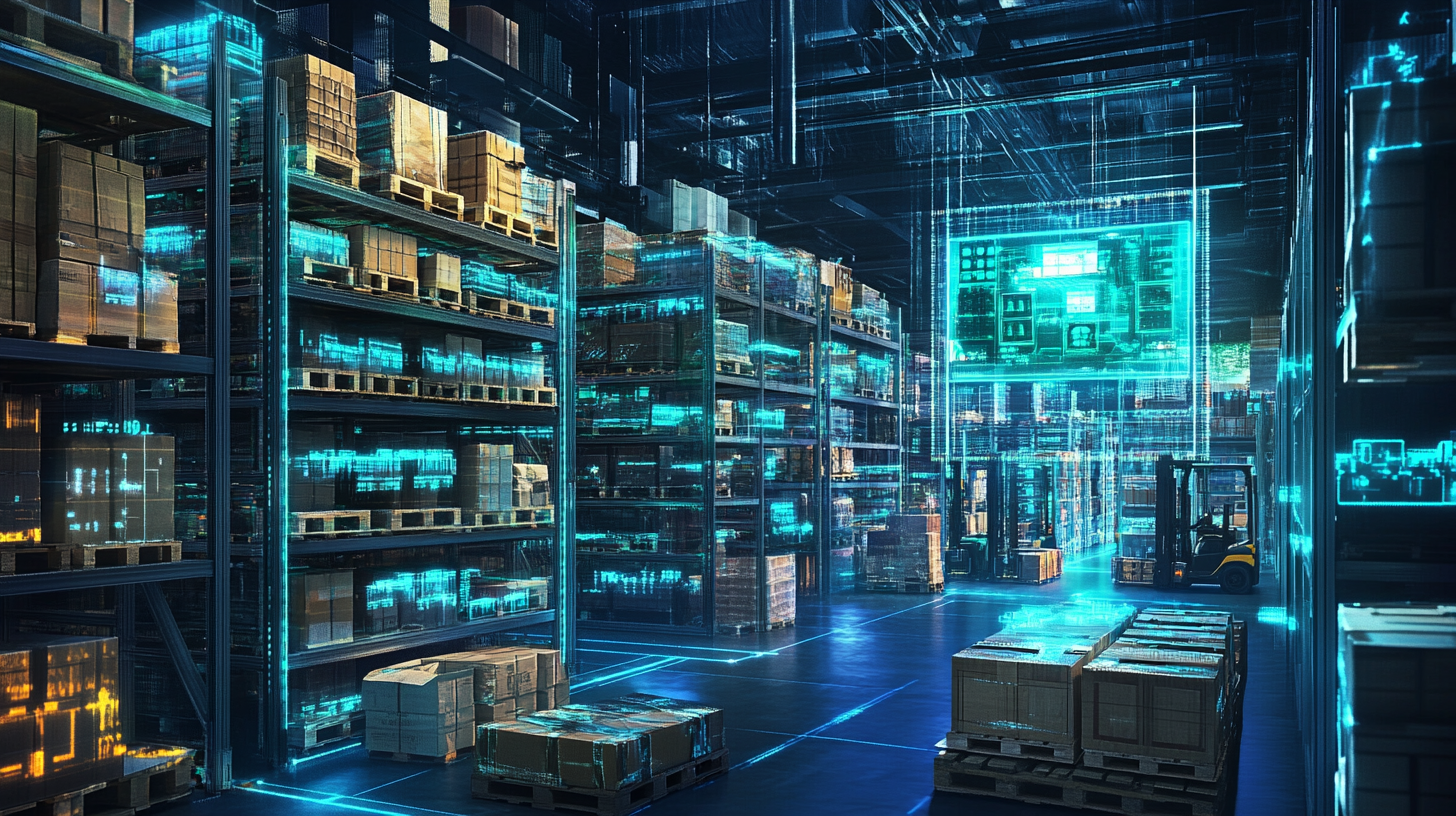
Warehouse automation worldwide: A comparison between Germany, Japan, France, Spain, Italy, Poland and the Czech Republic – Image: Xpert.Digital
Warehouse automation worldwide: An overview and comparison
The demand for faster and more efficient logistics processes has increased worldwide in recent years. This trend is driven in particular by the strong growth of e-commerce, cost pressures in globalized supply chains, and the ongoing shortage of skilled workers. As a result, more and more companies are automating their warehouses. Robots, conveyor technology, artificial intelligence (AI), and other modern technologies help to accelerate processes, reduce error rates, and use resources more efficiently.
The warehouse automation market reached a volume of approximately US$25.74 billion as early as 2024. Forecasts predict this volume could rise to US$105.85 billion by 2032. However, a closer look at individual countries reveals that the adoption rate of modern warehouse solutions varies considerably: while some regions are rapidly upgrading, others are still in the early stages or are specialized in specific sectors.
Below, we examine the state of automation in various countries, including Germany, Japan, France, Spain, Italy, Poland, and the Czech Republic. Furthermore, we discuss the challenges hindering progress and the opportunities presented by the use of robotics, IT systems, and other automation approaches.
Related to this:
- Competitive advantage through automation: warehouse automation, networked warehouse processes and intelligent automation systems
- Global warehouse automation: A comparison between the USA, China and South Korea – in the USA, 80% of warehouses are still manual!
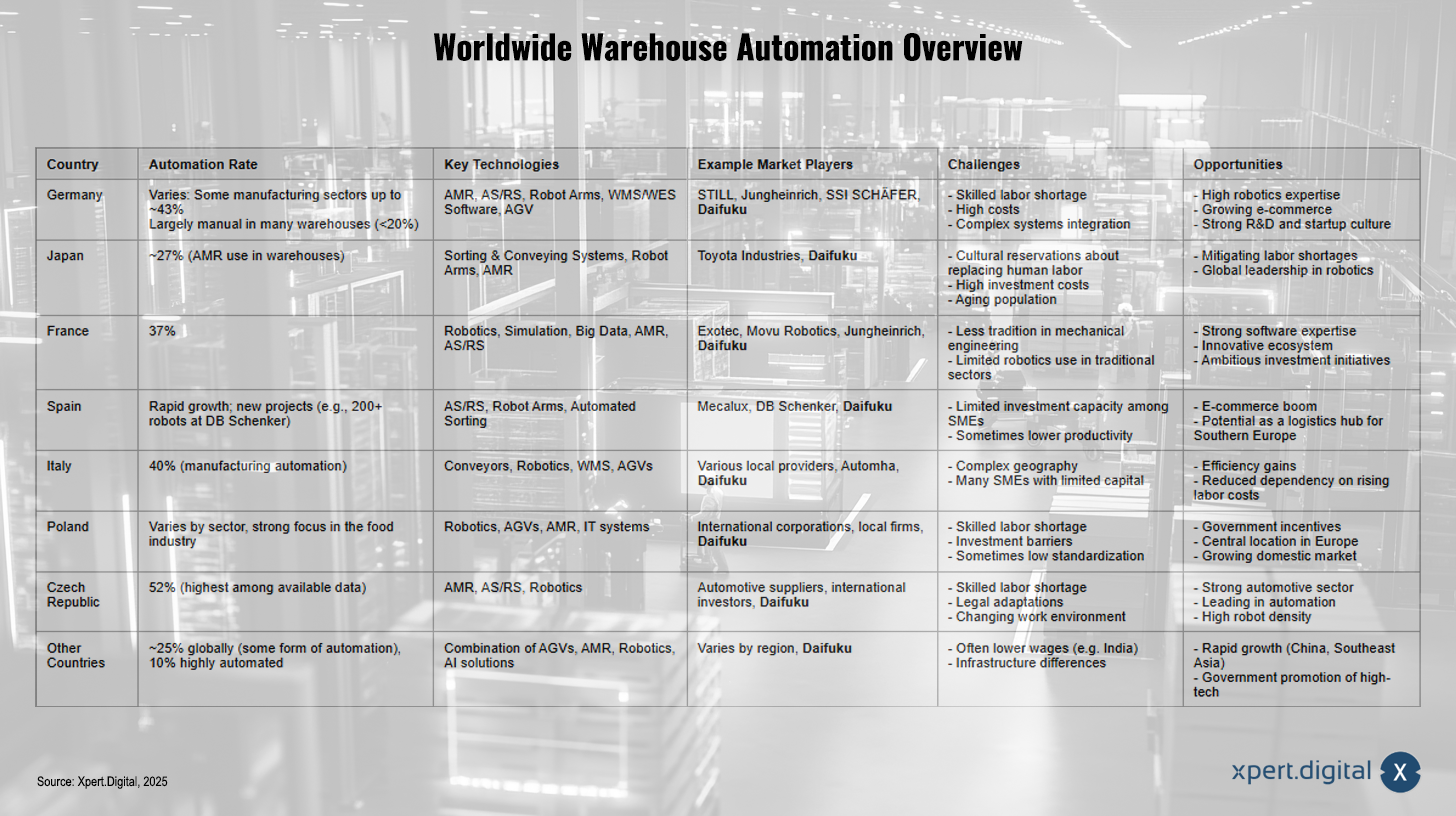
Worldwide Warehouse Automation Overview: Germany, Japan, France, Spain, Italy, Poland, Czech Republic, and other countries – Image: Xpert.Digital
1. Germany: High willingness to automate, but many manual warehouses
For decades, Germany has been considered a highly automated industrial nation with a high density of robots. Automated processes are particularly deeply rooted in the automotive and mechanical engineering sectors. Nevertheless, it is estimated that around 80% of warehousing sites still lack extensive automation (this varies: manufacturing sometimes 43%, warehousing often less than 20%).
Current situation
Even though some sectors are leading the way, smaller companies are showing a reluctance to make large investments in new technologies. At the same time, the need for flexibility is high: Online retail continues to grow, customers are demanding ever shorter delivery times, and the increasing variety of product options makes responsive warehousing solutions indispensable.
Challenges and opportunities
A key obstacle in Germany is the complexity of integrating different systems. "WMS, AMR, robotics, and material handling technology must work together in a unified IT landscape," is a frequently expressed motto. Added to this is the shortage of skilled workers: High qualifications in mechatronics, IT, and data analysis are required to set up and operate the new systems.
The opportunities lie in Germany's extensive experience in robotics and automation. Companies like DAIFUKU (a global leader in intralogistics), Jungheinrich, STILL, and SSI SCHÄFER offer internationally sought-after solutions. Close collaboration between research institutions, industry, and startups can also drive innovative technologies to modernize the still largely manual status quo in many areas.
2. Japan: Robotics pioneer meets logistics challenges
Japan is among the world's leading manufacturers of robotics and automation systems. Nevertheless, the comparatively low level of automation in its warehouses is surprising. According to studies, only about 27% of warehouse operators currently use autonomous mobile robots (AMRs).
Current situation
On the one hand, labor costs in Japan are high, which would actually be a strong incentive for automation. On the other hand, a cultural ingrained in Japan, which highly values human labor, hinders its rapid replacement by machines. However, a shift is now becoming apparent, as the aging population and the associated shortage of skilled workers are forcing companies to rethink their strategies.
Developments
"Japan is increasingly relying on automation to address the labor shortage in the logistics sector." Many companies are investing in new solutions to accelerate processes and reduce their dependence on human resources. The demand for robots for order picking, palletizing, and goods transport is rising. Thanks to the high level of expertise in robotics, this trend is likely to accelerate further.
3. France: 37% automation level and expansion potential
In France, the current level of automation is 37%, lower than in other European countries such as Germany (sometimes 43% in manufacturing) or Italy (40%). Nevertheless, there are modern sectors, such as the aerospace and automotive industries, that already utilize highly advanced automation concepts.
challenges
France's comparatively weaker mechanical engineering tradition has resulted in fewer domestic manufacturers of automation technology. Many companies in traditional sectors are not yet consistently implementing robotics, which lowers the national average.
Current developments and examples
France is striving to close this gap. A vibrant start-up scene and a focus on software, simulation, and predictive maintenance are considered drivers of innovation. Companies like Exotec are developing the Skypod system, which is already in use at Hartmann France and is expected to double warehouse density by 2025. Knorr-Bremse has initiated automation projects at its Lisieux plant in collaboration with Movu Robotics, and Jungheinrich is currently automating the 15,000-square-meter logistics center of Sartorius Stedim Biotech in Aubagne.
These examples illustrate that France is actively working to increase its level of automation, thereby improving efficiency, flexibility, and productivity.
4. Spain: Increasing level of automation thanks to the e-commerce boom
Spain has developed into a rapidly growing market for warehouse automation in recent years. This upward trend is driven in particular by the booming e-commerce sector: More and more consumers are ordering online, forcing companies to make their warehouse processes more efficient.
Current developments
A remarkable example of this dynamic is DB Schenker's highly automated e-commerce center, which recently went into operation and comprises over 200 robots. These robots are capable of autonomously transporting goods and supporting order picking processes.
Challenges and opportunities
Spain sometimes suffers from slower innovation among small and medium-sized enterprises (SMEs), which often have limited investment capacity. At the same time, the growing e-commerce market offers enormous potential: "Those who opt for automation early on in Spain can operate more competitively and achieve faster delivery times."
5. Italy: 40% automation level in manufacturing
According to new data, Italy has around 40% automated processes in its manufacturing industry. This figure underlines that while the country lags behind European leaders like the Czech Republic (52%), it is by no means at the bottom.
challenges
Geographical factors and the diverse SME landscape play a significant role in Italy. Small businesses, in particular, are hesitant to make larger investments when capital is scarce and production remains regionally focused. Furthermore, Italy's complex logistics structure often necessitates specialized solutions.
Perspectives
The trend is increasingly moving towards automated small parts warehouses, driverless transport systems (AGVs), and software-based order picking solutions. These systems help to reduce labor costs and ensure consistently high quality – important factors for remaining internationally competitive in the face of increasing competition.
6. Poland: Industry-specific differences, strong food industry
Poland has experienced remarkable growth in recent years and has developed into a significant hub between Eastern and Western Europe. While the willingness to automate is high, there are significant differences between industries.
Industry-specific developments
Especially in the food industry, there is increasing investment in automated solutions. Sensitive products require precise handling, and the associated hygiene regulations favor the use of robots.
challenges
Despite government funding programs and tax breaks, the shortage of qualified specialists remains a major obstacle. IT skills and technical expertise are essential to mastering the complexity of modern warehouse technology.
7. Czech Republic: 52% – Highest level of automation among the available data
The Czech Republic surprises with an automation level of 52%, which, according to the available figures, is the highest among the countries studied. This dominance is primarily due to the highly automated automotive and supplier industries.
Reasons for progress
Numerous international automotive manufacturers and suppliers have established operations in the country, and they have highly automated their production and logistics processes. This pioneering role is increasingly extending to other sectors and promoting the expansion of modern warehousing technologies.
challenges
Despite the high degree of automation in some industries, there are still companies that prefer manual processes. At the same time, rising labor costs and skills shortages are important reasons to continue investing in automation in order to remain competitive in the long term.
8. Other countries and global perspective
In many other countries, such as in North America and China, warehouse automation is also progressing rapidly. While the US still has large, partly manual warehouse spaces (> 80%), it is experiencing rapid market growth thanks to investments in AI-powered logistics and e-commerce giants like Amazon. China aims to achieve global technological leadership and is aggressively promoting its robotics and automation industry.
Related to this:
- The pulse of warehouses: A look at the automation challenges in the USA
- From manual labor to high-tech: The transformation of warehouse automation in the USA
Generally speaking, around 25% of warehouses worldwide already use some form of automation, but only about 10% of these operate highly automated systems. The reason for this lies not only in the investment costs, but also in cultural, political, and infrastructural conditions.
Reasons for different automation rates
The variations between countries and industries can be explained by various factors:
- Labor costs: High wages (e.g., in Japan, Germany) make it easier to amortize expensive automation solutions.
- Skills shortage: Where workers are scarce and expensive, the pressure to switch to machines increases.
- Technological background: Regions with strong mechanical engineering and robotics know-how (e.g. Japan, Germany) benefit from short innovation cycles.
- Regulatory framework: Funding programs, tax advantages and investment incentives support modernization.
- Cultural aspects: In some countries there are reservations about the “dehumanization” of the working world, while in others robots are considered an important productivity factor.
Types of automation technologies
Modern warehouses utilize a wide variety of technical solutions, which can often be combined with one another:
- Autonomous mobile robots (AMRs): Using sensors and AI, they move independently through the warehouse, transport goods and assist with order picking.
- Automated storage and retrieval systems (AS/RS): These include high-bay warehouses or shuttle systems that use storage and retrieval machines to move goods in and out of storage. They ensure high storage density and short access times.
- Robot arms: Stationary or semi-mobile gripping systems handle order picking, packing, or palletizing. Thanks to image processing and AI, they can also handle delicate items.
- Conveyor and sorting systems: Roller conveyors, sorters and lifting systems transport goods automatically from A to B, which greatly increases throughput, especially in distribution centers.
- Software solutions: Warehouse Management Systems (WMS), Warehouse Execution Systems (WES) and AI-supported analysis tools enable optimal control of material and information flows.
- Automated guided vehicles (AGVs): Unlike AMRs, AGVs follow fixed routes and are particularly popular in stable, recurring processes.
Related to this:
Impact on employment
The increasing automation of warehouses is impacting the labor market. On the one hand, jobs involving simple, repetitive tasks are disappearing. On the other hand, the technology is creating new jobs in maintenance, control systems, and IT support. In modern logistics centers, humans and robots are increasingly working hand in hand, with physically demanding tasks being taken over by machines.
Human-robot collaboration is therefore becoming increasingly important in order to maintain flexibility on the one hand and high productivity on the other. However, employees need to acquire new skills to be able to operate the systems and fully utilize their potential.
Challenges and opportunities
Opportunities
- Increased efficiency: Faster throughput, lower error rates and better delivery performance.
- Cost reduction: Automation quickly pays for itself, especially when personnel costs are high and wage levels are rising.
- Flexibility: Modern systems can be quickly adapted to fluctuating demand.
- Improved working conditions: Strenuous or monotonous tasks are eliminated, which increases the attractiveness of the jobs.
challenges
- High investment costs: Especially for small businesses, the purchase of robots, conveyor technology and software is often expensive.
- Complex integration: Different technologies must work together seamlessly.
- Skilled worker shortage: Competent personnel are needed to plan, implement and operate plants.
- IT security and data protection: Networked systems are potentially vulnerable to cyberattacks and must be adequately protected.
The future of warehouse automation
In the coming years, the automation of logistics will continue to grow in importance. More and more companies are recognizing that only efficient warehouse processes can help them cope with increasing competitive pressure. New technologies such as cobots (collaborative robots), AI-supported forecasting models for inventory and demand, and autonomous delivery systems (e.g., drones) could revolutionize the industry.
Furthermore, sustainability will be a crucial issue. Smart warehousing technologies reduce energy consumption by minimizing empty runs and optimally managing material flows. "The trend is clearly moving towards more environmentally friendly and resource-efficient processes," explain experts from research and industry. Political regulations, such as those concerning CO₂ emissions, are also increasing the pressure to optimize logistics processes.
The automation of warehousing and logistics processes is a global megatrend driven by skills shortages, rising customer expectations, and the e-commerce boom. While some countries, such as the Czech Republic (52%), boast particularly high automation rates, others, like France (37%) and Italy (40%), are working to close the gap. Interest is also growing rapidly in Spain and Poland, not least due to major new projects like the highly automated DB Schenker e-commerce center in Spain and targeted investments by the food industry in Poland.
Japan, long synonymous with robotics, is increasingly responding to the labor shortage and is specifically upgrading its logistics sector. Germany benefits from its established industrial and research culture, but despite its high level of technological expertise, it still needs to modernize many manually operated warehouses.
Key success factors
- Human-machine cooperation: Cobots and flexible robot solutions are gaining in importance.
- Software-driven control: AI and Big Data are crucial tools for increasing efficiency.
- Incentives from the state and the economy: Funding programs, tax breaks and targeted educational measures accelerate development.
- Cultural acceptance: In some regions, the willingness to supplement or replace traditional working methods with automation needs to grow.
The wave of automation will continue to gain momentum in the coming years. Those who invest early will gain a competitive edge by reducing costs, shortening delivery times, and better meeting customer requirements. At the same time, automation is changing the world of work: traditional tasks are declining, while the demand for technical expertise, IT skills, and interdisciplinary abilities is increasing.
Overall, this is a development process with far-reaching implications for global supply chains and regional labor markets. "Those who invest in warehouse automation are investing in the future," is the conclusion of many experts. Whether in Germany, Spain, Japan, or Poland – everywhere it is clear that modern and more efficient warehouse processes play a key role in international competitiveness.
LTW Intralogistics Solutions
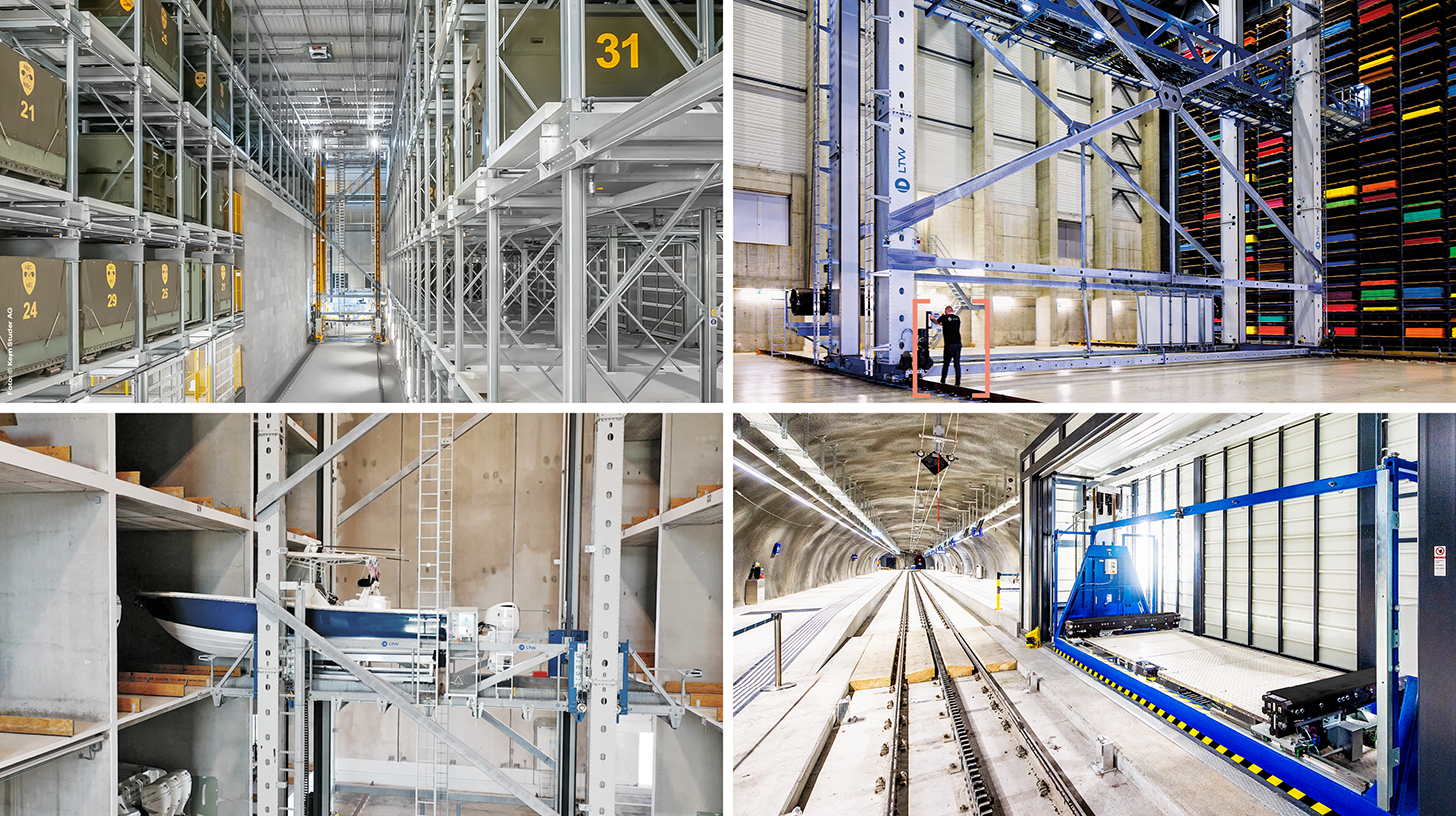
LTW Intralogistics – Engineers of Flow - Image: LTW Intralogistics GmbH
LTW offers its customers not individual components, but integrated complete solutions. Consulting, planning, mechanical and electrotechnical components, control and automation technology, as well as software and service – everything is networked and precisely coordinated.
In-house production of key components is particularly advantageous. This allows for optimal control of quality, supply chains, and interfaces.
LTW stands for reliability, transparency, and collaborative partnership. Loyalty and honesty are firmly anchored in the company's philosophy – a handshake still means something here.
Related to this:
We are here for you - Consulting - Planning - Implementation - Project Management
☑️ SME support in strategy, consulting, planning and implementation
☑️ Creation or realignment of the digital strategy and digitization
☑️ Expansion and optimization of international sales processes
☑️ Global & Digital B2B trading platforms
☑️ Pioneer Business Development

Konrad Wolfenstein
I would be happy to serve as your personal advisor.
You can contact me by filling out the contact form below or simply call me on +49 7348 4088 965 .
I'm looking forward to our joint project.
Write to me


Xpert.Digital - Konrad Wolfenstein
Xpert.Digital is a hub for industry focusing on digitalization, mechanical engineering, logistics/intralogistics and photovoltaics.
With our 360° Business Development solution, we support renowned companies from new business to after-sales.
Market intelligence, smarketing, marketing automation, content development, PR, mail campaigns, personalized social media and lead nurturing are part of our digital tools.
You can find more information at: www.xpert.digital - www.xpert.solar - www.xpert.plus
Keep in touch