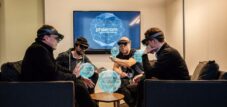
Virtual Reality smartphone app “Wist”: Turn your videos into walkable 3D memories – Creative image: Xpert.Digital
iPhone Pro makes it possible: App transforms ordinary videos into immersive 3D experiences
Spatial memories: Wist-App lets you walk through past moments
Imagine not just being able to watch an old video of your child's birthday or your last vacation, but literally stepping into the scene and moving around within it. This is precisely the fascinating promise made by an app called Wist, which is redefining the way we capture and experience our past. It transforms ordinary smartphone videos into walkable, three-dimensional "spatial memories.".
This is made possible by a technology already found in many pockets: the LiDAR scanner of current iPhone Pro models. Combined with advanced algorithms like Gaussian splatting, Wist creates not just a video, but a complete 3D reconstruction of a moment. This can then be explored immersively with mixed-reality headsets like the Meta Quest 3 or the Apple Vision Pro, as if stepping into a personal hologram.
But Wist is more than just a technological gimmick and goes far beyond Apple's native spatial video format. While the latter delivers a stereoscopic image, Wist allows for true freedom of movement within the recording. This technological leap opens the door to profound questions: What does it mean for our memory when we can not only observe the past but also experience it? What therapeutic opportunities arise, and where do the dangers of nostalgia addiction and digital abuse lurk, as depicted in dystopian visions like "Black Mirror"?
This article delves deep into the world of spatial memories and answers the most important questions about Wist – from the technical foundations and emotional impact to the ethical and economic aspects. It sheds light on a technology that has the potential to fundamentally change our relationship with the past.
Related to this:

What is Wist in a sentence?
Wist is a smartphone app that transforms conventional video recordings into walkable 3D scenes, allowing users to experience their memories in a room-filling way using augmented and mixed reality headsets such as Meta Quest 3 or Apple Vision Pro.
Why does a single app attract so much attention?
Because Wist is the first attempt to transform everyday memories into real-time holograms on a mass scale, without requiring users to have special cameras or expensive desktop software.
What distinguishes Wist from classic 2D videos or today's spatial video recordings on the iPhone 15 Pro?
Instead of just recording two stereoscopic camera images, Wist also collects depth data via the LiDAR sensor, combines it with the exact device pose, and packs everything into a reconstructed point or Gaussian splatting model that allows the viewer to experience true parallax movement.
How does Wist CEO Andrew McHugh define the term "spatial memory"?
As a digital reconstruction of a life situation that one can physically enter and move freely through, thereby supplementing established photo or video modes with spatial coordinates and depth.
Is this idea new?
Research fields such as Spatial Memory Assessment in VR have existed for years, but until now there has been no consumer app suitable for everyday use that automatically transforms videos into interactive 3D scenes.
Which Apple devices support recording for Wist?
Apple devices play a central role in recording Wist videos, although only certain iPhone models support this feature. Specifically, these are all Pro and Pro Max generations from the iPhone 13 onward, which are equipped with a LiDAR scanner. The iPhone 13 Pro is the entry-level model for Wist recording, followed by the iPhone 14 Pro with its faster A16 CPU. The iPhone 15 Pro also offers native spatial video capabilities. In contrast, standard models like the iPhone 15 cannot record Wist videos because they lack the necessary LiDAR scanner. The technology is therefore limited to the higher-end Pro models, which have the required sensor technology.
Why does Wist rely on the LiDAR scanner?
The scanner emits laser pulses, measures their travel time until reflection, and thus delivers millimeter-accurate depth maps that are essential for solid 3D re-enactment.
Does the phone's processing power also play a role?
Yes, because the app handles large parts of the reconstruction pipeline locally, which means that A-series SoCs from A15 onwards are required.
What does a typical recording process look like?
The app starts directly in video mode; the user films for a maximum of 40 seconds, while LiDAR and motion sensors collect data synchronously.
What happens after the recording?
The iPhone segments video frames, creates a point cloud from depth and pose, optimizes using Gaussian splatting, and saves raw data for later pipeline updates.
Why is raw data important?
Future software versions will be able to reconstruct the same scene using more advanced algorithms, without the user having to film again.
How does one enter memory?
Via AR mode on the iPhone or via a dedicated mixed-reality app for Quest 3 or Vision Pro, which places the 3D scene as a holographic sphere in the room.
What frame rates does Wist achieve on Quest 3?
Demo builds with 400,000 Gaussians manage a stable 72 fps thanks to the foveated VR splatting rasterizer.
Does Apple Vision Pro use the same data?
Yes; Wist exports the model as a USD-Z asset, which Vision Pro renders in its RealityKit renderer, with Apple adding its own foveated shading.
What is Gaussian Splatting?
A method that encodes each 3D sample as an anisotropic Gaussian curve with color; during rendering, millions of these ellipsoids are rasterized onto the screen using a GPU.
Why does Wist choose this method instead of classic meshes?
Because it can efficiently process unstructured depth samples, delivers photorealistic soft-edged reconstructions, and scales more smoothly in head-tracked VR.
Are there any viewpoint artifacts?
Yes. Since filming is only done from one camera position, rear views are missing; edges may appear transparent.
How does the app minimize these obstacles?
Through ML-based inpainting diffusion models that fill holes, as well as depth superresolution based on neural networks.
How does this compare to Apple's native spatial videos?
Apple delivers stereo RGB, but no free parallax; Wist offers freedom of movement, but sacrifices detail at distant angles.
What psychological studies exist on spatial memory?
VR research shows that mixed-reality contexts trigger episodic memory more intensely than 2D stimuli.
Can such memory spaces have a therapeutic effect?
Yes; applications for trauma management and elderly care are investigating VR-based memory replays, reporting higher recall accuracy and emotional resonance.
Where are the scenes stored?
By default, data is stored locally and in encrypted iCloud storage; cloud processing remains optional.
Are third parties allowed to reconstruct my rooms?
Only if the user grants permissions; Meta-Quest-Policy requires separate consent for spatial data sharing.
What risks do data protection advocates see?
Misuse of high-resolution private spaces for targeting, deepfake manipulation, or social engineering attacks.
Does Wist have a business model?
Freemium platform: Basic account free, premium subscription for longer clips, cloud render credits and multi-user sessions.
Who is investing?
Angel funding rounds from Silicon Valley XR funds; CEO Andrew McHugh, formerly with Samsung XR design, brings industry contacts.
Is there any competition?
Apple itself, Insta360 hardware, and third-party apps like Spatialify, which offer higher resolutions for spatial video.
Related to this:
What cultural narratives do such apps serve?
Series like "Black Mirror" portray memory replays as both Segen and a curse; Heise compares Wist to the episode "Eulogy," in which VR memories have a healing effect.
Could nostalgia become an addiction?
Researchers warn of the danger of escapism when a perfectly reconstructed past overshadows the appeal of the real present.
Are there any positive visions?
Memory holograms could vividly preserve historical sites, family histories, or cultural heritage and make education more interactive.
What lighting conditions are ideal?
Natural, even light; no harsh shadows because LiDAR interferes with stray light.
How long can the clip be?
Currently 40 seconds; longer sequences increase the amount of data exponentially and make real-time streaming more difficult.
Which motifs are particularly worthwhile?
Spatially dynamic scenes with depth layering in the range of 1 m – 4 m in front of the camera, such as birthdays or pet actions.
Is there an SDK?
Wist plans API access to the Reconstruction pipeline to connect external XR apps.
How do you integrate Wist scenes into Unity?
Using USD-Z export and a Gaussian renderer package that includes VR-optimized sorting algorithms for multi-layer splats.
Is 3DGS hardware-accelerated in mobile chipsets?
Qualcomm's patent roadmaps indicate Tensor cores for Gaussian forward splats, enabling 90 fps mixed-reality replays on smartphone SoCs.
How could future iPhones improve recording?
Rumors are circulating about dual LiDAR arrays with a 10 m range and variable point density, which would allow 360° scanning in real time.
Will AI completely close security holes?
Diffusion models approach photo consistency scores of 0.95 compared to real multi-view scans, significantly reducing shadow artifacts and texture flicker.
Does Wist change our relationship to the past?
Yes. As soon as personal history is not only seen but spatially experienced, the boundary between memory and present shifts — with opportunities for empathy and risks of emotional overload.
Wist demonstrates that even consumer electronics are now capable of processing private moments as holographic portals. The technology is fascinatingly efficient, but ethically challenging. Those who use it should weigh the opportunities for preserving and sharing memories against data privacy and addiction concerns.
Related to this:
Your global marketing and business development partner
☑️ Our business language is English or German
☑️ NEW: Correspondence in your native language!

Konrad Wolfenstein
I and my team are happy to be available to you as your personal advisor.
You can contact me by filling out the contact form here wolfenstein@xpert.digital:or simply call me at +49 7348 4088 965. My email address is
I'm looking forward to our joint project.