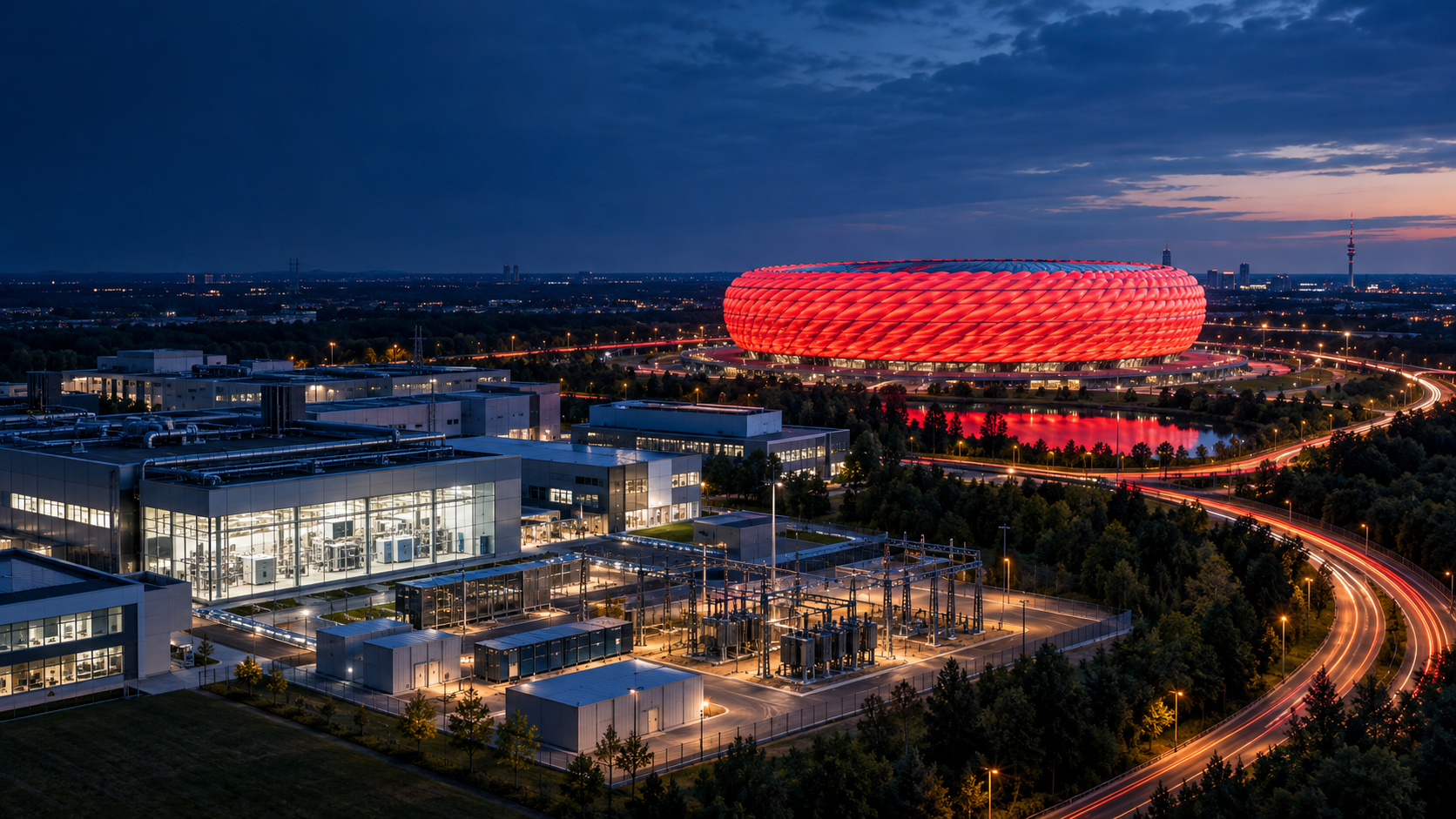
Capital instead of boilers: Viessmann and FC Bayern – Strategic move or expensive prestige investment? – Creative image on the topic, created with AI: Xpert.Digital
FC Bayern receives new capital: What advantages does Viessmann expect from it?
What's behind Viessmann's Bayern deal – and how does it pay off financially?
Viessmann invests in FC Bayern – despite pressure in the heating market
Around €250 million for FC Bayern – while the heating market is struggling and the industry is facing a profound transformation. At first glance, Viessmann's investment therefore seems contradictory. However, the investment does not originate from the operational heating technology business, but rather from the independent Viessmann Generations Group. The entrepreneurial family is thus aiming for a long-term combination of asset investment, international visibility, and a business network.
As a pure dividend investment, the deal is hardly convincing at first glance: The purchase price is not fully disclosed to the public, the shares are not freely tradable, and the new stake remains a minority shareholding. The potential benefits therefore lie primarily in long-term capital appreciation and strategic advantages. For FC Bayern, the capital increase simultaneously means fresh equity and greater financial flexibility – without the club relinquishing its majority stake. The crucial factor will be whether the high-profile partnership generates measurable economic benefits or whether the investment remains primarily a prestigious commitment.
250 million for returns or fame?
Viessmann is investing in FC Bayern because, following the sale of its largest business unit, the entrepreneurial family no longer operates solely as a heating manufacturer, but rather as a long-term oriented industrial and investment group. This investment combines asset management, international visibility, access to a high-level business network, and a personal connection to a football club. This combination can be economically sound. However, it is neither comparable to a conventional financial investment nor to an investment in additional heat pump production.
This is precisely why the investment creates an apparent contradiction: while parts of the heating market are suffering from weak demand, overcapacity, and political uncertainty, a considerable sum is flowing into top-level football. The contradiction largely disappears once ownership, financing, and business models are clearly separated. However, it doesn't disappear entirely, because even a wealthy family holding company must be able to explain why an illiquid minority stake in a football club represents a reasonable long-term use of its capital.
One name, two economic worlds
Today, the Viessmann name encompasses various business units. Viessmann Climate Solutions, formerly the large heating and air conditioning business, has been part of the US-based Carrier Global group since the merger completed in early January 2024. The Viessmann Generations Group, on the other hand, remained an independent family business. It holds industrial investments, invests in additional business areas, and manages assets resulting from the group's restructuring.
This simplistic view is misleading: that a German heating manufacturer under pressure to sell would take €250 million from its operating cash to buy football shares. The investor is the family group, not the operating heating technology company belonging to Carrier. The family's wealth originates primarily in the industrial sector. However, this does not mean that every subsequent investment is financed from the current profits of German heating production.
The separation is less absolute than it initially appears. The family received not only cash in the sale, but also Carrier shares. Through this stake, economic ties to the global climate and energy business remain. The Generations Group has therefore become less dependent on German heating sales, but not entirely cut off from industry developments. To assess its position, one must consider both its own industrial platforms and its financial holdings.
Industrial profits are used to generate investment capital
The sale of the climate technology division was agreed upon in 2023 and completed in early 2024. The announced transaction value was approximately twelve billion euros. According to the agreed structure, 80 percent was to be paid in cash and 20 percent in Carrier shares, subject to contractual adjustments. This breakdown alone demonstrates why a twelve billion euro sale price should not be equated with twelve billion euros of permanently available bank balances.
Between a transaction value and the liquidity that will actually be available later lie potential adjustments, costs, tax effects, new investments, and other obligations. Furthermore, the value of a shareholding fluctuates. Therefore, without a complete, up-to-date statement of assets and cash flows, neither the current available investment budget nor the family's precise financial leeway can be reliably determined. The sale establishes a substantial financial foundation, but it does not replace a balance sheet analysis.
The assumed investment of €250 million corresponds to roughly two percent of the original transaction value. This illustrates the scale of the investment, but it doesn't provide a reliable indication of the current portfolio share or the actual impact on liquidity. For a medium-sized manufacturing company, this sum would be exceptionally large. For an internationally investing entrepreneurial family with billions in assets, it could represent a significant, but limited, individual component.
More than asset management
The Viessmann Generations Group is not an empty shell simply managing a sale proceeds. Its industrial core employs around 6,000 people, the group operates in more than 40 countries, and generated sales of approximately two billion euros in 2025. Its key business areas include cooling and cleanroom solutions, district heating and cooling, and infrastructure for power grids. In addition, it holds stakes in young technology companies, including Isar Aerospace, and is involved in sports.
This structure is relevant to Bayern's investment. An internationally active industrial group can derive additional benefits from relationships with other companies, for example, in developing markets, in financing partnerships, or in the search for suitable investments. However, two billion euros in revenue is not proof of a specific company value, and certainly not proof of high free liquidity. Revenue, profit, equity, and solvency answer different questions.
A concrete example of industrial development is the merger of GRITEC and Venios. GRITEC has been part of the group since 2024 and offers, among other things, ready-to-connect technical buildings and transformer substations. In September 2026, a minority stake in the network software provider Venios was added. Here, the connection between hardware, network data, and automated operation is immediately apparent. In contrast, the connection to the core industrial business of FC Bayern is considerably more indirect and therefore requires a more rigorous justification.
What actually happens during the entry process
On October 22, 2026, the Viessmann Generations Group's acquisition of a stake in FC Bayern München AG was announced. The agreement stipulates approximately 6.7 percent for the new shareholder, approximately 7.8 percent each for Adidas, Audi, and Allianz, and 70 percent for FC Bayern München e.V. The partnership is to become effective upon registration in the commercial register. Max Viessmann is to join the supervisory board, which will be expanded from nine to ten members.
The frequently cited figure of approximately €250 million should be considered a publicly reported estimate. A binding purchase price has not been disclosed. This figure can be used for economic analysis, provided it remains clear that the transaction amount is not fully disclosed by the contracting parties. Details regarding payment dates and ancillary agreements are also not entirely public.
The crucial aspect is its implementation as a capital increase. This involves the football club receiving additional equity capital through the issuance of new shares. It is therefore not simply a change of ownership where an existing shareholder sells their shares and pockets the proceeds. The core economic principle is to provide the company with new financial resources while simultaneously altering the existing shareholdings.
Why five percent is misleading
The wording regarding the last available five percent package describes the range between the previous club shareholding of 75 percent and the statutory minimum of 70 percent. It is not identical to the new investor's shareholding percentage after the capital increase. If new shares are issued, the total number of shares increases. Therefore, all previous percentage shares change, even if no existing shareholder sells any shares.
The proposed quotas can be calculated. If the club's stake decreases from 75 to 70 percent through a pure capital increase, the new stake corresponds to approximately 6.67 percent of the increased shareholding. The existing external shareholders will see their stakes diluted from approximately 8.33 percent to approximately 7.78 percent each. The club thus loses five percentage points, but the new investor will not simply receive five percent of the shares after the transaction is completed.
This distinction is by no means a mere technicality. It affects the entire valuation. Dividing a hypothetical investment of €250 million by five percent yields €5 billion. However, applying the same investment to the actual new stake of approximately 6.67 percent, assuming a pure capital increase, leads to a different result. A sound economic analysis must not conflate these two reference points.
The club's value needs clear standards
Assuming the full €250 million is paid for the newly issued shares, the calculated equity value after the capital injection is approximately €3.75 billion. Before the injection, it would be around €3.5 billion. The widely circulated €5 billion figure therefore does not align with the published ownership structure. Due to the incomplete disclosure of the contractual documents, these figures remain a plausible model calculation and not a final transaction valuation.
Furthermore, a distinction must be made between the value of the shares and the value of the entire operating company. To arrive at a company value that includes financing, financial liabilities, liquid assets, and other relevant items must be considered. Similarly, the valuation of an investment is not the same as the equity shown on the balance sheet or the estimated market value of the player roster. These figures can differ significantly without any contradiction.
Even looking at earlier investments requires caution. Adidas invested around €77 million in 2002, Audi around €90 million as part of its investment starting in 2010, and Allianz around €110 million in 2014. Together, these investments totaled €277 million. Today's sum reflects a significant increase in valuation. However, a precise comparison of returns cannot be derived from this, as the original shareholding percentages, subsequent dilution, dividends, and associated partnership rights would all need to be taken into account.
Bayern will not sell emergency reserves
For FC Bayern, the investment cannot be convincingly explained as an urgent rescue measure. In the 2024/25 financial year, the group generated revenue of €978.3 million, earnings before interest, taxes, depreciation, and amortization (EBITDA) of €187.8 million, and a net profit of €27.1 million. Equity on the balance sheet amounted to approximately €585.5 million as of June 30, 2025. This historical starting point speaks to sound financial health, not to an immediately apparent financial crisis.
Nevertheless, the net profit margin of around 2.8 percent shows how little can remain after high football revenues are deducted. High incomes are met with high personnel expenses, depreciation, and ongoing operating costs. In the AG's individual financial statements, total personnel expenses for 2024/25 amounted to €408.3 million. Depreciation on transfer fees reached €126.4 million. Therefore, high revenues do not automatically protect against financial strain following poor sporting or personnel decisions.
A capital injection of €250 million would correspond to approximately 43 percent of the historical group equity as of mid-2025. This underscores the significance of the investment, but does not permit a continuation of the current balance sheet: further business transactions occurred between the original balance sheet date and October 2026. Similarly, the current assets of €398 million reported at that time should not be interpreted as bank balances. They explicitly included receivables and other short-term assets.
Liquidity is not yet profit
The familiar image of a well-funded fixed-term deposit account primarily illustrates the importance of financial reserves. However, without a current, sufficiently detailed liquidity statement, it is impossible to independently verify the actual historical peak of freely available bank funds. What is certain is the economic direction: a capital increase initially raises cash and equity, provided there are no transaction costs or immediate expenditures of the funds.
However, it does not increase operating revenue and is not an additional annual profit. This is crucial for corporate management. Equity capital does not have to be repaid on fixed dates like a bank loan. It represents risk capital and thus expands the ability to finance longer-term projects or absorb temporary burdens. In return, new owners receive a permanent stake in the company and its future economic development.
The particular advantage, therefore, lies not only in being able to spend more. A well-financed club is less likely to have to sell players quickly in the event of an unexpected drop in revenue, can plan investments more reliably, and gains time in contract negotiations. This freedom of action has economic value, even if it doesn't immediately appear as additional income. However, it is only permanently beneficial if a one-time payment doesn't become the starting point for permanently excessive costs.
Why Viessmann prefers ownership
A sponsorship agreement buys visibility for a defined period. An equity stake additionally provides a share in future value growth and an institutionalized relationship with the company. For Viessmann, this long-term commitment can be particularly attractive. The collaboration with Bavaria has been in place since 2018 and has evolved from a brand partnership to a more comprehensive climate partnership. This investment thus deepens an already established relationship rather than forging an entirely new connection.
Ownership, however, is not an automatic substitute for advertising expenditure. A share package does not automatically grant unlimited rights to logos, advertising banners, events, or digital channels. Such services depend on separate contracts. From an economic perspective, the share price, ongoing partnership payments, and additional activation costs must therefore be considered separately. Otherwise, the same expected marketing benefit will be used multiple times to justify different expenditures.
The potential added value lies in the combination: A long-term ownership relationship can make joint projects more reliable, while operational partnership agreements regulate their concrete implementation. In addition, there is a potential increase in the value of the shareholding. Whether this combination is more advantageous than comprehensive sponsorship without capital commitment cannot be definitively assessed publicly. This is due to a lack of both the complete contractual terms and a reliable valuation of the additional business returns.
The brand remains a family asset
An important connection is often overlooked when separating the heating technology division from the family holding company: The Viessmann brand didn't simply disappear along with the operational air conditioning business. It remains part of the Generations Group and is licensed to Carrier for use. The public recognition of the name thus remains a significant intangible asset for the family and its other activities.
This makes the football involvement more plausible than it would be for a completely unknown financial holding company. International visibility can connect the name beyond the traditional image of heating technology with entrepreneurship, technology, and long-term commitment. For the Generations Group, this presents an opportunity to communicate its changed identity: not as a family that has withdrawn from the industrial business, but as a still active group of companies with additional business areas.
The economic impact remains difficult to measure. A well-known name can foster trust among business partners, talent, or co-investors. However, this does not automatically translate into increased orders for cleanroom solutions or network technology. Furthermore, any potential increase in brand value is distributed among various users and companies. The benefits that ultimately accrue to the holding company, its industrial subsidiaries, or carriers depend on the specific business transactions and agreements.
The network as an advantage for participation
With Adidas, Audi, and Allianz, Viessmann encounters companies from the sporting goods, mobility, and insurance sectors. The supervisory board and the environment of an internationally renowned top club can facilitate encounters between decision-makers who would otherwise only be able to connect with considerable effort. For a holding company, this can create opportunities for joint investments, business contacts, or the assessment of new markets.
However, this benefit is not a guaranteed cash flow. Contacts only become economically valuable when they lead to viable business deals on market-based terms. Furthermore, a seat on a supervisory board is primarily a monitoring and advisory function in the company's interest, not a freely available sales tool for the appointing investor. Especially when personal connections, brand interests, and company holdings are involved, clear rules for potential conflicts of interest are essential.
Max Viessmann is already a member of the supervisory board of FC Bayern Munich e.V. His personal connection to Bayern is neither proof of irrationality nor a sufficient justification for investment in this context. Enthusiasm can foster perseverance and stabilize a partnership. However, it can also increase the willingness to pay an emotionally driven premium. Therefore, a sound investment decision must stand the test of time even when the personal fan perspective is disregarded.
Scarce property comes at a price
Bayern Munich shares are not freely traded on a stock exchange. Furthermore, the current ownership structure limits the stake of external investors to a total of 30 percent. This limit will be reached after the acquisition. The investment therefore offers access to a scarce asset that is rarely available to interested entrepreneurial families and strategic partners.
Scarcity alone, however, does not guarantee sufficient returns. It can explain a price premium, but it must be supported by sound economic substance. In the case of FC Bayern, this includes a well-known international brand, an established fan base, commercial partnerships, and a consistently successful sporting organization. The investor is betting that these qualities will persist beyond individual seasons and specific individuals.
The disadvantage of this same exclusivity becomes apparent when selling. A minority shareholder cannot simply sell their stake at any time via a stock exchange order. Suitable buyers must be a good fit both financially and in terms of their ownership structure; any transfer restrictions would also have to be considered. A high calculated equity stake, therefore, does not equate to readily available liquidity. This restriction may be acceptable for a family investing for the long term, but it would be problematic for an investor with short-term financing needs.
Our EU and German expertise in business development, sales and marketing

Our EU and German expertise in business development, sales and marketing - Image: Xpert.Digital
Industry focus areas: B2B, digitalization (from AI to XR), mechanical engineering, logistics, renewable energies and industry
More information here:
A thematic hub offering insights and expertise:
- Knowledge platform covering global and regional economies, innovation and industry-specific trends
- A collection of analyses, insights, and background information from our key areas of focus
- A place for expertise and information on current developments in business and technology
- A hub for companies seeking information on markets, digitalization, and industry innovations
Viessmann's strategic entry into FC Bayern
The current return is not very convincing
Historical profitability suggests that Viessmann can hardly justify its investment solely on the basis of short-term dividends. A calculated share of approximately 6.67 percent would equate to roughly €1.8 million of the 2024/25 consolidated net income. Based on an investment of €250 million, this would correspond to a historical return on equity of approximately 0.7 percent. This figure is not a dividend yield or a forecast, but merely a point of comparison.
Even more important is the difference between consolidated profit and legally permissible distribution. The company reported a net profit of €11.3 million in its individual financial statements for 2024/25. A calculated share of 6.67 percent of this would amount to approximately €0.75 million. However, this does not automatically result in a specific distribution: Relevant factors include retained earnings, reserves, and shareholder resolutions. Consolidated profit is not automatically available in its entirety for distribution to shareholders.
A deliberately simplified example clarifies the requirement. If an investor were to demand an annual return of five percent on 250 million euros, 12.5 million euros per year would be necessary. With a return of approximately 6.67 percent, the total distribution would theoretically have to amount to around 187.5 million euros. The five percent figure here is merely a chosen calculation assumption, not a claimed market return. Nevertheless, the comparison demonstrates why capital appreciation and strategic advantages must be essential to the investment rationale.
Growth counts more than dividends
Despite low current payouts, a stake in the club can be financially attractive if its value increases over the long term. For this to happen, FC Bayern would need to expand its revenue streams or strengthen its financial resilience. Additional international partnerships, better-marketed digital offerings, and more efficient operations are potential levers. Ultimately, the decisive factor is not the general popularity of football, but rather the actual additional financial surplus that remains with the club.
The 2024/25 financial figures illustrate the club's commercial breadth. In the individual financial statements, €240.4 million was attributable to sponsorship and marketing, €150.5 million to merchandising, and €260.7 million to match operations, including various competitions. Additional revenue streams included media marketing and player transfers. These items do not all follow the same revenue logic: some are more predictable through contracts, while others depend more heavily on sporting performance or individual transactions.
From an investor's perspective, a key challenge lies in the fact that higher revenues in top-level football often enable or even necessitate new expenditures. As international competition intensifies, the demands on squads, salaries, and support staff increase. Sustained value growth therefore requires not only revenue expansion but also disciplined cost control. Otherwise, the primary beneficiaries are players, agents, and transfer partners, while the additional return for owners remains limited.
The heating market remains contradictory
The German heating market clearly demonstrates why growth rates of individual technologies don't provide a complete picture. In 2025, around 299,000 heat pumps were sold, 55 percent more than in the previous year. Sales of gas heating systems, on the other hand, fell by approximately one-third to 276,500 units, while sales of oil heating systems plummeted by 74 percent to 22,500 units. Overall, only around 627,000 heating systems were sold, twelve percent fewer than in 2024 and the lowest figure since 2010.
The heat pump was thus the largest single appliance category. However, the statement that its sales have already clearly surpassed those of oil and gas heating systems combined goes beyond the rounded figures. Gas and oil together also account for approximately 299,000 units. Therefore, a more reliable figure is roughly parity with both fossil fuel categories combined and a clear superiority over each individual category. The heat pump's share of the total reported market was approximately 47.7 percent.
For manufacturers, this transformation presents both opportunities and challenges. Rising heat pump sales can generate new revenue streams, while declining boiler sales devalue existing equipment and production capacity. Development, qualification, sales restructuring, and inventory adjustments all incur additional costs. A company can therefore be technologically well-positioned and still face short-term pressure. Sweeping pronouncements of either a comprehensive crisis or an unbroken boom are equally inaccurate.
Europe's potential is no guarantee of sales
Europe offers significant long-term potential for energy-efficient heating and air conditioning technology. A large building stock needs to be modernized, and the electrification of heat supply opens up additional markets. According to a broader European market survey, heat pump sales increased by approximately 13 percent in 2025 to around 2.9 million units in 21 countries. The total number of units surveyed reached approximately 29.3 million. For three countries, sales figures were assumed to be unchanged from the previous year due to a lack of new data.
Such data should not be indiscriminately conflated with German heating statistics or more narrowly defined market forecasts. Results vary depending on the countries, technologies, and applications considered. One estimate for the European residential building market puts its value at approximately US$11.2 billion in 2025 and anticipates strong growth until 2035. Germany is ranked as the largest single market in terms of value. This is a specific market definition, not a universally applicable ranking for all sales statistics.
The key influencing factors remain concrete: acquisition costs, electricity prices relative to gas, subsidy conditions, financing, and available installation capacity. A technically suitable building stock does not automatically translate into strong purchasing power. Households may postpone investments if economic or regulatory conditions appear unclear. For manufacturers like Viessmann Climate Solutions and competitors such as Vaillant, Bosch, Daikin, and Stiebel Eltron, the crucial factor is therefore translating growth into profitable and reliably executable orders.
Carrier shows recovery with margin pressure
Carrier generated revenue of approximately $21.75 billion in 2025, three percent less than the previous year. Organically, revenue declined by one percent. The reported operating margin was ten percent, while the adjusted operating margin was 15.1 percent. The difference between these two margins alone demonstrates the importance of distinguishing between reported results and key performance indicators adjusted for certain costs.
The outlook at the time linked further growth in commercial air conditioning systems and services with weakness in the residential and smaller commercial business, particularly in the Americas. By the second quarter of 2026, the picture had improved. Quarterly revenue rose by four percent to approximately $6.35 billion, or three percent organically. Carrier raised its annual revenue forecast to roughly $23 billion. At the same time, the adjusted quarterly operating margin declined from 19.1 percent to 17.2 percent.
Additional momentum came from data center cooling. In July 2026, Carrier raised its corresponding annual revenue forecast from $1.5 billion to approximately $2 billion. This means that future development depends not only on residential heating system replacements but also on commercial investments and the expansion of digital infrastructure. However, this growth is no more a guaranteed profit driver than the energy transition: product mix, upfront costs, and investment expenses remain crucial.
The European business also illustrates this division. In the first half of 2026, segment revenues rose from US$2.422 billion to US$2.617 billion, while operating segment income declined from US$204 million to US$184 million. Thus, higher revenue did not translate into higher profits. These figures pertain to the entire European segment and do not allow for an isolated profit calculation for Viessmann Climate Solutions. Similarly, statements about market share gains do not automatically demonstrate above-average profitability.
Restructuring instead of a blanket crisis diagnosis
Industrial adaptation can be observed in the production of traditional gas heating appliances. In 2026, the factory in Manisa, Turkey, was closed; parts of the production were relocated to Allendorf an der Eder, Germany. Around 150 employees were affected at the Turkish site, while 105 additional production jobs were created in Allendorf. This was due to the sharp decline in demand for wall-mounted gas heating appliances and the resulting need to better utilize existing capacity.
This process demonstrates a real pressure for structural adjustment. However, it does not prove that the family holding company is insolvent or that the Bayern Munich stake is being financed from the budget of a specific factory modernization project. The decisions concern different companies and different capital accounts. Especially in emotionally charged debates about industrial jobs and football investments, this separation is essential, without downplaying the social consequences of industrial restructuring.
To properly assess Generations Group, other data would be required: current free cash flows from its industrial platforms, debt, equity investments, investment commitments, and readily available funds. This information is not publicly available in a complete manner that would allow for a conclusive credit or return analysis. Neither an acute structural crisis nor virtually unlimited financial strength can be inferred solely from the company's well-known name and historical sale price.
Sustainability must be economically viable
The closer cooperation with Bavaria will focus particularly on sustainability, internationalization, and digitalization. Concrete points of contact already exist regarding sustainability. The Allianz Arena, for example, uses heat pumps for pitch and arena heating, LED technology, and photovoltaic systems. Such infrastructure measures can reduce energy consumption and operating costs and simultaneously serve as a visible benchmark for technical modernization.
However, this does not automatically create a chain of orders for the Generations Group. Services related to heating and air conditioning technology are attributable to the Carrier Group. The family group's own industrial platforms could potentially become relevant for heat supply, grid connections, or other infrastructure issues. Whether and to what extent concrete business will result from this remains to be seen. A strategic analysis must differentiate between potential points of contact with projects already agreed upon.
Success should not be measured solely by high-profile publicity measures. More meaningful indicators would be sustainably lower energy and maintenance costs, reliable technical availability, and verifiable emission reductions. Efficient systems can be attractive to a stadium operator because they reduce cost risks. However, Bayern Munich's involvement would not be a logical economic approach if the sole aim were to sell individual pieces of technical equipment. A standard business relationship would suffice for that.
International fans are not yet customers
Internationalization opens up growth opportunities, but not every additional reach leads to correspondingly higher revenues. Crucial factors are customers willing to pay, commercial partnerships, and offerings that are tailored to regional markets. For a football club, this might include events, local collaborations, or more easily accessible distribution channels. For an industrial holding company, the same contacts can have different benefits, such as initiating business or finding entrepreneurial partners.
Digitalization can support this development. A better integration of ticketing, merchandising, and voluntarily provided customer data can make offerings more relevant and sales more efficient. Data protection, consent, and appropriate communication with fans remain essential. Simply introducing new technology does not create a profitable business model. Even a large digital following is not equivalent to a database of readily marketable customers.
A development that generates additional recurring revenue for Bavaria and demonstrably contributes valuable entrepreneurial expertise from Viessmann would be economically attractive. Conversely, a model that justifies large investments with vague slogans would be economically weak. The three aforementioned areas for future development represent a plausible agenda. Their true value will only be determined by concrete results, costs, and responsibilities.
More money, not unlimited transfers
An improved capital base generally makes it easier for Bayern to shoulder high payment obligations. A transfer fee in the region of €100 million or costly contract extensions with players like Harry Kane and Michael Olise would thus be financially more manageable. This does not imply, however, that corresponding decisions have been made, nor that the entire capital injection is earmarked for the squad. Financial viability and sporting expediency are separate issues.
An expensive player also ties up more than just the transfer fee. Salary, bonuses, agent fees, and potential follow-up costs burden the club for several years. At the same time, the club is subject to European financial regulations. UEFA generally limits the relevant squad cost ratio to 70 percent of the reference figure calculated according to its rules. A capital increase is not simply equivalent to additional operating revenue and therefore does not automatically create proportional leeway for squad costs.
The added value of the new capital lies primarily in greater stability and freedom of decision-making. It should not be mistaken for a call to immediately deploy all available resources. A financially strong club, in particular, can benefit from remaining agile during periods of market volatility. For this reserve to be effective, the ongoing cost structure must continue to align with recurring revenues.
The Bundesliga is feeling the advantage
In the Bundesliga, additional equity capital reinforces an already existing economic gap. Bayern Munich won 13 of the 14 championships between 2013 and 2026. Sporting success facilitates marketing and sponsorship; additional revenue, in turn, improves the possibilities for securing sporting success. This self-reinforcing relationship is not created by a new large capital injection, but it is further stabilized.
The scale of the transaction can be illustrated by the frequently used comparison with Freiburg. At the time the transaction was announced, Freiburg's entire squad was valued at approximately €244 million. The reported capital injection from Bayern would thus be roughly equivalent to this estimated value. While the comparison serves as a vivid image, it is of limited use as a financial analysis: a squad's value is neither a bank balance nor the revenue or enterprise value of the rival club.
Internationally, the situation is different. There, Bayern faces competitors who also possess high commercial revenues or financially strong owners. The capital increase can help secure investments and independence. However, it does not replace a sustainably competitive revenue base. A one-off quarter of a billion euros can change the gap with individual competitors, but it cannot overturn the entire economic structure of top-level European football.
Control remains, as does dilution
FC Bayern Munich e.V. will retain a 70 percent stake even after the capital increase. This means the club will maintain a clear majority, while the four external shareholders together own 30 percent. The investment thus combines additional private capital with the continuation of the existing fundamental control structure. Conversely, for Viessmann, this means the family gains access and influence, but no control over the club.
The scope for further external investments is now exhausted, given the current statutory limit. This does not mean that equity capital must remain unchanged under all circumstances in the future, or that the articles of association can never be amended. It means that further opening up of equity capital cannot simply continue in the same way within the existing framework. For capital planning, this increases the importance of using the funds now secured carefully.
Dilution also needs to be considered in a nuanced way. Existing shareholders hold a smaller percentage stake after the new shareholders acquire shares. This does not automatically imply a corresponding loss of capital, because the company receives additional funds in return. Whether existing shareholders gain or lose financially depends on the issue price of the new shares and the subsequent use of the proceeds. Percentage shares alone, therefore, only tell part of the financial story.
Diversification does not protect against everything
The Bavarian investment can add a business model to the family's portfolio that isn't directly dependent on replacing a heating system or building a substation. This generally argues for a broader distribution of entrepreneurial risks. However, true risk diversification doesn't arise simply from assigning investments to different industry labels. What matters is how their cash flows and values actually develop under the same economic pressures.
A weak economy can simultaneously negatively impact demand for capital goods, sponsors' willingness to pay, and consumer spending. Rising financing costs can complicate industrial projects and depress the valuation of long-term corporate investments. Furthermore, an international football club is heavily dependent on the solvency and interest of its commercial partners. These relationships differ from those in the heating market, but they don't disappear entirely.
For the holding company, the total amount of capital invested is more important than any single attractive name. Long-term industrial investments, young technology companies, and a privately held football stake can all require patience. When several investments need additional funding, available liquidity becomes more valuable. Therefore, the central portfolio review focuses not only on whether Bayern Munich is a high-quality company, but also on whether the size, duration, and marketability of the investment align with the company's overall assets.
Sporting success remains uncertain
Another difference from traditional infrastructure investments lies in sporting competition. A transformer station doesn't become worthless just because a competitor wins the decisive match. A football club, on the other hand, can lose significant revenue if it fails to meet its sporting objectives. FC Bayern's high historical success rate reduces this risk from today's perspective, but it doesn't eliminate it. Injuries, failed transfers, sporting transitions, or management errors can also burden established organizations.
Furthermore, a particular conflict of objectives arises. A club with sporting ambitions wants to retain its best players and compete for titles. A financially oriented minority investor, on the other hand, might prefer higher dividends or lower expenses. With a long-term, committed family business, this contrast may be less pronounced. Nevertheless, it remains economically relevant: money invested in the squad or infrastructure cannot simultaneously be distributed as dividends.
A sound investment must therefore function even without further sporting records. It should be able to withstand a period of weaker results, higher costs, and limited sales opportunities. Conversely, a favorable performance would be particularly valuable if higher revenues were not entirely consumed by additional expenses. This very distinction differentiates a sustainably valuable football stake from a prestigious investment whose economic justification always requires new successes.
How the deal can be measured
For Bayern, the economic logic is relatively clear: The club strengthens its equity, expands its financial flexibility, and deepens a long-standing partnership without relinquishing its majority stake. For Viessmann, the calculation is more complex. A low immediate profit margin, lack of stock market tradability, and limited control necessitate additional benefits beyond ordinary dividends.
These advantages could lie in long-term value appreciation, a stronger international corporate brand, and economically viable relationships. However, they must actually be generated in addition to the investment. A contact that would be available even without an investment does not justify a high capital outlay. Brand impact already financed through existing sponsorships should not be fully recorded again as investment income. And a calculated increase in value is only fully verifiable if there is a realistic possibility of sale or other economic use.
The rationale is therefore this: Viessmann's investment in Bavaria is plausible as a long-term strategic investment, but less convincing as a purely dividend-oriented financial investment. It is neither proof of a healthy heating industry nor an obvious contradiction to its difficulties. The crucial test lies in whether measurable added value arises from a limited ownership stake, international visibility, and entrepreneurial collaboration. If this fails to materialize, the investment would primarily be prestigious. If it does, a viable economic partnership could develop from personal connections.
🎯🎯🎯 Data-driven B2B industry hub as a quasi-in-house solution


The quasi-in-house solution: How Xpert.Digital closes operational gaps in B2B marketing and sales – Smart Content-Driven Business - Image: Xpert.Digital
Xpert.Digital is a data-driven B2B industry hub led by Konrad Wolfenstein . The company acts as an external, quasi-in-house solution for industrial partners, closing operational gaps in marketing, content, and sales – without requiring additional resources on the client side.
More information here:
Your global marketing and business development partner
☑️ Our business language is English or German
☑️ NEW: Correspondence in your native language!

Konrad Wolfenstein
I and my team are happy to be available to you as your personal advisor.
You can contact me by filling out the contact form here wolfenstein@xpert.digital:or simply call me at +49 7348 4088 965. My email address is
I'm looking forward to our joint project.