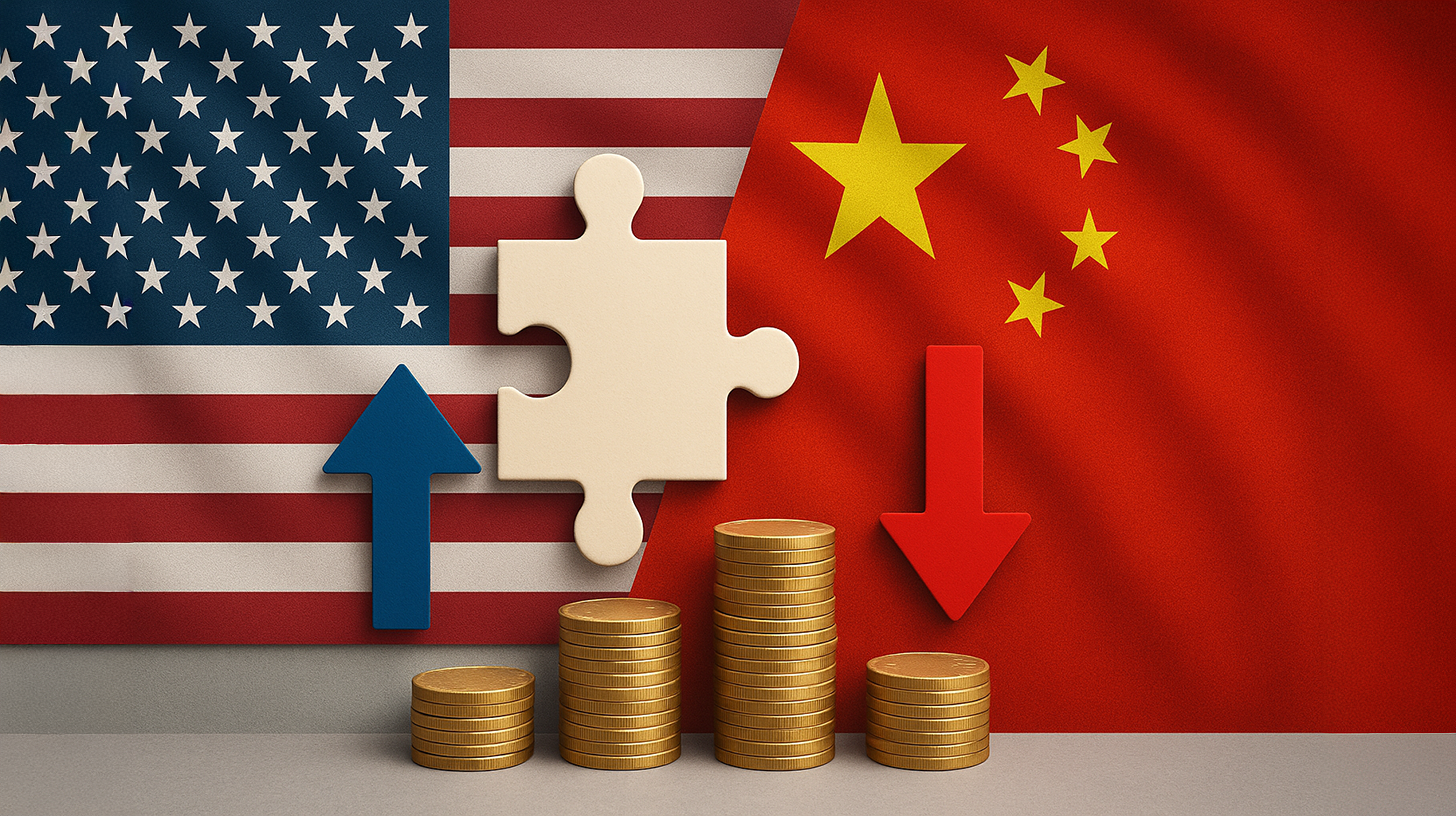
US strategies for reducing dependence on China: Friendshoring – Reshoring – Nearshoring – Image: Xpert.Digital
Goodbye China? America's 3-point plan for economic independence
America's expensive escape attempt: Are these strategies enough to escape China?
The global economic landscape is undergoing a tectonic shift. Driven by geopolitical tensions, national security concerns, and the painful lessons learned from the supply chain crises of recent years, the US is pursuing a radical realignment of its economic strategy. The goal is clear: to reduce its massive dependence on China and regain control over critical industries. But instead of a simple "China-Plus-One" strategy, which merely seeks an alternative location, the US has developed a far more complex, three-pronged approach: nearshoring, reshoring, and friendshoring.
These three pillars form the American response to the challenges of the 21st century. Nearshoring shifts production to geographically nearby countries like Mexico to shorten supply chains and benefit from trade agreements such as the USMCA. Reshoring aims to bring strategically important industries—most notably semiconductors and clean technologies—back to the US through massive government incentive programs like the CHIPS Act. And friendshoring focuses on building resilient supply chains with politically allied and values-based partners in Europe and Asia.
This transformation is more than just an economic policy course correction; it is an undertaking backed by hundreds of billions of dollars, redefining global trade flows, creating winners and losers, and presenting companies worldwide with new challenges. While impressive successes in the form of investments and new jobs are already visible, significant hurdles remain—from high costs and skills shortages to political uncertainty and the persistent reliance on Chinese intermediate goods. The following analyses examine how these strategies work in practice, which sectors are in focus, and whether this ambitious plan can ultimately succeed.
The Great Turnaround: Why billions in investment are bringing US industry back home
What alternatives to the China-Plus-One strategy are the US pursuing in its efforts to achieve greater economic independence? This question concerns both economists and politicians, as the US has not developed a directly comparable strategy but rather relies on a combination of different approaches. The American response to the challenges of global supply chains and growing dependence on China manifests itself in three main strategies: nearshoring, reshoring, and friendshoring.
Why did these strategies emerge, and how do they differ from traditional trade approaches? The development began during the Obama administration with initial containment measures, intensified under Trump through comprehensive trade wars, and was further expanded under Biden through systematic industrial policy. This evolution reflects the growing recognition that economic dependencies can also entail security risks.
Related to this:


Nearshoring: The geographical realignment
Fundamentals and motivation of nearshoring
What is meant by nearshoring, and what role does Latin America play in it? Nearshoring describes the strategic relocation of production and procurement to geographically nearby countries. For US companies, this primarily means a greater focus on Mexico and other Latin American countries. This strategy aims to strengthen supply chain resilience, reduce transportation times, and simultaneously avoid tariffs, particularly under the USMCA free trade agreement.
Mexico has established itself as a particularly attractive location. In 2023, the country recorded a record $36.06 billion in foreign direct investment. Between January 2023 and August 2024, over 400 investment projects with a total volume of $170 billion were announced. These figures illustrate the enormous growth of the nearshoring trend.
The role of the USMCA agreement
How does the USMCA agreement support a nearshoring strategy? The trade agreement between the US, Mexico, and Canada creates a preferential trading area with reduced or eliminated tariffs on a wide range of products. The agreement includes streamlined customs procedures, integrated rules of origin, and modernized labor and environmental standards that meet international compliance expectations.
Mexico has already become the largest supplier of imports to the United States, with a total value of $466.6 billion in 2024, representing 15.6 percent of all U.S. imports. This position underscores the country's strategic importance within regional manufacturing under the USMCA framework.
Sector-specific developments
Which industries benefit most from nearshoring to Mexico? The automotive industry tops the list. Mexico produced nearly four million vehicles in 2024, and the automotive sector accounted for 31.4 percent of total Mexican exports, valued at US$193.9 billion. These figures reflect the deep integration with US and Canadian supply chains under USMCA.
The electronics sector is also showing impressive growth. The Electronics Manufacturing Services (EMS) market in Mexico is projected to grow from US$53.2 billion in 2025 to US$97.4 billion by 2031, representing a compound annual growth rate (CAGR) of 10.6 percent. This growth is driven by the nearshoring of high-tech production lines, including semiconductors, telecommunications equipment, and automation systems.
Related to this:


Challenges and limitations
What problems does nearshoring entail? Despite positive developments, Mexico faces significant challenges. Security concerns due to powerful drug cartels and a high level of corruption rank the country 126th out of 180 in Transparency International's Corruption Perceptions Index. Additionally, public services are inadequate, and the demand for industrial space exceeds the supply.
The political developments under the Trump administration have created further uncertainties. In early 2025, President Trump initially imposed 25 percent tariffs on Canadian and Mexican exports to the US, before exempting vehicles from Mexico and Canada from the tariffs. These uncertainties could cause the anticipated nearshoring bubble to burst, which is causing growing concern in Mexico.
Reshoring: The return to one's homeland
Basic principles and objectives
What does reshoring mean and why is it strategically important for the US? Reshoring goes beyond nearshoring and aims to bring production completely back home. The US has implemented extensive tax incentives and subsidy programs to facilitate the return of industrial and technology companies, particularly in the semiconductor, medical technology, and electric vehicle sectors.
The Reshoring Initiative 2024 Annual Report shows that 244,000 U.S. manufacturing jobs were announced in 2024 through reshoring and foreign direct investment. Since 2010, over two million jobs have been announced, while 1.7 million have already been filled. These figures illustrate the continued growth of domestic manufacturing capacity.
The role of the CHIPS Act legislation
How does the CHIPS Act support reshoring efforts? The bipartisan CHIPS and Science Act of 2022 provides the basis for billions of federal dollars to reshort semiconductor manufacturing. The Act has authorized over $50 billion for semiconductor-related activities, along with 25 percent refundable tax credits for private companies that undertake projects by the end of 2026.
The effects are already visible. The Commerce Department has announced more than $30 billion in grants and loans to prominent semiconductor companies such as TSMC, Intel, and Micron, with projects in Arizona, Texas, New York, and other states. Micron's announcement of a $200 billion investment in domestic semiconductor manufacturing represents one of the largest reshoring announcements in recent years.
Sector-specific successes and challenges
Which industries are leading the way in reshoring, and what obstacles exist? High-tech industries are driving growth: 88 percent of jobs in 2024 were in high- or medium-high-tech sectors, a share that rose to 90 percent by early 2025. The leading industries in 2024 were computers and electronics, electrical equipment (including EV batteries and solar), and transportation equipment.
Nevertheless, significant structural challenges remain. US manufacturing costs are 30-50 percent higher than those in Asian countries due to energy, labor, and raw material costs. Additionally, structural gaps exist in the semiconductor value chain, including reliance on Asian upstream materials and a shortage of highly skilled domestic labor.
Regional distribution and government support
Which states benefit most from reshoring? Texas, South Carolina, and Mississippi are the leading states for reshoring and foreign direct investment in 2025. The South and Midwest accounted for 81 percent of reshoring and FDI jobs.
States are increasingly developing sector-specific incentive programs, moving away from generic stimulus packages and toward instruments tailored to high-value industries such as semiconductors, clean technologies, biotechnology, and quantum technologies. This strategic focus allows states to better compete for transformative investments and align more closely with federal priorities.
Friendshoring: Strategic partnerships with allies
Concept and political development
What is friendshoring and who coined the term? Friendshoring is a relatively new strategy in which supply chains are deliberately concentrated in countries with similar political values, stable relations, and as little geopolitical uncertainty as possible. The term was coined, among others, by US Treasury Secretary Janet Yellen to reduce dependence on China and mitigate risks such as sanctions, trade conflicts, and export restrictions.
In a speech in Seoul, South Korea, Yellen defined friendshoring as an international economic policy that aims to achieve "free but secure trade" by favoring "the friendshoring of supply chains to a large number of trusted countries." This strategy aims to deepen relationships and "diversify our supply chains with a greater number of trusted trading partners.".
Identification of strategic partners
Which countries are considered "friends" in the friendshoring strategy? Companies and the US government are developing strategic value chain partnerships primarily with countries like Canada, Mexico, South Korea, Japan, and the states of Europe. These countries are considered trustworthy and share similar values regarding the international trading system.
However, tensions are already emerging in the definition of "friendship." President Biden's decision in January 2025 to block Nippon Steel's acquisition of US Steel, citing national security concerns, raised questions about the permanence and reliability of the "friendship" category. Friendshoring partners may therefore question whether their friendship with the US is permanent or limited to specific situations at the discretion of the US government.
Implementation and practical challenges
How does friendshoring work in practice and what results does it show? Based on Executive Order 14017 “America’s Supply Chains”, the US Department of Commerce identified approximately 2,400 critical goods and materials in four broad product categories: public health and biological preparedness, information and communication technology, energy, and critical minerals and materials.
The results so far are mixed. While progress in reducing China's share of US goods imports has been modest, and in some cases China's share has actually increased, the consequences of Yellen's approach are beginning to emerge. Challenges are particularly evident in the areas of green energy and critical minerals, where China often appears to be the only producer with the scalability to meet growing demand.
Long-term strategic implications
What are the long-term effects of friendshoring on global trade patterns? The strategy is leading to a gradual realignment of US trade relations away from China and toward allied nations. However, this process is more complex than initially anticipated. One study shows that, following the trade friction, US companies tend to cooperate with third countries that are deeply integrated into Chinese supply chains.
This leads to longer supply chains and reduces their transparency, making them harder for authorities and companies to monitor. Chinese goods are sometimes repackaged or minimally processed in other countries before being exported to the US, as the US Department of Commerce has confirmed regarding solar panels via Vietnam, Malaysia, Thailand, and Cambodia.
Our US expertise in business development, sales and marketing
Our US expertise in business development, sales and marketing - Image: Xpert.Digital
Industry focus areas: B2B, digitalization (from AI to XR), mechanical engineering, logistics, renewable energies and industry
More information here:
A thematic hub offering insights and expertise:
- Knowledge platform covering global and regional economies, innovation and industry-specific trends
- A collection of analyses, insights, and background information from our key areas of focus
- A place for expertise and information on current developments in business and technology
- A hub for companies seeking information on markets, digitalization, and industry innovations
Automation as salvation: How US factories can become competitive again
Comparison of US strategies with China-Plus-One
Functional similarities and differences
How similar are the US strategies to the China Plus One strategy? All three American approaches – nearshoring, reshoring, and friendshoring – pursue the same goal as China Plus One: reducing the risks of concentrating resources in a single location. They aim to increase resilience and expand control over critical supply chains and technologies.
The key difference, however, lies in the geographical focus and political motives. While China Plus One primarily aims at cost optimization and risk diversification, US strategies are strongly influenced by security policy considerations and the pursuit of technological sovereignty. Furthermore, the American approaches are more heavily state-controlled and supported by extensive funding programs.
Sectoral focus areas and priorities
Which industries are the focus of the different strategies? While China Plus One traditionally focused on labor-intensive manufacturing and cost efficiency, the US strategies concentrate on high-tech and strategically important sectors. The CHIPS Act legislation specifically targets semiconductors, while the Inflation Reduction Act promotes clean energy and electric vehicles.
This sectoral focus reflects the recognition that not all industries are equally critical to national security and economic sovereignty. The US prioritizes sectors with high strategic relevance and technological complexity, while cost-driven, labor-intensive production continues to remain in low-cost countries.
Timeframe and implementation speed
How quickly do the different strategies take effect? The Reshoring Initiative reports that it took ten years for the first million jobs to return to the US, while the accelerated rate of one million jobs in the last four years was due to the additional impact of government incentives. This acceleration was driven by legislation such as the Inflation Reduction Act and the Biden administration's CHIPS and Science Act.
China-Plus-One strategies, on the other hand, can be implemented more quickly because they primarily redirect existing manufacturing capacity rather than building new capacity. US strategies require the development of complex industrial ecosystems, which naturally takes more time but is also more sustainable.
Related to this:

Geopolitical and economic impacts
US-China trade war and supply chain redesign
How is the ongoing trade war affecting global supply chains? The trade conflict, which began in 2018, has led to significant structural changes at the corporate level in China. Chinese companies have responded proactively through strategic foreign investments, supply chain reassessments, and accelerated technological modernization.
The relative importance of the US in China's export structure has declined annually, while South-South trade between China and developing countries has steadily expanded. By 2023-2024, only about 30 percent of Chinese exports were destined for G7 industrialized countries, compared to almost 48 percent in 2000.
Impact on third countries
What opportunities and risks arise for other countries? Attempts to reduce US import dependence on China could be advantageous for other countries. The stronger positions of Southeast Asian developing countries or Mexico in US imports present an opportunity to develop their industries and eventually replace China as a supplier to the US market.
However, it is also evident that many imports from these countries still rely on Chinese inputs. This is a first step towards developing their own industrial capabilities, but the process will take time. As production costs rise in China, it will become possible for other countries to compete with China, especially if the US introduces appropriate incentives.
Technological sovereignty and innovation
How do these strategies influence technological development? US strategies aim not only at relocating existing production but also at building innovative research and development capacities. South Korea, for example, announced in June 2024 that four research centers focusing on cutting-edge technologies had been established at Yale, Johns Hopkins, Purdue, and the Georgia Institute of Technology, with plans to increase the number of such centers to a dozen by 2027.
These collaborations not only create alternative supply chains but also alternative innovation networks that could challenge China's technological dominance in certain areas in the long term. The development of a "Chip 4 Alliance" between the US, Japan, South Korea, and Taiwan demonstrates how technological partnerships extend beyond mere trade relations.
Economic performance measurement and challenges
Quantitative successes of US strategies
What measurable successes can the US strategies point to? Since President Biden took office, companies have pledged $276 billion in investments in American clean energy and electric vehicle production. The Inflation Reduction Act alone has catalyzed nearly $900 billion in private sector investment commitments, including approximately $400 billion in clean energy across all states.
Real investment in manufacturing infrastructure is at an all-time high and has remained at this level for six consecutive quarters. Manufacturing's contribution to GDP broke record levels for three consecutive quarters in 2023. These figures demonstrate the tangible success of industrial policy measures.
Persistent structural challenges
What fundamental problems remain? Despite the successes, significant challenges persist. Frequent policy adjustments undermine investment confidence, and higher US manufacturing costs of 30–50 percent compared to Asian countries remain a key obstacle. Structural gaps in the semiconductor value chain, including reliance on Asian upstream materials and a shortage of domestic skilled labor, limit the effectiveness of reshoring efforts.
China maintains a strong position in US supply chains, and companies are seeking simple solutions to circumvent restrictions. This is evident in the apparent preference for shifting some production to countries linked to the Chinese economy. US dependence on China for critical minerals and rare earth elements remains a particularly sensitive issue.
Role of automation and technology
How important is technological modernization to the success of these strategies? Blanket tariffs will not rebuild domestic manufacturing because they fail to address the core challenge: the need for advanced, cost-effective production methods that make U.S. operations globally competitive. For a viable domestic manufacturing sector, companies must leverage automation and advanced technology—embracing robotics, AI, and real-time data systems to boost productivity.
The Cleveland Cliffs steel mill in Cleveland, for example, is the most productive steel mill in the world, achieving this through extensive automation in production to maintain well-paid, unionized steelworker jobs. Unfortunately, most current automation systems in US plants still lack the precision and cost-effectiveness for complex tasks such as assembling small electronic components.
Political continuity and change
Differences between the administrations
How do the approaches of different US administrations differ? The Obama administration had already implemented comprehensive containment measures, including investment restrictions and export control systems that excluded China from access to many advanced technology products. The Trump administration intensified containment policies through sweeping tariffs and trade policy measures.
The Biden administration not only continued Trump's containment policies but also intensified its own. The CHIPS and Science Act and the complementary new export controls on artificial intelligence and semiconductors represent the core of this new and very comprehensive containment policy. This policy aims to "maintain the biggest possible head start," as National Security Advisor Jake Sullivan put it.
Current political developments under Trump
What changes will the second Trump administration bring? The Trump administration appears to have no "friends," and its "Make America Great Again" goals contradict the concepts of friendshoring. Trump's recent announcements of new US tariffs, which could also be applied to friends and allies, will undoubtedly cause Indo-Pacific friendshoring partners and companies to reconsider the future economic integration of the US with their "friends.".
On March 31, 2025, President Trump signed an executive order establishing the United States Investment Accelerator, a new office within the Department of Commerce to oversee CHIPS implementation. While this initiative focuses on reducing red tape and streamlining federal approval processes to accelerate domestic manufacturing, it also creates greater uncertainty regarding funding criteria.
International reactions and adjustments
European Perspectives and Strategies
How is Europe reacting to US strategies and developing its own approaches? The European Union has developed its own measures to reduce dependence on China, which, however, differ from the US approaches. While the US relies on aggressive containment, the EU pursues a more balanced approach that prioritizes de-risking over decoupling.
European companies must adapt to the changing geopolitical landscape, especially if they operate in US markets or rely on US technologies. This leads to complex decisions regarding supply chain design and technology partnerships that must meet both European and American requirements.
Asian allies and the balance between the US and China
How do Asian allies navigate between US loyalty and Chinese economic ties? Countries like South Korea, Japan, and Taiwan face the difficult task of strengthening their security and defense relationships with the US while maintaining their economic connections with China. South Korea is literally “on the fault line of the US-China divide” and must act as a “critical technology wingman” for the US without sacrificing its economic interests in China.
The development of a five-pillar US-ROK technology alliance – enhanced coordination of counter-espionage, focused R&D cooperation on emerging defense technologies, increased bilateral foreign direct investment, strengthened economic security ties, and a joint approach to multilateral AI regulatory regimes – demonstrates how complex this balance is.
Related to this:


Regionalization of trade: Are we facing competing technology blocs?
Long-term sustainability of the strategies
Are US strategies sustainable and successful in the long term? The sustainability of US strategies depends on several critical factors. First, political continuity must be ensured, as frequent policy adjustments undermine investment confidence. Second, structural cost differences must be offset by productivity gains and technological innovation.
The successes achieved so far are encouraging, but the real test will come in the next few years when the built-up capacities actually have to deliver competitive products. Experience with Intel's delayed Ohio fab projects and TSMC's setbacks in Arizona shows that the path is not always smooth.
Technological development and innovation
What role will new technologies play in shaping future supply chains? AI-related semiconductor investments are projected to exceed $250 billion by 2025. This massive investment in advanced technologies could represent a turning point, where the US not only relocates existing supply chains but also creates entirely new technological ecosystems.
The development of quantum technologies, advanced artificial intelligence, and new materials sciences could render existing supply chains obsolete and create entirely new value chains. In this scenario, the US would not only attempt to compete with China but also define entirely new playing fields.
Global trade patterns of the future
How might global trade patterns develop in the coming decades? Current trends point to an increasing regionalization of world trade, with several competing blocs. The US is attempting to build a “democratic” trade bloc with allies, while China is expanding its Belt and Road Initiative and South-South partnerships.
This fragmentation could lead to a world where different technological standards, trade practices, and economic norms coexist. Companies would have to choose specific ecosystems or develop complex strategies to operate in multiple ones. The efficiency of global supply chains could suffer, but resilience could increase.
The strategic realignment of the USA
While the US has not developed a direct equivalent to the China Plus One strategy, its combination of nearshoring, reshoring, and friendshoring represents a comprehensive strategic response to the challenges of global supply chains. These strategies go beyond mere cost optimization and address fundamental issues of national security, technological sovereignty, and economic resilience.
The achievements to date are impressive: over two million announced jobs, hundreds of billions in investments, and the development of new industrial capacity in critical sectors. At the same time, significant challenges remain, ranging from cost disadvantages and skills shortages to persistent dependence on Chinese supply chains.
The success of these strategies will ultimately depend on whether the US manages not only to relocate existing production but also to develop innovative new technologies and production processes that create long-term competitive advantages. The transformation of the global economy is still underway, and the final results will only become apparent in the coming decades.
The American response to China Plus One is therefore not a single strategy, but a multifaceted approach that combines industrial policy measures, geopolitical considerations, and technological innovation. Whether this approach will be successful in the long term depends on the ability to maintain political continuity, overcome structural obstacles, and simultaneously reap the benefits of global interconnectedness without incurring its risks.
Your global marketing and business development partner
☑️ Our business language is English or German
☑️ NEW: Correspondence in your native language!

Konrad Wolfenstein
I and my team are happy to be available to you as your personal advisor.
You can contact me by filling out the contact form here wolfenstein@xpert.digital:or simply call me at +49 7348 4088 965. My email address is
I'm looking forward to our joint project.
☑️ SME support in strategy, consulting, planning and implementation
☑️ Creation or realignment of the digital strategy and digitization
☑️ Expansion and optimization of international sales processes
☑️ Global & Digital B2B trading platforms
☑️ Pioneer Business Development / Marketing / PR / Trade Fairs
Our recommendation: 🌍 Limitless reach 🔗 Connected 🌐 Multilingual 💪 Sales power: 💡 Authentic with strategy 🚀 Innovation meets 🧠 Intuition


From local to global: SMEs conquer the world market with a clever strategy - Image: Xpert.Digital
In an era where a company's digital presence determines its success, the challenge lies in creating an authentic, personalized, and far-reaching presence. Xpert.Digital offers an innovative solution that positions itself as the intersection of an industry hub, a blog, and a brand ambassador. It combines the advantages of communication and sales channels in a single platform and enables publication in 18 different languages. Cooperation with partner portals and the ability to publish articles on Google News and a press distribution list with approximately 8,000 journalists and readers maximize the reach and visibility of the content. This represents a crucial factor in external sales and marketing (SMarketing).
More information here: