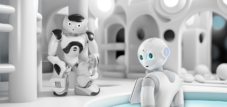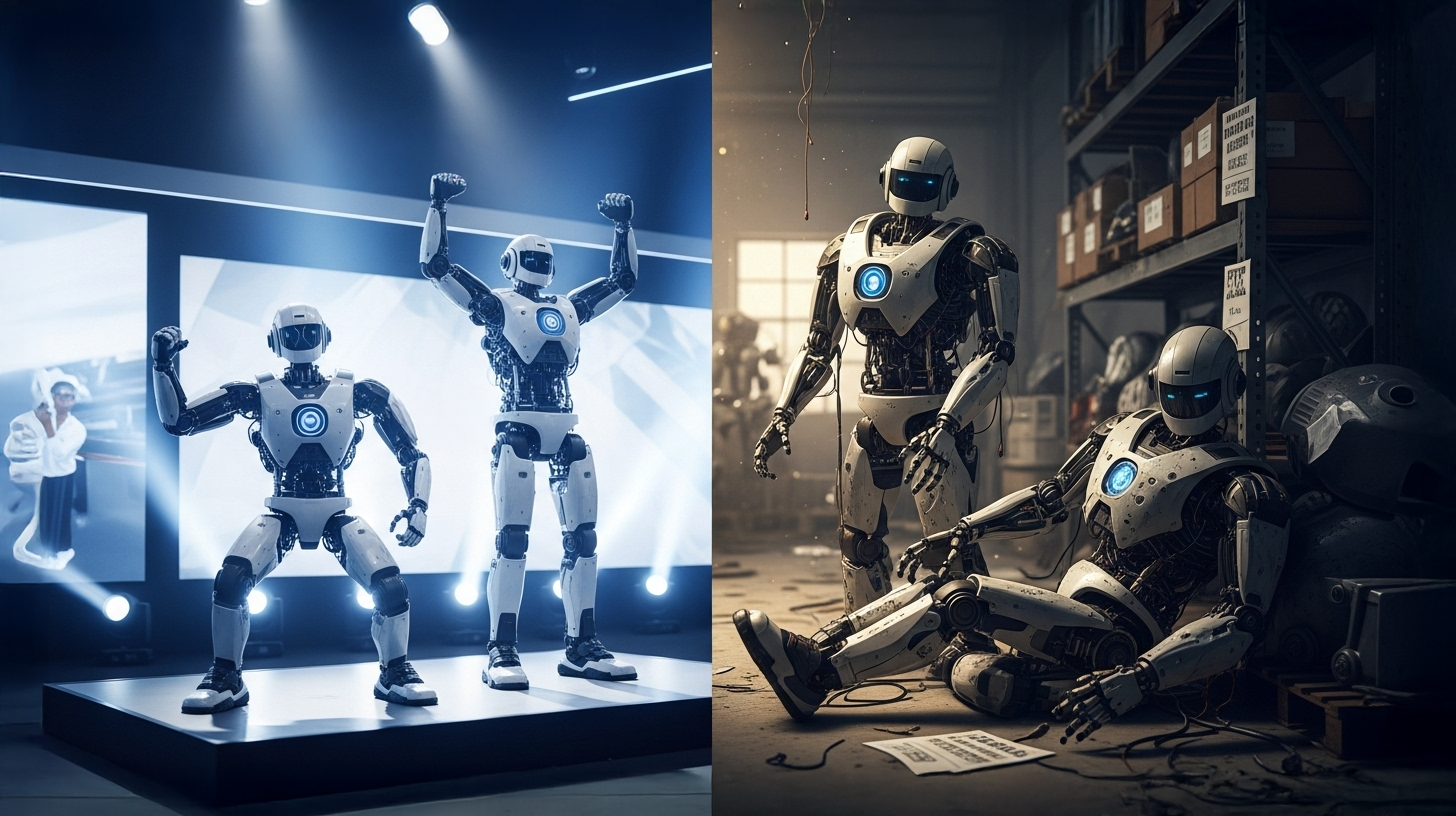
From celebrated champion to bankruptcy: The United Robotics Group – Why Europe's most ambitious robot champion failed – Creative image: Xpert.Digital
The end for Pepper & NAO? How Germany's robot hopes crumbled and what will become of the cult robots
Billion-dollar investment and grand visions: What's really behind the surprising bankruptcy of the United Robotics Group?
It was a vision as grand as the machines it aimed to create: The United Robotics Group (URG) from Bochum was to become nothing less than Europe's answer to global competition – a true "European robotics champion." Driven by the financially powerful RAG Foundation and the entrepreneurial drive of Thomas Hähn, URG acquired iconic brands such as Rethink Robotics and the creators of the world-famous humanoid robots Pepper and NAO. But the dream of an integrated ecosystem of hardware, software, and services came to an abrupt end.
In 2025, the ambitious company filed for bankruptcy, leaving the industry in shock. How could a project with so much capital and strategic vision collapse against reality? The URG story is a cautionary tale about high development costs, the pitfalls of rapid consolidation, and fierce competition in the global technology market. Yet, amidst the ruins of the old dream, a new hope is emerging: With a radical reorientation towards the healthcare sector and the announcement of a new humanoid robot called uMe, the company is attempting a fresh start. The case of United Robotics Group is thus more than just a chronicle of failure—it reflects the challenges and the future of European robotics as a whole.
Related to this:

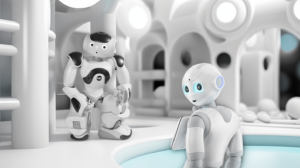
The United Robotics Group: Between Dream and Reality – What Happened to the United Robotics Group?
United Robotics Group (URG) was meant to be Europe's answer to international robotics competition. But in 2025, the Bochum-based company filed for insolvency under self-administration. What began as a visionary project to become the "European robotics champion" ended in financial difficulties. How could it have come to this, and what does it mean for the future of the European robotics industry?
How did the idea for the European Robotics Champion come about?
The idea for United Robotics Group originated from the vision of Thomas Hähn, the founder of the successful Hahn Automation Group. After nearly three decades in the field of industrial automation, Hähn recognized the potential of service robotics as a growth market. The inspiration came in 2016 when the Hahn Group acquired the Boston-based cobot specialist Rethink Robotics. The friendly cobot with its distinctive display face gave Hähn the idea: "Such a friendly cobot would be a perfect fit for public life.".
Who was behind the financing?
The driving force behind the United Robotics Group was the RAG Foundation from Essen. As one of Germany's largest foundations, established as a result of the structural transformation of the coal-mining regions, the RAG Foundation sought promising investments. Through its holding company RSBG SE, it invested a majority stake in the vision of a European robotics champion. Bernd Tönjes, Chairman of the Board of the RAG Foundation, supported the project with the conviction: "This is where solutions for the future are being created.".
Which companies belonged to the United Robotics Group?
The United Robotics Group (URG) evolved into a complex network of eight robotics companies with over 300 employees. At its core was Rethink Robotics, the former cobot pioneer from Boston, which was acquired by the Hahn Group in 2018 following its insolvency. In 2022, the spectacular acquisition of SoftBank Robotics Europe, which was subsequently renamed Aldebaran, was added. This secured URG the rights to the globally renowned humanoid robots Pepper and NAO. Other companies, such as Humanizing Technologies, Robshare, and various service robot specialists, completed the portfolio.
What was the strategy behind the robotics champion?
Thomas Hähn pursued a clear consolidation strategy for the fragmented robotics industry. Instead of developing individual robots, URG aimed to create a complete ecosystem – hardware, software, and services from a single source. The "CobiotX" approach was designed to develop robots that would not replace humans, but rather support them. The strategy encompassed various areas: industrial robotics with the Rethink cobots, humanoid robots with Pepper and NAO, service robots for the catering and care sectors, and laboratory automation.
How did the different product lines develop?
URG's product development spanned several areas. The Plato service robot for the hotel and restaurant industry was developed for this sector and was the first service robot developed and produced in Europe to comply with the EU Machinery Directive. In the laboratory sector, uLab Mobile established itself as a mobile automation solution. These robots could handle samples, operate laboratory equipment, and move autonomously through laboratories. The portfolio also included cleaning robots (uClean), transport robots (uLog), and other service solutions.
What led to the insolvency of the United Robotics Group?
The reasons for URG's insolvency were multifaceted. High development costs coupled with a lack of profitability burdened the company. Ambitious plans for rapid growth and the consolidation of various robotics divisions proved more costly than anticipated. As early as 2024, the RAG Foundation discontinued funding for Aldebaran, further exacerbating the company's difficulties. The challenging market conditions in the German robotics industry, which experienced a ten percent decline in revenue in 2025, exacerbated the situation.
How did the insolvency affect the employees?
The self-administered insolvency proceedings were originally intended to secure the approximately 200 jobs at URG. The process allowed the company to manage its own restructuring, while a trustee oversaw the interests of the creditors. The situation was more dramatic at Aldebaran, the French subsidiary: Massive job cuts were planned, with roughly half the workforce slated for dismissal. The uncertainty about the future placed a considerable burden on the employees.
What happened to the famous robots Pepper and NAO?
The humanoid robots Pepper and NAO experienced a turbulent period. After SoftBank discontinued Pepper production in 2021, URG attempted to revive the robots following its acquisition of Aldebaran. However, the hoped-for success failed to materialize. In mid-2025, Aldebaran was finally acquired by the Chinese Maxvision Technology Corporation, which intends to continue production of the robots. The new owners plan to leverage French expertise and manufacture the robots in China.
Our global industry and economic expertise in business development, sales and marketing
Our global industry and economic expertise in business development, sales and marketing - Image: Xpert.Digital
Industry focus areas: B2B, digitalization (from AI to XR), mechanical engineering, logistics, renewable energies and industry
More information here:
A thematic hub offering insights and expertise:
- Knowledge platform covering global and regional economies, innovation and industry-specific trends
- A collection of analyses, insights, and background information from our key areas of focus
- A place for expertise and information on current developments in business and technology
- A hub for companies seeking information on markets, digitalization, and industry innovations
From laboratory automation to humanoid helpers: URG's risky but exciting turn
Is there a new beginning for the United Robotics Group?
A new beginning was unexpectedly announced. United Robotics Health & Food GmbH acquired the patent, trademark, and content rights for all product lines and now operates as United Robotics Group (Holding). Kerstin Wagner, formerly of Siemens Healthineers, joined the company as Co-CEO and COO. The focus is now firmly on the healthcare sector, where the uLab Mobile laboratory robot is already in use in over 30 laboratories.
What role does the humanoid robot uMe play?
A key component of the realignment is the humanoid robot uMe, which is slated to be unveiled at the Consumer Electronics Show (CES) in Las Vegas in early 2026. Wassim Saeidi, the new CEO, promises a "milestone for the entire robotics industry." The uMe will be "Made in Germany" and will distinguish itself from the competition through its superior quality and reliability. In contrast to many visions within the industry, the new URG team aims to demonstrate that robotics already offers real benefits today.
How has the robotics market developed in Germany?
The German robotics industry is going through a difficult period. The industry association VDMA Robotics forecasts a 10 percent decline in revenue to €14.5 billion for 2025. The automotive industry, traditionally the largest consumer of industrial robots, has drastically reduced its investments. In 2024, only 7,000 robots were installed in the German automotive industry – the lowest figure in 15 years. Uncertainty surrounding US tariffs and weakening demand for electric vehicles has further exacerbated this reluctance to invest.
What does this mean for other robotics companies in Germany?
URG was not the only German robotics company in trouble. EK Robotics, a specialist in autonomous mobile robots, also filed for insolvency under self-administration. The challenges are similar across the industry: high development costs, customer reluctance to invest, and strong international competition, especially from Asia. Many German robotics companies are struggling with the question of whether their high investments in research and development will pay off.
What lessons can be learned from the URG case?
The case of United Robotics Group illustrates the challenges of building a European robotics champion. Despite generous funding from the RAG Foundation and a promising strategy, the project failed due to the complexity of the robotics industry. The rapid consolidation of various companies proved more difficult than anticipated. At the same time, the case underscores the importance of developing profitable products early on, rather than solely focusing on future markets.
How does Europe fare in international robotics comparisons?
Europe risks falling behind in robotics development. While the US, with companies like Boston Dynamics, and China, with massive state investments, are forging ahead, Europe lacks a clear champion in humanoid robotics. The fragmented landscape of smaller companies can hardly compete with the resources of American tech giants or Chinese state-owned enterprises. Germany, once a leader in industrial robotics, is criticized for being "too slow in its risk appetite.".
What are the future prospects for service robotics?
Despite the setbacks, experts still see great potential in service robotics. The market for professional service robots is expected to grow significantly by 2030. Applications range from delivery robots and cleaning machines to care robots. The shortage of skilled workers in many sectors, particularly in healthcare, is driving the demand for robotic support solutions. The question is whether European companies can develop competitive products in time.
What role does financing play in robotics projects?
Financing remains one of the biggest hurdles for European robotics companies. While American startups benefit from venture capital and Chinese firms from government investment, European companies are often dependent on a few large investors. The URG case demonstrates how dangerous this dependency can be: when the RAG Foundation reduced its funding, the entire project was jeopardized. Diversified funding sources and early profitability are therefore becoming even more crucial.
Is there hope for a European robotics champion?
URG's realignment towards healthcare applications could be a glimmer of hope. By focusing on concrete applications like laboratory automation rather than visionary humanoid robots, the company is pursuing a more pragmatic approach. Close collaboration with laboratory equipment manufacturers and successful installations in over 30 laboratories demonstrate that specialized solutions can indeed be successful. The announced humanoid robot uMe will have to show whether the lessons of the past have been learned.
What significance does Bochum have for the robotics industry?
Bochum developed into a key robotics hub in the Ruhr region through the establishment of URG and related companies. Its proximity to Ruhr University Bochum, with its Chair of Production Systems, provided ideal conditions for research and development. Even after URG's insolvency, Bochum remains an important location, as the new URG holding company continues to operate there. The former Opel site, MARK 51°7, has established itself as an innovation district and is home to various technology companies.
What can other European countries learn from the URG case?
The URG case also serves as a warning to other European countries that want to build their own robotics champions. France, with its strong tradition in humanoid robotics through Aldebaran, Italy with its automation manufacturers, and the Nordic countries with their tech companies face similar challenges. The lesson from Germany is clear: it is not enough to generously fund individual companies. Success requires a sustainable ecosystem of research, industry, and policy.
What is the impact of international competition?
International competition in robotics is intensifying rapidly. Chinese companies are pushing into European markets with affordable solutions, while American tech giants are setting new standards with enormous resources. German robot manufacturers must ask themselves whether they can survive in the global competition or whether they should concentrate on niche markets. URG's experience shows that even substantial funding does not guarantee success.
From dream to reality
The story of United Robotics Group is the story of a failed dream of becoming a European robotics champion. What began as a visionary project to consolidate the fragmented robotics industry ended in insolvency. However, the fresh start under new leadership shows that lessons can be learned from mistakes. With its focus on specific healthcare applications and a concentration on profitable niche markets, the new URG could forge a more successful path. The case, however, serves as a cautionary tale regarding overly ambitious plans and illustrates just how difficult it is to succeed in the globally competitive robotics industry. Europe still needs a robotics champion – but perhaps one that prioritizes sustainable innovation over sheer size.
We are here for you - Consulting - Planning - Implementation - Project Management
☑️ SME support in strategy, consulting, planning and implementation
☑️ Creation or realignment of the AI strategy
☑️ Pioneer Business Development

Konrad Wolfenstein
I would be happy to serve as your personal advisor.
You can contact me by filling out the contact form below or simply call me on +49 7348 4088 965 .
I'm looking forward to our joint project.
Write to me


Xpert.Digital - Konrad Wolfenstein
Xpert.Digital is a hub for industry focusing on digitalization, mechanical engineering, logistics/intralogistics and photovoltaics.
With our 360° Business Development solution, we support renowned companies from new business to after-sales.
Market intelligence, smarketing, marketing automation, content development, PR, mail campaigns, personalized social media and lead nurturing are part of our digital tools.
You can find more information at: www.xpert.digital - www.xpert.solar - www.xpert.plus
Keep in touch