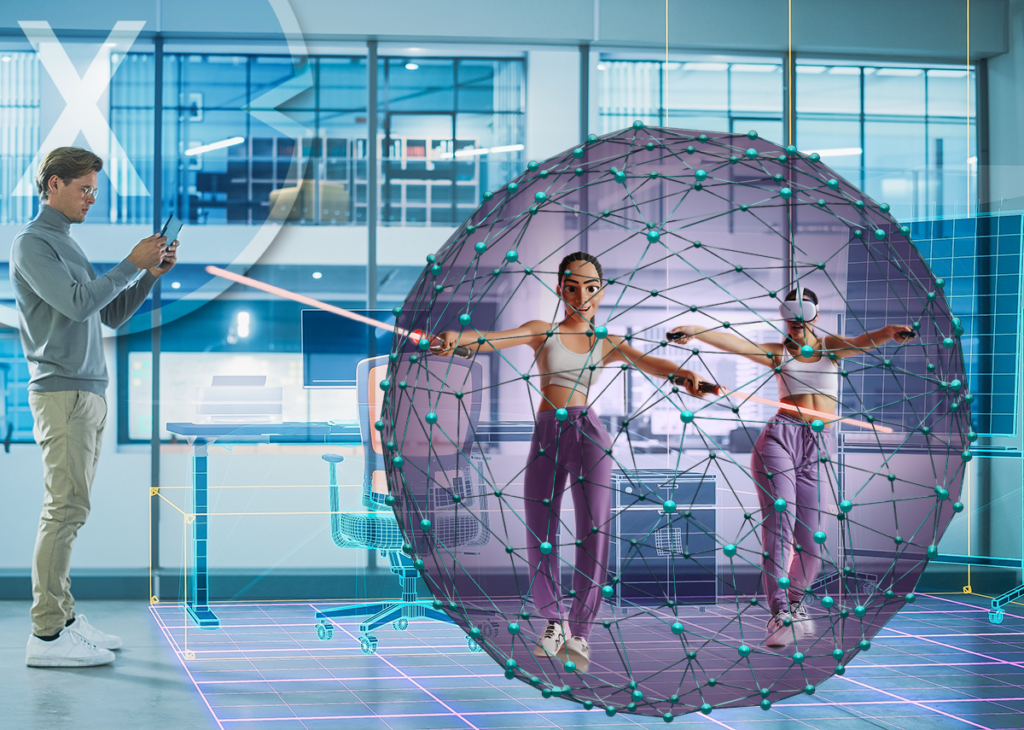
True digital collaboration is collaborative, immersive, and transformative – Image: Xpert.Digital
Innovation live: The industrial metaverse as a driver of the real economy - at a glance!
Immersive engineering and collaborative work in the industrial metaverse: A transformative symbiosis
The convergence of immersive engineering, collaborative working methods, and metaverse technologies is revolutionizing industrial product development and manufacturing. While the general metaverse is still searching for commercial viability, the industrial metaverse is taking a leading role as an innovation driver in the real economy. This report examines the technological, organizational, and economic implications of this development based on current research projects and industry initiatives.
Related to this:
- For hybrid teams: Success factors of collaborative platforms
- What advantages do collaborative platforms offer compared to traditional work models?
Technological Foundations of Immersive Engineering in the Industrial Metaverse
Networked XR environments as a basis
Modern Extended Reality (XR) technologies such as Virtual Reality (VR), Augmented Reality (AR), and Mixed Reality (MR) form the technological basis for immersive engineering processes. New developments like the Fraunhofer IAO's INSTANCE initiative replace traditional VR headsets with high-resolution projection systems, real-time graphics architectures, and precise tracking systems. These systems enable teams at different locations to interact simultaneously with identical virtual prototypes.
A significant innovation is CAVE technology (Cave Automatic Virtual Environment), which combines high-performance 4K projections with 360° tracking. At the Center for Virtual Engineering, this technology significantly improves immersion compared to conventional head-mounted displays and enables seamless integration into existing development environments.
Integration of CAD/PLM systems with XR interfaces
A key success factor is the integration of authoring systems such as CAD (Computer-Aided Design) and CAE (Computer-Aided Engineering) with virtual environments. Systems like Siemens' NX Immersive Designer demonstrate how parametric 3D models can be seamlessly transferred to mixed-reality headsets. Design changes can be saved back to the Product Lifecycle Management (PLM) system in real time, eliminating media breaks and accelerating development processes.
Advances in physically accurate simulations
Thanks to advanced ray-tracing engines and physics simulations, material properties, flow behavior, and mechanical stresses can be realistically represented. NVIDIA Omniverse enables GPU-accelerated multiphysics simulations, offering iteration cycles up to 40% faster. Systems like Holo-Lights AR3S allow finite element analysis in augmented reality, enabling the visualization of calculation results directly on physical prototypes.
Collaborative work models in the industrial metaverse
Multimodal interaction methods
Modern XR systems combine voice control, gesture recognition, and haptic feedback for intuitive operation. The integration of 6DoF (6 Degrees of Freedom) controllers in Siemens' partnership with Sony improves the precision of manipulating virtual assemblies. Eye-tracking systems analyze the distribution of attention within design teams, reducing onboarding time by up to 60% compared to traditional VR interfaces.
AI-powered avatars for asynchronous collaboration
Artificial intelligence makes it possible to create digital twins of team members that log interactions and generate decision recommendations based on historical data. AVEVA's research shows that such AI avatars increase the efficiency of intercontinental development projects by 35% by bridging time and cultural differences.
Intelligent knowledge databases
Integrated knowledge graphs connect CAD models with standards, material data sheets, and historical project information. Companies like DXC Technology use metaverse environments to deliver this data contextually as holographic overlays. Machine learning algorithms proactively suggest relevant information and reduce error rates in design reviews by 28%.
Related to this:
Economic implications and market development
Market forecasts and investment strategies
Analyses predict annual growth of 32.05% for the industrial metaverse market until 2034. Deloitte identifies three main investment areas: 45% of companies are focusing on digital twins, 30% on AI-powered collaboration tools, and 25% are developing their own XR ecosystems. Through technology sharing, companies like Siemens and Sony can reduce development costs by up to 40%.
Return on Investment (ROI)
Virtual prototyping reduces physical testing cycles by an average of 62%, while simultaneous multidisciplinary reviews shorten time to market by 35%. Companies like Igus save €780,000 annually through virtualized automation testing and reduce travel costs by 89%.
New business models and value chains
Metaverse-as-a-Service platforms are emerging, offering pay-per-use access to high-end simulation resources. Holo-Light enables companies to utilize supercomputing resources for €0.12 per GPU hour, thereby unlocking new potential for medium-sized businesses.
Challenges and success factors
Interoperability and standardization
The diversity of XR formats necessitates standardization initiatives. Fraunhofer IAO is developing OpenXRT, a standard that unifies file formats and tracking protocols. Initial tests show a 70% reduction in data conversion times while simultaneously improving model accuracy by 92%.
Security and data protection
Blockchain technologies like Siemens' Industrial Data Space enable the secure transfer of sensitive design data. Encrypted data tokens offer temporary access rights for partners without compromising the central PLM system.
Skills development and change management
XR-based training programs impart technical and collaborative skills. Gamification increases the completion rate of such training to 89%, compared to 67% with traditional methods.
Future prospects
Neuroadaptive XR systems
Research into brain-computer interfaces (BCIs) promises the integration of cognitive signals into design processes. Early prototypes read EEG data to detect stress levels in meetings and adjust lighting conditions.
Quantum computing for simulations
ETH Zurich is testing quantum algorithms for flow analysis that could reduce calculation times from weeks to minutes.
Sustainability through virtual factories
Digital twins optimize production facilities for energy efficiency. Simulations reduce energy consumption by 23%, while AI-supported logistics planning lowers CO2 emissions by 18%.
Immersive engineering in the industrial metaverse is not a futuristic vision, but a crucial driver of innovation. Companies should promote targeted implementation strategies, open ecosystems, and interdisciplinary centers of excellence to secure their competitiveness.
🗒️ Xpert.Digital: A pioneer in the field of Extended and Augmented Reality

Finding the right Metaverse agency, planning office, or consulting firm - Image: Xpert.Digital
🗒️ Finding the right Metaverse agency, planning office, or consulting firm – Search and search: Top Ten Tips for Consulting & Planning
More information here:
The key to the future: Collaborative engineering and digital transformation - in-depth analysis
Optimized processes through immersive technologies: Innovation reimagined
The rapid development of immersive technologies, collaborative work approaches, and digitalization in the form of the industrial metaverse opens up entirely new perspectives for companies in product development and manufacturing. This modern approach to engineering not only leads to a significant acceleration of development cycles but also offers the opportunity to holistically optimize design and manufacturing processes. In this context, it becomes clear that immersive engineering methods and collaborative approaches are far more than just trends—they are essential building blocks for remaining competitive in an increasingly digitalized world.
New technological foundations: Immersive engineering in the industrial metaverse
The foundation of this transformation is a combination of advanced virtual and augmented reality solutions that go far beyond traditional VR headsets. Instead of individual head-mounted displays, high-resolution projection systems and real-time graphics architectures are increasingly being used, enabling collaborative work in virtual environments. For example, a so-called XR ecosystem is being developed in specialized labs, which uses precise tracking systems and immersive projections to immerse users in a three-dimensional world. One example of this is the so-called CAVE environment, which utilizes high-brightness 4K projections and 360° tracking to create an even more realistic experience.
A key aspect is the integration of CAD and PLM systems into these virtual spaces. Modern systems allow parametric 3D models to be transferred directly into the virtual environment, enabling real-time synchronization of design changes. This bidirectional interface ensures that all participants—regardless of their physical location—are always working with the same information. This employs a closed-loop approach, eliminating media breaks and dynamically adapting to current requirements. For example, design teams in an international project can work on the same model simultaneously without any delays or loss of information.
Another milestone in this area is the development of physically accurate simulation environments. By using modern ray-tracing engines and precise physics simulations, material properties, flow behavior, and mechanical stresses can be realistically represented in virtual prototypes. These advances enable engineers to test the behavior of materials and components under real-world conditions as early as the digital phase. For example, simulations can be performed that show how a component behaves under extreme stress, leading to a significant reduction in costly prototype testing.
Collaborative working models in the new digital world
A key aspect of modern industrial development lies in collaboration across geographical and cultural boundaries. Thanks to immersive technologies, teams in different locations can collaborate in real time as if they were in the same room. This is where multimodal interaction paradigms come into play: systems that combine voice control, gesture recognition, and haptic feedback enable intuitive operation of the virtual environment. For example, the precision of manipulating virtual components is significantly improved by specialized controllers (such as 6DoF controllers). At the same time, eye-tracking systems can be used to analyze user attention and optimally adapt the work environment to their needs. Studies have shown that the onboarding time for new users can be reduced by up to 60% with such systems compared to conventional VR interfaces.
Furthermore, the use of artificial intelligence (AI) opens up entirely new avenues for collaboration. AI-powered digital twins, i.e., virtual representations of real team members, can log decisions and provide recommendations based on historical data. These so-called avatars support intercontinental projects by overcoming temporal and cultural barriers, thus ensuring greater consistency and efficiency in the development process. The use of such intelligent systems can significantly improve coordination in large, international teams, resulting in a reduction of communication errors and an acceleration of the entire development cycle.
Another innovative approach is the use of context-adaptive knowledge databases. In modern work environments, information from a wide variety of sources—from CAD models and material data sheets to historical project information—is linked and displayed as holographic overlays in the virtual environment. This allows design errors to be identified and avoided early on. The integration of machine learning algorithms that analyze user interactions makes it possible to proactively suggest relevant information, thus making the entire design process smarter and more efficient.
Related to this:
Economic opportunities and future developments
From an economic perspective, the industrial metaverse offers enormous potential. Experts predict impressive growth for this market, as companies increasingly invest in digital twins, AI-powered collaboration tools, and their own XR ecosystems. Strategic partnerships between technology providers can help significantly reduce development costs. Technology sharing can save up to 40% of costs, making the return on investment (ROI) even more attractive.
Virtual prototyping, enabled by immersive engineering, significantly reduces physical testing cycles. This not only shortens development times but also leads to substantial cost savings. Some companies have already achieved savings in the millions through the use of AR-supported maintenance systems and virtualized testing cycles. At the same time, the use of metaverse-as-a-service platforms is becoming increasingly popular. These platforms offer access to high-end simulation resources based on a pay-per-use model, opening up particularly attractive opportunities for medium-sized businesses without the need to invest in expensive infrastructure.
The way companies organize their value chains is also changing. Integrating virtual factories allows production processes to be planned and simulated with energy optimization in mind, even during the design phase. For example, virtually balancing production lines can significantly reduce energy consumption. AI-supported logistics simulations further contribute to reducing CO₂ emissions across the entire supply chain. This not only offers an economic advantage but also supports sustainability and environmental protection goals.
Challenges and solutions
Despite the numerous advantages offered by the industrial metaverse, there are also challenges that need to be overcome. One of the central issues concerns the interoperability and standardization of the technologies used. Since different systems and formats need to communicate with each other, new standardization initiatives are necessary. For example, several research institutes are working on developing uniform standards for XR formats, tracking protocols, and physics engines. Initial tests show that such standardization can drastically reduce data conversion times and significantly improve the accuracy of the models.
Another critical point is data security in distributed and decentralized systems. When transferring sensitive design data across different locations, it is essential to adhere to the highest security standards. Modern approaches utilize blockchain-based solutions to ensure secure data transfer. Encrypted data tokens and zero-knowledge proofs ensure that sensitive information is accessible only to authorized partners, without compromising the central system.
An equally important aspect is employee training. To successfully manage the transition to immersive work environments, comprehensive training and development programs are essential. Modern learning concepts that integrate VR-supported training modules and gamification elements have proven capable of significantly increasing completion rates. Companies that invest in their employees' professional development ensure they can respond competently and agilely to new challenges in the future.
Redesign of Engineering
A look into the future reveals that the possibilities of the industrial metaverse will continue to expand. Researchers are already working on integrating neuroadaptive systems that will allow cognitive signals to be directly incorporated into design processes. Early prototypes use EEG data to measure stress or fatigue in virtual meetings and automatically adjust the work environment. This could mean, for example, adjusting the brightness of the virtual environment or the volume of background noise to the users' needs.
The application of quantum computing in real-time simulations also promises to significantly accelerate complex calculations. For example, by combining quantum algorithms with immersive visualization techniques, flow analyses that currently take weeks could be performed in just a few minutes. This opens up entirely new possibilities in materials research and the field of component fatigue analysis.
Alongside these technological advances, sustainability is playing an increasingly important role. Digital twins and virtual factories make it possible to optimize production processes for energy efficiency as early as the planning phase. This allows companies not only to save costs but also to make a significant contribution to environmental protection. For example, CO₂ emissions can be considerably reduced through the simulation of production lines and the integration of AI-supported logistics solutions.
Overall, it is clear that the transformation towards the industrial metaverse should not be seen as a short-term trend, but rather as a long-term, strategic shift. Companies that invest early in immersive technologies and collaborative work models not only position themselves at the forefront of the economy, but also actively contribute to shaping a sustainable and innovative industry of the future.
Recommendations for companies
To fully exploit the opportunities presented by these developments, companies should consider the following strategies:
"It's important to start with small, clearly defined use cases." Companies can initially implement use cases such as virtual design reviews or AR-supported maintenance. This allows them to test the technology on a manageable scale and gain experience before making larger investments.
"Interdisciplinary competence centers are the key to success." Close collaboration between IT experts, engineers, and cognitive scientists enables the development of user-centered and future-proof solutions. Such competence centers not only foster innovation but also facilitate the integration of new technologies into existing processes.
"Open ecosystems and modular architectures offer flexibility." By using API interfaces and open standards, companies can quickly adapt their systems to new technological developments. This not only reduces development times but also facilitates the exchange of data and information across different platforms.
"Ethics and transparency should not be neglected in AI-supported collaboration." It is essential to define clear guidelines for the use of artificial intelligence to ensure transparency in decision-making processes while maintaining human control.
Pioneers of Change: Why Digital Integration Is the Key to Global Industry
The convergence of immersive technologies, collaborative work models, and digitally networked production processes marks a fundamental shift in industrial manufacturing. Companies that strategically embrace this transformation benefit from shorter development cycles, significant cost savings, and increased innovation capabilities. The integration of VR, AR, AI, and even quantum computing creates a new paradigm in which the physical and digital worlds seamlessly merge.
This paradigm shift is not just a technological advancement, but also a cultural transformation. The way people collaborate, learn, and develop creative solutions is fundamentally changing. More and more companies are recognizing that the key to the future lies in the intelligent integration of humans and machines – within an ecosystem that is flexible, transparent, and sustainable.
The transformation towards the industrial metaverse requires courage, investment, and above all, the willingness to question existing structures. Companies that are prepared to break new ground and embrace digital twins, immersive simulations, and AI-powered collaboration tools secure a decisive competitive advantage. They position themselves at the forefront of a new era of engineering, where innovation and sustainability go hand in hand.
In a world where technological developments are advancing at a rapid pace, continuous learning and the ability to respond flexibly to change are essential. The future of the industrial metaverse lies in the continuous integration of new technologies and the constant improvement of processes. Only in this way can companies master the challenges of a globally networked economy and simultaneously benefit from the enormous potential of digital transformation.
The Industry 4.0 revolution is in full swing, and the metaverse plays a central role. Companies investing in immersive engineering technologies and collaborative work models today are paving the way for a future-proof and sustainable industry. It is essential to seize the opportunities presented by these developments while actively addressing the associated challenges – for a successful and innovative future.
We are here for you - Consulting - Planning - Implementation - Project Management
Xpert.Digital - Pioneer Business Development
Smart Glasses & AI - XR/AR/VR/MR industry expert
Consumer Metaverse or Metaverse in general
If you have any questions, require further information or advice, please feel free to contact me at any time.

Konrad Wolfenstein
I would be happy to serve as your personal advisor.
You can contact me by filling out the contact form below or simply call me on +49 7348 4088 965 .
I'm looking forward to our joint project.
Write to me


Xpert.Digital - Konrad Wolfenstein
Xpert.Digital is a hub for industry focusing on digitalization, mechanical engineering, logistics/intralogistics and photovoltaics.
With our 360° Business Development solution, we support renowned companies from new business to after-sales.
Market intelligence, smarketing, marketing automation, content development, PR, mail campaigns, personalized social media and lead nurturing are part of our digital tools.
You can find more information at: www.xpert.digital - www.xpert.solar - www.xpert.plus
Keep in touch