
Published on: June 9, 2025 / Updated on: June 9, 2025 – Author: Konrad Wolfenstein
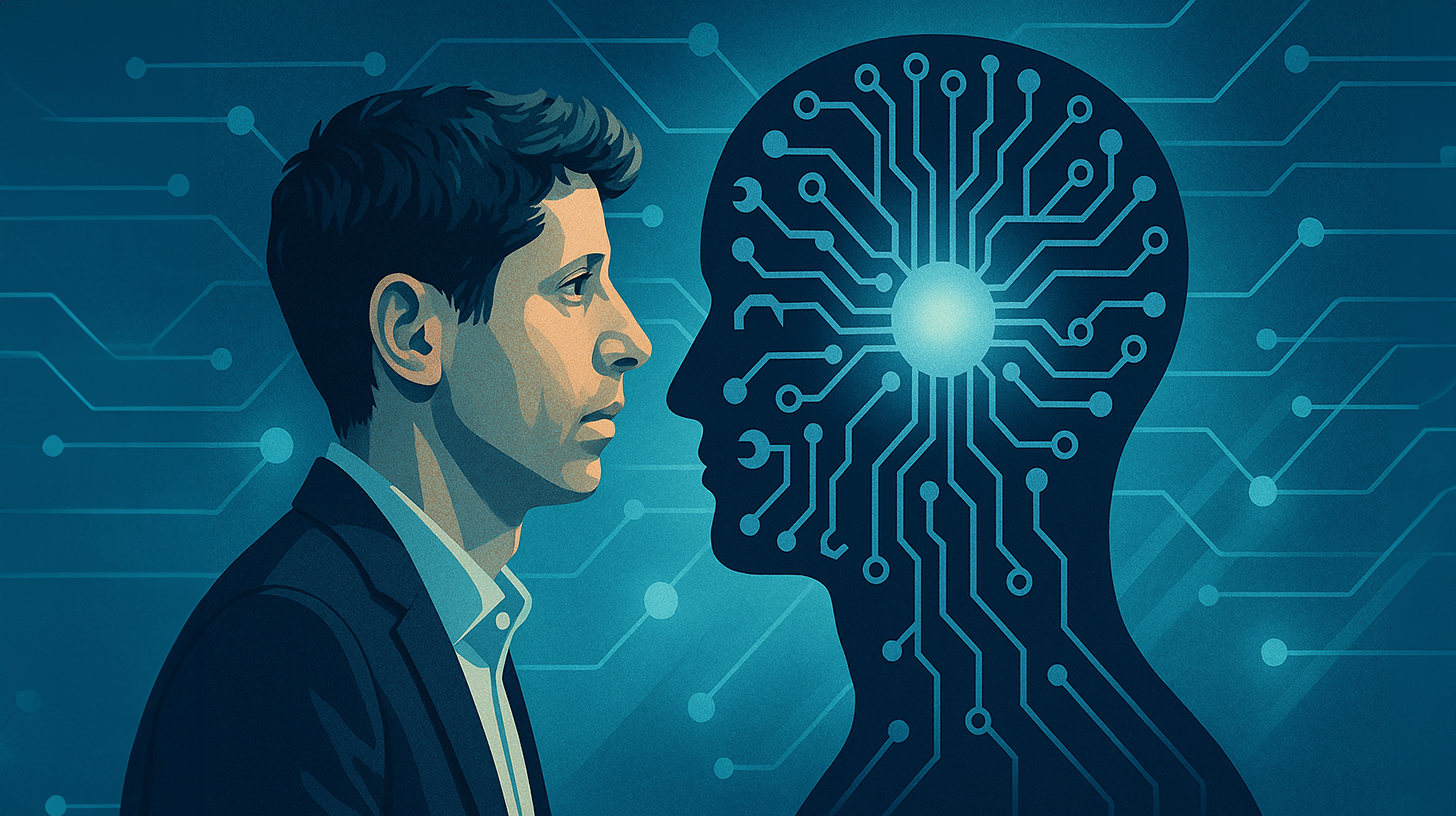
Sam Altman's vision: Artificial intelligence as a transformative force in the world of work – Image: Xpert.Digital
OpenAI CEO predicts: AI agents will become strategic business partners
The job market is changing: How AI automation is already transforming 19 percent of jobs
Sam Altman, CEO of OpenAI, paints an optimistic picture of the future of work, in which artificial intelligence (AI) evolves far beyond the role of a simple digital assistant. His vision includes AI agents as virtual colleagues who autonomously handle complex tasks, enabling new forms of knowledge work. While the job market is already undergoing noticeable changes—with a documented 19 percent decrease in AI-automatable jobs—Altman sees this development primarily as an opportunity to enrich human work through intelligent technology. His predictions range from AI agents as integral members of the workforce as early as 2025 to a fundamental paradigm shift in which AI not only automates tasks but also actively generates new knowledge and acts as a strategic partner.
Suitable for:

The evolution of AI: From chatbot to autonomous agent
From reactive tools to proactive systems
Sam Altman describes a fundamental transformation of AI technology that goes far beyond the current capabilities of ChatGPT. While current AI tools primarily respond reactively to user input, OpenAI is developing AI agents that can plan, decide, and act autonomously. These systems will no longer simply generate the next most likely word in a text, but will independently solve complex problems and develop solutions. The vision includes multimodal agents that can process text, speech, music, and video, making context-aware decisions.
Particularly noteworthy is Altman's comparison of current AI tools to junior employees who, while still requiring guidance and supervision, can already perform basic tasks independently. This analogy illustrates the paradigmatic shift: AI is evolving from a tool to a work partner. OpenAI is already planning to introduce AI agents by 2025 that will function as permanent members of the corporate workforce. OpenAI's planned "Operator" agent exemplifies this development through its ability to autonomously write code, test software, and even make restaurant reservations.
Technological breakthroughs and performance improvements
The technological foundation for Altman's vision rests on significant improvements in AI development. He predicts a considerably better understanding of how large AI models function within the next five years, which will significantly improve both training efficiency and accuracy. This development is already reflected in cost reductions: OpenAI was able to reduce costs for GPT-3 by a factor of 40 and for GPT-3.5 by a factor of ten. Altman's long-term goal is to bring the "cost of intelligence to zero," which would enable democratic access to advanced AI technology.
According to Altman, the next generation of AI models, exemplified by GPT-4.5, should be comparable to an “attentive and thoughtful human.” This characterization suggests a qualitative shift in AI capabilities that goes beyond mere data processing and integrates elements of human cognition such as attention and reasoning. Altman predicts milestones in logical reasoning, reliability, adaptation, and personalization within the next two years, enabling AI systems to leverage personal data to enhance the user experience.
Labor market transformation: disruption and redesign
Quantified impact on existing jobs
The impact of the AI revolution on the job market is already measurable and extends beyond theoretical predictions. An empirical analysis by Revelio Labs documents a 19 percent decline in job postings for tasks that can be automated by AI tools since the end of 2022. In particularly vulnerable occupational fields, primarily in IT and database administration, the decline is even more pronounced at 31 percent. These figures confirm earlier studies by the University of Pennsylvania with OpenAI Research, which showed that at least 10 percent of the job tasks of approximately 80 percent of the US workforce are affected by GPT models.
Concrete examples from companies illustrate this transformation: Shopify requires executives to justify why a job cannot be performed by AI before new positions are advertised. Duolingo announced it will increasingly rely on AI instead of freelancers. McKinsey, as one of the first users of AI agents, plans to automate customer inquiries and appointment scheduling, with the consulting firm anticipating that by 2030, tasks currently accounting for up to 30 percent of working hours in the US economy could be automated.
Altman's optimistic future forecast
Despite documented job losses, Altman remains convinced that “there will still be enough jobs, even if they look different from today’s.” His optimistic thesis is based on the historical observation that while technological revolutions eliminate existing jobs, they simultaneously create new, often higher-quality employment opportunities. Altman puts it succinctly: “ChatGPT will eliminate many current jobs—but create far better ones.” This assessment contrasts with more pessimistic forecasts, such as that of investor Vinod Khosla, who warned that AI could one day take over 80 percent of the work in 80 percent of jobs.
Altman's optimism stems from the assumption that AI will not replace human labor, but rather augment and enrich it. He emphasizes that "AI will not take our jobs, but rather someone who knows how to use it." This perspective implies a transformation in qualification requirements: success in the future job market will increasingly depend on the ability to effectively use and control AI tools. Altman therefore recommends that students and employees "engage directly with AI in order to succeed in the job market.".
AI agents as virtual colleagues: Practical applications and potential
Specific use cases and functionalities
Altman's vision of AI agents as "virtual co-workers" is concretized in specific application scenarios that illustrate the transformative potential of this technology. One prime example is the software development agent, which can take over many tasks typically performed by a seasoned developer at a leading company—at least for projects with a turnaround time of just a few days. These agents can write code, identify and fix bugs, create tests, write documentation, and make basic design decisions.
The practical applications extend far beyond software development. AI agents can function as sophisticated customer service bots, analyzing emails containing customer complaints, verifying reference numbers, accessing CRM databases and delivery systems, and processing complaints according to company policies. In the travel sector, an AI agent could handle vacation bookings, taking into account preferences for luxury hotels, suggesting suitable flights, planning itineraries, and even creating packing lists and contacting friends at the destination.
Scaling and productivity increase
Altman's vision becomes particularly clear when he discusses the scalability of AI agents: "Imagine having not just one, but thousands or even millions of such AI agents." This notion of a massive proliferation of virtual workers suggests a potential productivity explosion that could shatter historical comparisons. The possibility of deploying AI agents "in every field of knowledge work" opens up possibilities for virtual assistants in medicine, AI-powered financial advisors, automated research and analysis experts for journalists and scientists, and virtual teachers and tutors.
OpenAI is already developing concrete solutions: The AI agent “Codex” goes beyond conventional chatbots and can independently interact with software, initiate complex automations, and even make restaurant reservations. These capabilities demonstrate the potential of AI agents to evolve from reactive tools to proactive systems that independently identify problems and implement solutions. However, Altman emphasizes that these AI agents will require “human guidance and oversight” and should function as “tools and partners” for human workers, not as complete autonomous replacements.
Generational differences in AI use and societal adaptation
The younger generation as AI pioneers
Altman's observations on AI use across generations reveal fundamentally different approaches to this technology. While older users often treat AI as a "souped-up Google"—asking a question and getting an answer—younger users treat AI "like a real operating system for their lives." This generation develops complex prompt libraries, similar to cheat codes for video games, and builds sophisticated AI systems linked to diverse files and data sources.
It is particularly noteworthy that many young people “no longer make any major life decisions without first consulting ChatGPT.” They use AI as a context-aware advisor that understands their entire social environment and provides personalized advice. This development is reflected in sophisticated workflows: young users connect various data sources for complete context, create extensive prompt libraries, and use AI as a super-intelligent friend that analyzes complex situations and offers non-judgmental advice.
Labor market fears and adaptation strategies
The psychological impact of the AI revolution reveals significant generational differences. A PwC study documents that 27 percent of 18- to 29-year-olds fear being made redundant by AI tools, while this concern affects only 17 percent of the 60- to 65-year-old age group. This paradoxical reversal—the most tech-savvy generation exhibiting the greatest fears—may reflect a more realistic understanding of the transformative power of AI.
Altman acknowledges these concerns but focuses on adaptation strategies. He recommends learning AI technology to “remain competitive in the job market.” His approach is based on the belief that humanity will adapt and find “new ways to fulfill.” However, this adaptation requires an active willingness to learn: success will increasingly depend on individuals developing the ability to use and control AI tools effectively. Studies already show that over 2,800 job skills have been identified that are less likely to be replaced by AI, particularly in caring and interpersonal fields.
Suitable for:
Technological infrastructure and economic dimensions
Investment requirements and scaling challenges
Altman's ambitious vision requires massive technological and financial resources, exceptional even by Silicon Valley standards. He speaks openly about investments in the trillions of dollars, primarily for chips and data centers. This scale shatters conventional norms and raises questions about feasibility. However, the cost reduction curve for AI models shows encouraging trends: Altman reports cost reductions of a factor of 40 for GPT-3 and a factor of 10 for GPT-3.5, with efficiency gains that are "far better" than Moore's Law.
Microsoft, as OpenAI's largest investor, plays a central role in this strategy. The partnership provides access to necessary computing power and cloud infrastructure, but also creates strategic dependencies. Whether tech investors and partners will support this capital-intensive course could become the decisive bottleneck for Altman's vision. The planned transformation of ChatGPT into a comprehensive AI operating system requires not only technological breakthroughs, but also sustainable business models that extend beyond subscription services.
System integration and platform strategy
Altman's concept of an AI operating system with ChatGPT as its central element aims to "own the layer on which everything else is built." This strategy goes far beyond the app level and positions OpenAI as a fundamental infrastructure component of the digital economy. The planned system is intended to function as a personal assistant that not only responds but also autonomously plans, acts, and decides—across platforms and various devices.
The technical implementation involves developing multimodal interfaces that go beyond traditional text interactions. OpenAI's GPT-4o is already being marketed as an AI agent capable of processing audio and video input. This multimodal capability enables more natural interactions and significantly expands the range of applications. However, integrating diverse data sources and developing context-aware systems requires complex technical solutions for data privacy, security, and user trust that extend beyond pure AI algorithms.
Job losses due to AI reach 19 percent: What Altman's predictions mean for Germany
Sam Altman's vision of an AI-transformed working world is characterized by remarkable optimism, acknowledging both the disruptive and creative potential of the technology. His prediction that AI agents will become integral parts of the corporate workforce as early as 2025 is based on concrete technological advances and measurable market changes. The documented 19 percent reduction in job postings in AI-automatable areas demonstrates that this transformation is already well underway and can no longer be considered a distant vision of the future.
The societal implications of this development require proactive adaptation strategies at both the individual and institutional levels. Altman's recommendation to develop AI competence as a fundamental skill reflects a new reality in the labor market, where the ability to work with intelligent systems is becoming a core qualification. At the same time, generational differences in AI use demonstrate that adaptation is already underway, with younger users utilizing AI as an integral part of their lives, while older generations still perceive it as an enhanced search engine.
The economic and technological dimensions of Altman's vision—from trillions of dollars in investments to fundamentally new system architectures—illustrate both the transformative potential and the challenges of this development. Success or failure will ultimately depend on whether the necessary technological infrastructure can be created, sustainable business models developed, and societal acceptance achieved. Altman's confidence that this transformation will enrich human labor offers an optimistic counterpoint to dystopian AI scenarios and could serve as a guide for proactively shaping the future of AI.
Suitable for:
Your AI transformation, AI integration and AI platform industry expert
☑️ Our business language is English or German
☑️ NEW: Correspondence in your national language!

Konrad Wolfenstein
I would be happy to serve you and my team as a personal advisor.
You can contact me by filling out the contact form or simply call me on +49 7348 4088 965 (Munich) . My email address is: wolfenstein ∂ xpert.digital
I'm looking forward to our joint project.


