
The transformation of business communication: How smart glasses with live translation are changing the business world – Image: Xpert.Digital
Forget your smartphone: Why these glasses will be the most important business tool of the future
The silent revolution in the office: How smart glasses are already changing global communication
In a globalized economy that is becoming more interconnected than ever before, an invisible but multi-billion-dollar wall remains: the language barrier. It costs companies valuable time every day, hinders expansion into lucrative markets, and leads to costly misunderstandings in both internal and external communication. But this era is drawing to a close. A technological revolution, spearheaded by giants like Google, Meta, and Apple, is poised to fundamentally transform global business communication: smart glasses with integrated, AI-powered live translation.
Imagine conducting a complex negotiation with international partners, and the translation appears discreetly as "real-world subtitles" directly in your field of vision – in real time. Conversations become more natural, negotiations more efficient, and collaboration across continents more seamless than ever before. This development is far more than just a technological gimmick; it's a strategic turning point with enormous economic potential. From the rapidly growing market and concrete use cases that are already boosting productivity in industry and logistics, to the crucial issues of data privacy – the transformation has already begun and will forever redefine the way we do business.
Related to this:

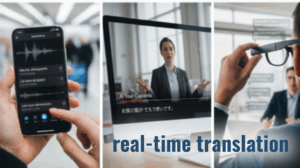
The language barrier as a business obstacle
The business world is facing a fundamental transformation. Live language translation between people using smart glasses with augmented reality technology will not only optimize individual workflows but also revolutionize the entire nature of global business communication. This development opens doors to new markets and business opportunities on a scale we can currently only imagine.
In our increasingly interconnected global economy, language barriers are becoming a critical success factor. Less than 20 percent of the world's population speaks fluent English, even though it is considered the global business language. This discrepancy leads to significant economic losses and missed opportunities.
Studies reveal alarming figures: 35 percent of companies struggle with expansion into new markets, 32 percent have difficulties with customer interaction abroad, and 24 percent experience communication problems in internal collaboration. These challenges add up to enormous economic damage.
The effects extend deep into everyday work life. 55 percent of employees lose up to two hours daily due to poor communication. From faulty internal agreements to misunderstandings in multilingual meetings, ineffective communication costs companies millions and significantly slows down decision-making processes.
This is particularly dramatic in the customer sector. 75 percent of international shoppers prefer to buy in their native language, while 59 percent of non-English-speaking consumers rarely or never shop on purely English-language websites. 29 percent of companies have already lost potential customers simply because they couldn't offer multilingual customer service.
The technological answer: Smart glasses with real-time translation
Smart glasses with integrated live translation offer the answer to these pressing challenges. This technology makes it possible to understand spoken language in real time and display it directly in the user's field of vision as text or audio in the desired language. This not only bridges language barriers but virtually eliminates them.
At its I/O 2025 developer conference, Google demonstrated a breakthrough with its new smart glasses, which are based on Android XR and the Gemini AI platform. These glasses are equipped with cameras, microphones, and speakers and can be paired with smartphones to use apps without having to take the device out of a pocket.
The revolutionary element lies in the combination of Project Astra with Gemini AI. This technology allows the artificial intelligence to see and hear the same things as the user, enabling it to understand the context of conversations and translate accordingly. Google calls this feature "subtitles for the real world"—a fitting description of the scope of this innovation.
AR text overlays play a central role in this process. They allow translations to be provided discreetly and without interrupting the flow of conversation. Users can simultaneously follow the original conversation and read the translation, enabling more natural communication than with conventional translation devices.
The current market for smart glasses with translation functions
The smart glasses market is currently experiencing explosive growth. In the first half of 2025, the global market saw growth of 110 percent. Meta dominates with a market share of 73 percent, driven by Ray-Ban Meta smart glasses, which achieved year-on-year growth of over 200 percent.
Particularly noteworthy is the rise of AI-based smart glasses, which account for 78 percent of all shipments – a significant increase compared to 46 percent in the same period last year. The AI segment even grew by over 250 percent, thus surpassing the already strong overall market growth.
Meta has strengthened its market position through strategic partnerships. Since July 2025, Ray-Ban Meta Glasses have supported German for Meta AI, enabling users to access information hands-free, control media, and manage messages and calls in German. This development makes the technology significantly more attractive for the German business market.
The new Oakley Meta HSTN sunglasses, designed for active sports enthusiasts, offer German language support right from launch. With twice the battery life and the ability to record videos in 3K resolution, they showcase the rapid technological advancements in eyewear.
Related to this:
Google and the Android XR Revolution
With Android XR, Google is positioning itself as a key player in the smart glasses revolution. After ten years of development, the company now plans to begin production of smart glasses. The glasses will be available both with and without a display to cover various usage scenarios.
The partnership with eyewear manufacturers like Gentle Monster and Warby Parker aims to develop stylish glasses powered by Android XR. These collaborations are crucial because they combine technological innovation with fashionable design – a combination essential for widespread market acceptance.
Samsung is expanding its collaboration with Google beyond mixed-reality headsets to include smart glasses. Together, they are developing a software and hardware reference platform that will enable the entire ecosystem to create high-quality glasses. Developers should be able to begin developing for the new platform as early as this year.
Xreal and Project Aura: The Next Generation
Alongside Google's announcements, Xreal unveiled its own smart glasses, Project Aura, which could set new standards. These Android XR glasses are said to offer an impressive 70-degree field of view – the largest field of view of any smart glasses announced so far. For comparison, the Xreal One and One Pro, which are already available, have a 57-degree field of view, previously considered the top value.
Project Aura is powered by a Qualcomm Snapdragon chip and uses an attached computing device that handles the complex AR calculations. This architecture allows the glasses themselves to be lightweight, while the computing power for demanding applications is housed in a separate device.
Project Aura, scheduled for market launch in early 2026, will integrate Gemini AI for seamless spatial computing, offer comprehensive support for the Android XR platform, and provide development tools. This combination of hardware expertise, AI integration, and platform support could set a new standard for business smart glasses.
Apple, Meta, and the future of the market
Apple is working intensively on its own smart glasses, but has chosen a different approach. After discontinuing Project N107 for fully-fledged AR glasses, the company is focusing on smart glasses without a display, similar to the Meta Ray-Ban models. These are intended to offer features such as audio playback, voice control, gesture recognition, and photo and video recording.
Apple's long-term vision, however, remains a lightweight AR headset that users can wear all day. Apple CEO Tim Cook gives augmented reality top priority, aiming to overlay AR content onto the user's field of vision. The technical challenges—from high-performance batteries to killer features—have not yet been fully resolved.
Meta continues to invest heavily in the future of AR. Reports indicate the company has acquired a three percent stake in its eyewear partner EssilorLuxottica, representing an investment of $3.5 billion. This strategic investment secures Meta's long-term position in the smart glasses market and access to traditional eyewear expertise.
Other providers and technologies
The market is evolving into a lively competition between different technological approaches. Rokid already offers models with Micro-OLED technology and high image quality with its Max and Max 2 AR glasses. The Rokid Max 2 supports myopia adjustment up to -6 diopters and offers a 50-degree field of view with a 120 Hz refresh rate.
Viture positions its Pro XR headset in the premium segment, offering 4K Micro-OLED displays with a 120Hz refresh rate for exceptionally sharp images. These headsets are particularly aimed at users who value the highest image quality and comprehensive streaming compatibility.
Xreal already dominates the market for wired AR glasses with various models such as the Air 2 and the new One series. The Xreal One Pro offers native 3DoF technology, which allows virtual screens to be fixed in space – an important feature for productive business applications.
Business applications and productivity improvement
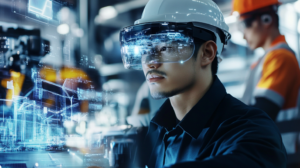
The impact of smart glasses with live translation on the business world extends far beyond simple communication aids. In manufacturing, they enable international teams to solve complex technical problems in real time without relying on interpreters. Maintenance work can be carried out with the support of experts from other countries, with instructions and diagnostics displayed directly in the user's field of vision.
By using Vuzix M400 smart glasses, Clorox was able to reduce audit time to one-tenth, saving $949 per person. At the same time, machine downtime was reduced by 20 percent, while employee exposure to health and safety risks was minimized.
In the logistics sector, the Aptus Group achieved a 15 percent increase in performance during goods receipt and a 24 percent improvement in storage through the use of smart glasses. Picking and packing speed increased by 20 percent, reducing the average order processing time by 16 minutes.
TotalEnergies uses RealWear HMT-1Z1 headsets combined with Microsoft Teams to streamline the maintenance of complex refinery equipment. The solution enables hands-free access to schematics, step-by-step instructions, and live communication with experts, thereby streamlining diagnostic processes and improving safety in hazardous environments.
Microsoft Teams and competing technologies
Microsoft has already taken significant steps toward integrating live translation into Teams. The platform offers AI-powered, real-time translations from 40 spoken languages, allowing meeting participants to read subtitles in their own language. This technology helps overcome language barriers in global meetings, making them more productive and effortless.
The new Microsoft Teams Interpreter Agent offers real-time speech-to-speech translation in multilingual Teams meetings. Participants with a Microsoft 365 Copilot license can listen to and speak in the meeting in their chosen language. The system can even simulate the speaker's own voice or use pre-defined auto-voice options.
DeepL Voice for Microsoft Teams expands these possibilities with highly accurate translations, enabling every meeting participant to speak in their preferred language and read subtitles. The cloud-based solution offers a faster, simpler, and more cost-effective alternative to traditional human interpreting services.
Wordly AI offers another solution for Teams translations, processing audio from Microsoft Teams meetings in real time to translate what is being said into dozens of languages simultaneously. Meeting participants can simply select their preferred language without needing a Wordly account or having to pay for translation minutes.
The impact on international business relationships
Smart glasses with live translation will fundamentally change international business relationships. Negotiations between partners of different nationalities can proceed without the delays and potential misunderstandings of traditional interpreting services. Each participant can speak and understand in their native language, leading to more authentic and efficient discussions.
The technology also eliminates cultural communication barriers that go beyond mere language problems. German business partners, known for their direct communication style, can convey their messages unfiltered, while the AI systems take cultural nuances into account and provide appropriate translations.
For multinational companies, this means a revolution in internal communication. Teams from different countries can collaborate seamlessly without language barriers hindering career development. Meetings become more inclusive, as all participants can communicate in their strongest language.
Our recommendation: 🌍 Limitless reach 🔗 Connected 🌐 Multilingual 💪 Sales power: 💡 Authentic with strategy 🚀 Innovation meets 🧠 Intuition


From local to global: SMEs conquer the world market with a clever strategy - Image: Xpert.Digital
In an era where a company's digital presence determines its success, the challenge lies in creating an authentic, personalized, and far-reaching presence. Xpert.Digital offers an innovative solution that positions itself as the intersection of an industry hub, a blog, and a brand ambassador. It combines the advantages of communication and sales channels in a single platform and enables publication in 18 different languages. Cooperation with partner portals and the ability to publish articles on Google News and a press distribution list with approximately 8,000 journalists and readers maximize the reach and visibility of the content. This represents a crucial factor in external sales and marketing (SMarketing).
More information here:
Language barriers are falling: How AI translations are transforming businesses
Impact on customer relationships and sales
In sales, smart glasses with live translation open up entirely new possibilities. Sales conversations can be conducted directly with international customers without relying on interpreters or multilingual colleagues. This significantly accelerates sales processes and enables smaller companies to operate internationally without large investments in multilingual staff.
Customer service is being revolutionized, as employees can instantly communicate with customers in their native language. This leads to higher customer satisfaction and reduces misunderstandings that could result in complaints or contract problems. Companies can expand their service capabilities globally without having to build up their own language resources.
Exhibition stands and presentations are becoming more interactive and accessible. Exhibitors can spontaneously communicate with visitors from all over the world without having to determine their language skills beforehand. This leads to more qualified leads and better business deals at international events.
Related to this:

Technical challenges and solutions
Implementing live translation in smart glasses presents significant technical challenges. Speech recognition must function in noisy environments, understand different dialects, and simultaneously conserve energy to avoid impacting battery life. Modern AI systems like Gemini and Meta AI have already made considerable progress in this area.
Latency presents another critical challenge. For natural conversations, translation needs to happen almost in real time. Google reports latency times of less than one second for live translation, which is fast enough for most business conversations. Improvements in processors and AI algorithms will further reduce these times.
The accuracy of the translation, especially with technical terms and industry-specific expressions, remains an important area for development. Here, providers are working on specialized models for different industries that take into account the specific vocabulary and communication patterns of their respective sectors.
Data protection and security aspects
Smart glasses with live translation process sensitive business conversations and personal data, which entails high data protection requirements. European companies must ensure that the systems used are GDPR-compliant and that business data is not passed on to unauthorized third parties.
Vendors are addressing these concerns with local data processing and end-to-end encryption. Google emphasizes that Android XR systems give users detailed control over their data, allowing them to selectively enable or disable features. Meta has integrated similar privacy features into its Ray-Ban glasses.
It will be important for companies to develop clear guidelines for the use of smart glasses. This includes regulations on when and where the glasses may be used, how recorded data is handled, and what security measures are necessary to protect confidential information.
Training and introduction in companies
The successful implementation of smart glasses with live translation requires well-designed training programs. Employees need to learn how to use the technology effectively without it becoming a distraction. This includes understanding voice commands, gesture recognition, and the optimal positioning of the glasses.
Change management will play a central role in the implementation. Many employees may initially be skeptical of the new technology or have concerns about surveillance. Companies must take these concerns seriously and communicate transparently about the benefits and data protection measures.
A phased rollout, starting with selected teams or departments, has proven successful. This allows for the gathering of experience, the adaptation of workflows, and the development of best practices before the technology is rolled out company-wide.
Economic impact and ROI
The economic impact of smart glasses with live translation is already measurable in pilot projects. Companies report time savings of between 15 and 25 percent in international projects, as meetings are more efficient and fewer clarifications are needed. The reduction in misunderstandings leads to fewer costly errors and rework.
The investment costs for smart glasses are steadily decreasing. While early models cost several thousand euros, current business-ready devices are available from 400 to 800 euros. Considering the savings from more efficient communication and reduced travel expenses, these investments often pay for themselves within a few months.
Small and medium-sized enterprises (SMEs) in particular benefit disproportionately, as they can now access markets that were previously closed to them due to language barriers. For example, a mechanical engineering company from Baden-Württemberg can negotiate directly with Chinese partners without having to hire expensive interpreters.
Industry-specific applications
In mechanical engineering and the automotive industry, smart glasses with live translation enable direct communication between German engineers and international partners in the development of complex systems. BMW already uses AR technologies and has filed over 70 patents in this field, underscoring the importance of this technology for the automotive industry.
The pharmaceutical industry benefits from the ability to coordinate international clinical trials more efficiently. Doctors and researchers from different countries can communicate directly without critical medical information being distorted by translation errors.
Smart glasses are already being used successfully in the logistics and transportation industry to optimize international supply chains. DHL uses Google Glass Enterprise Edition to improve communication between different locations and to standardize workflows.
The role of artificial intelligence
Artificial intelligence is at the heart of modern smart glasses with live translation. The AI systems continuously learn from millions of conversations and constantly improve their translation accuracy. Google Gemini and MetaAI use advanced language models that not only translate words but also understand the context and intent.
The integration of Project Astra into Google's smart glasses enables AI to process visual information and incorporate it into the translation. For example, if a speaker points to an object, the AI can recognize it and include relevant contextual information in the translation.
Machine learning ensures that the systems adapt to individual language patterns and technical terms. Companies can integrate their own terminology and abbreviations, thereby significantly improving translation quality in specific business areas.
Future prospects and market forecasts
According to Research and Markets, the market for AR glasses will grow by 17.1 million units by 2025, driven by a remarkable growth rate of 109.3 percent. These figures underscore the enormous potential of the technology and the willingness of companies to invest in this innovation.
Experts expect that by 2030, smart glasses with live translation will become standard in most international companies. The technology will evolve from an innovative tool to an essential business piece of equipment, much like smartphones did in the 2010s.
The trend towards even lighter and more elegant glasses will further increase their acceptance. Google is collaborating with eyewear manufacturers like Gentle Monster and Warby Parker to develop smart glasses that are virtually indistinguishable from regular glasses. This development will be particularly important for executives and sales staff who value a professional appearance.
Integration into existing IT infrastructures
Integrating smart glasses into existing corporate IT requires careful planning and potentially upgrades to the network infrastructure. The devices need stable internet connections for cloud-based AI services, which can pose challenges, especially in older office buildings.
Enterprise resource planning (ERP) systems may need to be extended to support smart glasses. This includes integrating voice commands, synchronizing translation data, and connecting to existing communication platforms such as Microsoft Teams or Slack.
IT security needs to be revised to address new attack vectors. Smart glasses are potential entry points for cyberattacks, which is why they must be integrated into comprehensive security concepts. This includes regular updates, encryption, and potentially the implementation of zero-trust architectures.
Impact on work culture
Smart glasses with live translation will profoundly change the work culture in international companies. Hierarchies previously based on language skills will be dismantled, as technical competence becomes more important than foreign language proficiency. This can lead to a fairer distribution of career opportunities.
The technology fosters a more inclusive work environment where employees can participate equally, regardless of their linguistic background. Meetings become more democratic, as all participants can argue in their strongest language.
At the same time, new challenges arise in team building and informal exchange. Companies must find ways to ensure that technology-mediated communication does not lead to social isolation and that interpersonal relationships are strengthened.
Related to this:
Ethical considerations and societal impacts
The introduction of smart glasses with live translation raises important ethical questions. Will this technology lead to people ceasing to learn foreign languages? What impact will this have on cultural exchange and intercultural competence?
There is a risk of technological dependency, where business communication is only possible with the support of technology. Companies must develop contingency plans for situations in which the technology is unavailable or fails.
The impact on traditional interpreters and translators must be considered. While simple translation tasks are being automated, new roles are emerging in the development, maintenance, and optimization of AI translation systems.
Regulatory framework
The regulatory landscape for smart glasses with live translation is still evolving. The European Union is working on guidelines for AI systems that will also include translation technologies. Companies need to monitor these developments and ensure their implementations comply with upcoming regulations.
Data protection regulations in different countries can affect the cross-border use of smart glasses. What is permitted in one country may be regulated or prohibited in another. International companies must navigate complex compliance requirements.
The question of liability for translation errors has not yet been definitively settled. Who is responsible if a faulty translation leads to business losses? Insurance companies are already developing new products to cover these risks.
Education and training
The introduction of smart glasses with live translation requires new training programs and qualifications. Companies must train their employees not only in the operation of the devices, but also in the effective use of technology-supported communication.
Universities and vocational schools are already developing curricula that include the use of AR technologies and AI translation systems. This will be particularly relevant for degree programs in international business administration, mechanical engineering, and other export-oriented fields.
Continuous professional development is becoming increasingly important as technology rapidly evolves. Companies must invest in the regular training of their employees to keep pace with the latest developments.
The transformation of the business world
Smart glasses with live translation are poised to revolutionize the business world. The technology is no longer just a futuristic vision, but is already being successfully used in initial applications. The combination of advanced AI, elegant hardware, and practical applications creates a solution that addresses fundamental business problems.
The economic benefits are already measurable: shorter project times, reduced costs for interpreting services, expanded market opportunities, and improved customer satisfaction. Companies that adopt this technology early gain significant competitive advantages in the globalized economy.
The societal impact will be profound. Language barriers, which have hampered international trade for centuries, will be virtually eliminated. This will democratize access to global markets and enable even smaller companies to operate internationally.
The technology is still in its early stages. The coming years will bring further breakthroughs in battery capacity, translation accuracy, and user-friendliness. Smart glasses with live translation will evolve from innovative tools into indispensable business instruments.
Companies should start developing their strategies for this technological revolution today. Those who are prepared will be the winners of this transformation. The future of global business communication has already begun – and it's wearing glasses.
We are here for you - Consulting - Planning - Implementation - Project Management
☑️ SME support in strategy, consulting, planning and implementation
☑️ Creation or realignment of the AI strategy
☑️ Pioneer Business Development

Konrad Wolfenstein
I would be happy to serve as your personal advisor.
You can contact me by filling out the contact form below or simply call me on +49 7348 4088 965 .
I'm looking forward to our joint project.
Write to me



Xpert.Digital - Konrad Wolfenstein
Xpert.Digital is a hub for industry focusing on digitalization, mechanical engineering, logistics/intralogistics and photovoltaics.
With our 360° Business Development solution, we support renowned companies from new business to after-sales.
Market intelligence, smarketing, marketing automation, content development, PR, mail campaigns, personalized social media and lead nurturing are part of our digital tools.
You can find more information at: www.xpert.digital - www.xpert.solar - www.xpert.plus
Keep in touch