Website icon Xpert.Digital

The transformation of an entire infrastructure: high-bay containers, micro-hubs, blockchain, automation and robotics

The transformation of an entire infrastructure: high-bay containers, micro-hubs, blockchain, automation and robotics

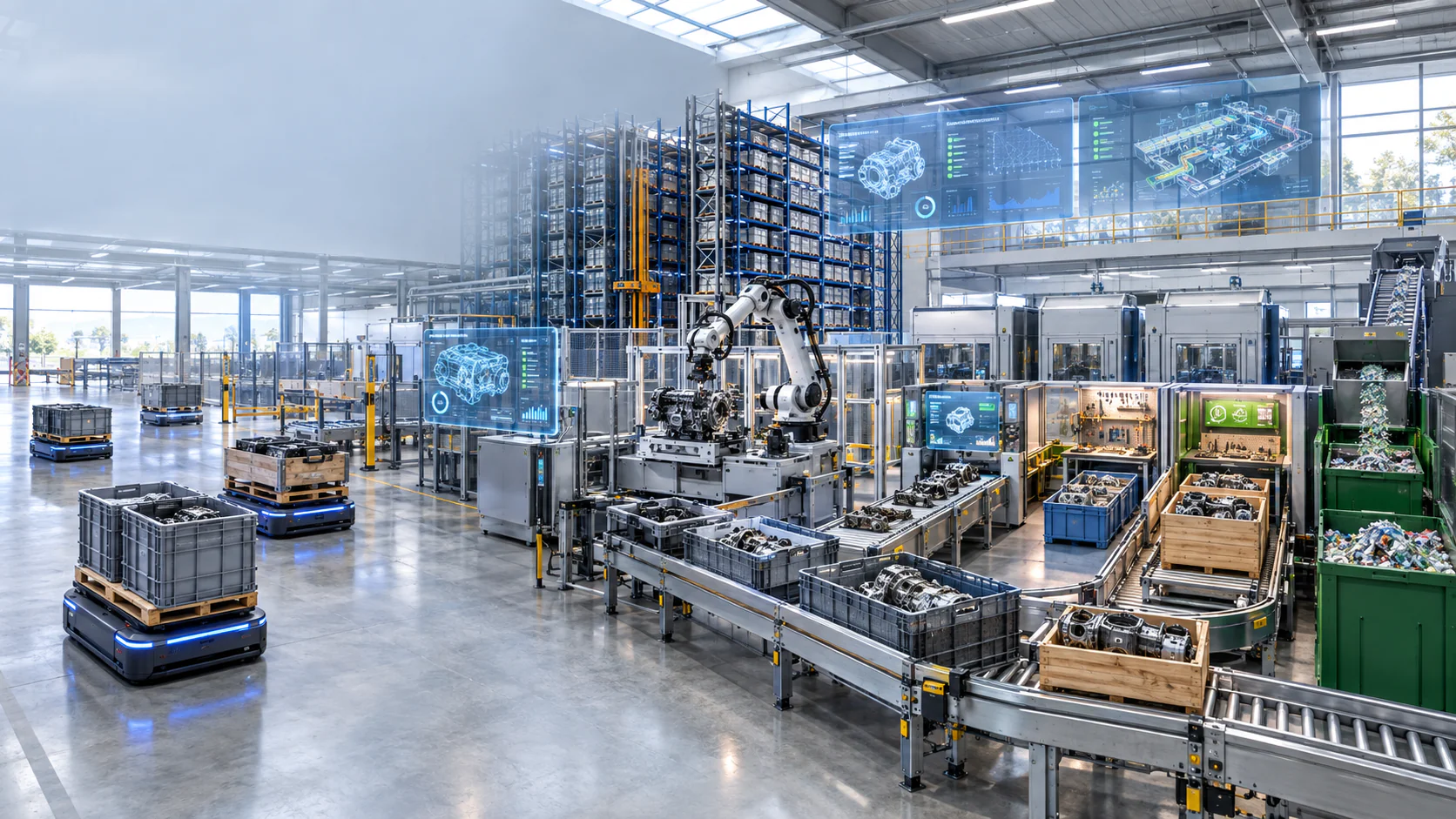
The transformation of an entire infrastructure: containers from high-bay racking, micro-hubs, log cabins, automation and robotics – Image: Xpert.Digital

The future of global logistics: Transformation of an entire infrastructure in the next ten years

More than just trucks: Why logistics is facing its biggest transformation since the invention of the container.

The logistics industry is on the cusp of a fundamental transformation that will drastically alter how goods are produced, transported, and stored over the next decade. This revolution encompasses all areas of the supply chain – from procurement and production to final delivery to the end customer. The drivers of this development are manifold: technological breakthroughs, evolving customer expectations, sustainability requirements, and the need for more resilient supply chains.

Suitable for:

Digitalization and automation as the foundation of the new logistics

Digitalization forms the backbone of the future logistics world. Artificial intelligence, big data, and the Internet of Things are increasingly becoming indispensable tools for optimizing processes, reducing costs, and promoting sustainability. These technologies enable companies to make their operations more efficient and, at the same time, react more flexibly to market changes.

Automated warehouses and robotics will increase efficiency and minimize error rates. Autonomous systems such as robots and drones could revolutionize warehouse logistics and delivery by 2035. Warehouses are expected to operate almost fully automatically, leading to a significant reduction in operating costs. Companies are already relying on warehouse management systems that monitor goods and their transport, while wearable RF scanners and even drones are being used for inventory tracking.

AI-driven route optimization improves the efficiency of delivery routes, saving time and fuel. At the same time, it reduces CO2 emissions, which is crucial given increasing sustainability requirements. Artificial intelligence and algorithms will organize and automate complex processes within and between companies more efficiently.

Autonomous vehicles and the redesign of transport

Autonomous vehicles are on the verge of revolutionizing the logistics industry. The use of autonomous trucks can help the logistics sector reduce its need for vehicles and skilled workers. This technology enables vehicles to operate around the clock, significantly shortening delivery times.

Autonomous trucks are already being tested, particularly on highways. The ATLAS-L4 research and development project has demonstrated since 2022 that the use of Level 4 automated, and therefore driverless, vehicles on highways is feasible. Integrating autonomous systems into logistics processes can reduce costs by optimizing fuel consumption and minimizing vehicle wear and tear.

Platooning technology enables trucks to drive closely behind one another and communicate with each other to optimize traffic flow. If the first truck brakes, the following vehicles can automatically brake and accelerate again at the same intensity within the same second. This reduces the risk of congestion, improves traffic flow, and keeps fuel consumption low.

Container high-bay warehouses: The future of port logistics

A particularly innovative development is container high-bay warehouses, which have the potential to fundamentally transform port logistics. These systems make it possible to store standard shipping containers in huge, fully automated racking systems, instead of stacking them flat and only a few layers high.

Unlike traditional container yards, where containers are stacked on top of each other using cranes or straddle carriers, a high-bay warehouse assigns each individual container a fixed, individual shelf space. The transport of the containers to and from these spaces is fully automated by rail-guided storage and retrieval machines or other specialized robotic systems.

The world's first high-bay container warehouse has already been successfully tested. In the port of Dubai, the system, called Boxbay, designed by the German plant engineering company SMS Group, has passed its practical test. The facility offers more than three times the storage capacity on the same footprint compared to conventional solutions. The system consists of an automated high-bay warehouse with 11 storage levels and flexible interfaces for sea and land-based loading.

Suitable for:

Sustainable logistics and decarbonization

Sustainability is becoming a key driver of logistics development. Companies are seeking innovative ways to reduce their carbon footprint, leading to increased use of alternative fuels and low-carbon packaging solutions.

Hydrogen technology is gaining importance as an alternative to diesel engines. Hydrogen vehicles can travel greater distances than electric vehicles, do not pollute the environment, and can be easily refueled in just a few minutes. Companies like BAUHAUS and EDEKA Nord have already put their first hydrogen trucks into operation, achieving a range of up to 400 kilometers and producing only water vapor as an emission.

Electromobility is simultaneously establishing itself as an important pillar of sustainable logistics. The development of battery-electric trucks is progressing, and with dedicated charging infrastructure at warehouses, these become cost-competitive and economically viable.

Artificial Intelligence in Supply Chain Management

Artificial intelligence is revolutionizing supply chain management through more accurate demand forecasting, improved inventory management, and optimized logistics. AI algorithms analyze massive datasets to generate demand forecasts, enabling companies to adjust their production plans and reduce excess inventory.

Predictive analytics enables companies to forecast future trends and potential bottlenecks, thereby minimizing risks and maximizing efficiency. Analyzing large datasets helps in making informed decisions that optimize the entire supply chain. Predictive analytics is becoming increasingly important for supply chain management, making processes more accurate, reliable, and cost-effective.

Blockchain and IoT for transparency and traceability

The combination of blockchain and the Internet of Things opens up new possibilities for monitoring and tracking products in logistics. Blockchain technology increases transparency in supply chains, helps prevent counterfeiting, and enables real-time tracking of transport routes.

IoT devices offer unparalleled real-time visibility and data collection capabilities. They improve real-time tracking and monitoring, which is essential for optimizing logistics and supply chain operations. IoT enables continuous connectivity, real-time decision-making, and predictive maintenance.

Tracking systems use small sensors attached to materials or products to ensure accurate and up-to-date inventories at all times. These smart inventories can contain a wealth of information about the products themselves, their previous locations, and how long they were present at a facility.


LTW Solutions

LTW Intralogistics – Engineers of Flow - Image: LTW Intralogistics GmbH

LTW offers its customers not individual components, but integrated complete solutions. Consulting, planning, mechanical and electrotechnical components, control and automation technology, as well as software and service – everything is networked and precisely coordinated.

In-house production of key components is particularly advantageous. This allows for optimal control of quality, supply chains, and interfaces.

LTW stands for reliability, transparency, and collaborative partnership. Loyalty and honesty are firmly anchored in the company's philosophy – a handshake still means something here.

Suitable for:


Circular economy: Logistics as a new revenue driver – Networked platforms and multimodality in freight transport

Resilience and risk management in supply chains

The pandemic and political uncertainties have demonstrated the vulnerability of global supply chains. By 2035, many companies will increasingly rely on reshoring, i.e., relocating production sites closer to consumption centers, in order to minimize risks.

Resilient supply chains are defined by their ability to withstand and recover from disruptions. They can mitigate disruptions or significantly limit their impact. The primary goal of supply chain risk management is to design the supply chain in such a way that it can successfully manage disruptions and integrates proactive risk minimization measures.

Supply chain diversification is becoming a necessity. Companies will be forced to diversify their supply chains and build alternative production and transportation networks to minimize the risk of disruptions caused by geopolitical tensions or natural disasters.

Urban logistics and micro-hubs

Urban logistics faces major challenges due to increasing delivery traffic, which clogs roads and is often inefficiently designed. Micro-hubs offer a solution: small, strategically located distribution centers that are as close as possible to the end customer.

These intermediate stations act as an interface between large-scale goods deliveries and finely branched end-customer deliveries. Instead of a delivery vehicle driving from a distant depot through the entire city traffic, its route ends at the micro-hub. From there, smaller, often emission-free vehicles take over the last-mile delivery.

Micro-hubs primarily shorten the route to recipients and act as range extenders to expand the use of cargo bikes and electric light vehicles for deliveries in urban areas. They allow for the use of locally emission-free, environmentally friendly vehicles for resource-efficient, city-compatible, and efficient last-mile delivery.

Suitable for:

Drones in logistics

Drones are revolutionizing last-mile delivery. The first commercial drone delivery service in Germany has already launched in North Rhine-Westphalia. A transport drone will fly packages along a defined route to their destination and deliver them there.

A key feature is that not every drone needs to be individually piloted. A trained employee can monitor ten to twelve drones simultaneously from a central control room and intervene if any deviations occur. The drone can carry a payload of approximately 6.5 kilograms and has a flight time of up to 45 minutes.

The use of drones in logistics is primarily being tested or already implemented in three areas: surveillance and inspection, order picking and inventory management, and last-mile delivery. Drones equipped with cameras and scanning technology can significantly reduce the need for personnel in warehouses by capturing barcodes and transmitting them to the warehouse management system.

Additive manufacturing and 3D printing

3D printing promises a revolution in the supply chain through decentralized production and on-demand manufacturing. This technology enables the production of products layer by layer from different materials and opens up new horizons in the supply chain through more agile and flexible methods.

3D printing makes the supply chain digital, decentralized, and flexible. Instead of transporting spare parts over long distances and storing them in large quantities, they can be manufactured directly on-site – in precisely the quantities needed at any given time. This reduces transport costs, shortens delivery times, and decreases the amount of capital tied up in inventory.

The advantages include increased flexibility in product design, faster prototyping, and the ability to realize complex geometries that would be impossible with conventional manufacturing methods. The potential is particularly evident in spare parts logistics: parts can be produced on demand without having to be stored for years.

Circular economy in logistics

The circular economy offers new opportunities for logistics and transforms or expands its business areas. Logistics is becoming the driving force behind the circular economy, which encompasses not only traditional delivery but also return, recycling, and related services.

Reverse logistics encompasses all processes in which goods move from their point of use within the supply chain. This can include returns management, exchange and restocking processes, product repairs, and the exchange of pallets and reusable containers. This onward logistics transforms linear supply chains into circular supply chains.

The circular economy leads to new markets, for example for spare parts or pay-per-use models, which can be used to address new customer groups. Logistics companies can evolve from service providers to value-adding members of the supply chain. At the same time, new logistics-related business areas are emerging, such as the individual disassembly, reprocessing, or repair of returned goods.

Networking and platform economy

The future of logistics lies in networked systems and platform solutions. Multimodal platforms enable interactive networking across modes of transport and companies, facilitating the data protection-compliant exchange of data, services, and experience. These platforms offer the opportunity to present logistics services across different modes of transport and to organize optimized transport services according to various criteria.

Germany is developing a multimodal transport system for national and international freight transport. Depending on the type of goods, quantity, time required, and distance, shipments can be handled via the most efficient transport routes. All stakeholders have access to comprehensive and up-to-date information regarding their freight transport operations.

Combined transport is gaining importance as an indispensable component. On long routes, predominantly environmentally friendly freight railways and inland waterways are used, which have continuously increased their share of the modal split.

Suitable for:

Agile supply chains: The key to tomorrow's competitive advantage

The transformation of global logistics over the next ten years will not be without challenges. The introduction of new technologies requires significant investments in infrastructure, training, and the adaptation of existing processes. At the same time, regulatory frameworks must be adapted to enable the use of autonomous vehicles, drones, and other innovative technologies.

The ability to adapt quickly to changing market conditions and customer needs will be crucial for logistics companies. Agile supply chains and flexibility will be key to overcoming future challenges. Companies that can rapidly adapt their supply chains will have a competitive edge.

The next ten years will show how these technological and strategic developments fare in practice and what new innovations will emerge. What is certain, however, is that the logistics industry will undergo a fundamental transformation affecting all areas, from production and transport to final delivery. High-bay containers will be just one visible symbol of this comprehensive change, which will enable a completely new way of global trade.


Advice - planning - implementation

Markus Becker

I would be happy to serve as your personal advisor.

Head of Business Development

LinkedIn


Advice - planning - implementation

Konrad Wolfenstein

I would be happy to serve as your personal advisor.

contact me under Wolfenstein Xpert.digital

call me under +49 89 674 804 (Munich)

LinkedIn


Exit the mobile version