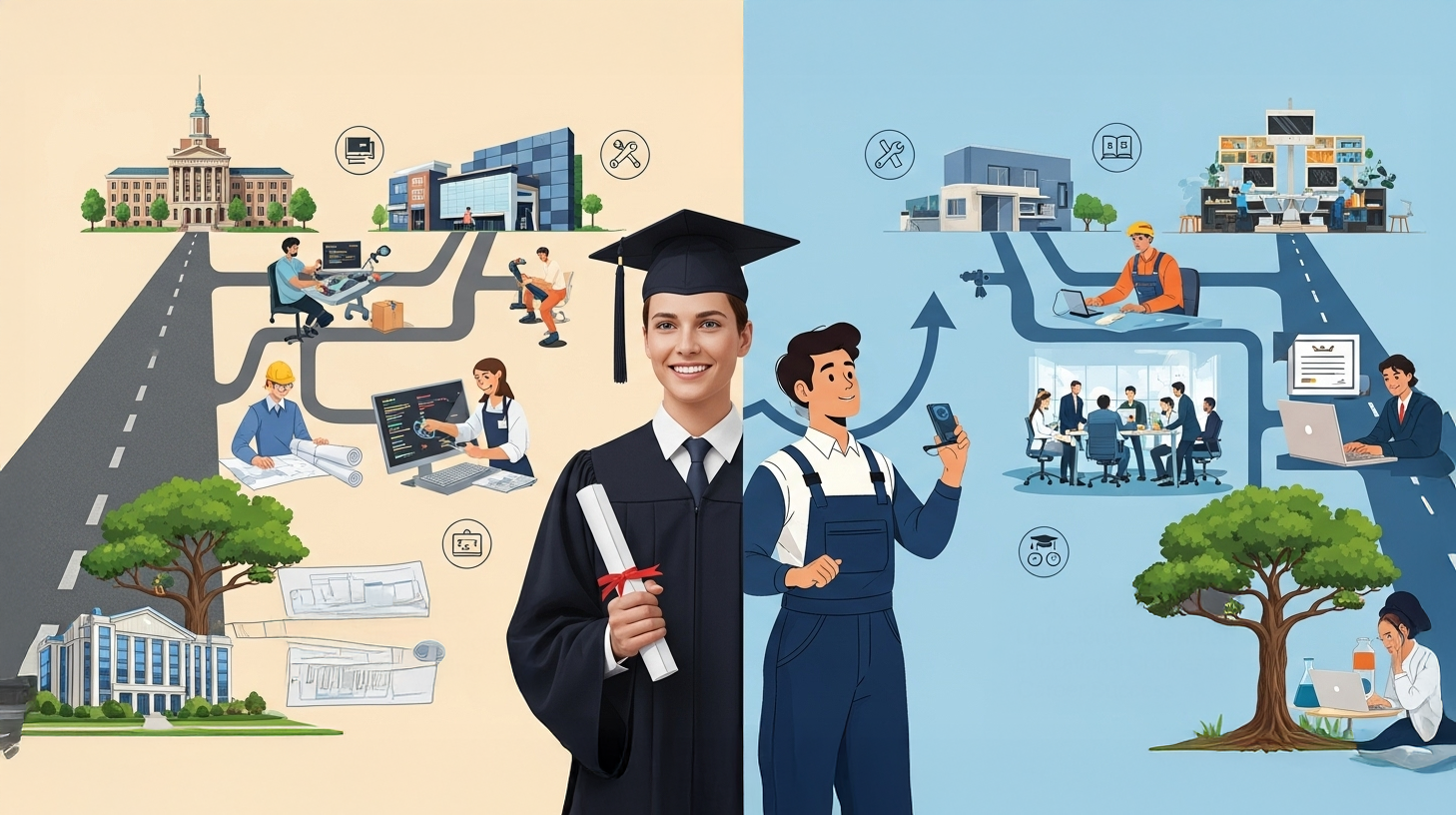
Vocational training or university studies: A myth, is a career only possible via university? Decision-making paths, opportunities and career prospects – Image: Xpert.Digital
Career myth debunked: In these cases, vocational training is the smarter choice than university studies
Extreme skills shortage: In these sectors, vocational training is more valuable than a master's degree
After graduating from school, countless young people face one of the most important decisions of their lives: Should they pursue university or a practical vocational training program? For a long time, a university degree was considered the gold standard for a successful career. But is this myth still valid in a job market desperately seeking skilled workers and where practical skills often count for more than a theoretical degree? The question is no longer relevant only for graduates – even later in their professional lives, the decision between academic theory and hands-on practice repeatedly comes into focus.
This article explores when vocational training can be not only an equivalent, but even the smarter alternative. We examine which personality types are ideally suited for direct entry into the workforce, which sectors – from skilled trades and IT to healthcare – offer tremendous opportunities, and why even the CEO of a global tech company strongly recommends an apprenticeship as an electrician. Discover which arguments are crucial for your personal path and how to make an informed decision about your professional future that aligns with your strengths, goals, and the demands of tomorrow.
Related to this:


Not keen on university? 5 reasons why an apprenticeship will put your career on the fast track right now
Which path leads to professional success – a traditional apprenticeship or a university degree? Are there life situations, industries, or personality traits in which vocational training is clearly preferable to university studies? What does professional success even mean, and how can young people make decisions that suit their personality and the demands of the future job market? What perspectives does the so-called dual vocational training system offer, especially in light of digitalization, globalization, and technological innovations? And what answers does the CEO of one of the world's leading technology companies give to the question of who will be most urgently needed in the future?
These and many related questions are asked by countless young people immediately after graduating from school, but also by a growing number of adults throughout their professional lives. It is worthwhile to examine the advantages and disadvantages of both paths, structural trends in the job market, and the demands of modern careers in detail and to compare them.
When is it better to choose vocational training instead of starting a university degree?
What are the reasons for starting an apprenticeship?
If you ask yourself when vocational training is equivalent to or even better than a university degree, you'll find several compelling arguments. Starting vocational training can be sensible, future-oriented, or even more lucrative for a variety of reasons.
What situations make an apprenticeship particularly attractive?
An apprenticeship is particularly advantageous for those pursuing a highly specific, practically oriented career path that emphasizes practical skills, on-the-job training, and routine in daily work. Occupations such as electrician, plant mechanic, automotive mechatronics technician, carpenter, IT specialist, or nurse fall into this category – fields where the demand for skilled workers is currently high or even critical. Furthermore, apprenticeships can now become extremely complex and demanding due to additional qualifications and further training leading to master craftsman or technician certifications.
Another advantage: Most apprenticeships are dual-track – meaning they combine practical experience in a company with classroom instruction. Those seeking extensive hands-on experience and responsibility early on, and who want to enter the workforce directly, will find this the right fit.
How does starting a career differ between university studies and vocational training?
Those who choose vocational training gain professional experience from day one and earn a monthly income. In contrast, university students often spend several years in lecture halls and usually have to complete internships in addition to their studies, frequently without pay or with low wages. After completing vocational training, graduates are generally immediately employable and valued as skilled workers.
Are there areas where traditional academic qualifications offer little added value?
Yes – especially in industries characterized by rapid innovation cycles, strong specialization, or a shortage of skilled workers. In many skilled trades and technical professions, concrete experience and competence often count for more than an academic degree. Furthermore, in some sectors, such as IT, the event industry, creative professions, or at specialized niche providers, there are fields of work for which no standard degree programs exist – but instead, there are tailored training models, traineeships, or career change pathways.
Related to this:


Can vocational training be the starting point for self-employment?
How does education facilitate steps towards self-employment?
Why can vocational or technical training create better conditions for self-employment than a university degree?
Those who complete a solid apprenticeship in a practical trade acquire concrete skills that are directly marketable. This applies to professions such as electrician, plumber, locksmith, carpenter, baker, hairdresser, or mechanic. Anyone wishing to start a business providing goods, repair services, or skilled trades primarily needs professional qualifications, a master craftsman's certificate or equivalent, and a network within the industry. Academic theory, on the other hand, is less frequently required.
Furthermore, the barriers to entry into self-employment in the skilled trades are often lower and involve less bureaucracy than, for example, in engineering, legal, or medical professions, where a university degree, license to practice, or membership in a professional association is required. Many successful medium-sized businesses have been and are still being run by skilled tradespeople. The step into self-employment is also facilitated by funding programs, business start-up seminars, and regional networks.
Are there differences in specializations and career access?
In young, dynamic industries or entirely new fields of work, vocational training can certainly offer better access. In areas such as renewable energies, automation, smart home technology, or the installation and maintenance of infrastructure (e.g., solar panels, heat pumps, fiber optic networks, etc.), specialized training programs are increasingly offered that traditional university courses simply cannot cover. Here, rapid, practical learning and participation in real-world projects are key.
A university degree can be advantageous when starting your own business if business administration knowledge, strategic expertise, or scientific know-how is required. However, in practice, business administration skills are also taught in many master craftsman or technician training programs.
What is the current state of demand in the economy?
Growing demand for skilled workers in the trades
The changing world of work is leading to a renaissance of dual vocational training. The skilled trades, in particular, are currently experiencing a noticeable shortage of skilled workers and depend on targeted support for young talent. Market experts, politicians, and even international technology leaders are increasingly emphasizing the importance of these professions.
What statements do key economic players, such as the Nvidia CEO, make regarding the development of labor markets and the need for skilled workers?
Nvidia CEO Jensen Huang emphasized in a widely noted statement that the demand for young skilled workers in the trades, especially electricians and plumbers, will increase rapidly. The expansion and maintenance of data centers, which are increasingly becoming part of society's digital infrastructure, also require skilled professionals with both technical and practical expertise. Huang stated that the modern job market needs "hundreds of thousands of electricians and plumbers"—a prediction supported by developments in the energy transition, broadband expansion, and the digitalization of the economy.
His recommendation is aimed primarily at Generation Z: Young people should be aware that not only academic professions offer excellent future prospects. "Real," skilled trades and technical professions form the backbone of every modern economy and offer enormous opportunities for professional self-realization, especially right now.
Educational pathways in light of digital transformation
The more automation, artificial intelligence, and digitalization transform traditional ways of working, the more differentiated the requirements for qualifications and access to the professions become. While some professions disappear or are significantly transformed, others are emerging anew: IT security experts, robotics technicians, building technology specialists, and renewable energy experts are examples. Many of these can be covered by modern vocational training programs or dual study programs, without necessarily requiring a traditional university degree.
Our EU and German expertise in business development, sales and marketing


Our EU and German expertise in business development, sales and marketing - Image: Xpert.Digital
Industry focus areas: B2B, digitalization (from AI to XR), mechanical engineering, logistics, renewable energies and industry
More information here:
A thematic hub offering insights and expertise:
- Knowledge platform covering global and regional economies, innovation and industry-specific trends
- A collection of analyses, insights, and background information from our key areas of focus
- A place for expertise and information on current developments in business and technology
- A hub for companies seeking information on markets, digitalization, and industry innovations
6 tangible benefits of vocational training for your career – A career without university: How vocational training leads to leadership and independence
What are the pros and cons of university studies versus vocational training?
Advantages of an education
What advantages does vocational training offer compared to university studies?
Key advantages include:
- Early career entry and financial independence: Trainees receive remuneration from the start, can build professional networks and gain professional experience.
- High demand for qualified professionals: In the skilled trades, in industry, in nursing and health professions as well as in many technical fields, the labor market forecast remains stable to rising.
- Practical qualification: The direct combination of learning and working ensures a realistic understanding and increases employability.
- Diverse career advancement opportunities even without a university degree: Master craftsman, technician or specialist are highly recognized advanced training qualifications that enable careers up to company management.
Advantages of studying
In which situations is a university degree still recommended?
Going to university is particularly useful if:
- Careers in science, engineering, medicine, law, or education are often pursued. A university degree is usually mandatory in these fields.
- There is interest in broad, general education, theory, and research. Universities offer opportunities for specialization, international mobility (e.g., through semesters abroad), and the development of academic networks.
- Long-term career goals include management positions in large corporations, public administration, or international contexts. University degrees are a prerequisite in many management positions.
- A deeper understanding of complex relationships, analytical thinking and broad methodological skills are required.
The role of dual study programs and alternative educational pathways
Between the poles of "traditional vocational training" and "pure university studies," numerous hybrid models have developed. Dual study programs or work-integrated programs combine theory and practice, offering an academic degree and intensive practical experience. These pathways are particularly in demand in technical, business, and IT-related sectors.
In addition, there are industry- or company-specific trainee programs, retraining and further education opportunities that are increasingly blurring the lines between vocational training and university studies.
Related to this:


Which industries are particularly suitable for training programs?
Current developments in the labor market
In which professional fields are training paths particularly future-proof?
Industries with high demand for trainees currently include:
- Construction, crafts and technical services (electricians, installers, heating and air conditioning technicians)
- IT and computer science (IT specialists, system administrators, IT support)
- Health and care professions (nursing professional, medical assistant, paramedic)
- Industry (Mechatronics engineer, industrial mechanic, plant operator)
- Logistics and warehousing (warehouse specialist, warehouse logistics specialist)
- Energy sector, especially renewable energies (solar installers, technicians in the field of photovoltaics/wind energy)
- Food industry, hotel and catering industry
- Creative industries (media design, photography, event management)
These areas benefit from demographic change, technological innovations and new legal frameworks (e.g. energy transition, digitalization of administration, EU climate targets).
Which personality type benefits most from education?
Are there personality traits for which starting an apprenticeship seems more advisable than attending university?
Yes, certain character traits and personal preferences are better suited to vocational training than to university studies.
People who are more receptive to direct training pathways are those who:
- Emphasis is placed on practical work, tangible results and immediate successes.
- Appreciate structure and clear processes.
- Wanting to become independent and financially self-sufficient at an early age.
- They prefer to work in a team and on specific tasks.
- Having little patience or interest in theoretically oriented seminars.
The training program fosters a sense of responsibility, resilience, and teamwork. Those who can easily adapt to practical processes, work routinely on projects, and enjoy taking on responsibility benefit from more direct integration into professional life.
Related to this:


How does career development vary depending on the chosen path?
Career options after training
Examples of career paths after completing an apprenticeship include:
- Further qualification through master craftsman school, technician or specialist courses
- Taking on responsibility in management positions
- Self-employment or business takeover
- Participation in national and international competitions (e.g. WorldSkills)
Earning potential increases with qualifications, experience, and specialization. For example, those who become a master craftsman in a sought-after trade or pursue further training as a technician will find excellent job markets in many regions of Germany.
Career development after graduation
After completing a university degree, the following opportunities become available:
- Scientific careers or activities in research and development
- Leadership and management functions in companies
- Higher-level service in government agencies or public institutions
- Jobs with high academic requirements (e.g. doctors, lawyers, engineers)
- International career options, especially at globally operating companies
A master's degree or doctorate can facilitate access to even more demanding positions. Long-term earning potential is higher, although the costs (tuition fees, living expenses, and later career entry) must be taken into account.
How do new technologies and social trends change the choice between vocational training and university studies?
Digitalization as an opportunity for vocational training
Digitalization means that skilled workers in technical and trade professions increasingly need to acquire digital skills. Training programs are evolving to meet these demands
- Modern training regulations integrate digital tools, software training, and practical technical problem-solving.
- Crafts are evolving into high-tech professions where automation, sensor technology and data analysis are commonplace.
- Vocational schools and businesses cooperate with universities to ensure knowledge transfer.
New job profiles such as "mechatronics technician for renewable energies" or "IT specialist for system integration" are emerging and offer highly specialized future prospects.
Academicization and social change
At the same time, a trend towards higher education has developed in recent decades: despite high demand for skilled workers, more and more young people are pursuing university studies. The reasons are manifold: social prestige, higher earning potential, flexibility in the job market, international work opportunities, and the desire for theoretical education all play a role.
Other aspects are easily overlooked: the stability, security, and practicality of many vocational training programs should not be underestimated. In economically unstable times or during economic downturns, professions with solid training often prove to be more resilient and less affected by unemployment.
Are there any long-term trends that speak for or against vocational training?
What long-term developments influence the attractiveness of a training program?
Key trend factors include:
- Demographic change – Germany is aging, the shortage of skilled workers is increasing, and traditional professions are in ever greater demand.
- Energy transition, sustainability, climate protection – the expansion of new technologies requires qualified personnel.
- Regionally different labor markets – in rural regions, vocational training often offers better career opportunities than academic careers.
- Corporate permeability – many companies specifically promote the further training of skilled workers (even without a degree) and fill management positions internally.
- The influence of global megatrends – globalization, urbanization, and digitalization – is constantly changing job profiles and simultaneously creating new qualification needs.
Those who take these factors into account can decide individually which path is most suitable for their own career goals.
Equivalent, but different – vocational training, university studies and hybrid pathways for modern careers
- Vocational training and university studies are equally valid but different paths to a career. The decision should be made based on personal interests, skills, career goals, and current labor market trends.
- For many technical, manual, social and health-related activities, vocational training is the better, more practical choice – especially with the aim of quickly gaining a foothold in the profession or becoming self-employed.
- Highly innovative, theory-heavy, or management-oriented jobs usually require a university degree.
- New hybrid approaches such as dual study programs combine the advantages of both worlds and are gaining in importance.
- Character suitability, motivation for practical work and the desire for rapid self-responsibility speak in favor of the training path.
- The future of work needs not only engineers, doctors or business administrators, but equally skilled professionals who can handle energy, technology and practical matters.
- Leaders emerge in both worlds.
Whatever the outcome, lifelong learning, flexibility and the willingness to constantly adapt to the demands of the market remain the most important skills in professional life in the 21st century.
Your global marketing and business development partner
☑️ Our business language is English or German
☑️ NEW: Correspondence in your native language!

Konrad Wolfenstein
I and my team are happy to be available to you as your personal advisor.
You can contact me by filling out the contact form here wolfenstein@xpert.digital:or simply call me at +49 7348 4088 965. My email address is
I'm looking forward to our joint project.
☑️ SME support in strategy, consulting, planning and implementation
☑️ Creation or realignment of the digital strategy and digitization
☑️ Expansion and optimization of international sales processes
☑️ Global & Digital B2B trading platforms
☑️ Pioneer Business Development / Marketing / PR / Trade Fairs
🎯🎯🎯 Benefit from Xpert.Digital's extensive, five-fold expertise in one comprehensive service package | BD, R&D, XR, PR & Digital Visibility Optimization

Benefit from Xpert.Digital's extensive, five-fold expertise in a comprehensive service package | R&D, XR, PR & Digital Visibility Optimization - Image: Xpert.Digital
Xpert.Digital possesses in-depth knowledge across various industries. This allows us to develop tailored strategies precisely aligned with the requirements and challenges of your specific market segment. By continuously analyzing market trends and monitoring industry developments, we can act proactively and offer innovative solutions. The combination of experience and expertise generates added value and provides our clients with a decisive competitive advantage.
More information here: