
Published on: November 4, 2024 / Updated on: November 4, 2024 – Author: Konrad Wolfenstein
Is Meta's Orion AR glasses' Compute Pack a significant disadvantage compared to TDK's FCLM technology? – Creative image: Xpert.Digital
Innovation compared: A review of Meta and TDK's AR approaches
Meta's Orion AR glasses Compute Pack has both advantages and disadvantages compared to TDK's FCLM (Full Color Laser Module) technology, especially in terms of user-friendliness and the design of AR glasses.
Compute Pack of the Meta Orion AR glasses
Meta's Orion AR glasses feature a slim form factor, made possible by offloading some of the processing power to an external handheld computer, the so-called Compute Pack. This wireless processor handles the rendering of the AR graphics and the calculations for the tracking systems. The advantage of this solution is that the glasses themselves remain lighter and less bulky, thus improving wearing comfort.
However, there are also clear disadvantages:
- Compute Pack dependency: The glasses only work within a limited distance (up to 3.5 meters) of the Compute Pack. Moving further away renders the glasses unusable.
- Battery life: The Orion glasses have a relatively short battery life of about two hours, which could be problematic for everyday use.
- Complexity and costs: The need for an additional device increases the complexity and potentially also the cost of the system.
TDK's FCLM technology
In contrast, TDK's FCLM technology offers a more compact and integrated solution for AR glasses. The ultra-compact, full-color laser module enables direct projection of images onto the user's retina, resulting in a clearer and sharper display. This technology is exceptionally lightweight (only 0.38 grams) and requires less space, allowing for slimmer and more comfortable AR glasses.
Advantages of FCLM technology:
- Compactness: The FCLM module is extremely small and lightweight, allowing integration into smaller and more elegant AR glasses.
- Direct Retina Projection: This technology offers a sharp image display regardless of the user's visual acuity.
- Independence from external devices: Since the FCLM technology is integrated directly into the glasses, no additional hardware such as a Compute Pack is required.
Our opinion
Meta's Orion AR glasses' Compute Pack can be considered a disadvantage, as it restricts freedom of movement and requires additional hardware. In comparison, TDK's FCLM technology offers a more compact and integrated solution that improves both comfort and image quality. For future AR glasses, FCLM technology could therefore be a more promising option, especially regarding ease of use and mobility.
More about it here:

- It's a milestone for the Extended Reality (XR) industry: Meta's new AR glasses “Orion” – Image: Meta

- Advances in XR technology for the metaverse, AR and VR glasses: Full-color laser for 4K smart glasses from TDK – Image: TDK

- Smart Glasses Orion by Meta: The future of augmented reality – Extended reality with Metaverse is just a matter of time – Image: Meta

- Is Meta's Orion AR glasses' Compute Pack a significant disadvantage compared to TDK's FCLM technology? – Creative image: Xpert.Digital
- XR headset battle: Differences between Meta Quest 3 and Apple Vision Pro – Image: Xpert.Digital

- Intelligent and suitable for everyday use: Full-color 4K smart glasses for augmented reality applications are only a matter of time – Creative image: Xpert.Digital

What is the 'Compute Pack' of Meta's Orion AR glasses?
The Compute Puck is an external device developed by Meta for its AR glasses, such as the Orion AR Glasses. It's a separate, wireless module that handles a significant portion of the computing power, allowing the glasses themselves to be lighter and more compact. The Compute Puck processes complex tasks like app logic and advanced calculations, while the glasses directly manage features such as hand and eye tracking and the rendering of augmented reality content.
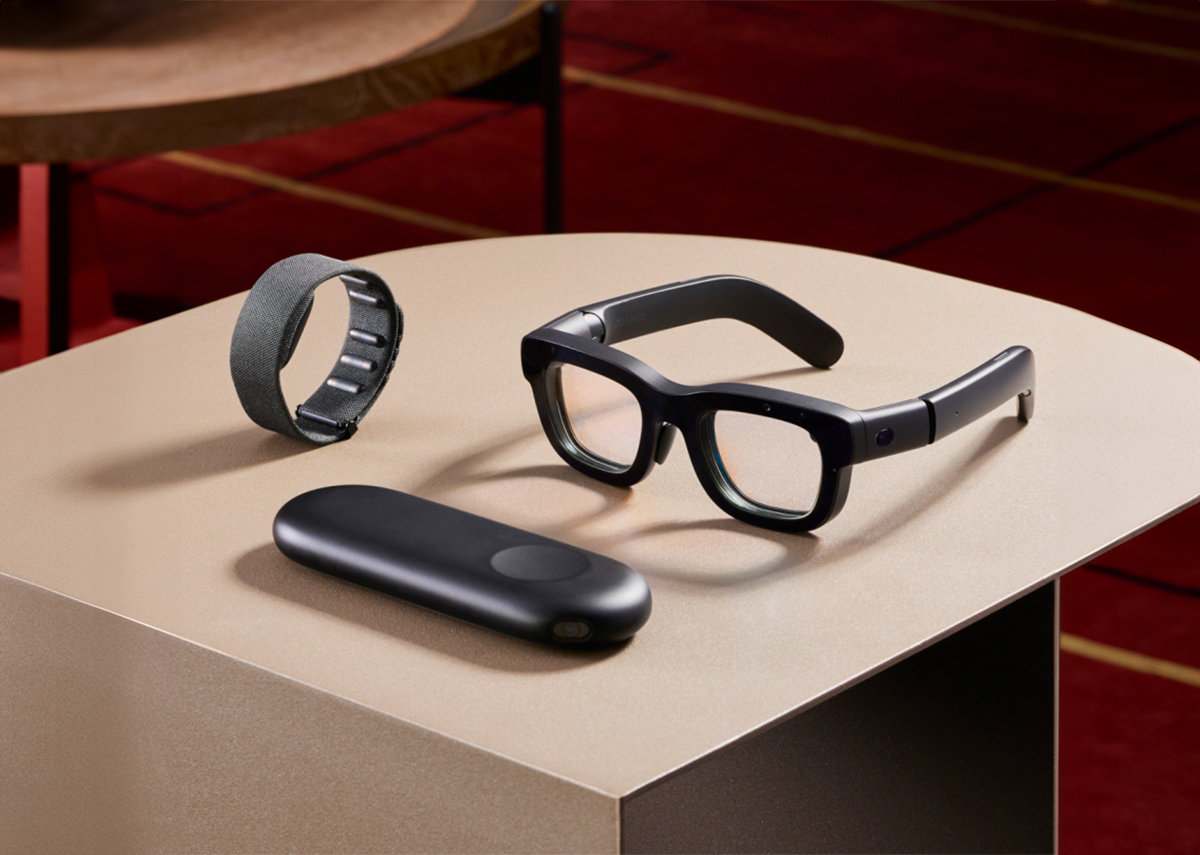
The glasses must be paired with a "neural armband" (left) and a wireless compute puck (center) – Image: Meta – Image: Meta
Key features of the Compute Puck include:
- 5G modem for fast connectivity
- Touchpad for control
- Qualcomm chipset for computing tasks
- Camera for full-color photography
Earlier prototypes of the Puck included additional features such as a LiDAR depth sensor and a projector for displaying images on surfaces, but these were removed from the final version for cost reasons.
The Compute Puck allows the glasses to be designed to be lightweight and ergonomic, as it shifts the computing load from the glasses to an external device. However, this can be a limitation for users, as they have to carry an additional device, which could potentially affect mobility [3].
Comparison of modern augmented reality technologies: Meta Orion and TDK FCLM
In the world of augmented reality (AR) technologies, hardware is constantly evolving to meet the demands of mobility, computing power, and user-friendliness. Two outstanding technologies in this field are the Meta Orion Compute Pack and TDK FCLM technology. Both solutions aim to facilitate the integration of AR into everyday life, but they take different approaches to achieve this. The following section examines the key differences, advantages, and disadvantages of both technologies in more detail to provide a better understanding of their respective characteristics and applications.
1. Form factor and construction
One of the biggest challenges in developing AR technology lies in the form factor, as the device must not only be powerful but also as compact and lightweight as possible. The form factor plays a crucial role in wearing comfort and practical everyday use.
The Meta Orion Compute Pack takes an approach where the processing unit is housed in a separate pocket computer. This slim form factor allows the AR glasses themselves to be very lightweight, as the computationally intensive processes run externally. Users can therefore wear the glasses for longer periods and more comfortably, which is particularly advantageous for applications in work environments and social interactions. However, this requires the user to carry the Compute Pack with them at all times, which, depending on the application, can limit a certain degree of independence.
In contrast, TDK's FCLM technology integrates all necessary components directly into the frame itself. This results in an even slimmer and lighter form factor, requiring virtually no external components. This technology utilizes an ultra-lightweight laser module weighing just 0.38 grams, making the glasses feel almost like ordinary eyeglasses. Thanks to this design, FCLM technology is exceptionally discreet and offers a high degree of mobility without requiring the user to wear additional hardware. This makes it ideal for unobtrusive use in everyday situations.
2. Computing power and data processing
Computing power plays a central role in AR applications, as it determines how quickly and in what detail information can be processed and displayed. The choice of architecture – internal versus external – is crucial in this regard.
The Meta Orion Compute Pack utilizes an external computing unit housed in a handheld computer. This external solution allows for high computing power and flexibility, as the computing unit can be scaled and optimized independently of the glasses. This can be particularly useful in professional environments requiring performance-intensive applications. The ability to upgrade the computing unit could extend the lifespan of the AR glasses in the future without requiring a complete device replacement. On the other hand, the need for an external handheld computer restricts the user's freedom of movement and independence.
The FCLM focuses primarily on the image projection technology and not the entire computing system of the glasses. It is unclear how TDK's FCLM technology incorporates an integrated computing unit; rather, it is an ultra-compact laser module for image projection. Therefore, the computing power could depend on other components.
3. Independence and freedom of movement
Hardware independence significantly influences the user-friendliness of AR technologies. Today, users expect wearable devices that they can use with as few restrictions and without additional hardware as possible.
The Meta Orion Compute Pack relies on the proximity of the handheld computer, as the glasses themselves do not have an independent processing unit. This means that users must maintain a certain distance between the glasses and the Compute Pack to ensure full functionality. In situations where mobility or freedom of movement is crucial, this could be perceived as a disadvantage, as the handheld computer must remain in close proximity at all times.
TDK FCLM technology solves this problem through its fully integrated architecture. Users are not dependent on external hardware and can move freely without having to worry about the position of a compute pack. This increases convenience and allows the AR glasses to be used in a variety of situations, such as outdoor activities or sports, where mobility plays a key role. This freedom is a significant advantage of FCLM technology and opens up new possibilities for the use of AR in everyday life.
4. Image display and visual quality
Image quality is crucial for the AR experience, as a clear and sharp representation of the virtual content can make the difference between an immersive and a disappointing experience.
The Meta Orion Compute Pack uses a uLED projection system, which provides a good field of view and appealing image quality. This projection technology enables the display of AR content in vibrant colors and with clear visibility, even under varying lighting conditions. However, the image sharpness is not on par with TDK's Retina projection technology, which can be particularly noticeable when displaying very fine details.
TDK FCLM technology uses direct retina projection. This method projects images directly onto the user's retina, resulting in exceptionally sharp and clear visuals. Retina projection technology is capable of displaying the finest details in high resolution, creating an immersive and realistic viewing experience. FCLM technology offers a distinct advantage, particularly for applications requiring high visual accuracy.
5. Weight and portability
The weight of AR glasses directly impacts wearing comfort and ease of use. A lighter device is easier to wear for longer periods and contributes to a more pleasant user experience.
While the Meta Orion Compute Pack is relatively lightweight, the weight of the Compute Pack itself, worn separately from the glasses, must also be considered. Depending on the application, this could affect the overall benefit, as the pocket computer has to be carried in addition to the glasses.
In comparison, TDK FCLM technology features an ultra-lightweight laser module weighing only 0.38 grams. This low weight makes the glasses themselves extremely light and comfortable to wear, which is particularly important for everyday use. Users can easily wear the AR glasses for extended periods without any additional device restricting their freedom of movement.
6. Battery life and energy efficiency
Battery life is one of the key challenges for wearable AR devices. A short battery life significantly limits their applications and reduces their everyday practicality.
The Meta Orion Compute Pack has a limited battery life, averaging around two hours. This could restrict its use, especially for applications requiring extended use, such as in professional environments. Users will need to recharge the Compute Pack regularly or consider an external power source to extend its operating time.
The battery life of TDK FCLM technology, however, is highly dependent on the design of the goggles themselves and can vary depending on the implementation. Since the technology relies on an ultra-lightweight and energy-efficient laser module, it is assumed that the overall battery life can be improved. Thanks to the energy-efficient design of FCLM technology, manufacturers have the flexibility to adapt the battery life to specific requirements.
Unique advantages
Both the Meta Orion Compute Pack and TDK FCLM technology offer unique advantages for various augmented reality applications. While the Meta Orion Compute Pack excels in professional scenarios thanks to its flexible computing unit and uLED projection, TDK FCLM technology impresses with its seamless integration, mobility, and the high image quality of its retina projection. The success of either technology will largely depend on user priorities and the context in which the glasses are used.
Suitable for: