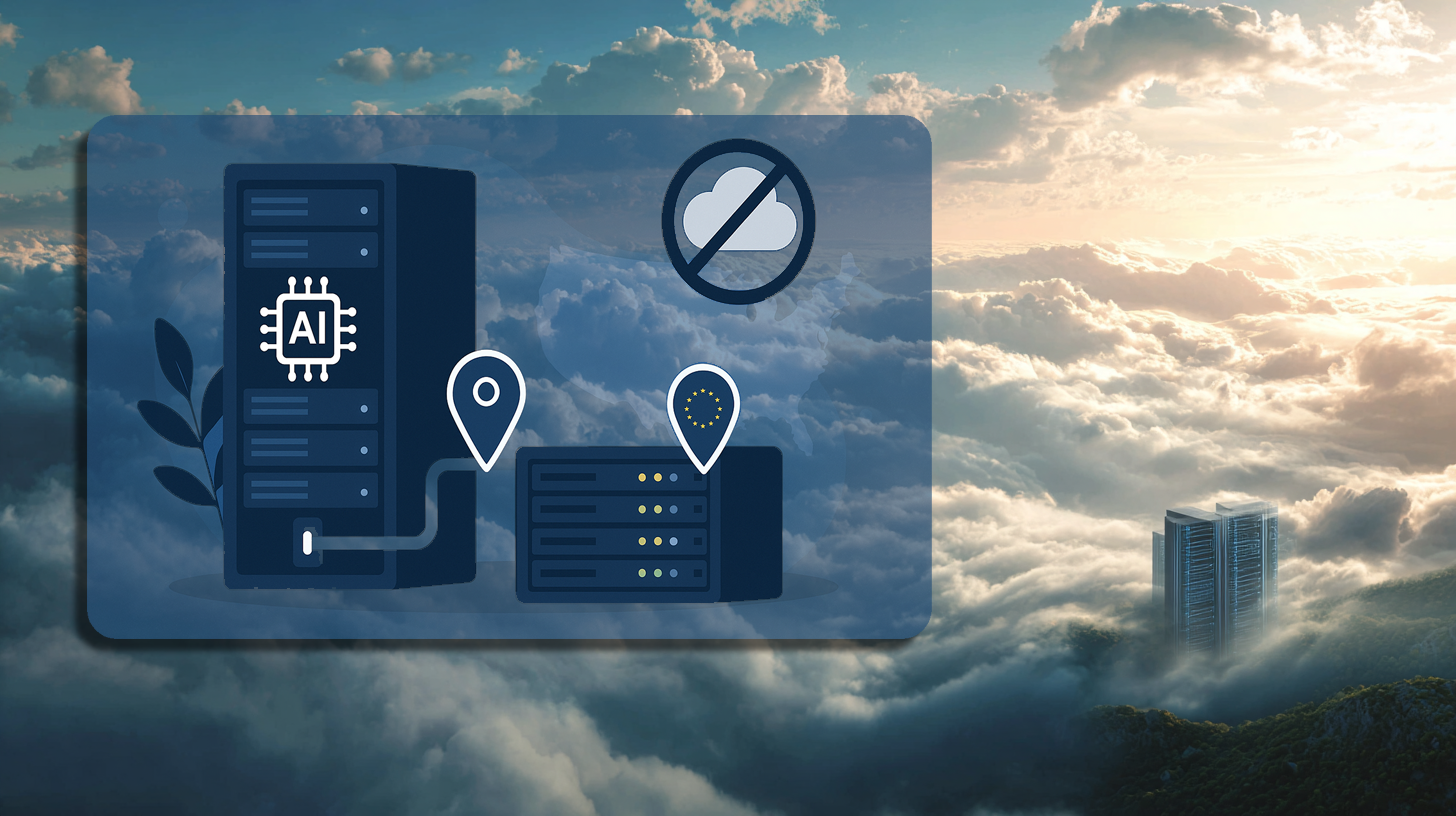
Independent of US tech giants: How to achieve cost-effective and secure in-house AI operation – Initial considerations – Image: Xpert.Digital
Dual-RTX 3090 instead of ChatGPT: The hardware sweet spot for your own AI server
DeepSeek V3.2: The trend reversal towards independent local AI infrastructures
For a long time, an unwritten rule prevailed in the world of generative artificial intelligence: anyone wanting top performance at the level of current AI had to become dependent on large US cloud providers, pay monthly subscription fees, and send sensitive data via external APIs. High-performance AI was a service, not an ownership. But with the release of DeepSeek V3.2, a fundamental shift is emerging. Released under the permissive Apache 2.0 license and with open weights, this model breaks with the previous paradigm and brings GPT-5-level performance directly to the local infrastructure of businesses and enthusiasts.
This development is more than just a technical update; it's a strategic breakthrough. For the first time, fully self-managing high-end AI models is not only theoretically possible, but also economically attractive and compliant with data protection regulations. However, this freedom comes with technical prerequisites: the bottleneck shifts from the cloud API to local hardware, specifically the graphics card's VRAM. Those who want complete control must grapple with hardware architectures – from the cost-effective "sweet spot" of a dual RTX 3090 cluster to the elegant, but expensive, Mac Studio solution.
The following article analyzes in detail how to successfully transition to an independent AI infrastructure. We examine the technical hurdles, compare specific hardware setups in terms of cost and benefit, and demonstrate why local operation is no longer just an option, but a necessity for German SMEs and data privacy-sensitive industries. Learn how to break free from the "cloud tax" and why the future of AI is decentralized and local.
Related to this:

Does DeepSeek V3.2 mark a turning point for independent AI infrastructures?
Yes, DeepSeek V3.2 truly marks a turning point. The model is released under the Apache 2.0 license with open weights, enabling commercial use and local on-premises operation without data leakage. This breaks the previous paradigm where businesses and individual users relied on expensive cloud subscriptions and had to hand over their data to US corporations. With GPT-5-level performance under a permissive open-source license, a realistic scenario emerges for the first time where large organizations can truly control their AI infrastructure.
What makes the Apache 2.0 license so important for DeepSeek V3.2?
The Apache 2.0 license is transformative for several reasons. First, it allows unlimited commercial use without license fees. Second, it permits redistribution and modification of the model. Third, it enables companies to host the model locally on their own servers without training data, user data, or proprietary requests ever leaving a data center. German and international reports have explicitly highlighted that this licensing enables in-house operation without data leakage. This is fundamentally different from OpenAI or Google, where use via APIs is tied to cloud infrastructure, raising privacy concerns.
How does DeepSeek V3.2 differ from previous open-source models?
DeepSeek V3.2 differs significantly in three factors. First, it achieves GPT-5-level performance, whereas previous open-source models typically performed at GPT-3.5 or even earlier at GPT-4. This is a leap in quality that justifies its adoption in production environments. Second, it is based on a mixture-of-experts architecture with 671 billion parameters, combining efficiency and performance. Third, it is provided with comprehensive local infrastructure documentation, including integration with vLLM and other engine platforms. DeepSeek itself promotes V3.2 in the official release notes as a daily driver with GPT-5-level performance and further positions V3.2-Speciale as a model intended to challenge Gemini-3-Pro in reasoning.
How does the local operation of DeepSeek V3.2 work technically?
Local operation follows a modular architecture. The model is downloaded from Hugging Face and installed using specialized engines such as vLLM or Transformers. The process utilizes Python and CUDA to enable hardware acceleration. Practical guides explicitly demonstrate how to start DeepSeek V3.2-Exp as a local OpenAI-compatible server, providing HTTP APIs on localhost or a dedicated server. The model then runs as a system service or container, accessible via REST APIs. This allows integration with existing application landscapes without relying on proprietary cloud services.
What hardware requirements are needed for full performance?
This is the critical threshold between hobby projects and serious IT infrastructure. The large model with 671 billion parameters has extreme hardware requirements. In full-precision arithmetic (FP16), DeepSeek V3 requires over 1200 gigabytes of VRAM, which is impossible for private infrastructure. Even with 4-bit quantization, the model still requires 350 to 400 gigabytes of VRAM. Since even the best consumer graphics card, an RTX 4090, only offers 24 gigabytes of VRAM, one would theoretically need 16 to 20 such cards. This is technically almost impossible to implement in a practical enclosure and economically absurd.
Why is VRAM the most critical factor in AI infrastructure?
VRAM is the limiting factor because AI models must store all their data and calculations in the fast video memory of the graphics card. Unlike RAM, which can exchange data with a delay, everything a model processes simultaneously must reside in VRAM. A model with 671 billion parameters requires at least several hundred gigabytes, depending on the required arithmetic accuracy. This is not structurally possible to circumvent VRAM; it is a physical limitation of the hardware architecture. This is the fundamental boundary between what is theoretically possible and what is practically financially feasible.
Which architecture is recommended for private GPU cluster operation?
The first realistic option is the GPU cluster for hobbyists and enthusiasts. This architecture offers the best price-performance ratio for throughput. The hardware selection focuses on used NVIDIA RTX 3090 cards with 24 gigabytes of VRAM per card. The RTX 3090 is preferred over the newer RTX 4090 because it supports NVLink, which allows for high-performance card connections, and because it costs around €700 used instead of €2000 for a new card. Two RTX 3090 cards provide 48 gigabytes of VRAM, which is sufficient for very good 70-billion parameter models. Four cards provide 96 gigabytes for extremely large models.
What other components are required for a GPU cluster?
In addition to the GPUs, the cluster requires a server or workstation motherboard with sufficient PCIe slots that are mechanically spaced enough to accommodate multiple large graphics cards. A power supply of at least 1600 watts is necessary, as AI calculations consume an extremely high amount of power. The operating system should be Ubuntu Server, which is free and highly optimized for server tasks. The software engine used is either ExllamaV2 or vLLM, both specifically optimized for NVIDIA hardware. The frontend uses OpenWebUI, which runs in Docker and provides a user-friendly interface.
What are the total costs for a private GPU cluster?
The cost breakdown for a dual 3090 configuration is as follows. Two used RTX 3090 cards cost approximately €1500 together. The remaining PC components—CPU, RAM, motherboard, and power supply—cost around €1000. The total investment is therefore between €2500 and €3000. For this performance, you get a very fast server capable of running 70-billion-parameter models that perform at Llama 3 levels. However, the memory is insufficient for the full 671-billion-parameter DeepSeek V3 model; for that, you would need six to eight cards.
Why is a dual 3090 configuration the sweet spot for enthusiasts?
A dual-3090 configuration hits the sweet spot for several reasons. First, it's still affordable compared to other high-end setups. Second, it offers enough memory for high-quality 70-billion-parameter models that significantly outperform ChatGPT-3.5 and come very close to GPT-4. Third, the hardware is mature and reliable, as the RTX 3090 has been on the market for several years. Fourth, power consumption is still manageable compared to older generations. Fifth, there's an established community and documentation for such setups. This combines performance, reliability, and cost-effectiveness better than any other configuration in this price range.
What is the Mac Studio alternative and how does it work?
The second realistic option is the Mac Studio, Apple's elegant solution with an unfair technical advantage. Apple uses Unified Memory, where the system memory also functions as video memory. A Mac Studio with an M2 Ultra or M4 Ultra and 192 gigabytes of RAM can load models that wouldn't run on a single NVIDIA card. Unified Memory isn't limited by PCIe bandwidth like it is with separate GPU VRAM systems.
How do you run AI models on Mac Studio?
Mac Studio uses specialized engines optimized for Apple hardware. Ollama is a popular choice that simplifies complex installations and automatically optimizes models. MLX is an alternative engine from Apple that utilizes native Silicon optimizations. Open WebUI or the modern Msty application serves as the frontend. This combination allows for the loading and use of large models or quantized versions of DeepSeek V3, albeit with some limitations.
How much does it cost to set up a Mac Studio?
The total investment for a Mac Studio ranges from €6,000 to €7,000 for a new M.2 Ultra with 192 gigabytes of RAM. The advantages lie in its compact size, elegant design, and easy installation. The disadvantage is that the token generation speed, measured in tokens per second, is slower than on NVIDIA cards. Despite this limitation, the hardware runs reliably and allows the use of models that would otherwise require multiple GPUs.
What is the rental solution for AI infrastructure?
The third option is renting hardware from specialized providers like RunPod, Vast.ai, or Lambda Labs. Here, you rent a pod by the hour, equipped with high-end GPUs like the H100 with 80 gigabytes of VRAM or multiple A6000 cards. While this isn't technically truly local, you retain full control over the execution, and there are no commercial intermediaries like OpenAI monitoring the data.
How economical is the rental solution?
The rental solution costs approximately €0.40 to €2.00 per hour, depending on the GPU type and provider. This is primarily worthwhile if you only need the model occasionally or if you require fast, highly parallel processing for a limited time. For continuous daily operation, renting is uneconomical; in that case, purchasing your own infrastructure pays for itself more quickly. However, renting is ideal for experiments and testing.
How do you connect an AI server to a LAMP server?
Establishing a connection follows a simple pattern. The AI server is assigned a static IP address on the local network, for example, 192.168.1.50. The software, whether vLLM or Ollama, opens a port, typically 11434. The LAMP server, i.e., the PHP-based web server on the same network, simply makes a cURL request to http://192.168.1.50:11434/api/generate. This establishes communication. PHP can thus integrate AI features directly into web applications without using external cloud APIs.
What security measures are required when operating a local AI API?
Security is critical, especially if the LAMP server is to be accessible from the outside. The AI API should never be directly exposed to the open internet. Instead, a VPN like WireGuard should be set up to enable encrypted remote access. Alternatively, a reverse proxy like Nginx Proxy Manager with authentication can be used. This sits in front of the AI server and ensures that only authorized requests get through. A further step is to isolate the AI server in a separate VLAN or container environment to prevent lateral movement should other systems be compromised.
Why not aim for the complete 671 billion parameter model?
The full 671-billion-parameter model is simply uneconomical for private infrastructure. Hardware costs would exceed €50,000, if not significantly more. The physical requirements for connecting several dozen high-end GPUs are hardly feasible in private environments. Energy consumption would be immense, and the payback period endless. Furthermore, there is practically no use case in the private or small business sector that requires the full performance of the 671B model.
Our global industry and economic expertise in business development, sales and marketing

Our global industry and economic expertise in business development, sales and marketing - Image: Xpert.Digital
Industry focus areas: B2B, digitalization (from AI to XR), mechanical engineering, logistics, renewable energies and industry
More information here:
A thematic hub offering insights and expertise:
- Knowledge platform covering global and regional economies, innovation and industry-specific trends
- A collection of analyses, insights, and background information from our key areas of focus
- A place for expertise and information on current developments in business and technology
- A hub for companies seeking information on markets, digitalization, and industry innovations
DeepSeek V3.2 vs. US hyperscalers: Is the real AI disruption for German companies beginning now?
Which alternative offers a better cost-benefit ratio?
Distilled or quantized versions with 70 to 80 billion parameters offer a dramatically better cost-benefit ratio. A model like DeepSeek-R1-Distill-Llama-70B runs smoothly on a dual-3090 system and is extremely capable. These models significantly outperform ChatGPT-3.5 and come very close to GPT-4. They require no more than 40 to 50 gigabytes of VRAM in quantized form. The investment of €2,500 to €3,000 pays for itself within months when you factor in ChatGPT Plus subscriptions or API costs.
Related to this:
How realistic is GPT-4 level performance on local hardware?
GPT-4 performance is realistic, while GPT-5 performance is less likely on home hardware. A well-distilled 70B model on a dual 3090 configuration comes very close to GPT-4, especially for standardized tasks like text creation, code generation, and analysis. The only areas where premium models still have a significant advantage are extremely complex reasoning tasks or multimodal processing. However, for the majority of business and personal use cases, 70B distilled performance is perfectly adequate.
What are the operating costs of a local system versus cloud subscriptions?
The annual operating costs of a local system consist primarily of electricity. An RTX 3090 consumes approximately 350 to 400 watts under load. Two cards plus other components result in a total consumption of about 1000 to 1200 watts. With continuous operation, this equates to roughly 8760 to 10512 kWh per year, costing approximately €2000 to €2500 in electricity in Germany. A ChatGPT Plus subscription costs €20 per month, or €240 per year; an enterprise license costs significantly more. With intensive use, the hardware investment therefore pays for itself within approximately 12 to 18 months.
How can you optimize the energy efficiency of an AI server?
Several techniques reduce energy consumption. First, GPU undervolting allows for lower operating voltage at the same frequency, saving 10 to 20 percent power. Second, quantization, reducing model accuracy from FP32 to FP16 or INT8, reduces both memory usage and power consumption. Third, intelligent scheduling ensures the server only runs when needed and remains in standby mode otherwise. Fourth, optimizing cooling leads to higher efficiency. Fifth, local caching of models avoids repetitive calculations. These optimizations can reduce energy consumption by 20 to 40 percent.
Which software stacks are relevant besides vLLM and Ollama?
Besides vLLM and Ollama, there are several important alternatives. LlamaIndex offers specialized orchestration for RAG systems with local models. LiteLLM enables abstracted interfaces that can switch between local and cloud models. Text-Generation WebUI provides a user-friendly interface for testing. LM-Studio is a desktop application for easy local model execution. For production environments, vLLM, with its OpenAI API compatibility, is the best choice. For private experiments, Ollama is ideal due to its simplicity.
What does a productive integration into existing business systems look like?
Productive integration requires several components. First, a robust deployment system, such as Kubernetes or Docker Swarm, for scalability and fault tolerance. Second, monitoring and logging to track model performance and system health. Third, API management and rate limiting to prevent overload. Fourth, authentication and authorization to control access. Fifth, backup and disaster recovery planning. Sixth, integration with existing data pipelines, such as ETL systems. Seventh, version control of models and configurations. Eighth, test automation and continuous deployment. Ninth, documentation and runbooks for operations personnel. Tenth, compliance documentation, especially for regulated industries.
What are the compliance and data protection advantages of local AI?
Local implementation offers significant data privacy advantages, especially in regulated industries. No training data leaves the organization's own infrastructure. No user data is transferred to US corporations or other third parties. This eliminates many GDPR compliance risks associated with cloud APIs. Particularly sensitive data, such as patient records in hospitals, financial data in banks, or design data in industrial companies, can be processed locally. At the same time, the organization remains independent of external service levels and price increases. This is a considerable advantage for large organizations with stringent security and data protection requirements.
What opportunities does the decentralization of AI infrastructure offer organizations?
Decentralization opens up several strategic opportunities. First, economic independence from cloud providers and their pricing models. Second, technical independence from external service outages; the infrastructure continues to run even if OpenAI goes offline. Third, a competitive advantage through proprietary models that are not publicly available. Fourth, data sovereignty and protection against data leaks. Fifth, the ability to fine-tune models to organization-specific use cases. Sixth, geopolitical independence, particularly relevant for European and German organizations. Seventh, cost control through predictable capital expenditures (CAPEX) instead of unlimited operating expenses (OPEX). Eighth, creative control over the AI used.
How is Germany positioning itself in the global AI infrastructure race?
Germany has historical strengths in hardware efficiency and industrial computing, but lags significantly behind the US and China in high-performance computing infrastructure. DeepSeek V3.2, with its open license, offers German organizations the opportunity to quickly gain independence. German companies can now build local AI infrastructure without relying on US monopolies. This is strategically relevant for industry, SMEs, and critical infrastructure. In the long term, this could lead to European sovereignty in AI resources.
What are realistic development prospects for the next 18 to 24 months?
The next 18 to 24 months will reinforce several trends. First, quantization techniques that further streamline models without significant performance loss. Second, mixture-of-experts models that combine efficiency and capacity. Third, specialized chips from startups that break GPU monopolies. Fourth, the adoption of DeepSeek and similar open-source models in enterprise environments. Fifth, the standardization of APIs and interfaces to increase portability. Sixth, regulatory innovations in Europe that enforce data privacy and promote local solutions. Seventh, educational offerings and community resources for local infrastructure. Eighth, integration with standard business tools.
How should companies design their strategy to benefit from this trend?
Companies should take several strategic steps. First, launch a pilot project with DeepSeek V3.2 or similar open-source models to gain experience. Second, build internal expertise, for example, through training or hiring machine learning engineers. Third, develop an infrastructure roadmap that outlines the path from cloud dependency to on-premises operations. Fourth, clarify data protection and compliance requirements with IT teams. Fifth, identify use cases that benefit most from on-premises processing. Sixth, collaborate with startups and technology partners to accelerate progress. Seventh, allocate a long-term budget for hardware investments.
What mistakes should organizations absolutely avoid when starting out?
Organizations should avoid several common mistakes. First, don't deploy the full 671B model when 70B is perfectly adequate; this leads to unnecessary hardware investments. Second, don't neglect security; AI APIs must be protected like any other critical infrastructure. Third, don't scale too quickly before processes are established; pilot first, scale later. Fourth, don't underestimate costs; not just hardware, but also operation, monitoring, and support. Fifth, don't spend too much time on optimization instead of implementing productive use cases. Sixth, don't ignore talent sourcing; good engineering expertise is scarce. Seventh, don't underestimate vendor dependency; consider what happens if a GPU fails.
Is this approach economically viable for medium-sized businesses?
This approach makes a lot of sense for medium-sized businesses. The investment of €2,500 to €3,000 for a dual 3090 system is manageable for most mid-sized companies. The ROI is predominantly positive, especially if the company currently has high API costs with OpenAI. Running a 70B model locally costs only electricity, around €200 to €250 per month, while cloud APIs are significantly more expensive. For industries such as marketing agencies, software development, consulting, and financial services, it makes great economic sense.
What changes for freelancers and sole proprietors?
This opens up entirely new possibilities for freelancers and sole proprietors. Instead of paying for expensive API subscriptions, they can run a simple, locally based model. This enables services such as AI-powered text editing, code generation, or design assistance with complete data sovereignty. The client benefits from data privacy, and the freelancer from reduced operating costs. A one-time investment in a dual 3090 pays for itself in just a few months. This democratizes high-quality AI capabilities for smaller market players.
How will the cloud AI industry develop?
The cloud AI industry will polarize. Large cloud providers like OpenAI, Google, and Microsoft will focus on highly specialized services, not commodity Large Language Models. They will seek to create premium value through specialized models, support, and integration. Mid-range providers without clear differentiation will come under pressure. Open-source models will completely take over the commodity layer. New business models will emerge, such as specialized infrastructure providers for fine-tuning or domain adaptation. This is a healthy maturation of the market.
What role do specialized hardware accelerators play?
Specialized hardware accelerators are playing an increasingly important role. TPUs, Google's dedicated chips for AI workloads, Graphcore's IPU, and other alternative architectures are evolving. NVIDIA remains dominant for large-scale training, but genuine alternatives are emerging for inference and specialized applications. This increases competition and will reduce hardware costs in the long run. NVIDIA will remain the top choice for private infrastructure for years to come, but the market is becoming more diverse.
What are the global geopolitical implications of DeepSeek?
DeepSeek has significant geopolitical implications. A Chinese company is delivering, for the first time, a globally competitive large language model under a permissive open-source license. This breaks the US monopoly on high-performance models. For European countries like Germany, this opens up the possibility of achieving technological sovereignty without being dependent on either the US or China. This is strategically highly relevant for national security, economic competitiveness, and data sovereignty. In the long term, this could lead to a multipolar AI landscape.
Is a European alternative stack emerging?
A European alternative stack is under development. European cloud providers like OVH and Scaleway are building Infrastructure as a Service for local AI models. European open-source initiatives are promoting alternative models. Regulatory frameworks like the AI Act support local approaches. German organizations are investing in sovereignty. It's still fragmented, but the building blocks are taking shape. An established European stack could be in place within three to five years.
When will local AI infrastructure become mainstream?
Local AI infrastructure will become mainstream for larger organizations within two to four years. The cost curve will continue to fall, hardware will become easier to procure, and software will become more user-friendly. Regulatory requirements will push more organizations to operate locally. Initial success stories will demonstrate that it works. However, mainstream doesn't mean it's available to individuals; it will remain a niche for enthusiasts for at least several years.
What are the final recommendations for decision-makers?
Decision-makers should consider the following recommendations. First, act now, don't wait; the technology is ready. Second, start with a pilot project, don't invest directly in full-scale deployments. Third, evaluate a dual 3090 system as reference hardware; it's the realistic sweet spot. Fourth, use DeepSeek V3.2 Distilled models, not the full model. Fifth, prioritize talent and expertise; hardware is cheap, good people are scarce. Sixth, integrate security and compliance into the design phase. Seventh, develop a long-term roadmap, don't make ad-hoc decisions. Eighth, work with the finance team to ensure that the hardware investment will pay for itself within 12 to 18 months. Ninth, communicate data sovereignty as a competitive advantage. Tenth, regularly monitor market developments and adjust strategy accordingly.
Is the trend reversal real?
The paradigm shift is real and fundamental. DeepSeek V3.2 is not a marginal project, but a model that fundamentally changes the framework for AI use. Open-source licenses, attractive performance, and realistic infrastructure costs enable organizations to operate AI truly independently for the first time. The end of cloud AI monopolies is in sight. This offers opportunities for technological sovereignty, economic independence, and data privacy. The next step lies with decision-makers in companies, government agencies, and critical infrastructures. The future of AI will be decentralized, polymorphic, and self-determined.
A new dimension of digital transformation with 'Managed AI' (Artificial Intelligence) - Platform & B2B solution | Xpert Consulting
A new dimension of digital transformation with 'Managed AI' (Artificial Intelligence) – Platform & B2B solution | Xpert Consulting - Image: Xpert.Digital
Here you will learn how your company can implement customized AI solutions quickly, securely and without high entry barriers.
A managed AI platform is your all-inclusive, worry-free solution for artificial intelligence. Instead of dealing with complex technology, expensive infrastructure, and lengthy development processes, you receive a ready-made solution tailored to your needs from a specialized partner – often within just a few days.
The key advantages at a glance:
⚡ Rapid implementation: From idea to ready-to-use application in days, not months. We deliver practical solutions that create immediate added value.
🔒 Maximum data security: Your sensitive data stays with you. We guarantee secure and compliant processing without sharing data with third parties.
💸 No financial risk: You only pay for results. High upfront investments in hardware, software, or personnel are completely eliminated.
🎯 Focus on your core business: Concentrate on what you do best. We take care of the entire technical implementation, operation, and maintenance of your AI solution.
📈 Future-proof & scalable: Your AI grows with you. We ensure continuous optimization and scalability, and flexibly adapt the models to new requirements.
More information here:
Your global marketing and business development partner
☑️ Our business language is English or German
☑️ NEW: Correspondence in your native language!

Konrad Wolfenstein
I and my team are happy to be available to you as your personal advisor.
You can contact me by filling out the contact form here wolfenstein@xpert.digital:or simply call me at +49 7348 4088 965. My email address is
I'm looking forward to our joint project.
☑️ SME support in strategy, consulting, planning and implementation
☑️ Creation or realignment of the digital strategy and digitization
☑️ Expansion and optimization of international sales processes
☑️ Global & Digital B2B trading platforms
☑️ Pioneer Business Development / Marketing / PR / Trade Fairs
🎯🎯🎯 Benefit from Xpert.Digital's extensive, five-fold expertise in one comprehensive service package | BD, R&D, XR, PR & Digital Visibility Optimization

Benefit from Xpert.Digital's extensive, five-fold expertise in a comprehensive service package | R&D, XR, PR & Digital Visibility Optimization - Image: Xpert.Digital
Xpert.Digital possesses in-depth knowledge across various industries. This allows us to develop tailored strategies precisely aligned with the requirements and challenges of your specific market segment. By continuously analyzing market trends and monitoring industry developments, we can act proactively and offer innovative solutions. The combination of experience and expertise generates added value and provides our clients with a decisive competitive advantage.
More information here: