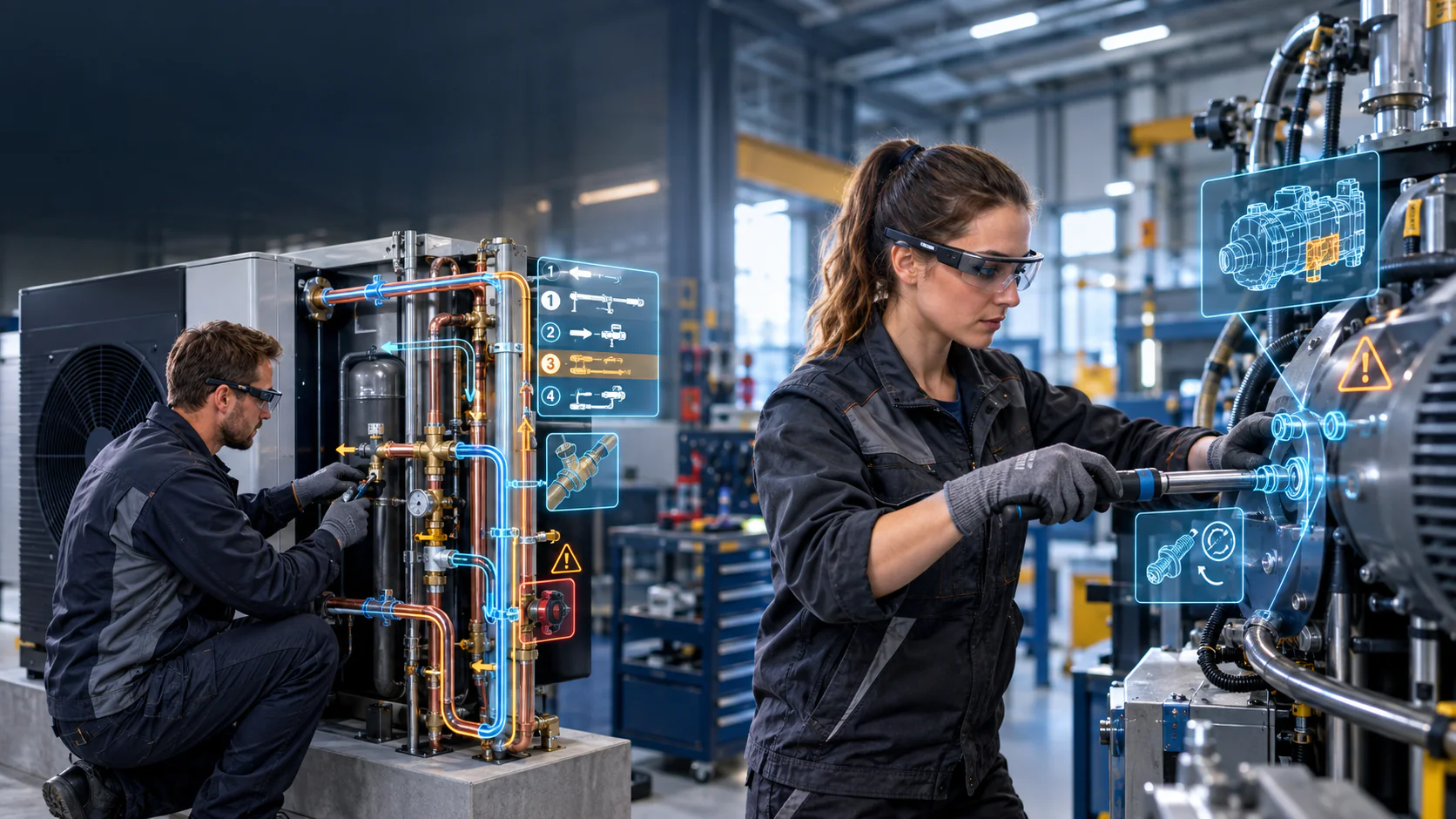
Robot revolution despite the crisis? How AI is transforming Germany's factories – and solving our biggest problem – Image: Xpert.Digital
Forget old industrial robots: These 3 megatrends are reshaping the future of production
Robotics paradox: Why €14.5 billion in revenue means new opportunities – Collaborative robots conquer Germany despite industry crisis
The German robotics and automation industry is currently facing a complex interplay of economic challenges and technological opportunities. While the sector is projected to experience a 10 percent decline in revenue to €14.5 billion in 2025, groundbreaking possibilities are simultaneously emerging through artificial intelligence, collaborative robots, and new application areas that have the potential to fundamentally transform the industrial landscape.
Suitable for:
- The potential for SMEs-AI-controlled robotics for medium-sized companies: transformation of the world of work and new competitive advantages
The current market situation: challenges and structural change
The German Engineering Federation (VDMA) has published sobering figures for 2025, revealing a significant deterioration in growth prospects across all sub-sectors of robotics and automation. Industrial image processing is stagnating at €3.1 billion in revenue, while robotics is experiencing a decline of five percent to €3.7 billion. The situation is particularly dramatic for automated solutions, which are slumping by 15 percent to €7.7 billion.
However, this development is not solely attributable to cyclical fluctuations in demand. VDMA Chairman Dr. Dietmar Ley makes it clear that the downward trend has structural causes, including an excessive dependence on the German automotive industry and weaknesses in competitiveness. Geopolitical tensions and increasing competitive pressure from the Far East, particularly from China, further exacerbate this problem.
A particularly worrying development is evident in international competitiveness: China has overtaken Germany in robot density in the manufacturing sector, ranking third with 470 units per 10,000 employees, while Germany has fallen back to fourth place with 429 units. This shift in global competitive position underscores the urgent need for strategic measures to strengthen the German robotics and automation industry.
Technological Trends and Innovations: The Path to the Future
Despite current market challenges, technological innovations are opening up entirely new perspectives for robotics and automation. The integration of artificial intelligence is considered one of the most important megatrends that will fundamentally change the industry. Generative AI makes it possible to program robots more intuitively – instead of complex code, users will be able to communicate with the machines in natural language in the future.
Collaborative robotics is experiencing a remarkable boom. The market for cobots is projected to grow from $3.17 billion in 2023 to over $71 billion by 2034, representing an annual growth rate of nearly 33 percent. This development is particularly relevant for small and medium-sized enterprises (SMEs), as cobots can work directly alongside humans without safety barriers and can therefore be flexibly integrated into existing production processes.
Another revolutionary trend is the development of humanoid robots. Goldman Sachs forecasts a market volume of $38 billion by 2035, while more optimistic estimates even reach up to $24 trillion. These systems, which can mimic human movements and interactions, are opening up entirely new fields of application beyond traditional industrial production.
Service robotics: The growth market of the future
Service robotics is developing into the most dynamic segment of the robotics industry. With a projected annual growth rate of 19.2 percent, the global market is expected to grow from US$22.40 billion in 2024 to US$90.09 billion by 2032. In Germany, the service robotics market is projected to grow from €3.72 billion in 2025 to €5.42 billion by 2029.
The development in professional service robots is particularly noteworthy: Sales increased worldwide by 30 percent to over 205,000 units. Transport and logistics dominate with over 113,000 units sold, representing an increase of 35 percent. This growth is largely driven by the shortage of skilled workers, as robots can take over time-consuming tasks such as loading and unloading.
Skilled labor shortage as a driver of automation
The shortage of skilled workers is becoming one of the most important catalysts for robotics and automation. According to the automatica Trendindex 2025, 75 percent of German employees expect robotics to offer a solution to the skilled worker shortage. This assessment is not unfounded: By 2030, Germany is expected to be short six million skilled workers.
Automation offers new perspectives, especially for small and medium-sized enterprises (SMEs). Studies show that 80 percent of SMEs still don't have a single robot in operation, even though modern automation solutions are becoming increasingly affordable and user-friendly. The development of low-cost robotics and easy-to-use automation is making these technologies attractive to SMEs as well.
Industry 4.0 and the transformation of production
Industry 4.0 forms the technological foundation for the further development of robotics and automation. The intelligent networking of people, machines, and processes creates entirely new possibilities for production control. AI-based systems make it possible to use robots not only as programmed machines, but also as adaptive systems that learn from experience and continuously improve.
The integration of digital twins and edge computing is revolutionizing production planning and monitoring. These technologies make it possible to simulate and optimize production processes in real time without disrupting ongoing operations. Predictive maintenance, based on AI analytics, can lead to significant cost savings by preventing unplanned downtime.
Strategic decisions: The VDMA Action Plan 2028
With its strategy paper “Robotics and Automation 2028,” the VDMA (German Engineering Federation) has defined concrete goals for the future of the German industry. As a technology leader in industrial robots, Germany aims to grow faster than the global market by 2028. At the same time, the goal is to achieve a leading position in professional service robotics and successfully scale this in European and international markets.
The action plan outlines three key demands: more venture capital for startups and scale-ups, a roadmap for competitiveness, and a targeted focus on scaling European innovations. These measures are intended to help reduce structural disadvantages in international competition and strengthen Germany's position as a robotics hub.
Market forecasts and future prospects
Long-term market forecasts for robotics are consistently positive. The global robotics market is expected to grow from approximately US$25 billion in 2024 to between US$160 and US$260 billion by 2030. Professional service robots are projected to reach a market share of up to US$170 billion, while industrial and logistics robots will account for approximately US$80 billion.
This development is driven by various factors: changing consumer preferences, the demand for customized products and faster delivery times, and the need to increase productivity despite demographic changes. Robot density will continue to increase worldwide, with service robotics in particular experiencing disproportionate growth.
Suitable for:
- Currently the largest humanoid robotics study by Xpert.digital-Marktboom ahead: from robot prototypes to practice
Challenges and solutions
The successful transformation of the German robotics and automation industry requires concerted efforts from policymakers, businesses, and society. A key problem is the insufficient provision of information, particularly to small and medium-sized enterprises (SMEs), about the opportunities and possibilities of robotics. Increased awareness and advisory services are needed in this area.
Financing automation projects presents a hurdle for many companies. Although the prices of robotics solutions are continuously falling—humanoid robots have reduced their cost from $250,000 to $150,000 within a year—initial investments are still substantial. Flexible financing models and government funding programs can provide support in this area.
The role of education and qualification
The transformation to robot-based production requires a comprehensive realignment of education and training systems. The VDMA calls for a doubling of robotics and automation degree programs at universities and mandatory STEM subjects in schools. Continuous training and professional development opportunities within companies are essential to prepare employees for the new demands.
The acceptance of robotics among employees is encouragingly high: 77 percent of German workers support the use of robots in the workplace. The takeover of dangerous, unhealthy, or repetitive tasks by robots is particularly valued. This positive attitude creates a favorable starting point for further automation.
Sustainability and environmental aspects
Robotics and automation make a significant contribution to achieving sustainability goals. More precise manufacturing processes and optimized resource use can reduce emissions and increase energy efficiency. Three-quarters of companies see potential in Industry 4.0 for reducing CO₂ emissions.
Automation also supports the production of environmental technologies: robots and automation solutions enable the faster and more cost-effective production of photovoltaic systems, heat pumps, fuel cells, and electrolyzers. These technologies are crucial for the energy transition and the shift to a sustainable economy.
Dawn of a new era
The German robotics and automation industry is at a turning point. Despite current market challenges, technological innovations and new fields of application are opening up enormous opportunities. The integration of artificial intelligence, the development of humanoid robots, and the growth of service robotics are creating entirely new possibilities for productivity increases and business models.
The success of this transformation depends significantly on whether the structural challenges can be overcome and the technological potential realized. This requires a coordinated strategy that includes investments in research and development, the promotion of innovation, and the training of employees.
With almost 49,300 visitors and over 1,100 robots on display, automatica 2025 in Munich impressively demonstrated that the industry remains highly innovative despite economic challenges. Robotics and automation will continue to be key technologies for the future viability of Germany as an industrial location – provided that policymakers and businesses work decisively to set the course for growth and competitiveness.
Suitable for:
Your global marketing and business development partner
☑️ Our business language is English or German
☑️ NEW: Correspondence in your national language!
I would be happy to serve you and my team as a personal advisor.
You can contact me by filling out the contact form or simply call me on +49 89 89 674 804 (Munich) . My email address is: wolfenstein ∂ xpert.digital
I'm looking forward to our joint project.