


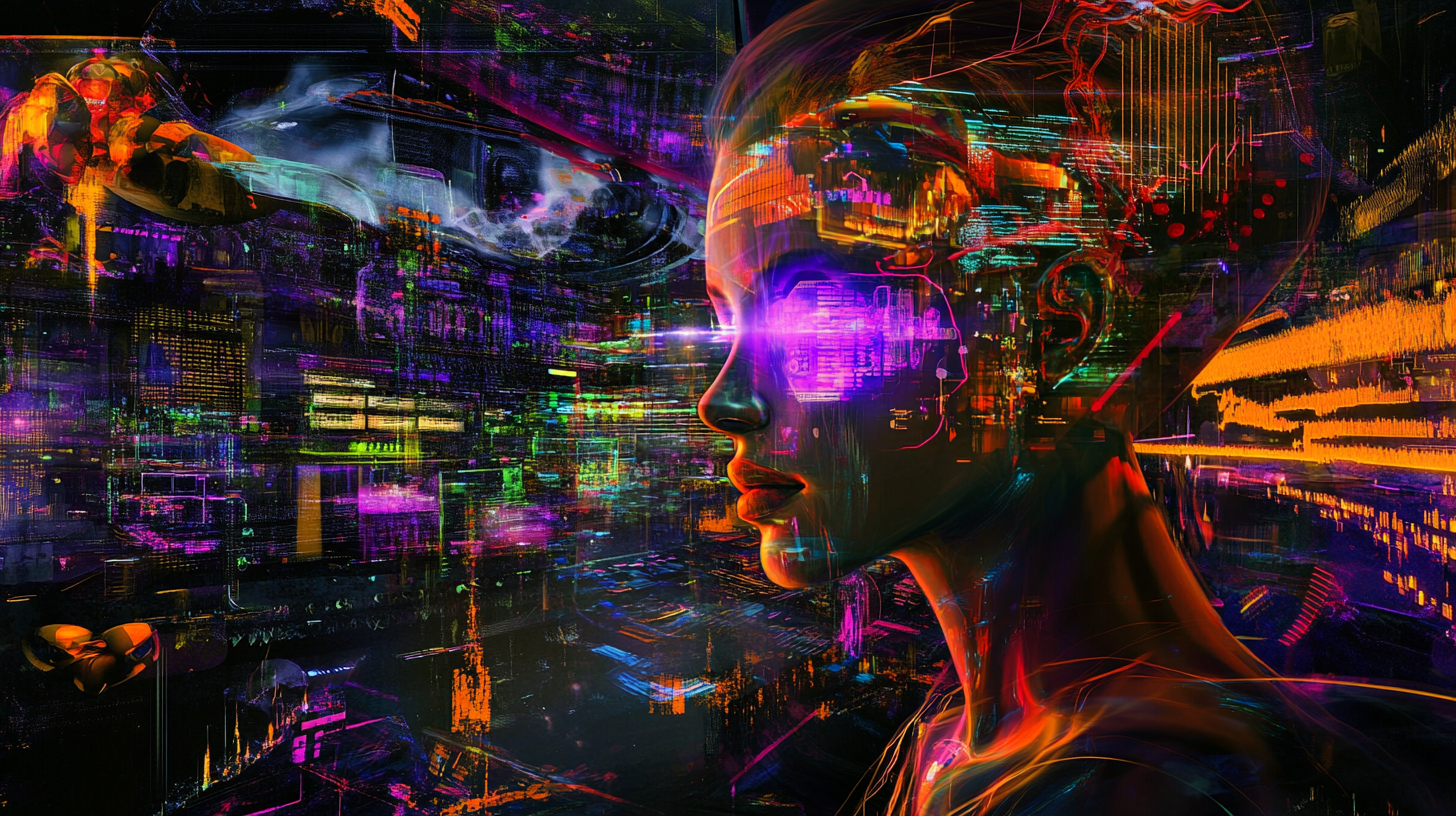
More than just games: The true potential of AI in the metaverse – from personalized worlds to the digital economy – Image: Xpert.Digital
Unforeseen possibilities: How AI is reinventing the metaverse – and what that means for us – Focus report
AI & Metaverse: The Dream Team of the Digital Future – Revolution or Reality?
The metaverse and artificial intelligence (AI) are at an exciting turning point, mutually influencing and reinforcing each other, and jointly shaping our digital future. Both technologies have made tremendous strides in recent years and promise to fundamentally change the way we interact in virtual spaces. But what exactly is the metaverse, what role does AI play in it, and how might both fields evolve? The following provides a comprehensive overview of the convergence of the metaverse and AI. It builds upon existing insights and supplements them with important, interesting details to reveal the full potential of this development.
Related to this:
The role of artificial intelligence
Artificial intelligence (AI) generally refers to methods and technologies that enable computers to acquire human-like abilities: they can learn, recognize patterns, make predictions, and adapt to changing environments. The field of AI has since developed significantly: machine learning, deep learning, neural networks, and other subfields make it possible to automate highly complex tasks. Some AI systems generate texts, images, music, or videos; others analyze vast amounts of data or control robots.
AI has long been an integral part of virtual worlds. "AI is a crucial driving force for the future of the metaverse," is a common conviction among experts. Why? Because AI makes it possible to efficiently create, manage, and adapt digital environments to the needs of users. While in earlier computer games the world and characters had to be designed entirely manually, AI systems can now automate large parts of this process. For example, 3D objects can be created more quickly with generative AI models, landscapes are designed algorithmically, and AI-controlled non-player characters (NPCs) are given "intelligent" behavior patterns.
AI as an enabler for the metaverse
The development of the metaverse benefits greatly from AI. There are several areas where AI acts as an enabler – that is, as a facilitator and driver:
1. Content generation
Digital worlds are incredibly diverse. In metaverse environments, we need buildings, landscapes, interactive objects, avatars, clothing, accessories, and much more. What used to be time-consuming to model in 3D programs can now be partially automated using generative AI systems. These systems analyze vast amounts of data and learn from it to create similar, new content. This allows developers to design extensive and varied virtual spaces in less time.
2. Intelligent NPCs and Avatars
People crave believable interactions in virtual worlds. AI-controlled NPCs can engage in complex dialogues, respond to player input, adapt their facial expressions, and even make decisions based on their experiences. "The metaverse only becomes truly interesting through vibrant, dynamic characters," is a common view among game developers. AI systems help to give characters more personality and depth.
3. Personalization
Another aspect is the real-time adaptation of the user experience. AI can analyze the behavior and preferences of individual users and derive tailored interactions from this. In this way, each person receives a customized experience in the virtual world. Be it music selection, special challenges in a game, or recommendations for virtual events – AI personalizes the metaverse.
4. Translation and Communication
Since the metaverse represents a global space where people of different languages and cultures meet, AI-based translation tools are extremely helpful. They can translate conversations in real time, thus breaking down language barriers. The result is seamless, global communication that brings people from all over the world together.
Metaverse as an application field for AI
Not only is AI driving the metaverse forward, but conversely, AI research and practice also benefit from the opportunities that virtual worlds offer:
1. Data collection and analysis
In a three-dimensional, immersive environment, vast amounts of data are generated. People move around, interact with objects and other avatars, conduct transactions, participate in virtual events, and thus generate a constant stream of information. AI systems can analyze this data to identify patterns, predict user behavior, and derive new strategies for optimizing the user experience. The larger the metaverse becomes, the more data is available—a goldmine for the development and improvement of AI algorithms.
2. Test environment
The metaverse offers a controlled yet complex world in which new AI models can be tested. Instead of expensive, sometimes complex or even dangerous, real-world experiments, specific scenarios can be simulated virtually. Autonomous agents learn in interactive environments, robot algorithms can be tested realistically before being implemented in physical robot bodies, and a wide variety of decision-making strategies can be evaluated for their efficiency and effectiveness.
3. AI-powered economy
The metaverse opens up diverse possibilities for digital ecosystems, trading platforms, and service offerings. AI systems could take on tasks such as transaction processing, creditworthiness checks in virtual markets, or the management of entire economic cycles. Some visions go so far as to envision AI avatars acting as autonomous agents on behalf of companies and automatically concluding transactions. These automated processes could reduce transaction costs and simultaneously give rise to new business models within the metaverse.
Current developments and future prospects
Many technology companies – small startups as well as large corporations – are investing heavily in the convergence of AI and the metaverse. The fundamental conviction is: "We are only at the beginning of a fusion that will fundamentally shape the digital world in the coming years." The following trends can be observed:
1. Rising investments
Large companies recognize the potential and are consistently investing in the development of new hardware and software solutions. Initial applications already combine the metaverse and AI for entertainment platforms, virtual conferences, product presentations, and training.
2. Improved tools for content creation
Generative AI tools enable the rapid creation of prototypes for virtual spaces, 3D objects, and avatars. These tools are becoming increasingly powerful and user-friendly, allowing even individuals without extensive programming knowledge to actively participate in shaping virtual worlds.
3. Social Metaverse and Virtual Communities
Social interaction is a central element of the metaverse. In the future, we will likely experience increasingly frequent virtual events where people from different countries meet using avatars. AI-based features such as real-time translation or emotion recognition can make such encounters even more immersive.
4. Industrial Metaverse
Besides the entertainment sector, there is also great interest in the industrial sector. Virtual factories, in which employees collaborate and control machines virtually, have already been implemented in initial pilot projects. There, engineers can plan and test production processes in a virtual environment before implementing them in the real world. AI systems support the data-driven simulation and optimization of such processes.
5. Spatial Computing
The convergence of AI, metaverse, and mixed reality leads to "spatial computing." This refers to the idea that computer interactions no longer occur solely via screens, keyboards, and mice, but that the real environment itself becomes the interface. Ideally, AI systems recognize our gestures, our speech, our movements, and react to them contextually in 3D. This should make technologies even more seamlessly integrated into our everyday lives.
Looking at the bigger picture, it becomes clear that we are on the path to a "merging" of the digital and physical worlds. A frequently expressed prediction is that within a few years, generative AI will be used even more intensively to create not only objects, but entire narrative worlds. In this process, avatars and non-player characters will become increasingly intelligent, able to react to emotional signals and develop independent storylines.
Related to this:
Possible everyday applications
How could we benefit from the metaverse and AI in the future? Here are some scenarios that are often mentioned in the discussion:
1. Virtual workplaces
People could hold meetings and conferences in virtual spaces without having to be physically present. This eliminates travel time and enables interactive presentations where models and visualizations can be viewed together in a 3D environment. AI-powered assistants could automatically generate minutes, assign tasks, or initiate documentation.
2. Education
Virtual classrooms or seminar rooms make it possible to deliver learning content in a more immersive and practical way. AI-based learning platforms adapt to the learning pace and abilities of each individual, while simultaneously allowing for interaction within a virtual group. In this way, education can become more globally accessible, without geographical or financial limitations.
3. Healthcare
Medical consultations and therapy can take place in virtual spaces, giving patients worldwide access to experts. AI can support diagnoses and make tailored treatment suggestions based on health data. Furthermore, surgical or emergency scenarios can be practiced in virtual environments to better prepare medical personnel for real-life situations.
4. Art and Culture
Artists can design virtual exhibitions, stage digital performances, or create avatars that interact and collaboratively create something new. The metaverse could become a vibrant, global art market where AI not only provides tools for creatives but also becomes a creator of new art forms itself.
5. Events and Leisure
Sporting events, concerts, or trade fairs could take place in virtual arenas where spectators can experience the events live in 3D. AI avatars could guide viewers through the program, overcome language barriers, and offer personalized recommendations.
6. Retail and E-Commerce
In the Metaverse, it's possible to open virtual stores, present products in three dimensions, and offer customers an interactive shopping experience. AI is used to tailor product suggestions and pricing to individual user behavior, promising a high degree of personalization.
Challenges and concerns
Despite all the opportunities and possibilities, there are also a number of challenges that should not be underestimated:
1. Data protection and security
The metaverse can generate vast amounts of sensitive information, from biometric data to complex interaction patterns. "Who owns this data, and how is it protected?" – these questions are becoming increasingly urgent. Strong security mechanisms, encryption, and clear regulations are needed to prevent misuse.
2. Ethical aspects
AI can be used manipulatively, for example through personalized advertising that targets a user's vulnerabilities or preferences. Surveillance and automated profiling also pose serious risks. In the metaverse, the boundaries between commercial offerings and personal freedom could easily become blurred. Accountability on the part of providers and increased user awareness are therefore essential.
3. Technical Complexity
Building a metaverse that can accommodate numerous people simultaneously requires enormous computing power, stable network infrastructure, and high-performance hardware for rendering virtual spaces. AI-powered systems for real-time dialogues, simulations, and analyses further increase resource demands. Costs and energy consumption could be high, raising questions about sustainability.
4. Access barriers
While smartphones have made digital participation relatively easy, immersing oneself in a virtual universe may require additional devices such as VR or AR glasses. This can lead to social inequalities if not everyone has access to the necessary equipment.
5. Dependencies and addictive potential
An immersive, captivating virtual world can be so fascinating that some find it difficult to return to the real world. Excessive use or even addiction are risks that could increase with the rising quality of virtual experiences. Similar to video games, education and responsible use are essential.
Security concepts and possible solutions
To address the challenges mentioned above, researchers and companies are working on various measures. Some concepts that are often discussed include:
1. Decentralized structures
One approach is to prevent the metaverse from being dominated by individual large corporations, but rather to build it on open, decentralized platforms. Blockchain technologies could manage digital property rights, transactions, and identities transparently and securely. This would prevent any single actor from becoming too powerful and gaining data sovereignty.
2. AI Governance and Ethics Guidelines
To prevent misuse, clearly defined rules are needed for the use of AI in the metaverse. Ethics committees, standardization bodies, and independent audits can ensure that human rights and data protection are not violated. "Transparent AI is the order of the day," is a frequently cited view. Users should be able to understand how AI systems make decisions.
3. Data minimization and privacy by design
Instead of collecting as much information as possible, metaverse platforms could focus on data-minimizing concepts. This involves processing only the absolutely necessary data while protecting user privacy to the greatest extent possible. AI can help process data locally on end devices (edge computing), so that less information ends up on central servers.
4. Technological innovations in hardware and infrastructure
To meet increasing demands, powerful hardware, widely available high-speed internet access, and energy-efficient data centers are needed. Advances in chip development, optimization of network protocols, and new transmission standards (e.g., 5G, and in the future, 6G) are essential building blocks for the metaverse to function smoothly and scale effectively.
5. Enlightenment and Education
Responsible engagement with the metaverse requires users to understand its opportunities and risks. This necessitates awareness campaigns and educational initiatives that provide early information on data protection, addiction prevention, safe interaction in online environments, and the potential of AI. Only in this way can widespread awareness develop, protecting against reckless actions.
The Convergence of AI and the Metaverse: A Look into the Future
The prospect of AI and the metaverse interplay in the coming years evokes both excitement and a degree of reflection. Technological advances indicate that virtual worlds will become increasingly authentic, immersive, and personalized. AI systems will learn to better understand human language and gestures, interpret emotions, and respond accordingly. "We could one day live in virtual spaces with AI avatars that seem almost like real people," is one vision. Whether and when this will become reality remains to be seen, but the trend is clear: the boundaries between reality and the virtual world are becoming increasingly blurred.
At the same time, the responsibility grows to ensure that AI algorithms do not operate unchecked, that power imbalances do not become too great, and that ethical principles are upheld. This requires a combination of regulation, technological development, and societal debate. Only in this way can we prevent the metaverse from becoming a surveillance space or a playground for manipulation.
Furthermore, the development of so-called "digital twins" could transform entire industries. A digital twin is an exact, virtual representation of a physical object, system, or process. Consider, for example, a production line in the automotive industry: AI-driven simulations and analyses make it possible to detect sources of error in the virtual representation before they manifest in the real factory. Digital twins of entire cities are also conceivable, where, for instance, traffic flows or infrastructure utilization are displayed in real time. In conjunction with the metaverse, people can virtually enter these cities, identify problems, and collaboratively develop solutions.
Related to this:
Creativity and innovation through AI in the metaverse
A particularly exciting aspect is the creative freedom offered by this new digital environment. In the Metaverse, people can collaborate with AI systems to create artworks, compose music, stage virtual plays, or develop games that react directly to the participants' behavior. At the same time, users themselves become the creators of their own world. "Creativity is being taken to a new level by the possibilities of AI," is a common sentiment in creative circles. Suddenly, anyone—regardless of programming knowledge or artistic skills—can design virtual scenarios, create characters, and tell stories.
AI becomes a co-creator: algorithms learn what is particularly aesthetically pleasing or which stories resonate well in digital spaces, and help bring these stories to life. For example, generative models can create images, models, or entire scenes in fractions of a second that would otherwise take days or weeks. This creative boost could not only revolutionize the entertainment industry but also invigorate fields such as education, architecture, urban planning, and product design.
Social and psychological implications
With the growing importance of the metaverse and the use of AI, the question of social and psychological implications also arises. One aspect is the possibility of assuming a new identity in a virtual environment. For some people, this can be liberating, allowing them to explore new facets of their personality; for others, it poses the risk of escapism.
Furthermore, there is an opportunity to create globally distributed communities where like-minded people can meet – regardless of geographical limitations. This fosters diversity and exchange. People with disabilities can participate in events without barriers, forge friendships, and unleash their creativity. Conversely, it cannot be ruled out that new forms of exclusion or digital inequalities will emerge. Therefore, it is important that we start thinking about inclusive metaverse concepts today to promote genuine equal opportunities in virtual spaces.
Economic prospects
Another field likely to be profoundly shaped by metaverse and AI is the economy. A digital economy has already developed in recent years, in which virtual goods and services represent considerable value. For example, millions of people spend money on digital skins, rare collectibles, or virtual real estate. AI could regulate these markets, calculate prices, create dynamic supply and demand models, and even act as an economic agent itself.
Let's take this a step further: In a world where artificial avatars are fully capable of conducting economic transactions, concluding contracts, and generating innovations, AI systems could even automate entire value chains. While this may sound like science fiction, much of it has already been tested in certain sectors. "We will see new business models that we haven't even imagined yet" is a frequently expressed hope that holds both opportunities and a fundamental shift in thinking about the world of work.
A symbiosis with far-reaching effects
The metaverse and AI exist in a symbiotic relationship, where both technologies benefit from and advance each other. AI is the crucial driving force behind making the metaverse more vibrant, scalable, and personalized. In return, the metaverse offers AI a vast playground for learning, testing, and application.
The future, in which we navigate virtual spaces as naturally as we navigate the internet today, is not too far off. With AI support, these spaces could offer us tailored experiences, translate languages in real time, and automate business transactions. We will interact with avatars that perhaps understand us better than we understand ourselves.
At the same time, we should be aware of the responsibility that comes with these innovations. Issues such as data protection, security, ethical conduct, and accessibility are not merely peripheral aspects, but key questions that must be answered if we want to create a metaverse that offers added value for all people. The energy consumption and sustainability of the technologies must also be brought into focus.
“Digitalization will reach a new level in the coming years, redefining our understanding of space, interaction, and community,” many experts believe. We can expect our habits, ways of working, and social relationships to change. AI and the metaverse could help break down barriers, make globalization tangible for everyone, and open up new horizons of creativity. If we succeed in reconciling the technological, social, and ethical issues, an exciting era full of potential lies ahead.
Ultimately, it is up to all of us – developers, companies, governments, and individual users – to actively shape this process. The metaverse must not merely become a luxurious playground for a select few corporations, but should evolve into an inclusive space that fosters diversity and democratizes innovation. AI, used wisely and responsibly, can be a powerful tool in this endeavor: it accelerates creation, promotes networking, and analyzes complex relationships in real time.
This shared journey of metaverse and AI reflects both human ingenuity and the ability to create new realities. Perhaps in a few years, we will find that this step into a fully immersive, artificially intelligent world is among the most significant upheavals of our time—a transformation that fundamentally reshapes our understanding of life, work, and community. It is therefore essential to continue closely monitoring developments and actively participating in the discussions to create a future where technology serves humanity, not the other way around.
Related to this: