The “Traffic Apocalypse”: Back to the Roots – When AI devours marketing and reinvents sales – Image: Xpert.Digital
Digitalization was yesterday. AI is today. And tomorrow, who stands next to the customer will decide: How AI searches are forcing sales to become human again
Why the future of B2B sales relies on handshakes instead of clicks: 69% of all searches end without a click – How ChatGPT & Co. are destroying the performance marketing funnel
The era of classic performance marketing in the B2B sector is faltering – and artificial intelligence, once hailed as the ultimate turbocharger for digital processes, is driving this structural upheaval. For decades, companies relied on search engine optimization, high click budgets, and well-designed funnels to guide potential customers to their websites. But this model was based on an information asymmetry that is now eroding rapidly thanks to AI systems like ChatGPT, Gemini, and Perplexity. Potential buyers today conduct their own research, compare complex market data in seconds, and no longer need glossy, promotional landing pages. The result is declining click-through rates, so-called zero-click searches, and a looming "traffic apocalypse.".
But this shift isn't the end of the world for B2B sales; rather, it's the catalyst for a long-overdue renaissance of classic virtues. In a world where information and perfectly crafted advertising copy are becoming inflationary and interchangeable thanks to AI, what gains value is something no algorithm can simulate: genuine trust, verifiable expertise, and personal, physical proximity to the customer. The following article delves into why the end of the pure click economy presents a tremendous opportunity for all those companies that are refocusing on people in sales—and how smart organizations are using AI as an ally to scale precisely these human strengths.
Related to this:


The long march from brochure to performance dashboard
Anyone who has spent the last three decades actively working in sales or marketing remembers the triumphant march of digitalization well. In the late 1990s, the gradual shift began: away from brochures, away from trade show booths, and away from cold calling – towards websites, search engine optimization, banner advertising, and eventually the first email newsletters. The promise was enticing: those with an online presence reach more people, more cheaply, more scalably, and more measurably than ever before. And this promise was fulfilled. The rise of Google, later Facebook, and finally LinkedIn seemed to establish a new, permanently superior order.
As digital tools matured, a whole universe of terms and methods emerged, becoming part of everyday sales language. Contact forms, call-to-action buttons, landing pages, lead generation, buyer personas, conversion funnels, marketing automation – all promised to make the buying process completely predictable and controllable. Agencies specialized in performance marketing, Google Ads became second nature to many marketing departments, and content marketing was considered the gold standard for attracting potential customers without direct advertising pressure. Sales was systematized, digitized, and broken down into increasingly granular key performance indicators (KPIs). Cost per lead, customer acquisition cost, return on ad spend – anyone who couldn't manage these figures was considered backward.
This development wasn't linear, but it did proceed steadily in one direction: The physical world lost importance, while the digital world gained it. Field sales representatives were supplemented by webinars and demo videos, trade fair budgets were partially shifted to paid media budgets, and the first customer contact increasingly took place not through a conversation, but through an algorithm. Humans in sales were taking a back seat – or at least it seemed that way.
The turning point: What AI is doing to the information monopoly
Ironically, the very technology that was originally hailed as an extension of digital marketing is now initiating its structural dismantling. Artificial intelligence is not just changing the efficiency of individual processes – it is attacking the very foundation upon which the entire edifice of online marketing was built.
The foundation was always the information asymmetry. Companies invested considerable sums in content, search engine optimization, and advertising because information about products, prices, services, and competitors was difficult for potential customers to access and time-consuming to obtain. Whoever appeared first in the search results, whoever built the most compelling landing page, whoever generated the highest click-through rate, gained the first point of contact in the buying process and thus a structural advantage. Put simply, advertising budget was about buying an information advantage.
This model is eroding. AI systems like ChatGPT, Gemini, Perplexity, and other Large Language Models enable potential customers to conduct comprehensive market analyses, compare competitors, estimate price ranges, and contrast product features within seconds—without visiting a single company website, filling out contact forms, or entering any marketing funnel. What once required expensive consulting services or hours of research is now accomplished in just a few prompts. The information asymmetry upon which performance marketing was built is rapidly disappearing.
This development isn't a dystopia for marketing professionals—it's an economic principle. When a good becomes more abundant, it loses its price. Information about products and markets was long a scarce commodity. It no longer is. And that means all the tools designed to monetize this informational advantage—from search ads to the gate content behind the lead form—are losing their effectiveness.
Zero clicks, empty funnels: The structural crisis of performance marketing
The numbers speak for themselves. According to data from Similarweb, zero-click searches—search queries where users find the desired information directly on the results page without visiting an external website—rose from 56 percent to 69 percent of all Google searches between May 2024 and May 2025. For searches that trigger an AI overview, this rate is even higher at 83 percent, and in Google's new AI Mode, it's already at 93 percent. According to Ahrefs, the click-through rate for organic results in the top position has fallen by up to 58 percent.
Since Google rolled out its AI-powered summaries across Germany in March 2025, German companies have seen an average decline of seven percent in their organic Google traffic, according to an analysis by the Munich-based agency Seokratie based on more than 100 anonymized company websites. The initial drop after the rollout was even as high as 20 percent before leveling off at this level. HubSpot, one of the world's largest providers of marketing software, reported a decline in its own blog traffic of almost 50 percent – HubSpot CEO Yamini Rangan coined the term "traffic apocalypse" to describe it.
This shift is structural in nature, not a short-term anomaly. Gartner predicts a long-term decline of 25 percent in traditional search volume due to AI chatbots. At the same time, Semrush data shows that AI-generated traffic converts 4.4 times better than traditional organic traffic – because anyone who visits a company website after an extensive dialogue with an AI system has already completed the comparison phase and arrives with a concrete interest. So, while the number of visitors decreases, the quality of those remaining increases. This initially sounds positive, but for companies that have built their model on reach and traffic volume, it represents a fundamental devaluation of their previous investments.
For performance marketing in the narrower sense—that is, click-based, conversion-oriented advertising—this marks the beginning of an erosion crisis. The number of purchase-relevant search queries, where users would even click on an ad, is shrinking continuously. Google itself is trying to compensate for this development by building a closed e-commerce ecosystem—with features that keep users within the Google interface, similar to what WeChat has been doing in China for years. WeChat, Tencent's multifunctional super-app with over 1.2 billion monthly active users, combines messaging, shopping, payments, doctor appointments, and hundreds of other services within a single, closed ecosystem. Google, Meta, and other Western platform providers are now trying to implement precisely this logic—never letting the user leave their own platform.
This strategy may work for the B2C segment. In the B2B market, it is structurally doomed to failure – and for a fundamental, often underestimated reason.
Why B2B is not and never will be a consumer goods market
The fallacy of the digital age in the B2B sector was the tacit transfer of logic that works in the consumer market to entirely different purchasing processes. It's plausible and economically sound for a consumer to buy a pair of sneakers via a Google search ad that leads them to a fully automated checkout process. However, the idea that a medium-sized mechanical engineering company would select its next CNC milling machine, its new ERP software, or its logistics provider in the same way has always been an illusion – even though parts of the marketing industry perpetuated this notion for years.
B2B products and services require explanation. The term sounds technocratic, but it gets to the heart of the matter. They demand a deep understanding of the customer's individual needs, typically involve long-term commitments and substantial budgets, and profoundly impact the processes, structures, and strategic decisions of the purchasing company. Decisions are not made by a single person, but by committees – management, technical leadership, purchasing, and sometimes external consultants are all involved. No contact form, no lead scoring algorithm, and no automated email funnel can even begin to reflect this complexity.
Furthermore, the budget that B2B companies can allocate to Google advertising per product and target customer is marginal compared to what B2C companies invest with mass-market goods. If a machine manufacturer wants to acquire ten potential customers per year, each of whom brings a seven-figure investment volume, and the buying process takes six to eighteen months, then Google Ads are simply the wrong tool – not because of a lack of creativity, but because of structural incompatibility.
At the same time, the democratization of AI-powered research opens up new opportunities for the B2B sector. When potential customers can independently conduct in-depth market analyses and compare providers, they no longer arrive as mere searchers – they arrive as informed partners. Those who are discoverable and well-positioned in these AI-driven searches will be contacted. Not because they have purchased the most clicks, but because they are perceived as a trustworthy, competent voice in their field. This is structurally closer to traditional reputation management and specialist journalism than to performance marketing.
Related to this:


The demystification of advertising: When facts are more powerful than glossy brochures
The paradox of the AI-driven information environment lies in the overturning of a centuries-old sales and marketing principle: the selective use of information. Traditional advertising works by strategically omitting unfavorable facts and highlighting favorable ones. Products are presented in the best possible light, prices are only revealed late in the process, customer reviews are curated, and competitors are not mentioned. The potential buyer navigates an information space that has been deliberately designed.
AI is fundamentally changing this asymmetry. Anyone evaluating an investment product today doesn't consult a curated website – they consult a system trained on comprehensive data, familiar with product reviews, specialist publications, customer testimonials, and market analyses, and capable of providing a dispassionate, comparative answer to their specific question. The embellished words of an advertisement stand no chance against the sum of all available facts. What was once expensive knowledge held by management consultants is now accessible to anyone with internet access in minutes.
This, and let's be clear about this, is not a threat to good companies – it's a threat to poor communication and empty promises. Those who deliver substantial results, can provide genuine references, and are able to communicate complex issues transparently will be more likely to be found and trusted in an AI-informed world than in one dominated by advertising. The real victim isn't the good product – it's the campaign that made a mediocre product look good.
For marketing professionals, this means a shift in priorities: away from click optimization and conversion rate manipulation, and towards substantive content, clarity, and credible expertise. Content marketing in the traditional sense—that is, using content as a lure for search engines—is being replaced by genuine thought leadership, which AI systems recognize as a trustworthy source and incorporate into their responses. Those who publish in specialist journals, are cited in academic journals, and are considered experts in industry discussions will be treated as authorities by AI. At its core, this is a return to principles far older than Google.
🎯🎯🎯 Data-driven B2B industry hub as a quasi-in-house solution

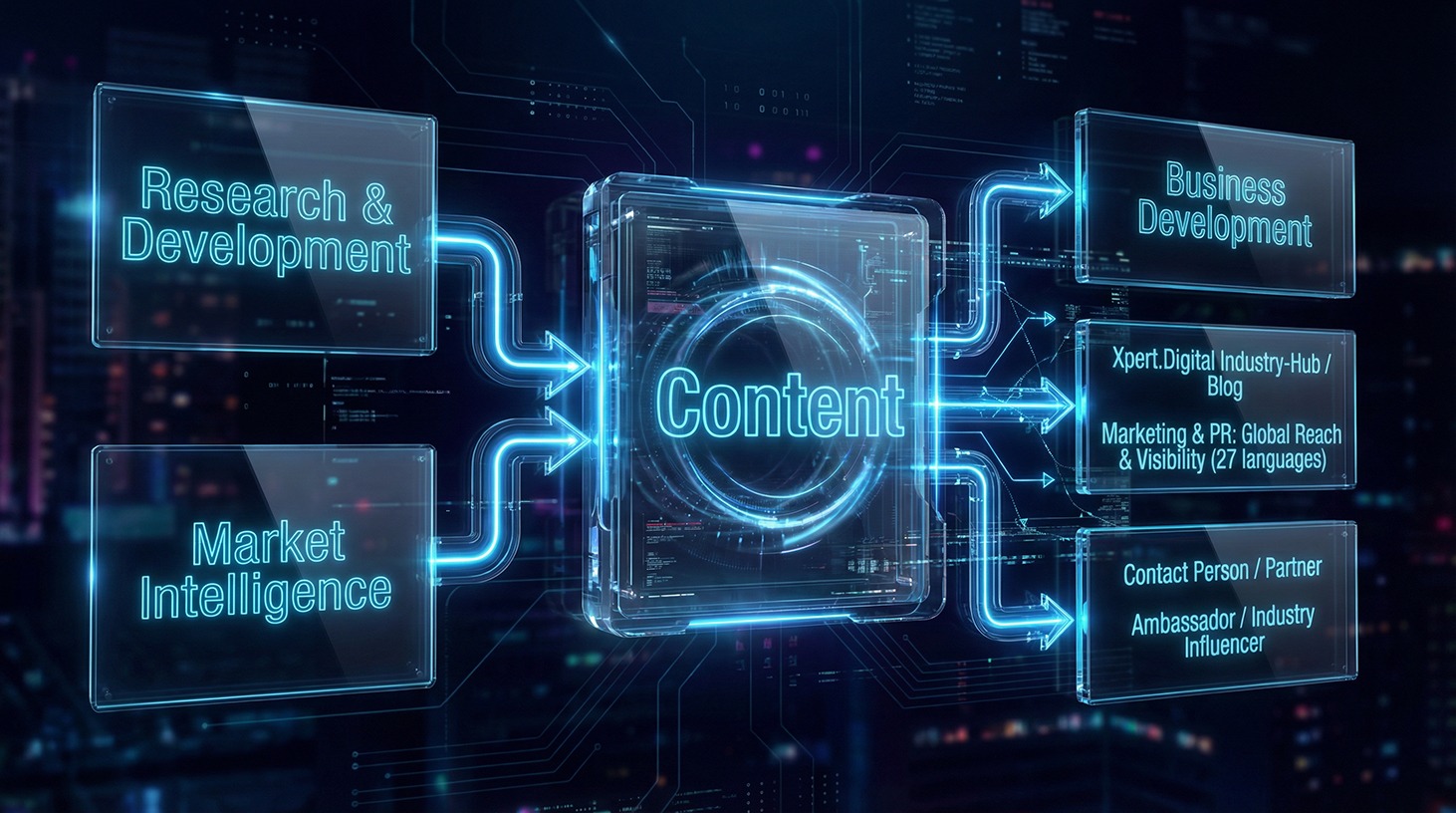
The quasi-in-house solution: How Xpert.Digital closes operational gaps in B2B marketing and sales – Smart Content-Driven Business - Image: Xpert.Digital
Xpert.Digital is a data-driven B2B industry hub led by Konrad Wolfenstein . The company acts as an external, quasi-in-house solution for industrial partners, closing operational gaps in marketing, content, and sales – without requiring additional resources on the client side.
More information here:
Zero-click strategies: Visibility without clicks for SMEs – Why reliability and trust are the new currency in B2B sales
The new sales approach: Personality beats algorithm
The economic conclusion drawn from the decline of performance marketing and AI-driven pre-selection by customers is clear: Initial customer contact no longer occurs through advertising, but through reputation. And the sale is no longer closed through a digitized process, but through trust. Trust, in turn, is built between people, not between a person and an algorithm.
Ninety-three percent of industrial companies already use generative AI tools in their marketing. Paradoxically, this high adoption rate leads to homogenization. If everyone uses AI to create content, optimize campaigns, and generate leads, the technological advantage disappears. What remains is differentiation through what AI cannot create: genuine human relationships, personal trust, physical presence, and lived partnership. Studies by Google, CEB, and Motista demonstrate that emotional strategies in B2B are up to seven times more effective than purely rational approaches. Trust is not just a soft, barely measurable asset—it is a hard competitive factor.
Sales is thus experiencing a renaissance of qualities that were considered outdated during the euphoria of digitalization: personal interaction, face-to-face conversation, and long-term relationships. Not the sales representative who drops by once a year with product brochures, but the sales expert who truly understands the customer, knows their processes, and supports them as a partner in their decision-making. In the B2B sector, people don't buy products – they buy security, competence, and reliability. And these goods, unlike information, cannot be democratized.
Related to this:

Geographical proximity as an economic advantage: Why overseas headquarters are becoming irrelevant
This structural change has a geographical dimension that has been underrepresented in the strategic considerations of many companies. The globalization of the early 21st century had seemingly rendered distances irrelevant. A provider headquartered in the Far East or the USA could serve customers worldwide via its website, digital channels, and automated processes. Physical proximity was considered a costly luxury, not a strategic necessity.
This is changing. If purchasing decisions in the B2B sector are once again driven more by personal contacts, local references, and tangible reliability, then companies with a local presence will structurally gain ground. Not the company's headquarters overseas, but the local branch, the sales representative who can be with the customer in two hours, the customer service that responds in the same time zone and speaks the same language – these are the decisive competitive parameters.
Regionality is not merely an emotional value. Studies show that up to 78 percent of companies prefer regional suppliers when faced with equally good offers, particularly when factors such as trust, accessibility, and local economic ties are relevant. In the industrial SME sector, where maintenance contracts, training, and rapid response times to technical problems are key purchasing criteria, geographical proximity is not a nice-to-have but a crucial decision-making factor. A machine manufacturer that promises to be on-site within four hours regularly beats a competitor with a lower price but overseas headquarters – because the customer values the risk of downtime more highly than the potential savings on the purchase.
This trend is also supported by macroeconomic factors. Experiences with fragile global supply chains in the years following the pandemic have heightened awareness of the risks of excessive geographical sprawl. Nearshoring – the relocation of production and services to nearby regions – is not merely a political demand, but a rational business response to vulnerabilities that have proven too costly. What applies to supply chains also applies analogously to sales and service: proximity reduces risk and increases responsiveness.
The new game: Visibility without clicks and trust without advertising
The shifts described above result in a concrete strategic agenda for B2B companies – even if at first glance it looks more like a return to the familiar than innovation.
The first axis is visibility in AI systems, rather than click optimization for search engines. Zero-click searches are increasing dramatically: 69 percent of all Google searches end without a click, and AI assistants are increasingly generating answers without linking to individual websites. Companies that are present as trusted sources of knowledge in structured data, specialist publications, and industry networks are used as references by AI systems—even if the user has never actively searched for the company. This requires a different kind of content strategy: less focused on clicks and conversions, more on substance and citability.
The second axis is the increased importance of the human factor in sales. AI takes over repetitive tasks such as lead scoring, appointment scheduling, follow-up emails, and market analysis – thus freeing up sales staff for what human intelligence remains indispensable for: a deep understanding of the customer's situation, empathetic communication, creative problem-solving, and building long-term trust. The statement "people buy from people" sounds like a cliché from a sales seminar in the 1980s – but it is structurally confirmed by all available data on B2B purchasing decisions.
The third axis is the realignment of the organizational structure towards physical presence. Companies that have relied on purely digital sales models in recent years and reduced their physical presence in target markets will have to reverse this – not because digitalization has failed, but because the context in which it takes place has changed. The combination of strong digital visibility and physical local presence is the new standard, not one dimension or the other alone.
AI as an ally: How intelligent systems liberate sales instead of replacing them
The key to understanding the current transformation phase lies not in the opposition between humans and machines, but in their complementarity. AI disrupts certain marketing models – but at the same time, it creates significant efficiency gains for companies that know how to use it correctly.
In Germany's small and medium-sized enterprises (SMEs), 40.9 percent of companies currently use AI in their business processes – a significant increase compared to the previous year's figure of 27 percent. A further 18.9 percent are planning to implement it in the near future. Applications range from automating routine tasks and analyzing large data sets to supporting complex decision-making processes. In sales, AI means, specifically, that a sales representative who previously had to spend four hours preparing for a customer meeting by researching company history, industry trends, and the customer's current challenges can now obtain a complete overview in twenty minutes. The time saved directly translates into improved call quality.
AI also enables increased precision in lead management. In practice, AI-supported lead qualification has been shown to reduce lead times in sales processes by up to 20 percent while simultaneously increasing the closing rate, because sales representatives can focus on truly relevant contacts. This efficiency gain doesn't contradict the idea of the return of human sales – it's its prerequisite. Only those who consistently use AI for repetitive, analysis-intensive tasks can free up human sales staff to do what only humans can do.
Economic implications: What structural change means for budgets and strategies
For companies planning their marketing and sales budgets today, the developments described offer clear courses of action. The most important finding: Investments in performance marketing – particularly in paid search, display advertising, and click-through-oriented content marketing – will continue to decline in efficiency, while fixed costs rise. The return on investment for these investments is flattening.
At the same time, investments in sales expertise, local presence, and reputation building have become structurally more attractive. They don't generate immediate clicks and measurable conversions – but they do create trust and customer loyalty, which are more lasting and valuable in an AI-informed market than purchased attention. This requires a shift in internal controlling logic. Those who evaluate performance marketing based on cost per lead will systematically underfund investments in sales presence and subject matter expertise because their ROI lies on longer timescales and is more difficult to quantify.
Trade publications, presence in industry media, customer reference programs, local sales offices, and personal networks – all these were tools of B2B sales before Google existed. Now they are returning, not as a sentimental regression, but as a rational response to a changed information economy. This is no coincidence. It is the economic logic of a market that, through technological disruption, values precisely what technology cannot replace.
Conclusion in numbers: The change is not a theory, but a metric
The transformation dynamics described here are empirically verifiable. 69 percent of all search queries end without a click. AI traffic converts 4.4 times better than organic traffic. Organic web traffic is declining structurally. 93 percent of industrial companies use generative AI in their marketing. Emotional B2B strategies are up to seven times more effective than purely rational ones. 78 percent of companies prefer the regional provider when faced with equally good offers. 40.9 percent of German companies are already using AI.
These figures collectively describe a structural shift, not a short-term trend. Companies that perceive this structural shift as a threat will continue to invest in tools whose effectiveness is declining. Companies that see it as an opportunity will reposition themselves – with more substance in their communication, closer relationships in their sales, and more humanity in a world that, paradoxically, demands precisely this human element precisely because of its technological advancement.
In this context, "back to the roots" doesn't mean returning to the past. It means returning to what has always been fundamental to good business relationships and what no algorithm will ever replace – trust, competence, presence, and honest conversation between people.
Your global marketing and business development partner
☑️ Our business language is English or German
☑️ NEW: Correspondence in your native language!

Konrad Wolfenstein
I and my team are happy to be available to you as your personal advisor.
You can contact me by filling out the contact form here wolfenstein@xpert.digital:or simply call me at +49 7348 4088 965. My email address is
I'm looking forward to our joint project.
☑️ SME support in strategy, consulting, planning and implementation
☑️ Creation or realignment of the digital strategy and digitization
☑️ Expansion and optimization of international sales processes
☑️ Global & Digital B2B trading platforms
☑️ Pioneer Business Development / Marketing / PR / Trade Fairs
B2B support and SaaS for SEO and GEO (AI search) combined: The all-in-one solution for B2B companies


B2B support and SaaS for SEO and GEO (AI search) combined: The all-in-one solution for B2B companies - Image: Xpert.Digital
AI search changes everything: How this SaaS solution will revolutionize your B2B ranking forever.
The digital landscape for B2B companies is undergoing rapid change. Driven by artificial intelligence, the rules of online visibility are being rewritten. For companies, it has always been a challenge not only to be visible in the digital mass, but also to be relevant to the right decision-makers. Traditional SEO strategies and managing local presence (geo-marketing) are complex, time-consuming, and often a battle against constantly changing algorithms and intense competition.
But what if there were a solution that not only simplified this process but also made it smarter, more predictive, and far more effective? This is where the combination of specialized B2B support with a powerful SaaS (Software as a Service) platform comes into play, specifically designed for the demands of SEO and GEO in the age of AI search.
This new generation of tools no longer relies solely on manual keyword analysis and backlink strategies. Instead, it leverages artificial intelligence to more accurately understand search intent, automatically optimize local ranking factors, and conduct real-time competitive analysis. The result is a proactive, data-driven strategy that gives B2B companies a decisive advantage: they are not only found, but perceived as the leading authority in their niche and location.
Here's the symbiosis of B2B support and AI-powered SaaS technology that transforms SEO and GEO marketing, and how your company can benefit from it to grow sustainably in the digital space.
More information here: