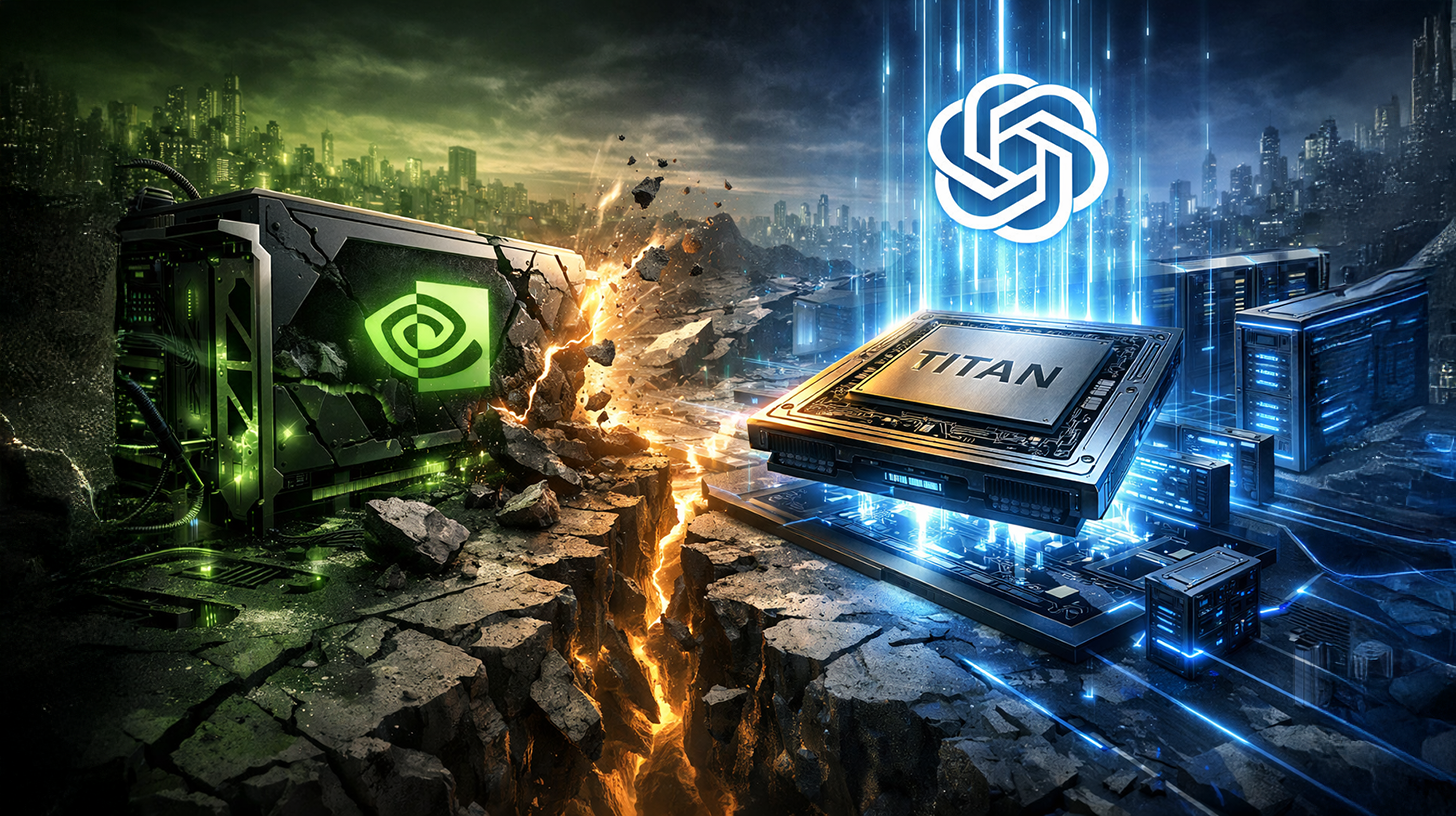
OpenAI breaks Nvidia's monopoly: The Titan chip and the redistribution of AI infrastructure – Image: Xpert.Digital
How a dual strategy aims to end dependence on the GPU elite
The silent power shift in the AI hardware industry
OpenAI will mark a turning point in the artificial intelligence race in 2026: With the planned mass production of its Titan chip, the company is breaking free from the constraints of the CUDA ecosystem and establishing a heterogeneous infrastructure strategy that will fundamentally shift the economic balance of the semiconductor industry. This move follows a clear economic imperative. OpenAI's total spending on AI infrastructure by 2029 is projected to reach $115 billion, with an outflow of $8 billion planned for 2025 alone. These sums make structural independence no longer optional, but essential. Such a volume of investment justifies the in-house development of specialized hardware as a strategic tool for survival.
The partnership with Broadcom, signed in October 2025, envisions jointly deploying ten gigawatts of computing power with custom-designed AI accelerators. The Titan chip's architecture is based on application-specific integrated circuits, known as ASICs, which OpenAI optimizes exclusively for its models. This differs radically from Nvidia's strategy of standardized, general-purpose chips. While Nvidia has spent two decades building a software ecosystem around its CUDA platform, now used by 16,000 startups and whose software tools have seen a 30 percent performance increase, OpenAI is pursuing a vertical integration strategy, where insights gained from model development are directly incorporated into the chip architecture.
The chip as a tool for cost destruction
The economic logic behind this investment is precisely calculated. Nvidia's flagship GPUs, such as the H100 and H200, cost around €30,000 per card. Multiplying this expenditure by the millions of processors consumed for training and inference, a custom chip generates savings measured not in percentage points, but in billions. A successful Titan deployment could reduce the cost structure for large-language model operations by a third or more, an advantage that gives OpenAI considerable flexibility in its API service pricing model compared to competitors like Anthropic, which rely on external hardware.
This also explains the dual strategy running parallel to the Titan development: A multi-billion dollar contract with Cerebras Systems secures an additional 750 megawatts of computing power specifically for inference workloads. Combining different processors for various tasks reduces the risk of failure and creates redundancy in a market plagued by supply bottlenecks. TSMC recently reported that Nvidia has already reserved approximately 60 percent of its planned CoWoS capacity for 2026, a fact that underscores the strategic vulnerability of relying on external manufacturing for proprietary hardware. With Titan and the Cerebras deal, OpenAI addresses this vulnerability through diversification.
Broadcom's role as an architecture partner and industry pivot
For Broadcom, this partnership marks a strategic shift. The company, which profited for over two decades as a networking and connectivity specialist, was marginalized by the AI revolution as the competition for GPU dominance cemented Nvidia's power. With OpenAI, Broadcom has found a way to reposition itself as an integral design partner in the core hardware ecosystem. OpenAI handles the design, while chip architecture and production integration are Broadcom's domain. The plan to scale the systems to Ethernet technology demonstrates a conscious choice for open standards instead of proprietary interconnects like Nvidia's NVLink. This creates vendor neutrality and reduces lock-in effects, a psychological advantage in sales negotiations with other hyperscalers who also develop chips.
The serial rollout strategy of the Broadcom partnership is characteristically rigorous: the first custom server racks are planned for the end of 2026, with complete deployment to be finished by 2029. In parallel, OpenAI is already working on a second generation of chips based on TSMC's upcoming A16 process technology (1.6 nanometers with improved rear-side power delivery), demonstrating that this is not a one-off investment, but rather a multi-year technology roadmap.
The race for manufacturing capacity and semiconductor geopolitics
TSMC, the Taiwanese manufacturing giant, is becoming a key player in this economic reorganization. The company announced capital expenditures of $52 billion to $56 billion for 2026, a jump of about 30 percent compared to 2025. With this capital, TSMC is building factories in Taiwan, the US, and Japan to scale up its 3-nanometer and later 2-nanometer production capacity. However, structural bottlenecks are becoming apparent. Demand for manufacturing time will significantly exceed supply until at least mid-2026. Nvidia, as its largest customer, has secured strategic priority.
OpenAI is competing for the same scarce resources. Google, on the other hand, which has been developing Tensor Processing Units since 2015, has a combined strategy: in-house TPU production, massive capacity expansion programs, and the ability to market TPUs externally. Analyst estimates suggest that Google could more than double its TPU portfolio by 2028 and tap into a market potential of up to $900 billion through external sales. Meta, with its MTIA, and Amazon, with Trainium, follow similar logic.
A new dimension of digital transformation with 'Managed AI' (Artificial Intelligence) - Platform & B2B solution | Xpert Consulting

A new dimension of digital transformation with 'Managed AI' (Artificial Intelligence) – Platform & B2B solution | Xpert Consulting - Image: Xpert.Digital
Here you will learn how your company can implement customized AI solutions quickly, securely and without high entry barriers.
A managed AI platform is your all-inclusive, worry-free solution for artificial intelligence. Instead of dealing with complex technology, expensive infrastructure, and lengthy development processes, you receive a ready-made solution tailored to your needs from a specialized partner – often within just a few days.
The key advantages at a glance:
⚡ Rapid implementation: From idea to ready-to-use application in days, not months. We deliver practical solutions that create immediate added value.
🔒 Maximum data security: Your sensitive data stays with you. We guarantee secure and compliant processing without sharing data with third parties.
💸 No financial risk: You only pay for results. High upfront investments in hardware, software, or personnel are completely eliminated.
🎯 Focus on your core business: Concentrate on what you do best. We take care of the entire technical implementation, operation, and maintenance of your AI solution.
📈 Future-proof & scalable: Your AI grows with you. We ensure continuous optimization and scalability, and flexibly adapt the models to new requirements.
More information here:
The CUDA fortress is falling: Is a 20-year-old software advantage about to disappear?
Nvidia's defensive strategy and the CUDA ecosystem as a fortress
Nvidia is not passive. The company is pursuing an innovation offensive with annual product cycles that put pressure on competitors. The Blackwell architecture, with 208 billion transistors and ten petaflops of FP4 inference performance, was introduced in 2024. Blackwell Ultra, with optimized specifications, will follow in 2025. Nvidia plans Rubin for 2026 and Rubin Ultra for 2027, featuring four GPU chiplets per socket and 100 petaflops of FP4 performance. This roadmap demonstrates backward compatibility and reinforces the CUDA lock-in effect.
The software layer is critical. CUDA is a 20-year-old ecosystem into which millions of hours of development and optimization work have been invested. Competitors like AMD cannot simply port CUDA because it is proprietary Nvidia software. Industry analyses estimate the software performance gap between Nvidia and AMD at five to eight years. This means that even if AMD's hardware specifications are cheaper and more powerful, the lack of CUDA compatibility remains a sales obstacle for companies whose data science teams are already trained on CUDA. This also explains why AMD, despite its quite competitive hardware, has only been able to gain marginal market share.
OpenAI circumvents this dilemma through in-house model development and chip optimization. Claude, GPT-4, and GPT-5 are not trained on CUDA but are developed by OpenAI itself. This is a strategic advantage over competitors who use external software frameworks like PyTorch or TensorFlow, which rely on CUDA optimizations.
The new market structure: fragmentation instead of monopoly
The consequence of these developments is a fragmentation of the AI hardware market. Instead of a dominant provider, a hybrid ecosystem with various specializations is emerging. Nvidia maintains its strength in training and general GPU usage. Google dominates inference and TPU integration in its own cloud service and potential external sales. OpenAI, with its Titan chip, aims for optimal cost efficiency for its own workloads. Meta and Amazon are developing chips for their specific use cases. Microsoft is relying on partnerships with OpenAI and AMD.
The economically interesting phenomenon is that none of these strategies aims to completely displace Nvidia. Instead, each player aims to become more independent while simultaneously building redundant supply chains. This has two effects. First, the market share of any single supplier decreases, but not its revenue, as the overall market is exploited. Second, competitive pressure on prices and innovation cycles increases significantly, which benefits the industry as a whole.
The role of TSMC and global semiconductor geopolitics
TSMC becomes a critical chokepoint institution in this scenario. The company manufactures all proprietary chips: Nvidia's H100, H200, Blackwell, Google's TPU, Meta's MTIA, Amazon's Trainium, and OpenAI's Titan. Taiwanese geopolitics thus becomes economic reality. Disruptions in TSMC's manufacturing would have an immediate impact on all AI providers. This also explains TSMC's massive investment program in the US and Japan, as well as the European Semiconductor Manufacturing Company initiative in Dresden, in which Bosch, Infineon, and NXP are involved. Diversification of manufacturing sites becomes a strategic necessity for global AI security.
The scale of the investment underscores its strategic importance. Meta plans to invest a total of $600 billion in AI infrastructure by 2028. OpenAI and Oracle together are investing $500 billion in the Stargate project. Microsoft is investing $80 billion in the next fiscal year. Amazon currently plans to invest $22.6 billion by 2025, with quarters exceeding $30 billion. These capital flows exceed the regional GDPs of medium-sized countries and signal the vital importance of AI as economic infrastructure.
Cheaper AI services on the horizon: Chip competition challenges Nvidia's dominance
For users and application developers, diversification results in potentially lower operating costs for AI services. OpenAI with Titan-efficient hardware could lower ChatGPT API prices, putting pressure on competitors and intensifying competition. At the same time, it reduces dependence on individual vendors, a classic market outcome of fragmented industries.
The question of Titan's success hinges on technical and organizational metrics: Can the A16 process technology truly be scaled to mass production by 2026? Will OpenAI's chip design deliver significant cost savings, or was the investment merely a marginal performance increase? Can the Ethernet standards-based systems compete with Nvidia's NVLink interconnects? These questions will be answered with clear techno-economic data in 2026–2027.
What is already becoming clear today: The myth of Nvidia's monopoly is being replaced by structural redundancy. The future of AI infrastructure will not be dominated by a single chip type, but by a complex, polypolar ecosystem of specialized hardware, tailored to different workload profiles and business strategies. That is the real business outcome of 2026.