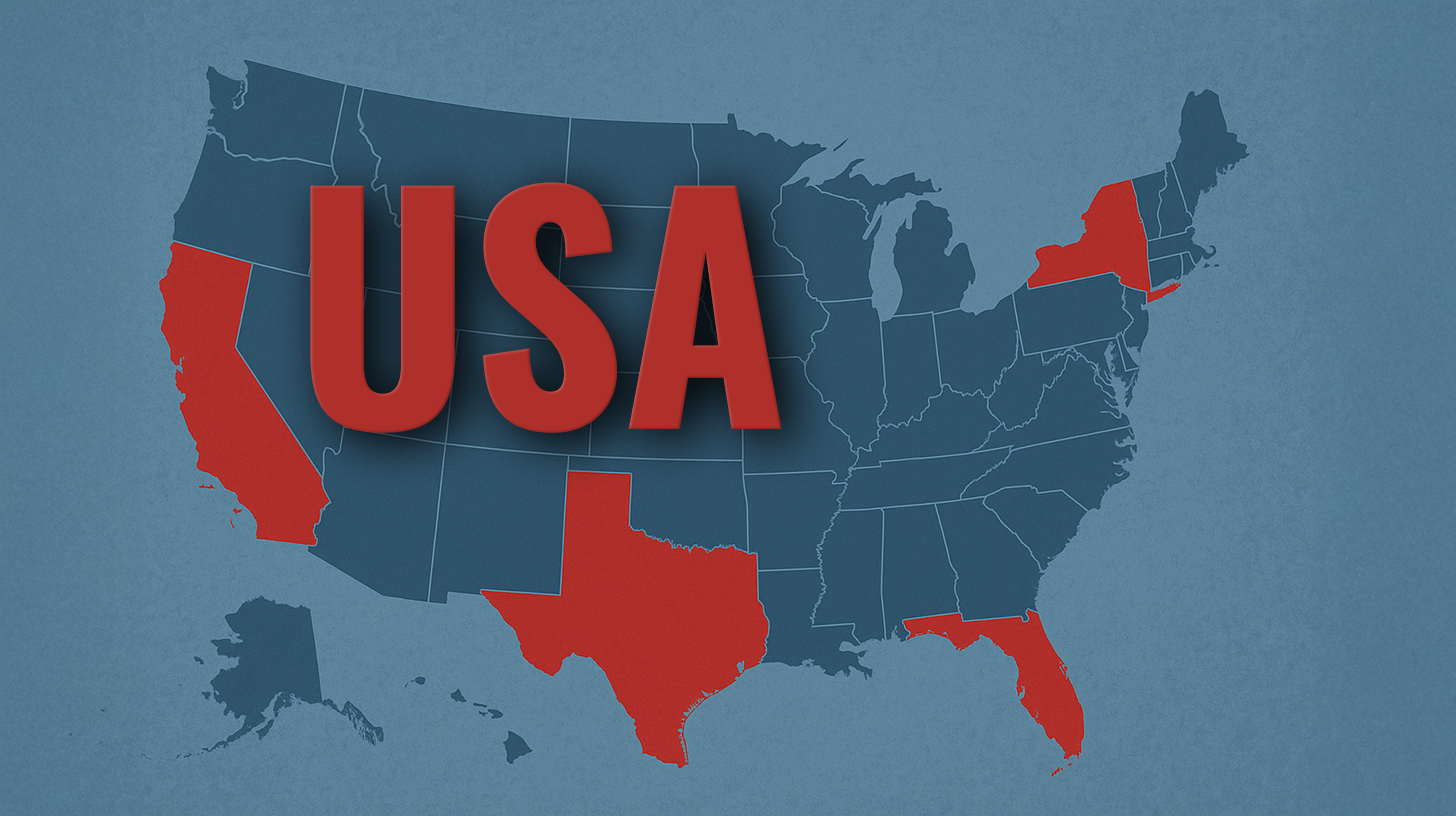
The secret of the US economy: Just four states control everything – California, Texas, New York, Florida – Image: Xpert.Digital
Record growth meets record debt: Is the US economy a ticking time bomb?
### The US Economy: State Dominance vs. Overall View ### Texas vs. California: Who is the true economic engine of the USA? ### Tesla, Apple & Co. are fleeing: Why Texas is becoming the new economic wonderland ###
America's unequal power: How few states are saving – and simultaneously endangering – the USA
The US economy is considered the most robust in the world, but behind this impressive facade lies a remarkable concentration of power. It's not the 50 states marching in lockstep, but rather a handful of economic giants that are almost single-handedly propelling the country upward. At the top sits California, whose economic output surpasses that of Japan alone. Close behind is Texas, which, thanks to aggressive growth and the attraction of tech giants like Tesla and Oracle, is developing into the new powerhouse.
This article explores the fascinating dual nature of the American economy: On the one hand, there are the unstoppable engines like California, Texas, New York, and Florida, which together generate over a third of total US GDP. On the other hand, however, lurk systemic risks—record debt, growing social inequality, and political instability—that threaten the foundations of this strength. We analyze how this concentration strengthens the US globally, but also what vulnerabilities it creates for the future of the world's largest economy.
The economic powers are pulling the country upwards
The US economy is clearly dominated and driven upwards by a few states. California alone generates 14.1% of the total US GDP – with $4.1 trillion, the Golden State would be the fourth-largest economy in the world as an independent nation, ahead of Japan. Texas follows with $2.7 trillion (9.3% of US GDP), roughly equivalent to the economic output of Italy. The top four states (California, Texas, New York, and Florida) together account for 37.2% of total US economic output. This concentration clearly demonstrates that a few economic powerhouses pull the other states along with them. While 11.7% of Americans live in California, the state contributes 14.2% to the national GDP – a clear indicator of above-average productivity.
The regional distribution reveals further patterns: The Southeast leads all US regions with $6.5 trillion in GDP, driven by Florida and Georgia. The Far West reaches $5.8 trillion, primarily through California, while the Northeast generates $5.0 trillion, carried by New York and Pennsylvania.
Related to this:


Structural shifts reinforce dominance
A remarkable trend is reinforcing this regional concentration: Texas is developing into the new economic powerhouse and could overtake California as the engine of growth. Over the past five years, Texas has achieved annual GDP growth of 5.8%, significantly above the national average. Companies like Tesla, Oracle, SpaceX, and Apple are relocating headquarters or establishing large operations in Texas, attracted by lower taxes, less regulation, and more favorable operating costs.
California's economy grew more slowly (2.3% annually) between 2020 and 2023 than Florida (4.6%) and Texas (3.9%), but maintains its absolute dominance through technology, entertainment, and agriculture. Over the long term (25 years), California grew by 111% compared to 75% nationally, while Texas reached an even higher 128%.
The US economy as a whole: Strengths and vulnerabilities
Economic strengths
The US will remain the most robust major economy in 2025, with a GDP of $29.2 trillion. While Germany stagnates (0.1% growth) and the EU achieves only 0.7%, experts predict 1.5% growth for the US despite protectionist trade policies.
Key factors of US strength
- Demographic dynamics: Florida exemplifies how population growth through immigration creates continuous economic stimulus
- Technological leadership: Companies like NVIDIA recorded a 262% increase in revenue, Apple achieved record sales
- Consumer strength: Real wages are rising, retail sales are growing robustly
- Financial market dominance: 63% of global financial assets ($59 trillion) are held by the USA
Structural vulnerabilities
Despite its strengths, the US economy has significant structural weaknesses:
- Debt problems: Public debt will reach 124% of GDP in 2024 and could rise to 143% by 2035. The budget deficit is 5.6% of GDP and is projected to grow to 6.1%. Total debt (private + public) exceeds $100 trillion.
- Economic inequality: The richest 1% earn 139 times more than the poorest 20%. This concentration weakens domestic demand and creates social tensions.
- Geoeconomic risks: US trade policy with flat tariffs of 15% on EU goods and up to 125% on certain countries jeopardizes global supply chains and could drive inflation to 3.2% (2025) and 3.1% (2026) – significantly above the Fed's target of 2%.
Related to this:

International Stability Assessment
In the Fragile States Index 2024, the USA ranks 141st out of 179 with 44.5 points – indicating relative stability, but also signs of deterioration. US economic experts fear increased political instability (-22 points), while other regions show improvements (+10).
Comparison of economic resilience 2025
- USA: Growth 1.5%, but inflation 3.2%, high debt, political uncertainty
- Germany: Stagnation 0.1%, low inflation 2.3%, but structural problems
- China: Strong exports, but weak domestic demand, real estate crisis, local debt
Concentrated strength with systemic risks
The US economy functions as a dual system: A few economic powerhouses (California, Texas, New York, Florida) pull the country upwards and compensate for weaker regions. This concentration is intensified by corporate relocations and demographic shifts.
The US remains the most stable major economy internationally, but the combination of record-high debt, growing inequality, and political polarization creates medium-term vulnerabilities. While other developed countries struggle with stagnation, the US benefits from its size, diversity, and the ability of individual states to boost the overall economy.
The regional economic engines (especially California and Texas) will continue to be crucial – their innovative strength, demographic development and political framework significantly determine the overall economic performance of the USA.
Our recommendation: 🌍 Limitless reach 🔗 Connected 🌐 Multilingual 💪 Sales power: 💡 Authentic with strategy 🚀 Innovation meets 🧠 Intuition


From local to global: SMEs conquer the world market with a clever strategy - Image: Xpert.Digital
In an era where a company's digital presence determines its success, the challenge lies in creating an authentic, personalized, and far-reaching presence. Xpert.Digital offers an innovative solution that positions itself as the intersection of an industry hub, a blog, and a brand ambassador. It combines the advantages of communication and sales channels in a single platform and enables publication in 18 different languages. Cooperation with partner portals and the ability to publish articles on Google News and a press distribution list with approximately 8,000 journalists and readers maximize the reach and visibility of the content. This represents a crucial factor in external sales and marketing (SMarketing).
More information here:
Your global marketing and business development partner
☑️ Our business language is English or German
☑️ NEW: Correspondence in your native language!

Konrad Wolfenstein
I and my team are happy to be available to you as your personal advisor.
You can contact me by filling out the contact form here wolfenstein@xpert.digital:or simply call me at +49 7348 4088 965. My email address is
I'm looking forward to our joint project.