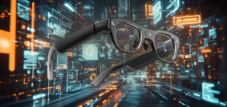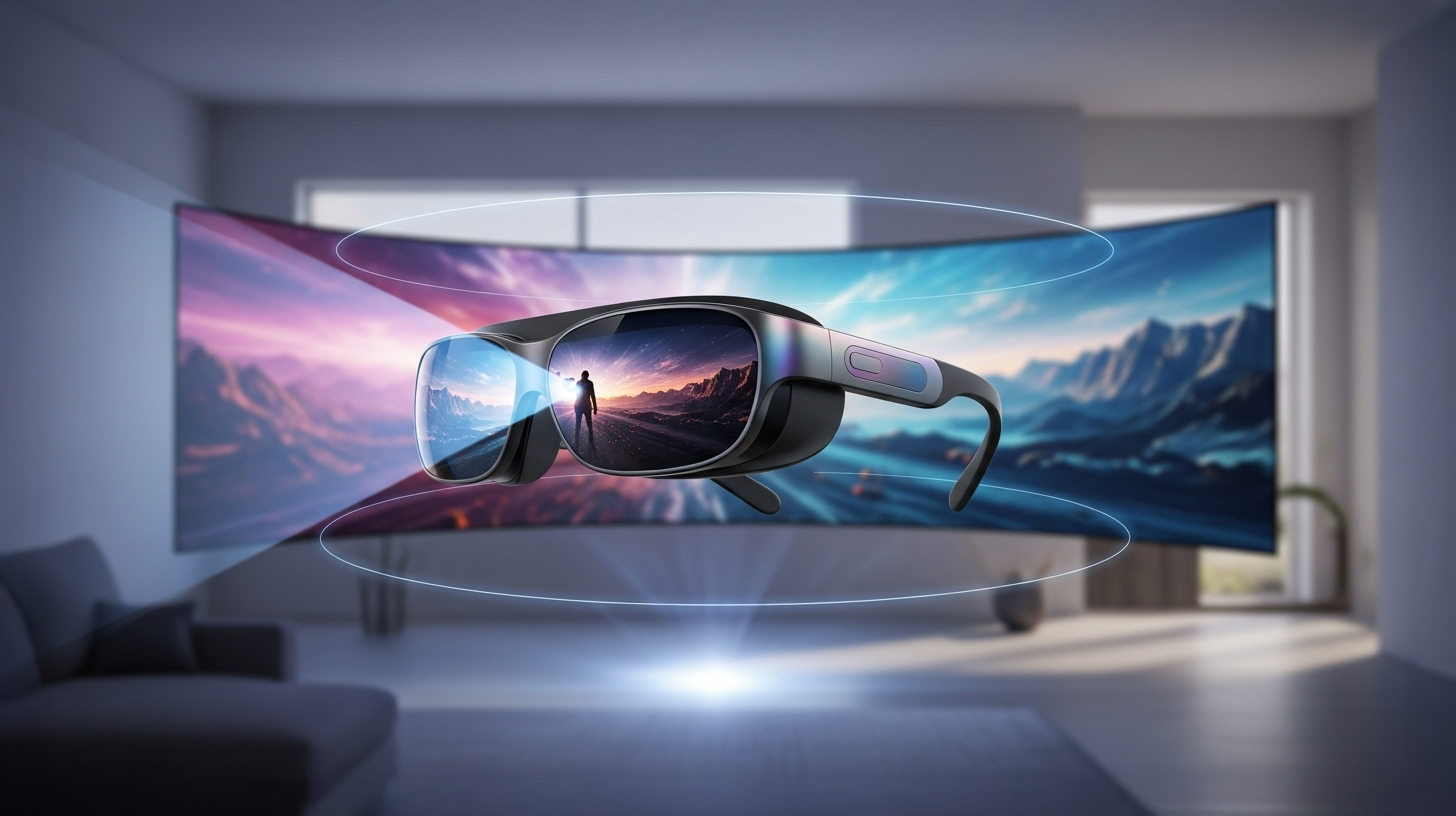
Forget your monitor – the perfect video glasses? – Image: Xpert.Digital
Discreet sound, huge image: The secret of the RayNeo Air 3s Pro and its "Whisper Mode"
What is the RayNeo Air 3s Pro and what makes it special?
The RayNeo Air 3s Pro is a state-of-the-art video headset distinguished by its innovative tandem OLED display technology. Belonging to the latest generation of AR glasses, it stands out for its extreme brightness of 1,200 nits, making it one of the brightest AR headsets available on the market. What makes this video headset truly special is its ability to simulate a virtual screen with a 201-inch diagonal, as if viewing a giant television from a distance of six meters.
The glasses deliberately forgo an integrated processor or battery, focusing instead on pure image reproduction. This makes them exceptionally lightweight at just 76 grams and highly versatile, as they are compatible with a wide range of devices. This design philosophy transforms them into a pure display device, where their strengths lie in image quality and comfort.
Related to this:

How does the tandem OLED technology work in the RayNeo Air 3s Pro?
Tandem OLED technology is an advanced evolution of conventional OLED displays and represents a significant technological leap forward. This technology utilizes two stacked organic RGB light-emitting layers, unlike the single-layer OLED displays used in many other devices. This dual-layer structure enables significantly higher brightness while simultaneously improving energy efficiency and extending the display's lifespan.
In the RayNeo Air 3s Pro, this technology is implemented in the form of two tandem micro-OLED panels capable of achieving an impressive brightness of 1,200 nits. This extreme brightness is particularly important for AR glasses, as it ensures that the display remains clearly visible even in bright ambient light. The tandem structure also provides improved edge sharpness and an impressive contrast ratio of 200,000:1.
Technical specifications and display quality
What display features does the RayNeo Air 3s Pro offer?
The RayNeo Air 3s Pro is equipped with state-of-the-art Micro-OLED panels manufactured according to the HueView 2.0 standard. These displays offer a resolution of 1920 x 1080 pixels per eye and support a 120 Hz refresh rate, ensuring smooth motion and judder-free visuals. The display covers 98 percent of the DCI-P3 color gamut, enabling exceptionally realistic and vibrant color reproduction.
A particularly important aspect of the display quality is the 200,000:1 contrast ratio, made possible by OLED technology. This means that black areas are displayed truly black, while bright areas shine brilliantly. Color accuracy is specified with a Delta E value of less than 2, which meets professional standards and guarantees very precise color reproduction.
How is the brightness of the RayNeo Air 3s Pro regulated?
The RayNeo Air 3s Pro features a sophisticated system with 20 different brightness levels for adjusting the screen brightness. This fine gradation allows users to precisely adapt the screen brightness to varying lighting conditions. The glasses utilize a PWM frequency of 3,840 Hz to prevent visible flickering. This high frequency is particularly important for eye comfort, as lower PWM frequencies can cause headaches and eye strain in sensitive individuals.
The use of a 3,840 Hz PWM frequency is far above the range at which the human eye can perceive flicker. While sensitive users may still notice flicker at frequencies below 500 Hz, the RayNeo Air 3s Pro, with its high frequency, offers comfortable and eye-friendly operation. Additionally, the glasses are TÜV SÜD certified and offer both low blue light emissions and flicker-free visuals.
What does the DCI-P3 color space mean for image quality?
The DCI-P3 color space is an industry standard originally developed for digital cinema productions, offering a significantly wider color gamut compared to the conventional sRGB color space. The RayNeo Air 3s Pro covers 98 percent of the DCI-P3 color space, meaning it can reproduce virtually the entire spectrum of colors used in professional film productions. This is particularly important for realistic and vibrant color reproduction that matches the original intentions of filmmakers and content creators.
The DCI-P3 color space encompasses approximately 25 percent more colors than the sRGB standard and offers a significantly expanded palette, particularly in reds and greens. This results in more natural skin tones, more vibrant landscapes, and overall more realistic color reproduction. For users, this means that movies, games, and other content are displayed as originally intended, with the full color depth and brilliance that modern production standards allow.
Related to this:
Audio technology and sound quality
How does the audio system of the RayNeo Air 3s Pro work?
The RayNeo Air 3s Pro features a sophisticated audio system with a total of four speakers integrated into the temples. This configuration creates a spatial sound that gives the impression of sound coming from different directions. The system utilizes proprietary spatial audio technology that adapts the sound to the wearer's head movements.
The speakers are built according to the dual-opposing acoustic chamber principle, which ensures a particularly balanced sound reproduction. This technology makes it possible to create a cinema-like surround sound effect, even though the speakers are located directly at the ears. The sound is directed so that it is primarily audible to the wearer of the glasses, while the surrounding environment is only minimally affected by the audio.
What is Whisper Mode and how does it work?
Whisper Mode is a special audio technology of the RayNeo Air 3s Pro designed to protect the user's privacy in public environments. This feature utilizes advanced phase-cancelling technology to prevent the sound emitted by the speakers from being audible to people in the immediate vicinity. The sound is directed and modulated so that it primarily reaches the wearer's ears, while minimizing sound leakage to the outside.
Whisper technology utilizes various acoustic principles, including beamforming and phase cancellation. Beamforming focuses sound precisely towards the wearer's ears, while phase cancellation neutralizes sound waves that might propagate in other directions using out-of-phase signals. This allows users to enjoy private audio content even in busy environments like public transport or cafes without disturbing others.
Compatibility and connectivity options
Which devices are compatible with the RayNeo Air 3s Pro?
The RayNeo Air 3s Pro boasts exceptionally broad device compatibility, encompassing over 1,000 different devices. Its primary connection is via USB-C with DisplayPort support, making the headset compatible with modern smartphones, tablets, laptops, and game consoles. Supported devices include Android smartphones and iPhones (with a suitable adapter), MacBooks, Windows laptops, and game consoles such as the PlayStation 5 and Xbox systems via HDMI adapters.
Particularly interesting is its compatibility with portable gaming devices such as the Steam Deck, the ROG Ally, and of course the Nintendo Switch and the upcoming Nintendo Switch 2. RayNeo offers special accessories for the Nintendo Switch systems, such as the JoyDock, which enables seamless integration and also functions as a power bank. This broad compatibility makes the headset a versatile display device that can be used with virtually any modern electronic device.
How does the connection with the Nintendo Switch 2 work?
The RayNeo Air 3s Pro is already compatible with the upcoming Nintendo Switch 2, even though the console is not yet officially available. The connection is established via RayNeo's special JoyDock accessory, which acts as an intermediary between the console and the headset. This dock must be purchased separately and offers additional features beyond simple signal transmission.
The JoyDock features an integrated 10,000 mAh power bank that can power both the Nintendo Switch and the AR glasses. This significantly extends playtime and eliminates the problem of limited battery life during mobile gaming sessions. The dock also supports the simultaneous connection of two RayNeo headsets, enabling cooperative gaming or shared multimedia experiences. The connection is made via a single cable, simplifying handling and eliminating cable clutter.
What additional adapters and accessories are needed?
For full functionality of the RayNeo Air 3s Pro with various devices, several additional adapters and accessories are required, which must be purchased separately. An HDMI-to-USB-C adapter is needed to connect to HDMI-based devices such as game consoles or older laptops. This adapter converts the HDMI signal into a DisplayPort signal that the glasses can process.
For optimal use with the Nintendo Switch or Switch 2, the previously mentioned JoyDock is recommended, which not only enables signal transmission but also functions as a charging station and power bank. iPhone users will need a special USB-C to Lightning adapter or a USB-C to USB-C adapter, depending on the iPhone model. RayNeo also offers additional accessories such as carrying cases, extra nose pads for different face shapes, and a frame for prescription glasses.
🗒️ Xpert.Digital: A pioneer in the field of Extended and Augmented Reality


Finding the right Metaverse agency, planning office, or consulting firm - Image: Xpert.Digital
🗒️ Finding the right Metaverse agency, planning office, or consulting firm – Search and search: Top Ten Tips for Consulting & Planning
More information here:
AR glasses of the future: Lightweight, smart, and multifunctional
Design and comfort
What is the design of the RayNeo Air 3s Pro and how comfortable is it to wear?
The RayNeo Air 3s Pro was developed with a special focus on comfort and everyday wearability. Weighing just 76 grams, it is among the lightest AR glasses in its class. The weight is optimally distributed, with a ratio of 46.7 percent to 53.3 percent between the front and back, ensuring balanced pressure distribution on the nose and ears.
The design is visually based on conventional sunglasses, with the Pro version featuring a uniform matte black finish that appears more elegant and understated than older models with silver accents. The glasses have a FlexiFit hinge system and adjustable temples with nine different adjustment levels. Additionally, the nose pads are adjustable in three positions, allowing the glasses to adapt to various face shapes and be used by 93 percent of all users without constant readjustment.
Related to this:

What adjustment options does the glasses offer for different users?
The RayNeo Air 3s Pro offers extensive adjustment options to accommodate different face shapes and vision needs. The temples are adjustable in nine different positions, allowing for a precise fit to individual head sizes. The nose pads can be adjusted to three different positions, and additional nose pads in various sizes are included to ensure an optimal fit.
A particularly important aspect is compatibility with prescription glasses. The RayNeo Air 3s Pro comes with a frame for prescription lenses, allowing users with vision impairments to use the glasses without restrictions. The large 14 x 7 mm eyebox ensures that users with varying interpupillary distances also receive a sharp image. This eyebox is the area within which the eye must be positioned to see the entire image clearly, and the generous dimensions of the RayNeo Air 3s Pro make it comfortable for most users.
Application areas and usage scenarios
For which applications is the RayNeo Air 3s Pro particularly suitable?
The RayNeo Air 3s Pro is designed for a wide range of applications, with gaming and multimedia consumption taking center stage. The headset offers unique advantages, especially for gaming, as it creates a huge virtual screen that significantly intensifies the gaming experience. Its 120 Hz refresh rate makes it particularly suitable for fast-paced games where smooth motion is crucial. A special Game Mode optimizes contrast and color reproduction for gaming applications, ensuring that all details remain visible even in dark game scenes.
For multimedia consumption, the glasses transform any compatible device into a personal home theater. Whether streaming movies and series, watching YouTube videos, or viewing photos – the 201-inch virtual screen provides an immersive experience that conventional smartphone or tablet displays cannot offer. The high color accuracy and excellent contrast ratio also make the glasses attractive for professional applications such as photo and video editing, especially for users who need to work on the go.
How can the glasses be used for mobile gaming?
The RayNeo Air 3s Pro opens up entirely new possibilities for mobile gaming by eliminating the limitations of small screens. When used with the Nintendo Switch or other portable consoles, it transforms the gaming experience from a small handheld display into a large-format, cinematic experience. The virtual 201-inch screen allows you to experience games with a level of detail and immersion that is impossible on conventional mobile displays.
The combination with the JoyDock is particularly advantageous, as it not only provides the technical connection but also significantly extends battery life. The JoyDock's 10,000 mAh power bank can supply both the console and the headset with power for hours, enabling extended gaming sessions. The headset's 120 Hz refresh rate ensures smooth motion, which is especially important in action games and fast-paced action. Game Mode further optimizes the display for in-game content and enhances contrast, ensuring that all details remain visible even in dark game areas.
What advantages do the glasses offer for entertainment and productivity?
For entertainment applications, the RayNeo Air 3s Pro offers the advantage of a completely private and portable cinema experience. The 201-inch virtual screen creates the feeling of sitting in front of a giant television, while you are actually wearing lightweight, discreet glasses. This makes it possible to enjoy a large-format entertainment experience even in confined spaces such as airplanes, trains, or small apartments. The high image quality with 98 percent DCI-P3 color coverage ensures that films and series are reproduced in the color quality intended by the director.
In the productivity sector, the glasses can serve as a large, additional monitor for laptops and tablets. Their high resolution and color accuracy make them suitable for tasks such as photo and video editing, graphic design, or simply working with multiple windows on a virtually enlarged desktop. Whisper Mode enables discreet video conferencing or audio playback without disturbing others. For presentations or training sessions, the glasses offer the ability to display content on a large virtual screen without relying on a physical projector.
Comparison with other AR glasses and market positioning
How does the RayNeo Air 3s Pro position itself in the AR glasses market?
The RayNeo Air 3s Pro positions itself as one of the brightest and most technologically advanced AR glasses in the mid-price range in 2025. With its 1,200 nits of brightness, it significantly surpasses many competing products and sets new standards in this category. Compared to other AR glasses like the Xreal One Pro, which is offered for $798, the RayNeo Air 3s Pro, priced at $249.99, offers exceptional value for money.
The AR glasses market diversified significantly in 2025, with offerings from various manufacturers such as Meta, Xreal, Viture, and others. The RayNeo Air 3s Pro differs from many competing products by focusing on pure display functionality without integrated computers or complex AR features. This specialization allows for higher image quality and longer battery life at a lower price, but makes it dependent on external devices for content generation.
What distinguishes the RayNeo Air 3s Pro from the standard Air 3s?
The RayNeo Air 3s Pro differs from the standard Air 3s version in several key areas, the most significant being its brightness. While the standard Air 3s offers a brightness of 650 nits, the Pro version reaches an impressive 1,200 nits, nearly doubling its luminosity. This increased brightness has a noticeable effect when used in bright environments, providing improved visibility in sunlight or well-lit rooms.
Another key difference lies in the display engine. The Pro version uses the HueView 2.0 Micro-OLED engine with a tandem OLED structure, which is not only brighter but also offers improved edge sharpness and a higher contrast ratio. The audio system has also been revamped, providing enhanced spatial sound reproduction with a better stereo effect and more precise positioning. Interestingly, despite these improvements, the Pro version is less expensive than the original Air 3s was at launch, making it an attractive upgrade.
How does this headset compare to traditional VR headsets?
Compared to traditional VR headsets, the RayNeo Air 3s Pro occupies a completely different market position, as it focuses on AR and display functions rather than creating a fully virtual environment. While VR headsets like the MetaQuest or PlayStation VR generate complete virtual worlds and have integrated computers, sensors, and tracking systems, the RayNeo Air 3s Pro is purely a display device that shows content from external devices.
The RayNeo Air 3s Pro's advantages over VR headsets lie primarily in its weight, portability, and versatility. At 76 grams, it is significantly lighter than most VR headsets, which often weigh 500-800 grams, and can therefore be worn comfortably for extended periods. It requires no elaborate room setup or tracking systems and can be used anywhere a compatible device is available. On the other hand, it does not offer the full immersion and interactive capabilities of VR headsets and is not suitable for true VR applications, as evidenced by its incompatibility with Nintendo Labo VR games.
Our recommendation: 🌍 Limitless reach 🔗 Connected 🌐 Multilingual 💪 Sales power: 💡 Authentic with strategy 🚀 Innovation meets 🧠 Intuition


From local to global: SMEs conquer the world market with a clever strategy - Image: Xpert.Digital
In an era where a company's digital presence determines its success, the challenge lies in creating an authentic, personalized, and far-reaching presence. Xpert.Digital offers an innovative solution that positions itself as the intersection of an industry hub, a blog, and a brand ambassador. It combines the advantages of communication and sales channels in a single platform and enables publication in 18 different languages. Cooperation with partner portals and the ability to publish articles on Google News and a press distribution list with approximately 8,000 journalists and readers maximize the reach and visibility of the content. This represents a crucial factor in external sales and marketing (SMarketing).
More information here:
The future of visibility: How tandem OLED and AR glasses are changing our technology landscape
Technical innovation and future orientation
What role will tandem OLED technology play in the future of display development?
The tandem OLED technology used in the RayNeo Air 3s Pro represents a significant step forward in display evolution and is expected to play an increasingly important role in various device categories. Already used in premium products like Apple's iPad Pro, this technology is slated to find its way into other product categories such as smartphones and televisions in the coming years. The advantages of tandem OLED – higher brightness, improved energy efficiency, and a longer lifespan – make it particularly attractive for portable devices and applications where image quality is paramount.
In the display industry, leading manufacturers like LG Display and Samsung Display are already working on the next generation of OLED technologies based on the tandem principle. LG Display has announced that its new 4th generation OLED panels for televisions can reach up to 4,000 nits, using an RGB tandem structure. Samsung Display is even developing OLED panels with up to 5,000 nits of brightness for smartphone applications. These developments demonstrate that tandem OLED technology is not just a passing innovation, but a fundamental building block for the next generation of displays.
Related to this:
How is the market for AR glasses and video glasses developing?
The market for AR glasses and video glasses will experience a period of rapid growth and technological maturation in 2025. Various manufacturers are continuously launching new models that differ in functionality, price, and intended use. While earlier AR glasses were often experimental in nature, current models are becoming increasingly suitable for everyday use and are gaining wider consumer acceptance.
The development is proceeding in several directions: On the one hand, there are video glasses like the RayNeo Air 3s Pro, which focus solely on display functionality and function as external monitors. On the other hand, "true" AR glasses are emerging, equipped with cameras, AI features, and interactive elements. Companies like Meta, Rokid, and others are working on glasses with built-in cameras, voice assistants, and AR overlays that superimpose digital information onto the real world. The market is therefore increasingly differentiating between simpler, more affordable display glasses and more complex, expensive AR systems with comprehensive functionality.
What technological improvements can be expected in future versions?
Future versions of AR glasses like the RayNeo Air series are expected to benefit from several technological developments already in the pipeline of the display and semiconductor industries. Tandem OLED technology will be further refined, with even higher brightness levels and improved energy efficiency anticipated. LG Display and other manufacturers are already working on micro-OLED displays with up to 10,000 nits of brightness for VR and AR applications, which would significantly improve outdoor usability.
PWM frequencies are expected to be further increased to minimize eye strain, while color accuracy will be improved through expanded color spaces such as BT.2020. In the audio realm, improvements to Whisper technology and spatial sound reproduction are anticipated, potentially with even more precise directional control and better noise cancellation. Miniaturization will continue, potentially leading to even lighter glasses with longer battery life for external devices. Additionally, enhanced connectivity options are expected, possibly including wireless transmission and improved compatibility with an even wider range of devices.
Practical use and suitability for everyday life
How long can the RayNeo Air 3s Pro be used continuously?
The continuous usage time of the RayNeo Air 3s Pro depends primarily on the battery capacity of the connected device, as the headset itself does not have an integrated battery. The headset draws its power directly from the connected device via the USB-C connection, meaning that usage time is directly correlated with the battery life of the smartphone, tablet, or game console. When used with the recommended JoyDock accessory for gaming applications, usage time is significantly extended, as the dock features a 10,000 mAh power bank.
The RayNeo Air 3s Pro is designed for comfortable wear, weighing only 76 grams, making it ideal for extended sessions. Its balanced weight distribution and adjustable temples and nose pads allow many users to wear the glasses for several hours at a time without significant discomfort. TÜV-certified eye protection, featuring reduced blue light and a high PWM frequency, further helps prevent excessive eye strain, even during prolonged use.
What limitations exist in practical use?
One of the main limitations of the RayNeo Air 3s Pro is its reliance on external devices. Since the glasses have neither their own processor nor battery, they depend entirely on a connected device that provides both content and power. This means the glasses cannot be used independently and always require a compatible device with sufficient battery capacity.
The glasses also allow ambient light to enter from below, which can impair the visibility of the virtual screen in very bright environments, even though the high brightness of 1,200 nits largely compensates for this. For optimal results in very bright environments, separate accessories such as a light shield are required. Another practical aspect is that various adapters and accessories for use with different devices must be purchased separately, which means additional costs and complexity.
How suitable is the RayNeo Air 3s Pro for mobile use?
The RayNeo Air 3s Pro is exceptionally well-designed for mobile use, which is reflected in various design choices. Its light weight of 76 grams and compact design make it an ideal travel companion. The glasses come with a storage case, which, while a soft fabric pouch in the Pro version and lacking the structured hardness of the original Air 3s, still offers a degree of protection during transport.
The headset is particularly well-suited for mobile gaming, transforming portable consoles like the Nintendo Switch, Steam Deck, or ROG Ally into large, immersive displays. Plug-and-play functionality via USB-C makes setup quick and easy, without complicated configurations or software installations. The high brightness of 1,200 nits allows for use in various lighting conditions, from dimly lit interiors to brightly lit environments. For frequent travelers, the headset offers the opportunity to enjoy a large-format entertainment or productivity experience even in confined spaces like airplane seats, without disturbing other passengers.
Related to this:

AR glasses: Technological revolution between gaming, education and industrial transformation
What developments can be expected in the AR glasses segment in the coming years?
The AR glasses segment is entering a phase of rapid technological evolution, characterized by several parallel development trends. One of the most important is further miniaturization and weight reduction, with manufacturers working to make the glasses even more discreet and suitable for everyday use. At the same time, the integration of AI functions will progress, with glasses capable of recognizing objects, translating text, counting calories, and offering complex augmented reality overlays.
Display technology will continue to improve, with even higher brightness levels, better color accuracy, and higher resolutions expected. Micro-OLED displays with 10,000 nits or more are anticipated to become available in the next few years, making AR glasses perfectly usable even in direct sunlight. At the same time, companies are working on power supply solutions, potentially through more efficient displays, improved battery technologies, or even wireless power transmission.
How will compatibility with gaming systems develop?
The compatibility of AR glasses with gaming systems is expected to improve significantly and become more standardized. The Nintendo Switch 2 marks an important milestone, as it was designed with AR glasses compatibility in mind from the outset. Future consoles and gaming handhelds will likely support DisplayPort over USB-C as standard, reducing the need for dedicated adapters.
The gaming industry is increasingly recognizing the potential of AR glasses for immersive gaming experiences, especially for mobile and handheld gaming. This could lead to games or game modes specifically optimized for AR glasses, taking advantage of the unique benefits of large virtual displays. Manufacturers like RayNeo are already working on enhanced gaming accessories such as the JoyDock, and similar solutions are likely to be developed by other vendors. Integration could progress to the point where future gaming systems offer native AR glasses support without the need for additional hardware.
What impact could this technology have on various industries?
The technologies used in the RayNeo Air 3s Pro, particularly the tandem OLED displays and advanced audio systems, have the potential to transform various industries. In education, AR glasses could enable immersive learning experiences where complex concepts can be visually represented and interactively explored. The high color accuracy and large virtual display also make such glasses attractive for professional applications in design, architecture, and engineering.
In healthcare, doctors and therapists could use AR glasses for visualizations, remote consultations, or even surgical support. Whisper technology would protect patient privacy. In the entertainment industry, AR glasses enable new forms of storytelling and content creation, while simultaneously offering personalized media experiences independent of physical screens. The transportation industry could use AR glasses for entertainment systems on airplanes, trains, and other modes of transport, giving each passenger an individual, large-format display without the need for physical screens.
We are here for you - Consulting - Planning - Implementation - Project Management
☑️ SME support in strategy, consulting, planning and implementation
☑️ Creation or realignment of the AI strategy
☑️ Pioneer Business Development

Konrad Wolfenstein
I would be happy to serve as your personal advisor.
You can contact me by filling out the contact form below or simply call me on +49 7348 4088 965 .
I'm looking forward to our joint project.
Write to me


Xpert.Digital - Konrad Wolfenstein
Xpert.Digital is a hub for industry focusing on digitalization, mechanical engineering, logistics/intralogistics and photovoltaics.
With our 360° Business Development solution, we support renowned companies from new business to after-sales.
Market intelligence, smarketing, marketing automation, content development, PR, mail campaigns, personalized social media and lead nurturing are part of our digital tools.
You can find more information at: www.xpert.digital - www.xpert.solar - www.xpert.plus
Keep in touch