
Three markets instead of a world ranking: The new landscape of generative AI – Creative image on the topic, with AI: Xpert.Digital
Anthropic vs. OpenAI: Who is leading the race for monetary power?
Automation in business: How AI is changing value creation
By October 2026, the market for generative artificial intelligence is facing a fundamental transformation that can no longer be captured by simple rankings. A multifaceted picture of current developments emerges when considering various metrics: While ChatGPT remains the primary user interface, low-cost Chinese models dominate data traffic via APIs, and Anthropic has established itself as a significant player in the enterprise segment. This diverse market is divided into several economically distinct sub-markets, each with its own dynamics and challenges.
A thorough analysis of AI model usage requires a precise definition of the underlying metrics – be they user numbers, tokens, expenditures, or productive workflows. This differentiation is crucial for understanding which providers are truly profitable and where price pressure is developing. OpenAI and Google continue to dominate the visible consumer landscape, but beneath the surface, the operational burden is shifting toward low-cost models from China and specialized systems for programming and automation. In this complex landscape, it will be essential for companies to rethink their strategies and adopt an orchestrated use of diverse models to meet evolving demands.
The invisible power shift in the AI market
Those who only look at ChatGPT don't understand the new AI economy
The global market for generative artificial intelligence can no longer be explained by a single ranking in October 2026. Depending on the metric used, a different picture emerges: ChatGPT clearly leads in terms of reach among end users, particularly inexpensive Chinese models dominate in terms of data volume processed via APIs, and Anthropic has established an exceptionally strong position in terms of spending by large companies. These three levels are not contradictory. Rather, they demonstrate that the AI market has fragmented into several economically distinct sub-markets.
The most popular user interface is not automatically the most widely used single model. The model with the highest token volume does not necessarily generate the highest revenue. And the provider with the largest corporate budgets does not necessarily reach the most people directly. Therefore, anyone who wants to seriously assess the global use of AI models must first clarify whether they are referring to users, visits, requests, tokens, expenditures, installed systems, or productive workflows.
This methodological distinction is more than a statistical footnote. It determines which providers are truly economically successful, where price pressure arises, and which business models are viable. The visible consumer world continues to be dominated by OpenAI and Google. Beneath this surface, however, the operational burden is shifting to low-cost models from China and to specialized systems for programming, agents, and automated processes. In the enterprise market, a large portion of the cash-generating demand is concentrated on a few high-performance US providers with deeply integrated development tools.
Three markets instead of a world ranking
The first submarket is direct access by end users. This includes website visits, active users, app usage, search queries, and the service's everyday use. ChatGPT remains the global benchmark in this segment. Depending on the measurement method, its share of recorded AI chatbot traffic ranges from approximately 55 to 80 percent. Google Gemini follows at a considerable distance, but depending on the data source, it already achieves roughly 11 to 28 percent. This enormous range demonstrates how strongly the result depends on whether referrals to websites, pure web visits, apps, desktop programs, or overarching user activity are measured.
The second submarket consists of access via application programming interfaces (APIs). Here, direct human interaction with the model is often absent. Software agents write or review code, analyze documents, generate structured data, process support requests, or execute multi-stage workflows. These systems can process billions or even trillions of tokens in a short time. A single developer or automated agent can therefore generate more traffic than thousands of occasional chatbot users. For this reason, token volume is not a reliable substitute for user numbers.
The third sub-market is operational value creation. Here, reach or raw volume are not the deciding factors, but rather budgets, integrations, security requirements, reliability, and the economic benefit of an application. Companies pay high prices for models that reliably solve programming tasks, operate tools securely, execute long workflows stably, or reduce the costs of manual rework. Therefore, an expensive model with a lower token share can be more economically significant than an extremely cheap model with a considerably higher data volume.
A fourth layer completes this picture: operation on private infrastructure. Open or freely customizable model families like Llama, Mistral, and parts of the Qwen ecosystem are frequently deployed in private cloud environments, data centers, or isolated corporate networks. This usage appears incomplete in public platform rankings. However, especially in regulated industries, with sensitive production data, and in government applications, it can be strategically more important than publicly visible chat traffic.
ChatGPT controls the interface
In the B2C market, ChatGPT remains the clear number one. Statistical surveys that track outbound referrals from AI chatbots to websites attribute a share of around 80 percent to OpenAI. Analyses of global website traffic, on the other hand, arrive at approximately 55 percent. Both figures can be correct simultaneously because they measure different behaviors. Those who reach a particularly high number of external pages via ChatGPT are weighted more heavily in referral-based statistics than in pure website traffic measurement.
Defining the product is also important. ChatGPT is not a single model, but a platform on which different GPT variants are used depending on the plan, task, and availability. A statement like "ChatGPT is the most widely used AI model" is therefore convenient linguistically, but technically inaccurate. The correct statement is that ChatGPT is the most widely used general AI service for end users, thus giving the GPT family a unique distribution.
This distribution represents a significant economic advantage. It creates habits, brand trust, data on real-world use cases, and a large base of potential subscribers. Estimates of around one billion weekly users illustrate the scale, but this should not be confused with a precisely comparable number of paying or daily active users. Likewise, broad reach does not automatically mean that OpenAI leads in every business segment or every technical workflow.
OpenAI nevertheless benefits from a strong feedback loop. A large user base facilitates the dissemination of new features, attracts developers, and makes ChatGPT the standard access point for people trying generative AI for the first time. This turns the platform into a kind of operating system for general AI interaction. This advantage is real, but not unassailable, because competing services can be directly embedded in search engines, smartphones, office software, and enterprise platforms.
Gemini is growing through distribution
Google Gemini is the clear number two among end users. Depending on the measurement method, Gemini reaches approximately 11 percent of website referrals originating from AI systems, or more than a quarter of visits to standalone AI-powered services. The difference is again due to methodological differences. The crucial factor is not so much the exact number, but the trend: Gemini has significantly increased its share and benefits from Google's enormous reach across Search, Android, Workspace, Cloud, and other services.
Gemini's economic strength lies in this integration. Google doesn't need to acquire users solely through a standalone chat interface. The company can distribute generative AI as a function within existing products. This blurs the lines between traditional search, assistant, office software, and AI agent. Consequently, some Gemini usage isn't fully reflected in statistics for standalone chatbots.
This development is strategically relevant for OpenAI. While ChatGPT remains larger, the distance is decreasing in some metrics. At the same time, multiple use is increasing: many users no longer rely on just one assistant, but choose between ChatGPT, Gemini, Claude, Perplexity, Grok, or specialized tools depending on the task. The market is thus evolving from a dominant single product to a portfolio of interchangeable and sometimes complementary services.
Gemini also has an advantage in multimodal and product-related applications. When a model has access to emails, documents, calendars, search data, videos, or smartphone functions, the benefit arises not only from the quality of the language model, but also from context and integration. The competition is therefore shifting from isolated model intelligence to the control of the user interface, data access, and workflows.
DeepSeek leads the machine economy
While ChatGPT dominates the visible user landscape, DeepSeek V4.1 Flash leads in token volume processed via OpenRouter. In current timeframes, roughly a quarter of the measured data traffic is attributable to this single model; at times, more than 40 trillion tokens were processed within a single week. Thus, DeepSeek is not necessarily the service with the most users, but it is certainly a key player in the automated machine economy.
The "Flash" suffix describes a key market trend. Many productive tasks don't require the most expensive and powerful model at every step. Classification, data extraction, simple code changes, summarizing, translating, pre-checking, and repetitive agent steps can often be handled with fast and inexpensive systems. When a workflow involves hundreds of model calls, the price per token becomes a crucial competitive factor.
DeepSeek thus represents a shift from maximum intelligence to economically sufficient intelligence. Companies and developers are optimizing not just the quality of a single answer, but the overall output of a process. A model that is somewhat weaker, but significantly cheaper and faster, can generate higher business value when dealing with large volumes. This is especially true when challenging cases are automatically routed to a more powerful model.
This cascading approach transforms the market. The top-tier model becomes the escalation service for difficult tasks, while lower-cost models handle the majority of routine work. In such an architecture, the share of the most expensive systems in the token volume decreases, without their strategic importance disappearing entirely. They continue to set the performance limit, but mass production shifts to more affordable model classes.
China's price offensive is changing the cost curve
The most striking economic shift of 2026 is the rise of Chinese models in API traffic. In September, an estimated 65 percent of the tokens processed via OpenRouter came from Chinese providers, but only about 30 percent of the corresponding spending. At the beginning of the year, the ratio was almost reversed: US providers held a significantly larger share of the volume and almost all of the revenue.
The reason lies in a price difference of approximately 80 percent compared to similar US offerings. This difference is so significant that it not only drives vendor turnover but also generates additional demand. As soon as inference becomes considerably cheaper, processes that were previously not economically viable are automated. Developers run agents for longer periods, generate multiple solution proposals, review results more frequently, and process larger datasets. Consequently, decreasing unit costs do not automatically lead to lower overall expenditures but can instead increase consumption disproportionately.
This pattern corresponds to the Jevons paradox: efficiency gains do not necessarily reduce resource consumption if cheaper utilization leads to new applications. This effect is particularly pronounced in AI because tokens are not a physically scarce unit in the classical sense. They represent computing power, the marginal cost of which can continuously decrease due to better chips, quantization, model architectures, and increased competition. The cheaper an intelligent processing step becomes, the more such steps are incorporated into software.
For Chinese providers, this creates a volume-oriented business model. Low prices accelerate adoption, increase dependence on interfaces, and generate experiential data from real-world applications. However, the revenue gap with US providers remains significant. High data traffic, therefore, does not automatically translate into corresponding profitability. In the long run, the key will be whether providers can stabilize their prices, sell additional services, and gain the trust of international companies.
GLM, Qwen, MiMo and Hy4 form the second line of attack
DeepSeek isn't the only Chinese winner. Z.ai, with its GLM 5.3 Flash, temporarily captured around 13 percent of requests, representing a high single-digit percentage of the token volume, and experienced strong growth rates within a short period. Xiaomi MiMo V2.6 Flash was also among the five most-used models on OpenRouter. Tencent Hy4 achieved a top ranking in 30-day evaluations, while Alibaba Qwen boasts a broad developer base and particular strength in multimodal applications.
This diversity is strategically significant. Competition is no longer solely between a leading US and a leading Chinese provider. Instead, a dense ecosystem of internet companies, device manufacturers, specialized AI firms, and open pilot projects is emerging in China. Providers can distribute their models via cloud services, smartphones, enterprise software, e-commerce, social platforms, or developer communities.
Qwen demonstrates the breadth of the field. The model family is used for text and programming tasks as well as image and video applications. In individual platform analyses, Qwen achieves a leading position in generative media. This expands the competition from language models to production chains for marketing, design, product visualization, and video content.
Xiaomi, in turn, can connect AI to a large device ecosystem. MiMo, therefore, doesn't need to be profitable solely as an independent API. The model can enhance smartphones, vehicles, household appliances, and personal assistants. Tencent, with Hy4, also has access to communication, entertainment, cloud, and enterprise services. This vertical distribution lowers customer acquisition costs and means that pure API rankings only represent a snapshot of the actual market position.
🎯🎯🎯 Data-driven B2B industry hub as a quasi-in-house solution


The quasi-in-house solution: How Xpert.Digital closes operational gaps in B2B marketing and sales – Smart Content-Driven Business - Image: Xpert.Digital
Xpert.Digital is a data-driven B2B industry hub led by Konrad Wolfenstein . The company acts as an external, quasi-in-house solution for industrial partners, closing operational gaps in marketing, content, and sales – without requiring additional resources on the client side.
More information here:
The future of generative AI: New market strategies
Anthropic monetizes quality over quantity
Anthropic provides the strongest counterexample to equating volume with economic leadership. In the general end-customer market, Claude lags significantly behind ChatGPT and Gemini. Even in terms of total OpenRouter token volume, cheaper models lead. However, when it comes to spending by US companies on LLM interfaces deployed in production, Anthropic achieved around 40 percent, ahead of OpenAI with approximately 27 percent and Google with around 21 percent.
This position is primarily due to programming and agent-based workflows. Claude models have become deeply embedded in development environments, code assistants, and toolchains. In enterprise market surveys, Anthropic accounted for more than half of programming task expenditures, while OpenAI accounted for approximately one-fifth. Companies are not paying for abstract benchmark scores, but rather for shorter development times, fewer errors, and reliably executable workflows.
The economic logic differs from the strategy of Flash models. Anthropic competes based on high value creation per call. If an expensive model completes a task with fewer correction loops or gets a developer to a result an hour sooner, a high token price may be economically insignificant. The more relevant metric is then not the price per million tokens, but the price per successfully completed task.
However, the known company figures are based on surveyed US decision-makers and modeled expenditures. They should not be readily interpreted as global market share. In Europe, China, India, or the Middle East, data privacy, local cloud offerings, regulation, and price sensitivity can lead to different results. Nevertheless, Anthropic's rise demonstrates that specialized strength in a valuable application area can be a more viable business model than maximum reach.
Programming agents distort any simple ranking
A significant portion of API growth stems from programming agents. These systems read large codebases, schedule changes, generate files, run tests, analyze error messages, and repeat the process. Each step can generate substantial inputs and outputs. A single job can therefore potentially generate millions of tokens, even though only one person is involved.
OpenRouter rankings measure precisely these processed tokens, not the number of users. They reflect actual usage, but only the usage that runs through this platform. Direct contracts with OpenAI, Anthropic, Google, or Chinese cloud providers are absent, as are locally executed models. Free versions can further increase volume without generating proportional revenue.
The platform is nevertheless a valuable early indicator. It shows which models developers actually choose when prices and providers are relatively easy to compare. Especially in open agent ecosystems, users quickly switch to a cheaper or more powerful model. This makes changes visible earlier than in long-term corporate contracts.
However, there is a clear limitation to this interpretation: a token is not a standardized unit of economic performance. Models tokenize texts differently, tasks have varying levels of difficulty, and outputs can differ significantly in length. Caching, batch processing, and internal reasoning processes also influence costs and volume. A ranking based on tokens measures activity, not automatically productivity.
The top models are losing out on routine work
Particularly noteworthy is the declining share of the most powerful models in total data traffic. In the third quarter of 2026, some analyses showed that only about 14 percent of usage was attributable to the ten most powerful models. In the first quarter of the previous year, this figure was around 55 percent. This shift does not indicate a loss of importance for high-performance models, but rather a maturing of the market.
In the early stages of generative AI, the best available model was used for almost every task. Uncertainty was high, optimization tools were lacking, and companies initially prioritized maximum quality. With increasing experience, developers are breaking down applications into subtasks and assigning a suitable model to each step. Simple tasks migrate to Flash, Mini, or OpenWeight systems, while complex planning, challenging error analysis, and high-quality communication remain with Frontier models.
This process is similar to the evolution of cloud computing. Companies don't use the most expensive computing instance for every workload. They combine high-performance systems for peak loads with more affordable resources for standard tasks. In AI, this results in model routing that dynamically balances quality, speed, data privacy, and cost.
The result is intense price pressure in the mid-range performance segment, where models are most easily interchangeable. Providers must differentiate themselves through latency, long context windows, tool usage, specialized languages, or industry expertise. Those who deliver only average text quality risk entering a commodity market with shrinking margins.
Open source remains the invisible adversary
Meta Llama, Mistral, and other openly available token families are systematically underrepresented in public usage statistics. Companies can download them, customize them, and run them on their own infrastructure. Every locally processed token disappears from the rankings of commercial interfaces. Therefore, the statement that Llama is one of the most widespread foundations for self-hosted tokens is plausible, but difficult to quantify precisely on a global scale.
The economic benefits of in-house models lie in control and predictability. Companies retain sensitive data within their own network, can adapt models to specific business terminology, and avoid complete dependence on external interfaces. With consistently high utilization, in-house operation can be more cost-effective. However, this is offset by investments in hardware, energy, personnel, maintenance, and updates.
This area is of particular importance for Europe. Mistral can benefit from requirements regarding data sovereignty, European infrastructure, and regulatory traceability. The provider competes not only on model quality but also on geographical and legal proximity. In government, industry, defense, finance, and critical infrastructure, this advantage can be more important than a small benchmark gap.
Open-weight models simultaneously increase the pressure on proprietary providers. Even if companies don't operate them entirely themselves, they create a credible alternative. This limits prices, facilitates multi-model strategies, and prevents a single provider from controlling the entire value chain.
The most economically sensible top ten
A combined ranking must consider multiple metrics and therefore remains a reasoned overall assessment rather than an objectively measured final result. The OpenAI GPT family leads the ranking due to the reach of ChatGPT, its strong corporate presence, and its broad developer base. Google Gemini follows because of its end-user focus and unique distribution through the Google ecosystem.
DeepSeek ranks third due to its highest visible API volume. Anthropic Claude follows closely behind, despite a smaller consumer reach, because it captures a particularly large share of enterprise spending and high-quality programming work. Z.ai GLM secures a place among the top performers due to its rapidly growing Flash volume.
Alibaba Qwen follows due to its broad model family, developer base, and strength in multimodal applications. Meta Llama, or rather the extended Muse ecosystem, remains strategically relevant due to its operation on its own infrastructure and the role of open models. Xiaomi MiMo belongs in the top ten because of its large API volume and connection to a large device ecosystem.
xAI Grok has a visible user base, particularly in the US, and benefits from its integration into a high-reach social platform. Tencent Hy4 and Mistral share last place in an overall ranking: Hy4 impresses with its high current token volume, while Mistral stands out due to its position in Europe, open models, and robust enterprise solutions. A rigid ranking of these providers would be artificial given the different metrics used.
Microsoft Phi, on the other hand, should not be included in a global top ten list without reliable usage data. The model family is technically and strategically relevant, but relevance alone does not replace proof of high actual usage. This distinction is important because otherwise rankings can easily become a mixture of brand awareness, quality, and actual usage.
Sales, volume, and value are diverging
The key economic insight is that usage and monetization are becoming decoupled. Chinese providers capture enormous volumes through low prices, while US providers retain a disproportionate share of the spending. Anthropic can extract more enterprise value with significantly fewer tokens than many volume leaders. OpenAI, in turn, monetizes both consumer subscriptions and APIs and enterprise contracts.
This structure creates different risks. Volume providers must achieve consistently low unit costs while simultaneously generating sufficient revenue per customer. Premium providers must prove that their superior quality justifies the higher prices. Platform providers like Google can partially cross-subsidize AI to protect their existing advertising, cloud, or productivity businesses.
For investors and corporate strategists, pure market share is therefore of limited significance. More important are revenue per token, gross margin, customer loyalty, integration rate, and the cost of switching providers. Equally relevant is the proportion of usage embedded in productive processes. An experimental chat generates less lasting value than a model that checks orders daily, tests software, or analyzes production data.
In the long term, the market is likely to divide into three price zones. Frontier models charge high prices for complex tasks. Efficiency models compete on speed and cost. Locally operated or specialized models offer control and customization. Successful companies will not view these zones separately, but rather combine them within a common architecture.
What the power struggle means for companies
For companies, the most important consequence is a move away from the single-model strategy. Those who tie all tasks to the same provider may be paying too much, accepting unnecessary dependencies, and missing out on the quality advantages of specialized systems. A more sensible approach is an orchestrated environment in which different models are selected based on task, risk class, and cost.
For example, a logistics workflow can classify incoming documents using a cost-effective Flash model, extract sensitive data locally, and only pass complex deviations to a high-performance Frontier model. A programming agent can perform routine changes inexpensively, while difficult architectural issues are handled by Claude, GPT, or another top-tier model. This reduces costs without compromising the quality of critical decisions.
The selection should be based on concrete process metrics. These include the success rate of completed tasks, the necessary human rework, latency, failure risk, data protection, and total cost per operation. A low token price can be misleading if a model requires more iterations. Conversely, an expensive model is uneconomical if its added quality doesn't provide a measurable benefit for a simple task.
Companies therefore need their own evaluation systems. Public benchmarks provide guidance, but they don't replace testing with real documents, specialized languages, and the consequences of errors. Especially in industry, logistics, and B2B communication, results depend heavily on data quality, process integration, and domain knowledge. The best general model is not automatically the best model for a specific company.
Geopolitics becomes part of the model architecture
The rise of Chinese AI models is turning AI procurement into a geopolitical decision. Low prices and high performance make them attractive. At the same time, companies must assess data privacy, export controls, legal jurisdictions, supply capabilities, and political risks. These factors vary considerably depending on the industry and country.
A blanket rejection of Chinese models would be economically short-sighted because it ignores important cost and innovation advantages. Uncritical dependence on them would be equally problematic. The appropriate response is a risk-based architecture: non-critical, high-volume tasks can run on inexpensive models, while sensitive data and strategic processes remain in controlled environments.
Even US providers are not immune to dependency risks. Price changes, technical upgrades, quotas, or new terms of service can directly impact business models. Multi-cloud and multi-model capability is therefore becoming a form of digital resilience. Companies should abstract interfaces, standardize data formats, and regularly test switching between models.
Europe occupies a difficult but not hopeless position in this competition. The continent lacks the same platform power as the US or the same price-driven scalability as China. However, it can differentiate itself through industrial data, specialized applications, trusted infrastructure, and legal certainty. Mistral and European cloud providers should therefore be viewed less as direct copies of global chatbot platforms and more as building blocks of a sovereign enterprise architecture.
The new center is located within the automated process
The public debate still focuses heavily on chatbots and their responses. However, the greater economic potential lies in processes that users rarely see. Agents check invoices, plan transport, analyze machine reports, write software, create offers, and monitor supply chains. In these situations, what matters is not which model has the most well-known brand, but which system operates reliably, quickly, and cost-effectively.
This shift is particularly relevant for logistics and industry. Both sectors generate large volumes of structured and unstructured data, operate with tight margins, and involve many recurring decisions. Inexpensive models can preprocess documents, emails, sensor data, and order information. High-performance models handle exceptions, negotiations, and complex planning issues.
This also changes the role of managed AI. The economic value no longer lies solely in access to a model, but in selection, routing, monitoring, security, and continuous optimization. A service provider that flexibly combines models and measures their performance in real-world processes can create more value than a provider that simply resells a single interface.
The competition between models thus leads to a new layer of abstraction. In the long term, companies are buying less of "a model" and more of a guaranteed quality of results. The technology provider can be changed in the background, as long as costs, data protection, and performance are met. This development weakens the dependence on individual model names and strengthens orchestration platforms and industry-specific applications.
The market leader depends on the question
A reliable answer to the question of the most widely used AI models therefore requires a multi-faceted approach. ChatGPT leads among end users, with Gemini in second place. DeepSeek V4.1 Flash is in the lead in terms of visible API token volume, followed by other inexpensive Chinese models such as GLM, MiMo, and Hy4. Anthropic holds a top position in enterprise spending on model APIs, primarily due to its strong programming capabilities.
The differences between the measurements are not a flaw, but rather the most important information. Statcounter measures different actions than Similarweb. OpenRouter tracks a specific developer platform, not a global census. Business studies reflect the budgets of selected decision-makers, not the entire global economy. Each number answers a different question.
The rationale is therefore: OpenAI leads in terms of brand and direct reach, Anthropic in high-quality enterprise monetization, Google in integrated distribution, and Chinese providers in price-driven scaling of automated work. Meta, Mistral, and open model families secure the strategic alternative of in-house operation.
The decisive shift in power is not that a single provider has already displaced ChatGPT. It lies in the fact that the bulk of machine work is increasingly being performed by models other than those that dominate public perception. Those who only look at the most familiar interface overlook the part of the market where cost curves, automation, and industrial value creation are being redistributed.
📈🚀 From visibility to trust 👀🤝 Your scalable path with Xpert.Digital

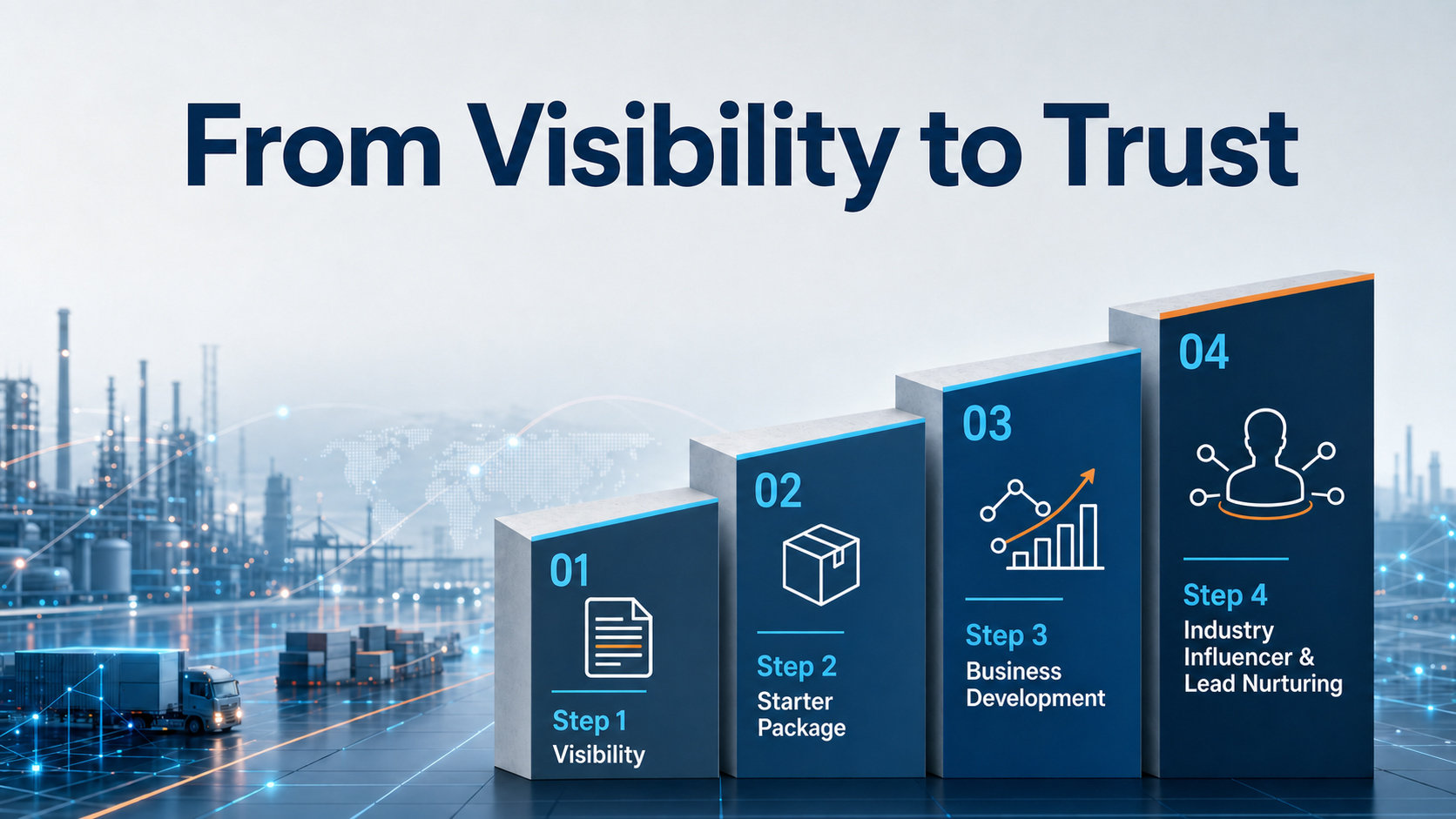
From visibility to trust: Your scalable path with Xpert.Digital - Image: Xpert.Digital
In industrial B2B, sustainable business relationships rarely emerge overnight. They develop step by step – through visibility, professional relevance, recurring touchpoints, and growing trust. Xpert.Digital's 4-stage model addresses precisely this: It offers a structured path that begins with a manageable entry point and can evolve into deeper collaboration in business development if needed.
Instead of relying on loud marketing promises, this model puts the relationship at the forefront. Companies start with clearly defined, easily calculable measures and then decide, based on their own experience, how far they want to expand the collaboration. A key factor for this undisturbed trust-building process: The platform completely avoids annoying advertising ads, so the editorial focus remains solely on the companies' expertise.
More information here:
Your global marketing and business development partner
☑️ Our business language is English or German
☑️ NEW: Correspondence in your native language!

Konrad Wolfenstein
I and my team are happy to be available to you as your personal advisor.
You can contact me by filling out the contact form here wolfenstein@xpert.digital:or simply call me at +49 7348 4088 965. My email address is
I'm looking forward to our joint project.