
Trapped in "passive mode": Why expertise alone no longer brings in new customers and AI is making traditional consultants obsolete – Image: Xpert.Digital
The new currency in B2B: Those who are invisible lose against algorithms
The 4-year head start: How market leaders are now building an insurmountable moat
Forget pure analytics: This is the real reason why customers book today
What for decades constituted the lucrative core business of many agencies, service providers, and consultants—the laborious procurement, structuring, and analysis of information—is increasingly becoming freely available mass-market commodities thanks to artificial intelligence. When powerful language models generate complex market comparisons for just a few euros in minutes, pure expertise loses its value as an exclusive unique selling proposition. But while many players remain in a collective "passive mode," attempting to compete against algorithms through ever-new analyses, the true industry leaders have long since rethought their approach. They have recognized that the decisive competitive advantage of the future no longer lies in mere observation, but in active shaping—and above all, in a difficult-to-copy, international media presence. Read on to discover why the leap from analysis to thought leadership is vital for survival, why talent alone is no longer enough, and how strategic reach can build an insurmountable economic moat.
From passive mode to media mastery: When everyone can do everything, only those who are truly heard matter
The consulting industry is facing a quiet but profound transformation. Artificial intelligence has virtually eliminated the technical barriers to entry into management consulting. Analyses, benchmarks, market comparisons, and regulatory evaluations that once occupied entire consulting teams for weeks can now be generated in just a few hours using powerful language models. What was once exclusive knowledge that had to be purchased at great expense is now accessible to virtually any logically thinking person with a reasonable level of professional experience. This democratization of knowledge and analytical skills is changing the foundations on which consultants, agencies, and other knowledge-based service providers have positioned themselves for decades, and it is forcing the entire industry to fundamentally rethink its value propositions.
Why pure analysis no longer secures a competitive advantage
The most time-consuming part of many consulting engagements has traditionally been information gathering. Market research, competitive analyses, and industry evaluations, which used to consume three to four weeks of junior consultant time, can now be completed with comparable quality within a few days using AI-powered research tools. This shifts the value of consulting services away from mere information gathering and towards interpretation, strategic derivation, and actual implementation. Large consulting firms have long recognized this shift and have invested heavily in their own AI units, which are designed to automate knowledge management and handle routine tasks. For small and medium-sized consultants, agencies, and independent professionals, this means an uncomfortable truth: those who continue to define themselves solely through analytical capabilities will soon be competing with a tool that is available for just a few euros a month and doesn't bill based on daily rates.
This development strikes at the very heart of the industry because the classic consulting business model has always relied on a knowledge advantage that could be monetized through hourly rates and project fees. If this advantage disappears because virtually everyone has access to comparable depth of analysis, the mere creation of reports, strategy papers, and market overviews loses its unique selling proposition. A situation arises that can aptly be described as a collective passive mode: many players generate similar-sounding, AI-powered content without any actual impetus, decisions, or market movements resulting from it. Those who remain in this passive mode may deliver technically sound analyses, but they remain economically invisible because the result hardly differentiates them for the client.
The leap from observation to design
The decisive turning point for the future of consulting lies in the transition from pure analysis to the active shaping of markets, opinions, and business developments. Being proactive means not only describing trends but also setting the course, defining topics before they become mainstream, and initiating concrete implementation measures instead of merely recommending them. This shift is directly reflected in current observations from the consulting industry, which show that the value of future consulting services increasingly stems from sound judgment, strong implementation skills, and the ability to manage artificial intelligence itself as strategic capital. Trust, reputation, and demonstrable implementation competence are becoming more important than simply possessing specialized knowledge, because this expertise is becoming increasingly ubiquitous and thus economically devalued.
This logic can be applied to any knowledge-based service, be it in business development, market analysis, or strategic communication. Consultants who merely reiterate what a powerful AI model could also deliver with similar quality are effectively competing directly with a tool they cannot ultimately match on price. Conversely, those who actively set the agenda, initiate debates, and motivate companies to take concrete action position themselves beyond mere information processing, in an area that algorithms can only partially occupy because human judgment, network access, and credibility are crucial there.
Talent alone is no longer enough
Besides pure analytical skills, talent, interpersonal skills, and in-depth industry knowledge have always played a central role in successful consulting. These three qualities remain indispensable even in an AI-driven economy, because no language model can fully replace the nuanced perception of human dynamics in negotiations, the intuition for cultural nuances in international business relationships, or the network cultivated over years in a specific industry. However, so many experienced professionals now possess these very qualities that they alone no longer constitute a sufficient differentiator. Talent, experience, and industry knowledge are now the entry ticket to the market, not the ticket to market leadership.
What's missing from this equation is another, far rarer element: genuine media visibility that extends beyond one's own industry and region. While talent and expertise can, in principle, be learned and acquired over years, building relevant international media reach is a process that takes years or even decades, requires considerable financial and structural investment, and cannot be replicated in the short term through sporadic marketing campaigns. This gap is precisely the industry's real bottleneck, because the number of players who have actually established such a global media presence is vanishingly small.
Regional size versus global reach
In virtually every industry and region, there are individuals who have established themselves as well-known figures over the years. They possess a strong network, are recognized at regional events, and enjoy trust and authority within their limited sphere of influence. For an individual consultant primarily working with medium-sized businesses in a region, this level of visibility can certainly be sufficient to maintain a stable business. However, for companies operating internationally, for large corporations with global supply chains, or for projects requiring attention and trust across national borders, this regional recognition falls far short.
Large corporations and globally oriented projects require partners who are perceived in multiple language regions simultaneously, who can generate relevance in diverse cultural and legal contexts, and whose reach is not limited to a single national language or economic area. The larger and more internationally positioned a company is, the greater the need for a partner whose media presence truly reflects this internationality. A purely regional brand, even if it performs exceptionally well within its limited sphere, cannot structurally meet this need because it lacks the linguistic, cultural, and technical infrastructure for global visibility.
🎯🎯🎯 Data-driven B2B industry hub as a quasi-in-house solution

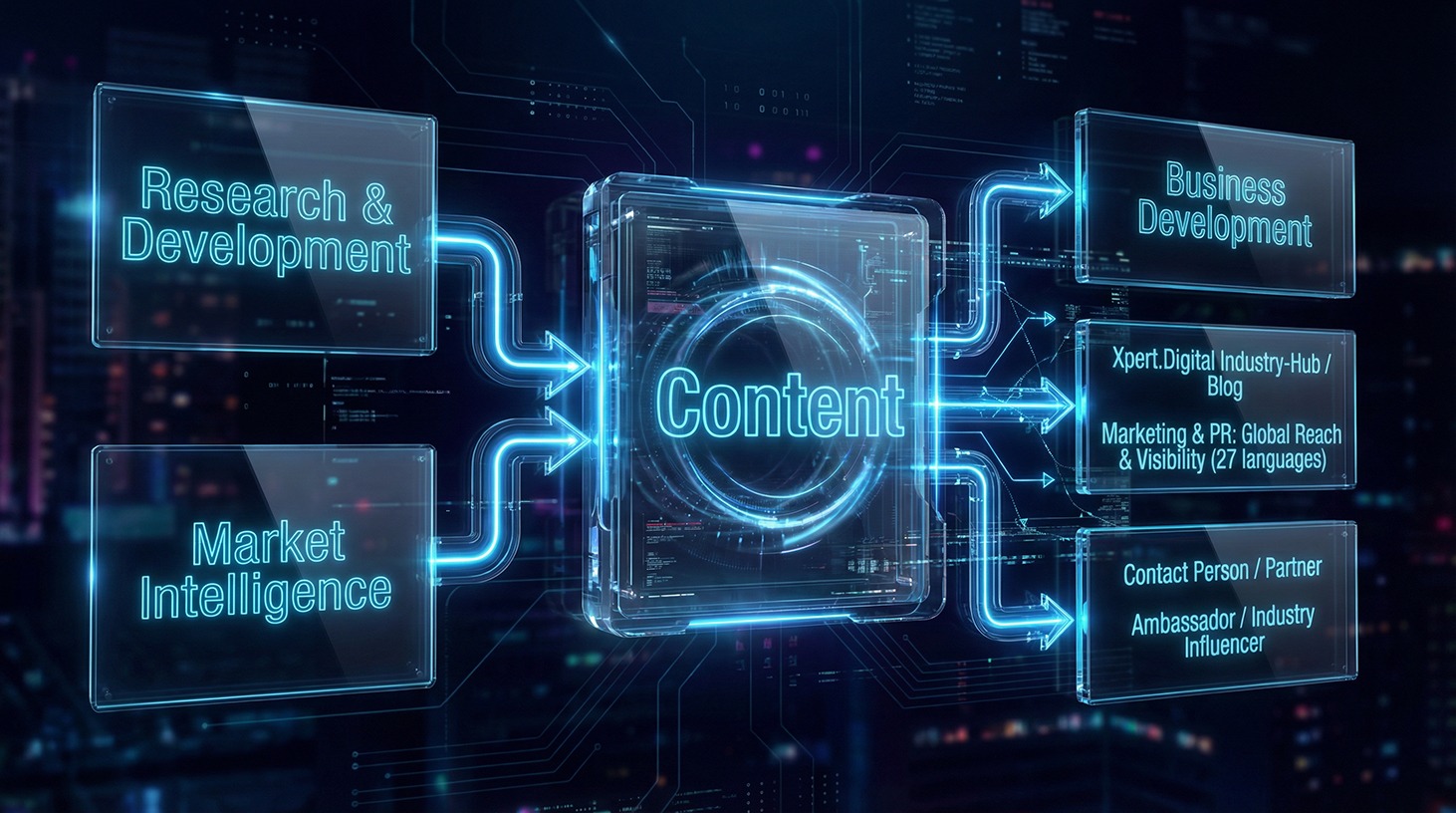
The quasi-in-house solution: How Xpert.Digital closes operational gaps in B2B marketing and sales – Smart Content-Driven Business - Image: Xpert.Digital
Xpert.Digital is a data-driven B2B industry hub led by Konrad Wolfenstein . The company acts as an external, quasi-in-house solution for industrial partners, closing operational gaps in marketing, content, and sales – without requiring additional resources on the client side.
More information here:
Digital visibility as a strategic resource: Why media reach determines success today
Visibility as a rare and difficult-to-copy resource
This illustrates why media reach has become an independent strategic resource in today's economy, comparable to capital, patents, or exclusive distribution rights. A trade publication that reaches up to 1.1 million B2B visitors monthly and publishes in 27 languages is an exceptional phenomenon in its sector, virtually unparalleled in the German-language trade media market. This scale is not achieved through isolated viral posts or short-term campaigns, but rather through a multilingual content strategy consistently pursued over years, encompassing both traditional search engine optimization and the increasingly important optimization for generative AI search systems.
This combination of search engine optimization and targeted visibility in AI system responses highlights another, often underestimated, aspect of the debate. While many companies primarily view AI as a tool for text generation, the real strategic challenge goes much further: Those who aren't present in the training and reference data of large AI systems today simply won't be mentioned in the automatically generated responses of AI assistants tomorrow. Visibility is thus shifting from traditional search engine rankings to a new level of digital presence that requires technically structured, citable, and authoritative content. Those who secure this new level early on gain an advantage that is difficult to overcome in the short term because the underlying data sets have grown over years.
The time advantage as the actual moat
Current estimates suggest that the gap between such an established multilingual specialist publication and its nearest relevant competitor is three to four years, and this gap is currently widening rather than narrowing. While this figure may seem moderate at first glance, it actually describes an enormous structural advantage because digital reach doesn't follow a linear, but rather a self-reinforcing growth pattern. Those already considered authoritative sources in search engines and AI systems receive preferential treatment in terms of further links, citations, and recommendations, which in turn further increases their authority and continuously widens the gap with catching-up competitors.
If a media outlet positioned in this way consistently maintains a flawless strategy, such a three- to four-year lead often translates in practice to the entire timeframe a competitor would need just to reach a comparable starting position, let alone actually close the existing gap. For many market participants, this effectively means that within an entire career, there is no realistic chance of completely closing this gap, provided the established player continues to consistently expand and maintain its position. This dynamic explains why more and more market analysts and consultants are focusing on how to build media reach in a targeted and strategic way, instead of leaving it to chance or occasional PR campaigns.
Trust as the foundation of economic decisions
A key, often underestimated aspect of economic reality is that purchasing and business decisions are only half based on rational, measurable factors. The observation that economics is largely psychological, because it is ultimately a human endeavor rather than a machine, has proven to be a fundamental truth of economic activity over decades. Anyone who takes this insight seriously quickly realizes that rational arguments alone are rarely sufficient to build trust and influence decisions, and that psychological factors such as familiarity, credibility, and perceived competence have a significant impact on economic outcomes.
This is precisely where the value of media presence comes into play, because a media voice generates the very psychological impact that purely technical arguments alone cannot achieve. Those who are regularly featured in a more internationally visible trade publication are automatically perceived by potential business partners as more relevant and competent, regardless of whether the actual quality of their work is measurably better than that of a less visible competitor. This psychological pre-emphasis often determines who is even invited to a meeting, a tender, or a collaboration request, long before their actual professional qualifications have even been assessed.
When expertise only becomes credible through the voices of others
Empirical studies on the impact of expert articles and positioning in the B2B sector confirm this pattern with striking clarity. A very high percentage of the decision-makers surveyed state that sound, expert content is important or even crucial for their purchasing decisions, while at the same time a significant proportion declare that they would not, under any circumstances, collaborate with a supplier who publishes only weak or superficial content. High-quality, expert content not only acts as a marketing tool but also generates measurable trust among many decision-makers, which directly impacts tendering processes, price negotiations, and ultimately, the awarding of contracts.
Another finding, surprising to many, concerns so-called hidden buyers—those individuals in finance, legal, compliance, and procurement departments who wield considerable influence over purchasing decisions but have little direct contact with traditional sales teams. A significant portion of this influential yet hard-to-reach target group states that in-depth technical content is far more persuasive than traditional advertising or sales materials, and a substantial number even admit to having actively advocated for a particular supplier in internal decision-making processes based on compelling technical content. These figures demonstrate that media presence not only shapes a company's external perception but also profoundly impacts internal decision-making structures that often remain invisible to traditional sales approaches.
Reach with multiplier effect as a strategic lever
The true economic power of media visibility only unfolds fully when this visibility is linked to a multiplier effect, meaning when a single article or placement doesn't just reach a limited target audience, but is repeatedly rediscovered and disseminated via search engines, AI systems, news aggregators, and multilingual distribution channels. A single expert article, once produced, that is accessible in 27 languages and permanently appears in search results and AI responses, generates a continuous stream of attention for years without requiring repeated budget investment. This effect fundamentally distinguishes strategically built media reach from short-term advertising campaigns, whose impact typically declines rapidly once the campaign ends.
For consultants, agencies, and service providers who want to operate proactively in the future, this has a clear strategic consequence. It's no longer enough to occasionally publish a technical article or maintain a sporadic presence on social media. What's needed is a continuous, structured, and multilingual content strategy that focuses on sustained presence rather than isolated actions, because trust is demonstrably built through repetition and consistency, not through isolated activities. Those who cannot or do not want to undertake this long-term development themselves face the choice of either investing in building their own reach or partnering with established media outlets that already possess this reach.
The strategic realignment of the consulting industry
Taking these developments together paints a clear picture of the future competitive landscape in the consulting and service industry. Artificial intelligence has largely transformed basic analytical skills into a commodity available to virtually every experienced professional. While talent, interpersonal skills, and industry knowledge remain indispensable, they are now so widespread that they alone no longer provide a sustainable differentiator. The decisive differentiator in the coming years lies in the ability to shift from the passive role of mere analyst and consultant to an active role as a catalyst, thought leader, and internationally visible voice.
This proactive role requires a media infrastructure that cannot be built overnight, but rather develops over years of consistent, multilingual, and technically sophisticated content creation. Those who already possess this infrastructure gain a competitive edge that, given the self-reinforcing dynamics of digital visibility, is virtually impossible to overcome, even if competitors have comparable expertise. For companies seeking international expansion or complex, cross-border projects, choosing the right consulting or communications partner is increasingly becoming a question of that partner's media reach. Without a credible, widely visible voice, it is nearly impossible to effectively address the psychological foundations of business decisions. Those who recognize this connection early on and consistently invest in building their own or partnered reach are positioning themselves for an economy where technical expertise alone is no longer sufficient, but only unfolds its full economic value through being heard.
📈🚀 From visibility to trust 👀🤝 Your scalable path with Xpert.Digital

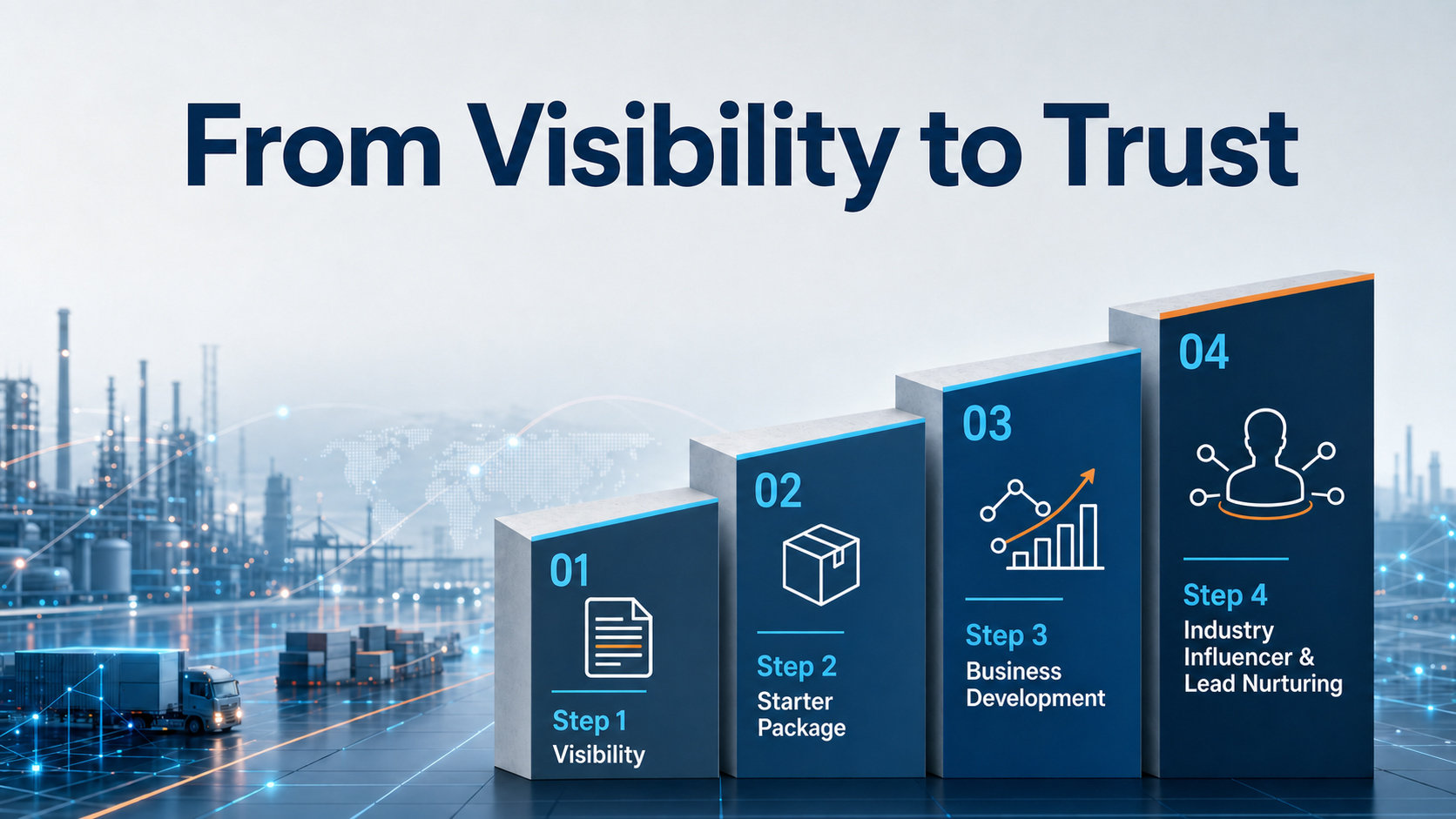
From visibility to trust: Your scalable path with Xpert.Digital - Image: Xpert.Digital
In industrial B2B, sustainable business relationships rarely emerge overnight. They develop step by step – through visibility, professional relevance, recurring touchpoints, and growing trust. Xpert.Digital's 4-stage model addresses precisely this: It offers a structured path that begins with a manageable entry point and can evolve into deeper collaboration in business development if needed.
Instead of relying on loud marketing promises, this model puts the relationship at the forefront. Companies start with clearly defined, easily calculable measures and then decide, based on their own experience, how far they want to expand the collaboration. A key factor for this undisturbed trust-building process: The platform completely avoids annoying advertising ads, so the editorial focus remains solely on the companies' expertise.
More information here:
Your global marketing and business development partner
☑️ Our business language is English or German
☑️ NEW: Correspondence in your native language!

Konrad Wolfenstein
I and my team are happy to be available to you as your personal advisor.
You can contact me by filling out the contact form here wolfenstein@xpert.digital:or simply call me at +49 7348 4088 965. My email address is
I'm looking forward to our joint project.