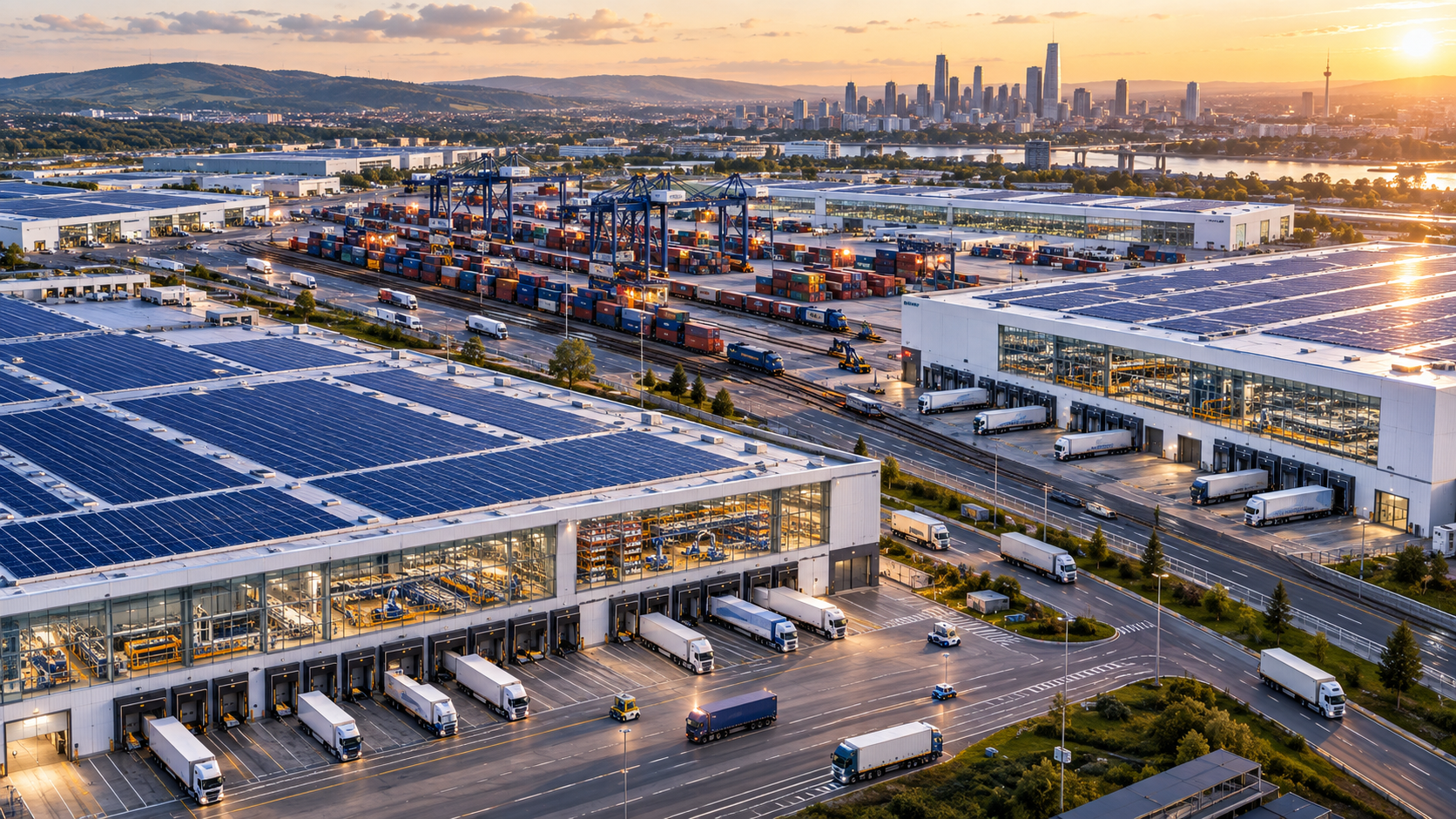
Logistics centers in an investment frenzy: Cold chains and automation – The new challenges of the logistics industry – Creative image on the topic, with AI: Xpert.Digital
How logistics centers are shaping the future of trade and production
The logistics real estate boom: risks, opportunities and the new dependency
The evolution of warehouses: From storage to critical infrastructure
The global boom in logistics centers is not merely a passing phenomenon, but reflects profound changes in production, trade, and consumption. Fueled by the rapid rise of online retail, further accelerated by the pandemic and geopolitical tensions, capital is flowing into a wide range of logistics properties—including distribution centers, fulfillment facilities, and cold storage warehouses. These facilities have transformed from passive storage sites into critical hubs in the global economy, determining how quickly goods flow, how readily available they are, and how resilient supply chains can be in the face of disruption.
The economic importance of modern logistics centers cannot be underestimated. They consolidate not only inventory and data, but also energy and labor in one location, significantly increasing the efficiency and adaptability of goods flows. However, this boom also brings challenges. While companies seek to diversify their dependencies and strengthen their resilience, they simultaneously concentrate increasing operational importance in highly complex and often vulnerable large-scale facilities. In this dynamic and constantly evolving landscape, the central question is what kind of logistics capacity is being created, where, and whether these investments truly lead to robust networks or merely create new dependencies.
The world is building itself to be resilient – and in doing so, may be cementing its next dependency
From warehouse to critical infrastructure
The global expansion of logistics centers is far more than a real estate cycle. It is the built response to a profound transformation of production, trade, and consumption. Since the rise of e-commerce, accelerated by the pandemic, geopolitical conflicts, trade barriers, and the increasing vulnerability of global supply chains, capital has been flowing into distribution centers, fulfillment facilities, cold storage warehouses, and intermodal transshipment hubs. These buildings are no longer passive storage sites. They are taking on functions that were previously distributed among stores, factory warehouses, wholesalers, and regional depots.
This also changes their economic significance. A modern logistics center consolidates inventory, data, energy, technology, and labor in one location. It plays a crucial role in determining whether production lines can continue running, medications remain available, food supply chains function, and online orders can be delivered within a few hours. The warehouse becomes a physical platform for the digital economy. Its value is therefore measured not only in square meters or rental income, but also in the speed, reliability, and adaptability of the flow of goods it facilitates.
However, this boom contains an inherent contradiction. Companies are building additional capacity to become less vulnerable, but in doing so, they are increasingly concentrating operational importance in highly complex, large-scale facilities. They are partially replacing dependencies on scarce labor with dependencies on electricity, software, robotics, semiconductors, and specialized maintenance services. The crucial economic question, therefore, is not whether the world needs more logistics space. The crucial question is what kind of capacity is being created, where it is being built, and whether these investments actually create robust networks or merely produce new systemic bottlenecks.
One market, many contradictory sizes
The size of the global logistics real estate market cannot be described with a single, reliable figure. Depending on the definition used, studies include only project developments and transactions, annual rental and management revenues, the value of modern warehouses, or the entire portfolio including land and older industrial sites. Accordingly, estimates for 2025 range from significantly less than $200 billion to well over $1 trillion. This range is not a minor statistical error, but rather the result of differing definitions.
For an economic analysis, the most spectacular market figure is therefore less relevant than the general direction of the forecasts. Most studies expect nominal annual growth rates in the mid- to high single digits until the early 2030s. For more narrowly defined segments of modern logistics real estate, many forecasts range around six to eight percent. For warehouse automation, robotics, and orchestration software, the expected rates are sometimes significantly higher. Thus, the building area is growing more slowly than the technical value installed per square meter.
The term "trillion-dollar boom" is nevertheless justified if one considers more than just the annual revenue of a narrowly defined real estate segment. Land, warehouses, transport connections, conveyor technology, robotics, energy infrastructure, software, cooling, and the financing of long-term portfolios together form an investment system of enormous proportions. Added to this are indirect expenditures for roads, rail connections, substations, data links, and municipal infrastructure. The real megatrend, therefore, lies not in a specific market forecast, but in the sustained shift of capital into the physical and digital infrastructure of goods distribution.
Online retail as a sales machine
E-commerce remains the most visible structural driver. A traditional retail chain stores large quantities in a few distribution centers and uses its branches as additional inventory, display, and handover points. In online retail, on the other hand, each item must be individually located, picked, packed, sorted, and shipped to a specific address. This also creates additional space requirements for returns, packaging materials, quality control, refurbishment, and the simultaneous operation of various sales channels.
A commonly used rule of thumb is that an additional billion US dollars in online sales can require approximately 1 to 1.25 million square feet of distribution space. This equates to roughly 93,000 to 116,000 square meters. This metric originates from a specific market environment and should not be mechanically applied to every country, industry, or year. Automation, taller buildings, denser storage, and improved inventory management reduce the space required per unit. At the same time, shorter delivery times and a greater variety of products increase the need for decentralized inventory. Therefore, this rule of thumb primarily describes the order of magnitude of the relationship, not its exact future.
The most significant impact on retail space is no longer necessarily generated by purely online retailers. Many traditional retailers are building omnichannel networks that connect stores, central warehouses, regional fulfillment centers, and pickup points. This blurs the lines between brick-and-mortar retail and e-commerce. An order can begin in a large warehouse, be assembled in a store, processed at an urban micro-hub, and, if returned, inspected in a specialized returns center. The more promises retailers make to their customers, the more complex and capital-intensive the underlying network becomes.
Same-day and next-day deliveries exacerbate this logic. Speed cannot be achieved simply by using faster vehicles. Goods must already be located near the point of demand. This leads to a hierarchy of large national centers, regional facilities, and smaller locations in metropolitan areas. While large warehouses offer economies of scale, space closer to cities is scarce and expensive. Therefore, companies are no longer just optimizing transport costs or warehouse rents, but an entire system encompassing delivery time, inventory, returns, personnel, energy, and service quality.
Resilience comes at a price
The pandemic and subsequent disruptions haven't abolished the long-dominant just-in-time principle, but they have tempered it. Companies are now trying to combine efficiency with additional buffers. Critical components are more frequently procured in duplicate, safety stocks are increasing in selected product groups, and production and distribution networks are being organized more regionally. Just-in-time isn't automatically becoming just-in-case. Rather, a segmented model is emerging: scarce or strategic goods are being stocked in larger quantities and given alternative supply routes, while standardized and readily available products continue to be managed as leanly as possible.
Additional inventory ties up capital. It incurs financing costs, insurance expenses, shrinkage, spoilage, and the risk of technological obsolescence. For fast-moving electronics, a large buffer can be more economically dangerous than a short-term supply shortage. However, for pharmaceuticals, spare parts, or intermediate products without immediate alternatives, the same inventory can prevent factory shutdowns or supply crises. Resilience, therefore, is not about maximizing inventory levels, but rather the economically sound ability to absorb disruptions and reorganize.
Nearshoring and friendshoring are increasing the need for regional logistics structures. Production is shifting, in some cases, closer to sales markets or to countries perceived as more politically reliable. Mexico benefits from its proximity to the USA, Eastern European countries from their integration into the EU single market, and Vietnam and other Southeast Asian locations from diversifying outside of China. These shifts shorten individual transport routes but create new supplier relationships, cross-border traffic, and intermediate storage. Regionalization does not automatically simplify a supply chain; often, it initially becomes more fragmented.
A complete relocation of all production stages would be extremely expensive and could even reduce stability. Economies that radically isolate themselves lose the advantages of specialization and yet remain vulnerable to local natural disasters, energy shortages, or labor scarcity. Robust supply chains are more likely to emerge from diversification, transparency, alternative routes, and trusted partners than from national self-sufficiency. For logistics centers, this means that what's needed is not just larger inventory, but flexible hubs that can connect different suppliers, modes of transport, and sales channels.
The new map of logistics
North America remains the most visible stage for large-scale distribution projects. The United States boasts a deep consumer market, vast distances, a dense highway network, and a strong willingness among institutional investors to finance modern industrial properties. Following the extremely lean years of the pandemic, robust construction activity temporarily led to higher vacancy rates. However, in the second quarter of 2026, the nationwide industrial vacancy rate fell back to a range of approximately 6.5 to 7 percent, depending on the data set. Simultaneously, the rate of absorbance accelerated, while fewer speculative new builds were completed. This suggests a cyclical normalization, not the end of the structural trend.
Within the US, growth patterns are shifting. Texas, the Southeast, parts of the Midwest, and regions near the Mexican border are benefiting from population growth, new factories, and nearshoring. Traditional port and gateway markets remain important but are limited by high land prices, permitting issues, and traffic congestion. Canada complements the North American network with highly automated facilities in Ontario and growing refrigerated and healthcare logistics capacities in British Columbia. The key factor is not the national border, but rather a location's integration into continental production and consumption corridors.
Europe's growth is less spectacular, but structurally more demanding. In the first half of 2026, take-up in the ten most important European markets increased again compared to the same period of the previous year, while the combined vacancy rate was just over five percent. Germany, the Netherlands, France, Spain, Poland, and the United Kingdom remain key markets. However, the focus is shifting from maximizing new construction to better locations, modern energy supply, and greater potential for alternative uses. Because open space is scarce and politically contested, brownfield projects, densification, and the replacement of outdated warehouses are gaining in importance.
Asia is not a homogenous market. Japan, with its large metropolitan areas, high service demands, and established real estate players, offers stable conditions for multi-story or multi-tenant centers. In regions like Hokkaido and the greater Sapporo area, facilities are being developed that can accommodate diverse users from the retail, manufacturing, and logistics sectors. China already possesses enormous inventories and is increasingly focusing on modernization, automation, and network optimization. In India and Southeast Asia, urbanization, industrial development, and growing consumer markets are driving new construction. At the same time, Australia is investing in intermodal hubs to distribute long distances more efficiently between road and rail.
Latin America and Africa remain smaller in the global institutional real estate market, but possess considerable development potential. Mexico is already a special case due to US nearshoring. In North Africa, proximity to Europe, competitive costs, and new industrial projects can generate additional demand. The bottleneck there is often not the warehouse itself, but the quality of roads, ports, customs clearance, energy supply, and digital systems. Logistics properties only realize their full value in conjunction with functioning infrastructure.
When the hall becomes a factory
Technological advancements are transforming the economic function of warehouses. Autonomous mobile robots transport shelves or containers, driverless systems move pallets, automated small parts warehouses consolidate inventory, and image-guided robotic arms are taking over an increasing number of order picking tasks. Overarching this is a software layer encompassing warehouse management, order control, simulation, and artificial intelligence. This layer determines where goods are placed, which orders take priority, and whether humans, conveyor systems, or robots perform the next work step.
By 2028, according to widespread industry forecasts, around 80 percent of warehouses and distribution centers are expected to use at least some form of robotics or automation. This doesn't mean that four out of five warehouses will be completely unmanned. Scanners, automatic sorting, pick-by-voice, mobile robots, or semi-automated packaging already meet this definition. Fully automated systems remain capital-intensive and are primarily suitable for high, relatively stable volumes. The reality will consist of hybrid systems in which humans handle exceptions, quality issues, and unforeseen tasks, while machines take over standardized operations.
Automation is also changing building architecture. Higher ceilings allow for greater storage density, particularly level and load-bearing floors ensure precise travel paths, additional power connections supply robots and charging infrastructure, and high-performance data connections are becoming essential for operations. Fire protection, maintenance zones, and redundancies must be considered during the planning phase. Therefore, an older warehouse in a good location may be less economically attractive than a new building, even if both offer the same footprint.
Productivity gains are significant, but not guaranteed. An automated system can improve throughput, accuracy, and uptime. However, if poorly designed, it can become an expensive bottleneck. Fluctuating item sizes, unpredictable demand, or frequently changing product ranges make amortization difficult. Therefore, companies should choose not the maximum possible automation, but rather the economically sensible level. Modular systems and rentable robotics lower the barriers to entry, while highly integrated large-scale systems demonstrate their advantages primarily with consistently high volumes.
Capital doesn't seek space, but quality
Logistics real estate has evolved from a niche market to an institutional asset class. Large owners and developers such as Prologis, Blackstone, GLP, Goodman, and Segro manage international portfolios, while insurance companies, pension funds, and sovereign wealth funds invest through equity stakes and special funds. At the beginning of 2026, Prologis held interests in approximately 1.3 billion square feet of logistics space and development projects, both owned and under management. This scale demonstrates the extent to which the sector has professionalized and concentrated.
Following the end of the zero-interest-rate environment, valuations had to be adjusted. Higher financing costs are driving down the price investors can pay for future rental income. At the same time, modern logistics properties offer inflation-adjusted rent increases, long-term demand, and, compared to some office properties, a clearer usage perspective. Prime yields in many established European markets are roughly in the range of four to six percent, although location, lease term, building quality, and financing strongly influence the actual return.
The decisive competitive advantage no longer lies solely in having the largest possible plot of land. Investors are now evaluating proximity to the population and infrastructure, the availability of electricity and labor, expandability, and energy efficiency. A building with a solar roof, battery storage, efficient heating, and a reliable grid connection can achieve higher rents, lower operating costs, and better financing options. In contrast, outdated buildings risk requiring investment, facing regulatory restrictions, and being sold at a discount.
Multi-tenant facilities distribute the risk of vacancy and allow for adaptation to varying space requirements. Single-tenant large centers can be more efficiently tailored to a single user, but create concentration risks. If a dominant online retailer or retail group leaves the location, a highly specialized facility may only be re-let at considerable expense. Therefore, adaptability to third-party uses becomes a kind of insurance against technological and economic changes.

Expert partner in warehouse planning and construction

Innovative approaches to temperature-controlled logistics
Cold chains as a capital-intensive growth niche
Temperature-controlled logistics is growing for several reasons. Consumers demand more fresh and frozen food, online grocery retailers require controlled deliveries, and the pharmaceutical industry transports sensitive biologics, vaccines, and specialty medications. Unlike in a conventional dry warehouse, a break in the cold chain can destroy the entire value of the goods or compromise product safety. Redundancy is therefore not a convenience, but an integral part of the business model.
Cold storage facilities are technically complex. They require robust insulation, airtight building envelopes, high-performance refrigeration systems, emergency or backup power supplies, and precise temperature monitoring. Hygiene regulations, different temperature zones, and, in many cases, specialized racking systems also need to be considered. High energy consumption makes electricity prices and grid stability crucial location factors. Modern refrigerants, heat recovery, and intelligent load management can reduce costs and emissions, but these require additional capital investment.
Specialization offers some protection against economic fluctuations because food and pharmaceuticals can be transported even during weaker economic periods. At the same time, it narrows the pool of potential users. A cold storage facility cannot simply be operated like a standard warehouse, and technical malfunctions can cause exceptionally high costs. Investors therefore receive a potential return premium but also assume operational, energy, and regulatory risks, which are lower with standard logistics.
Work doesn't disappear, it changes
The logistics boom creates direct employment in warehousing, transportation, technology, and administration, as well as indirect jobs at construction companies, suppliers, maintenance services, and local service providers. For structurally weaker regions, a large logistics center can be a significant employer and taxpayer. However, the impact depends on the level of vertical integration. A largely automated transit warehouse with few skilled positions generates different regional effects than a site with repair, packaging, returns processing, and management functions.
Automation significantly reduces repetitive walking, lifting, and transport tasks. At the same time, the demand for mechatronics engineers, electricians, software specialists, data analysts, and shift supervisors with technical understanding is increasing. This transition does not automatically solve the labor shortage; it merely shifts it to occupational groups that are already experiencing a shortage. Therefore, the economic success of a plant increasingly depends on qualifications, maintenance organization, and the ability to develop operational staff into technical roles.
The social impact remains ambivalent. Ergonomic systems can reduce physical strain and take over hazardous tasks. However, these same data and control systems can measure performance every second, intensify work rhythms, and restrict employees' autonomy. Productivity alone says little about workplace quality. Employee turnover, absenteeism, and recruitment costs can negate some of the anticipated efficiency gains.
Successful operators therefore do not treat staff as a residual component of an automated system. They involve employees early in process changes, create transparent performance standards, and combine technological investments with training. Certification programs in distribution centers can open up career paths for employees without academic degrees. This presents a key lever for municipalities and regions: Location policies should consider not only the number of announced job openings, but also qualifications, compensation, and long-term employability.
Land, electricity, and acceptance are becoming scarce
Large logistics centers require significant land and generate additional traffic. On greenfield sites, they compete with agriculture, nature conservation, and residential development. In metropolitan areas, they encounter already scarce land and congested road networks. The economic return on a project can therefore be positive, while its social impact, due to noise, land sealing, and infrastructure costs, is considerably less favorable.
Modern buildings offer large, unshaded roof areas suitable for photovoltaics. Combined with battery storage, heat pumps, and charging infrastructure, a building can cover part of its own energy needs and generate electricity on a temporary basis. The potential is particularly high when roof structure, grid connection, and energy management are planned together from the outset. However, a solar roof alone does not make transportation climate-neutral, nor does it eliminate the problems associated with land use.
European regulations are increasing the pressure on property owners. Energy requirements for new non-residential buildings are rising, sustainability reports demand reliable data, and the EU taxonomy is influencing financing and investment decisions. For existing properties, the risk of losing rentability and value without energy-efficient renovations is growing. Sustainability is thus transforming from a matter of image into a component of capital and operating costs.
Public acceptance is not achieved through glossy visualizations, but through demonstrable local benefits. Noise protection, green buffer zones, intelligent traffic management, rail connections, and mandatory training programs can reduce negative impacts. Municipalities should fully consider the costs for roads, fire departments, drainage, and network expansion. A project only benefits a location if its additional economic advantages outweigh the resulting public and environmental costs.
More halls do not automatically mean more safety
An additional warehouse can make a supply chain more robust by keeping critical inventory in a suitable location or opening up an alternative route. However, it can also increase vulnerability if too many goods flows are concentrated in a single, highly automated facility. A fire, power outage, cyberattack, or software error can then affect an entire region. Economies of scale and resilience are therefore often in tension.
Digital dependency is particularly critical. Warehouse management, robot control, transport planning, and inventory data are closely intertwined. If the central software fails or interfaces are compromised, the physical goods remain, but can no longer be efficiently located and moved. Redundant systems, offline procedures, segmented networks, and regular emergency drills are therefore just as important as sprinkler systems or backup power.
Energy is also becoming a systemic factor. Automated warehouses, cold storage facilities, charging parks, and data infrastructure increase the electrical connection capacity. In regions with limited grid capacity, logistics centers compete with factories, residential areas, and data centers. A theoretically ideal location can be practically unsuitable if grid connection is only available years later. The search for space is increasingly becoming a search for guaranteed power.
Resilience, therefore, arises from redundancy without blind duplication. Companies need alternative suppliers, transport routes, and operating modes, but not a second identical warehouse for every product. A risk-based segmentation according to criticality, replenishment time, value, shelf life, and substitutability is more sensible. Only then can it be determined where additional inventory, regional hubs, or flexible contracts are economically justified.
Projects send signals across industries
The diversity of current projects demonstrates that the boom is not solely driven by online retail. In Japan, multi-tenant centers are emerging even outside the largest metropolitan areas. They rely on flexible units and a broad user base. This signals confidence in regional demand and protects owners from dependence on a single tenant. At the same time, such buildings allow smaller companies access to modern infrastructure without having to finance a large-scale facility themselves.
In North America, healthcare providers and food wholesalers are investing in additional storage and refrigeration capacity. This often involves acquiring existing buildings and upgrading their technology. This strategy can be faster and more space-efficient than new construction, but requires a thorough assessment of insulation, power supply, floor load capacity, and expandability. Meanwhile, new large-scale facilities operated by international online retailers demonstrate that regional delivery speed remains a competitive advantage.
European food and beverage producers are expanding production and storage facilities to combine growth with supply security. In Vietnam, new regional logistics projects are emerging, benefiting from Southeast Asia's industrial diversification. Australia is developing intermodal hubs to move containers more efficiently between rail and road. What these projects have in common is not a specific building model, but rather the attempt to bring the flow of goods closer to production, demand, or high-performance transport hubs.
The most important lesson from the individual projects is therefore this: The global trend is broad, but its local economics remain specific. What works in a North American consumer corridor may not be suitable for a Japanese regional market or a European brownfield site. Capital can be distributed globally; operations, permits, personnel, and transportation remain local.
Strategies for companies
Companies should no longer treat logistics as an isolated cost center. Delivery capability impacts revenue, customer loyalty, production capacity utilization, and working capital. The cheapest warehouse can prove expensive within the overall system if it necessitates additional transportation, increased inventory, or longer delivery times. Location decisions therefore require a model that holistically evaluates real estate costs, personnel, energy, taxes, traffic, risk, and service levels.
A second principle is technological openness. Buildings and automation should be designed modularly to allow for changes in product ranges, throughput, and tenants. While fixed, large-scale technology achieves high efficiency at appropriate volumes, it can complicate adaptations. Mobile robotics, standardized interfaces, and scalable software increase flexibility. Crucially, this requires a robust database covering order profiles, product structure, peak loads, error costs, and staff availability.
Third, companies must make resilience measurable. General statements about secure supply chains are insufficient. Suitable key performance indicators (KPIs) include restart time, critical inventory coverage, the proportion of redundantly sourced components, alternative transport capacity, and maximum tolerable downtime. A center should be evaluated based on its specific contribution to risk mitigation. Otherwise, there is a risk of building expensive facilities without addressing the most critical vulnerabilities.
For small and medium-sized enterprises (SMEs), cooperation can be more economical than ownership. Multi-tenant facilities, contract logistics, and shared automation provide access to technology and economies of scale. However, this also creates dependencies on the service provider. Contracts should clearly define data access, service levels, emergency procedures, price changes, and switching options. Outsourcing transfers processes, but not the strategic responsibility for delivery capability.
What states and regions can gain
Efficient logistics reduces trading costs, expands sales markets, and increases a location's attractiveness for production. Regions with good ports, rail connections, customs processes, and digital networks can integrate more effectively into international value chains. Furthermore, logistics centers generate demand for construction, technology, energy, maintenance, and business services. Their economic impact thus extends beyond the immediately visible warehouse jobs.
At the same time, states must not engage in a subsidy competition for every warehouse. Standardized logistics is relatively mobile and sometimes generates low added value per square meter. Public funding should focus on infrastructure and capabilities that benefit multiple companies: rail connections, digital customs systems, network expansion, vocational training, and accelerated brownfield development. Direct subsidies are more justifiable where strategic supply, innovation, or exceptionally high regional added value is generated.
Planning policy must resolve land-use conflicts early on. Suitable corridors should combine transportation, electricity, and labor, instead of only permitting industrial buildings where land is readily available. Municipal boundaries must not result in one community receiving tax revenue while neighboring towns bear the burden of traffic. Regional coordination and infrastructure contributions based on cost-causation improve the economic balance.
For Bulgaria and other Southeast European locations, a unique opportunity lies in combining nearshoring, the EU single market, and corridors leading to Turkey, the Black Sea, and Central Europe. However, pure cost advantages are not enough. Crucial factors include reliable permits, efficient border and customs processes, a skilled workforce, network capacity, and the integration of road, rail, port, and airport infrastructure. Simply building warehouses creates real estate. Combining these factors creates a logistics hub.
The boom remains cyclically vulnerable
Despite structural growth drivers, the market is not immune to overcapacity. The years 2021 to 2023 triggered a wave of speculative projects in several regions. As interest rates rose and companies adjusted their pandemic-driven expansion, vacancy rates increased. Such phases are typical for real estate markets: years pass between planning and completion, so new supply often arrives when demand is already declining.
High construction and financing costs exacerbate the risk. A project may be operationally sound but become unprofitable due to expensive debt financing. Developers are responding with less speculative launches and more frequently requiring pre-leasing. This slows down new construction in the short term and could create renewed shortages in the medium term. The declining pipeline in the US and parts of Europe is already contributing to a rebalancing of supply and demand.
Concentration risks remain particularly prevalent with large tenants. Online retailers, retail groups, and logistics providers can dominate entire local markets. When a company changes its network, several spaces become available simultaneously. Technological specialization can also become a risk if existing fixtures are unsuitable for the next tenant. Investors should therefore examine not only the creditworthiness of the current tenant but also the alternative use potential of the property.
Geopolitical changes have reciprocal effects. Trade barriers and regional production can create additional storage needs, while simultaneously reducing the flow of goods and devaluing investments. An escalation of fragmentation would burden the global economy and trade. The logistics sector can mitigate individual disruptions, but cannot compensate for a lasting loss of international division of labor. More warehouses are no substitute for stable trade relations.
The quality of growth will be decided by 2030
Demand for modern logistics space is expected to continue rising until 2030. Online retail, aging inventories, new production sites, temperature-controlled goods, and increased delivery reliability requirements all point to this growth. However, the strongest value increases are not likely to occur with just any space, but rather with energy-efficient, well-connected, and flexibly automatable facilities. The market will increasingly differentiate between future-proof and technologically outdated buildings.
Artificial intelligence will primarily transform planning and control. It can forecast demand, position inventory, coordinate personnel and robots, and identify maintenance needs. Its benefits depend on data quality, clear processes, and reliable integration. A poorly organized supply chain cannot be made robust simply by an algorithm. The greatest gains arise where digital decisions and physical infrastructure are developed together.
Energy is becoming the third dominant location criterion, alongside location and workforce. Operators need not only affordable electricity but also reliable grid connection capacity and predictable prices. Solar roofs, storage systems, and flexible loads can offer advantages, but they cannot replace a high-performance grid. Projects that optimize electricity demand, vehicle charging, cooling, and building technology in an integrated manner will have lower operating costs and better financing opportunities.
Land scarcity will limit new construction in densely populated regions. Brownfield sites, multi-story buildings, and the modernization of existing facilities are gaining importance. At the same time, not all inner-city logistics remain economically viable. High land costs and neighborhood conflicts impose limitations. The network of the future will therefore consist of a few very large hubs, regional centers, and strategically deployed urban locations.
Progress made of concrete – with built-in risk
The global logistics center boom is neither a speculative fad nor an unmitigated success story. It reflects real changes in trade, technology, and geopolitical risk perception. Modern centers can increase productivity, shorten delivery times, secure food and pharmaceutical supply chains, and integrate regions into international value chains. They thus create economic benefits that extend far beyond their physical boundaries.
However, building additional capacity is not synonymous with resilience. Oversized facilities tie up capital, large plants concentrate failure risks, automation increases dependence on energy and software, and land use generates local costs. The economically sound approach lies between maximum efficiency and maximum redundancy. Companies must differentiate risks, design flexible facilities, and combine physical and digital security.
The winners will therefore not be those who simply construct the most square meters. Successful sites and operators will be those that combine space, transport, energy, data, and skills into a resilient system. This includes sustainable buildings, interoperable technology, alternative operating methods, and employees who can master complex systems. Political decision-makers, too, must make more precise distinctions: between strategic infrastructure and interchangeable warehouses, between regional value creation and mere land turnover, between genuine decarbonization and greenwashing.
The world needs more efficient logistics centers, but not at any cost and not everywhere. The boom makes supply chains more resilient when new hubs create diversity, transparency, and options for action. It creates new dependencies when scaling becomes an end in itself, and electricity, software, personnel, or a single major user become an irreplaceable bottleneck. By 2030, therefore, the deciding factor will be less how much has been built, but whether the massive investments have resulted in an adaptable network. This is precisely the provocative truth of this megatrend: The next supply crisis might not fail due to a lack of warehouses, but rather due to too many highly optimized warehouses, all dependent on the same vulnerable systems.
Your intralogistics experts

Consulting, planning and implementation of complete solutions for high-bay warehouses and automated storage systems - Image: Xpert.Digital
More information here:
Your global marketing and business development partner
☑️ Our business language is English or German
☑️ NEW: Correspondence in your native language!

Konrad Wolfenstein
I and my team are happy to be available to you as your personal advisor.
You can contact me by filling out the contact form here wolfenstein@xpert.digital:or simply call me at +49 7348 4088 965. My email address is
I'm looking forward to our joint project.
☑️ SME support in strategy, consulting, planning and implementation
☑️ Creation or realignment of the digital strategy and digitization
☑️ Expansion and optimization of international sales processes
☑️ Global & Digital B2B trading platforms
☑️ Pioneer Business Development / Marketing / PR / Trade Fairs
Our global industry and economic expertise in business development, sales and marketing


Our global industry and economic expertise in business development, sales and marketing - Image: Xpert.Digital
Industry focus areas: B2B, digitalization (from AI to XR), mechanical engineering, logistics, renewable energies and industry
More information here:
A thematic hub offering insights and expertise:
- Knowledge platform covering global and regional economies, innovation and industry-specific trends
- A collection of analyses, insights, and background information from our key areas of focus
- A place for expertise and information on current developments in business and technology
- A hub for companies seeking information on markets, digitalization, and industry innovations