
The lighthouse effect: Why Xpert.Digital is considered a pioneer among the 12 medium-sized companies in the Unternehmer Magazin when it comes to AI search – Image: Xpert.Digital
Survival in the digital fog: How modern AI discoverability works – AI revolution in marketing
Staying visible despite ChatGPT: How Xpert.Digital and 11 other medium-sized companies cracked the code of AI search in the DUP Entrepreneur Magazine
We are currently experiencing the most dramatic paradigm shift in digital marketing since the invention of Google Search. Users no longer simply type their questions into search boxes and painstakingly click through a dozen websites. They query artificial intelligences like ChatGPT, Perplexity, or Gemini and expect ready-made, precise answers. For companies, this convenient new world poses a real threat: those who are not cited as a source in the AI's direct answers are practically invisible online.
Traditional SEO (Search Engine Optimization) is rapidly giving way to GEO (Generative Engine Optimization). It's no longer about exploiting algorithms through keyword density, but about achieving genuine, in-depth authority within a specific niche. The renowned DUP business magazine, in its current cover issue, demonstrates how to make this leap into the new, AI-driven visibility. Under the apt term "lighthouse effect," the magazine profiles companies that stand out from the digital noise. The fact that pioneers like Xpert.Digital are among the 12 featured medium-sized businesses proves that it's not necessarily the global tech giants leading this revolution, but rather specialized medium-sized companies with genuine expertise.
How exactly this lighthouse effect works, why EEAT is becoming the most important currency on the internet, and which strategies your company can use to remain visible in AI searches, can be read in the following analysis.
The lighthouse effect: How medium-sized businesses can remain visible in the age of AI search
If Google is no longer the first port of call – those who don't shine now will disappear into the digital fog
The way people and businesses search for information is changing faster than in the past two decades combined. Where search engines with their results lists were once the undisputed gateway to the digital world, they are increasingly being replaced by language-based models like ChatGPT, Gemini, Perplexity, and Copilot. These no longer deliver a list of links, but rather a complete answer, formulated in full sentences, often without the user even having to visit a website. For businesses, this represents a fundamental shift in the rules of the game: visibility is no longer solely determined by a good ranking on the first page of search results, but by whether the company's brand, expertise, and products are even mentioned in the answers provided by an artificial intelligence. This transformation is increasingly described by the term "generative engine optimization," or GEO for short, in analogy to the classic search engine optimization (SEO) that has shaped digital marketing for decades.
A current example of this development is provided by DUP Unternehmer Magazin, a business magazine with a circulation of nearly 300,000 copies. Its cover story, entitled "The Lighthouse Effect – How Companies Gain Visibility and Revenue on ChatGPT and Similar Platforms," profiles twelve medium-sized companies that have successfully made this leap into increased visibility. The case studies range from compliance software and agent-based financial management to real estate brokerage, spice manufacturing, and industrial market intelligence. They exemplify that the challenge of being present in AI systems no longer affects only technology companies, but extends across all industries and company sizes.
Related to this:
From search results to direct answers – a silent revolution in user behavior
To understand the economic implications of this development, it's worth examining the mechanics of traditional search engine optimization (SEO) compared to the new AI-driven search engine optimization (SEO). Traditional SEO focused on achieving the highest possible ranking in organic search results through targeted keywords, technical optimization of loading times, a clean page structure, and a network of backlinks. Users were presented with a selection of links and could choose which source to open. For years, this principle generated fierce competition for attention, but at least it distributed traffic across multiple providers simultaneously.
With generative AI systems, this intermediate selection step is largely eliminated. The artificial intelligence searches, weights, and condenses a multitude of sources into a single, coherent answer. Only the content that the model deems particularly relevant, trustworthy, and thematically appropriate is included in this answer or cited as a source. Those who fail this internal selection process simply don't appear, regardless of how well their website previously ranked in traditional search engines. This shift creates a kind of digital bottleneck effect: The number of visible positions shrinks dramatically, while the value of each individual position achieved simultaneously increases.
Why a lighthouse is the perfect symbol for corporate AI presence
The term "lighthouse effect," chosen by the business magazine for its cover story, captures the essence of this new reality with astonishing precision. A lighthouse doesn't emit diffuse light in all directions, but rather shines in a focused and intense beam within a clearly defined orbit, allowing ships to easily identify and locate it even from a great distance. Applied to digital visibility, this means that companies that manage to position themselves as a clear, specialized, and trustworthy source on a well-defined topic will be recognized by AI systems as a point of reference and cited in responses. Companies that try to offer a little bit on everything, on the other hand, will disappear into the digital background noise of countless similar providers.
This focus on clearly defined niches is not a new marketing principle, but in the context of artificial intelligence, it takes on a new, existential urgency. Language models, when evaluating sources internally, favor content that covers a topic exhaustively, precisely, and with demonstrable depth of expertise, rather than superficial overview articles that already exist a thousand times over online. Paradoxically, a medium-sized company that concentrates on a narrow specialization and provides the most comprehensive, up-to-date, and best-structured information on the entire web often has a better chance of AI visibility than a global corporation with widely scattered but shallow content.
EEAT as a new foundation for entrepreneurial credibility online
A key evaluation principle used by both traditional search engines and modern AI systems to classify content is the so-called EEAT principle. The acronym stands for Experience, Expertise, Authority, and Trustworthiness, and describes four dimensions by which algorithmic systems assess the quality and reliability of an information source. Experience refers to whether the creator of a piece of content demonstrably possesses practical, often personal, experience with the topic. Expertise relates to specialized knowledge and its verifiable depth. Authority describes how strongly a source is recognized as a reference in its field and how it is linked to or mentioned by other relevant sources. Finally, trustworthiness encompasses factors such as transparency, timeliness, accuracy, and the verifiability of statements.
This presents a remarkable opportunity for German SMEs. Companies that have built up practical, highly specialized expertise over many years, for example in heavy-lift logistics, solar infrastructure, water management, or industrial plant engineering, often possess precisely the depth of experience that generative AI systems consider particularly valuable. The digital industry hub Xpert.Digital, for instance, has consistently made this principle the foundation of its content strategy by publishing highly specialized articles ranging from 800 to 8,000 words in 27 languages, reaching over one million industry professionals each month. The underlying logic is strikingly simple: the more detailed, up-to-date, and technically sound an article is on a narrowly defined topic, the more likely it is to be used by an AI model as a reliable primary source when users ask complex questions, such as those concerning industrial automation solutions.
From the data protection jungle to the automated response engine – practical examples from medium-sized businesses
The companies profiled in the business magazine illustrate how diverse the paths to AI visibility can be in practice, even if the underlying principles remain comparable. For example, a compliance software provider has developed a platform that supports companies in implementing European directives and regulations, automates governance, risk, and compliance processes, and generates data analyses and risk profiles. Visibility in AI search engines is achieved through the deliberate publication of highly specialized use cases and consistent technical optimization of its website for generative search systems.
Another company in the field of agent-based financial management is pursuing a similar approach, but going a step further: They intend to use generative engine optimization not only internally, but also as a service to other small and medium-sized enterprises (SMEs) in the near future. The rationale is economically sound: AI systems rely heavily on citable, relevant digital content, but smaller companies without their own content teams often cannot produce such content in sufficient quality and quantity. Generative visibility thus becomes an independent, growing service market.
Even outside the traditional technology sector, surprising successes are emerging. One provider of agent-based software testing reports significantly lower quality assurance costs and higher test coverage, achieved through the targeted use of AI agents, while simultaneously increasing its digital visibility through comprehensive website content, videos, expert articles on social media, workshops, and strategic partnerships. Even a single real estate agent describes how, through regular, expert publications on real estate and construction financing topics, as well as targeted optimization for AI-powered search systems, he is making his expertise more visible—all without the marketing budget of a large corporation.
🎯🎯🎯 Data-driven B2B industry hub as a quasi-in-house solution

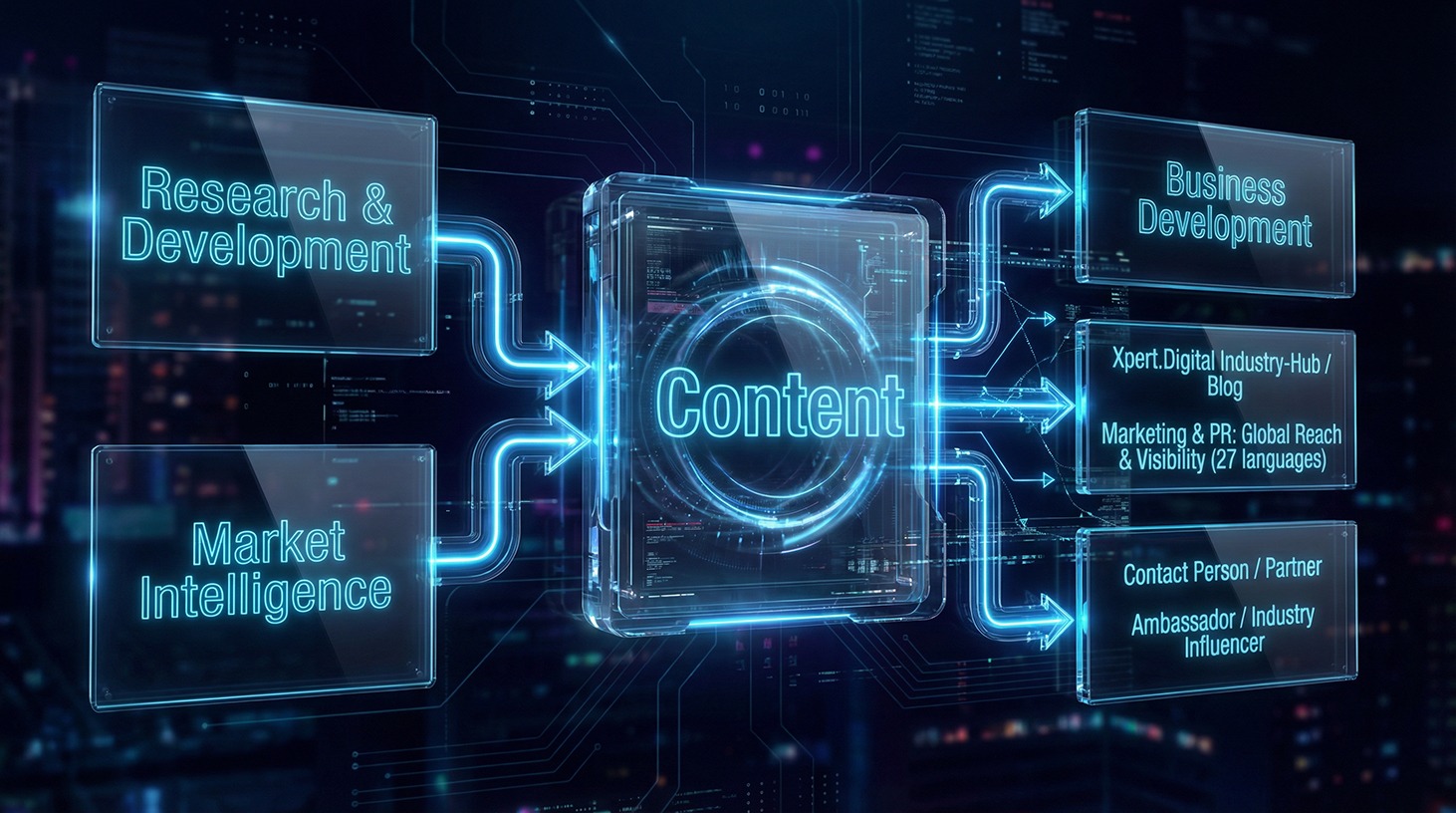
The quasi-in-house solution: How Xpert.Digital closes operational gaps in B2B marketing and sales – Smart Content-Driven Business - Image: Xpert.Digital
Xpert.Digital is a data-driven B2B industry hub led by Konrad Wolfenstein . The company acts as an external, quasi-in-house solution for industrial partners, closing operational gaps in marketing, content, and sales – without requiring additional resources on the client side.
More information here:
AI revolution in SMEs: Why expertise is more important than advertising budget today
When small businesses become the biggest winners of AI transformation
A particularly revealing example is that of a supplier of cleaning and power equipment, which uses artificial intelligence to create almost all content for its online shop, blog posts, and newsletter. This time saving enabled the company to launch new products significantly faster, resulting in a revenue increase of around 20 percent and a profit increase of approximately 40 percent within a year. For actual visibility in AI-powered search engines, the company also relies on structured data in its e-commerce shop system and recognized quality seals – two factors that algorithmic systems interpret as strong signals of trust.
These examples refute a widespread misconception that digitalization, and especially the use of artificial intelligence, primarily benefits large, well-capitalized companies. In practice, the opposite effect is evident: because generative AI systems prioritize in-depth expertise, thematic focus, and practical experience over mere advertising budgets or brand recognition, small and medium-sized enterprises (SMEs) with limited resources but genuine expertise can benefit disproportionately. An interim manager and management consultant from the manufacturing sector succinctly illustrates this principle by systematically documenting and publishing how he uses AI systems in his consulting practice. Each solved case simultaneously becomes evidence of professional competence, which generative search systems can recognize as a relevant source and recommend in their responses.
Content as the raw material of the future – why niche knowledge is becoming more valuable than mass reach
The economic logic behind this development can be well described using classic economic concepts. In a world where information is abundant, but user attention—and now even that of AI systems themselves—is a scarce commodity, the economic value shifts from mere reach to verifiable, differentiated expertise. Where previously the sheer number of backlinks or the frequency of a keyword determined search engine ranking, today the focus is increasingly on the substantive content, semantic consistency across numerous posts, and the demonstrable authority of a contributor in their specific field.
For management consultants, industry associations, and specialized trade publications, this results in a strategic obligation to systematically, continuously, and with high-quality content digitization of their own knowledge base. It is no longer sufficient to occasionally publish a blog post or maintain a static company website. Rather, a competition for digital hegemony in clearly defined subject areas is emerging, in which those players who invest early, consistently, and with a long-term perspective in structured, multilingual, and technically sound content will ultimately come out on top. It is precisely this long-term, cumulative nature that fundamentally distinguishes the new GEO strategy from short-term advertising campaigns, whose impact usually ends abruptly when the budget runs out.
The other side of the coin – risks, dependencies and open questions
While there is justified enthusiasm for the new opportunities offered by AI-generated visibility, the associated risks must not be ignored. A key problem lies in the largely opaque evaluation mechanisms of large language models. Unlike traditional search engines, whose fundamental ranking factors have been relatively well documented over years through specialist publications, conferences, and official guidelines from the operators, it often remains unclear with generative AI systems why one source is cited and another is not. Companies are therefore investing in an optimization goal whose precise rules can change continuously and without notice, as the underlying models are regularly updated and retrained.
Furthermore, there is a structural dependency on a few very powerful technology companies that operate the dominant AI systems. While there was at least some competition between different providers in the traditional search engine market, market power in the field of generative AI is currently concentrated in the hands of a very limited number of companies from the United States. For the digital sovereignty of European and especially German SMEs, this means additional economic vulnerability, as business-critical visibility ultimately depends on the business decisions of a few non-European platform operators.
Another often underestimated risk concerns so-called traffic erosion. Because generative AI systems bundle information directly into their responses, the need for users to even visit the original source decreases. Companies that previously relied on direct website traffic and the associated advertising revenue or lead generation processes may have to fundamentally rethink their business models if visibility in the AI response no longer automatically translates into a measurable flow of visitors to their own site. Simply being mentioned as a source thus becomes an independent brand asset, the economic benefit of which cannot always be directly reflected in traditional traffic metrics.
Strategic areas of action for SMEs – what needs to be done now
The analysis of the profiled companies and the fundamental operating principles of generative AI systems reveal several concrete areas of action for medium-sized businesses seeking to future-proof their digital presence. First and foremost is a consistent focus on clearly defined topics where demonstrable expertise and experience exist, rather than an arbitrary expansion to cover as many search terms as possible. Secondly, the technical structure of digital content is gaining importance: clear structures, precise definitions, structured data, and machine-readable formats make it easier for AI systems to correctly capture and categorize content.
Third, companies should take the multilingualism of their content seriously, especially if they operate internationally or want to reach international customers, as generative search systems are increasingly working across languages and comparing content from different language regions. Fourth, it is advisable to build verifiable authority signals, for example through customer case studies, documented practical experience, specialist publications, awards, and an active presence on specialist portals and in industry networks. Fifth, companies should continuously monitor the development of generative AI systems and regularly adapt their content strategy, rather than considering a once-established strategy as permanently valid.
A turning point? The race for digital hegemony has long since begun
The transformation towards an active, strategically planned presence in AI search systems, documented by twelve medium-sized companies in the Unternehmer Magazin (Entrepreneur Magazine), does not mark a short-term trend, but rather a structural shift in how economic visibility in the digital space is created. Companies that recognize this development early on and consistently invest in technically sound, clearly structured, and continuously maintained content gain a cumulative advantage that will become increasingly difficult to overcome as generative AI systems mature. Those who wait, hoping their existing digital presence will suffice, risk becoming simply invisible in an increasingly AI-driven information landscape, even if their own expertise is objectively outstanding.
The key economic insight from this development is therefore this: Digital visibility in the age of generative AI is not a one-off marketing project, but an ongoing strategic task that reaches deep into the corporate culture, knowledge organization, and communication processes of every medium-sized company. The lighthouse, which once served as a metaphor for orientation in stormy seas, thus becomes a fitting symbol for those companies that understand how to bundle their expertise so clearly, so consistently, and so trustworthyly that artificial intelligence automatically recognizes them as a reliable point of reference, while the rest drift past unnoticed in the digital fog.
📈🚀 From visibility to trust 👀🤝 Your scalable path with Xpert.Digital


From visibility to trust: Your scalable path with Xpert.Digital - Image: Xpert.Digital
In industrial B2B, sustainable business relationships rarely emerge overnight. They develop step by step – through visibility, professional relevance, recurring touchpoints, and growing trust. Xpert.Digital's 4-stage model addresses precisely this: It offers a structured path that begins with a manageable entry point and can evolve into deeper collaboration in business development if needed.
Instead of relying on loud marketing promises, this model puts the relationship at the forefront. Companies start with clearly defined, easily calculable measures and then decide, based on their own experience, how far they want to expand the collaboration. A key factor for this undisturbed trust-building process: The platform completely avoids annoying advertising ads, so the editorial focus remains solely on the companies' expertise.
More information here:
Your global marketing and business development partner
☑️ Our business language is English or German
☑️ NEW: Correspondence in your native language!

Konrad Wolfenstein
I and my team are happy to be available to you as your personal advisor.
You can contact me by filling out the contact form here wolfenstein@xpert.digital:or simply call me at +49 7348 4088 965. My email address is
I'm looking forward to our joint project.