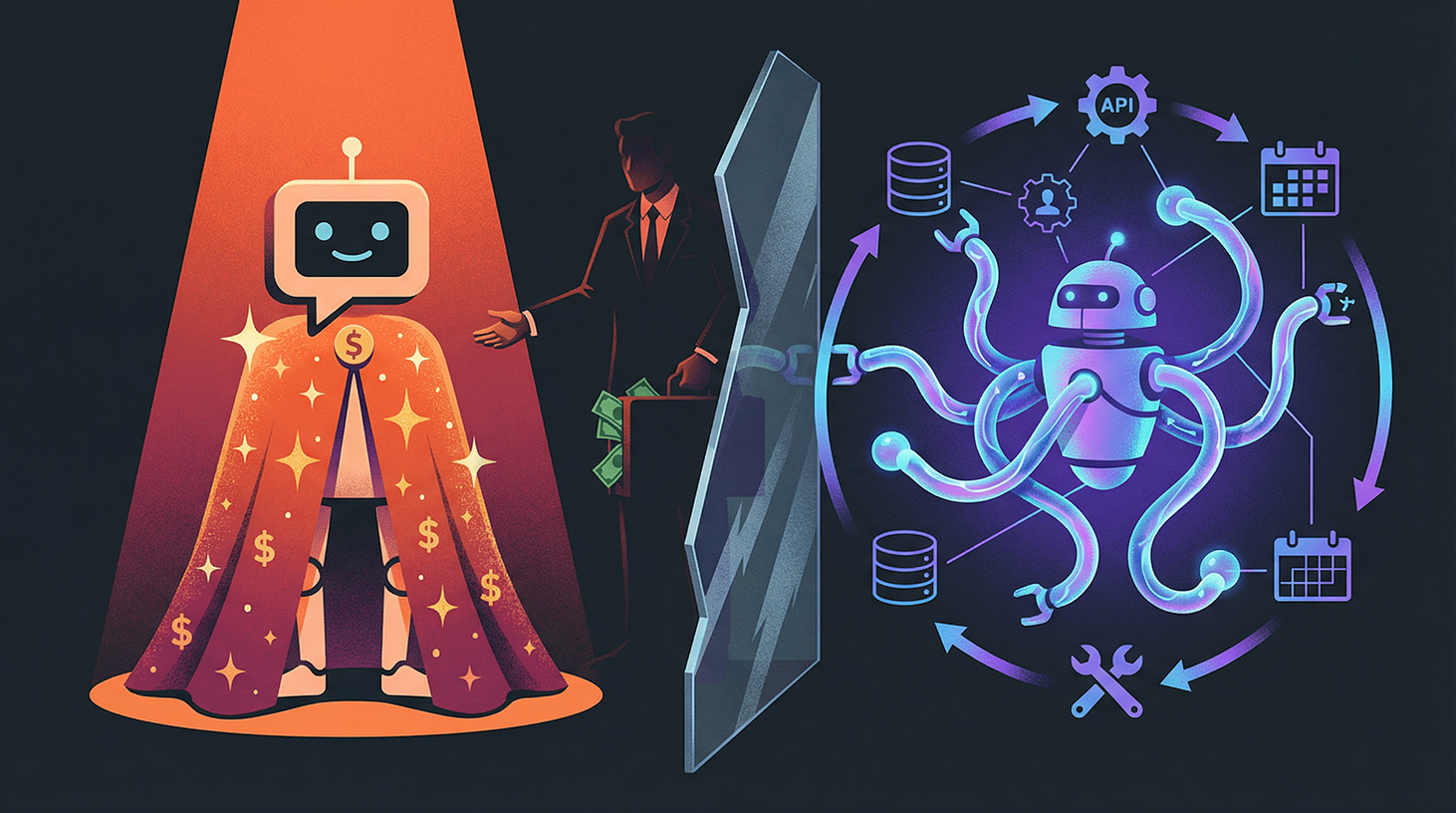
Agent washing and deceptive labeling: Only 130 out of thousands are real – How to truly recognize genuine AI agents – Image: Xpert.Digital
AI: A Million Dollar Trap: 5 Criteria That Separate a True Autonomous Agent from the Rest
Expensive deception: Why your new "AI agent" is actually just a chatbot
The hype surrounding artificial intelligence has reached a new stage: Autonomous AI agents are considered the next major milestone across all industries. They are expected not only to passively generate texts, but also to independently plan complex processes, operate tools, and complete tasks end-to-end. However, this technological gold rush is arousing considerable interest. To justify higher license fees and company valuations, more and more software providers are resorting to a risky marketing strategy: so-called "agent washing." This involves simply rebranding conventional chatbots or simple automation tools as highly intelligent, autonomous agents. For companies looking to transform their processes, this deceptive practice quickly becomes a fatal and costly trap. A Gartner study reveals the drastic extent of the problem: Of the thousands of advertised solutions, only around 130 actually deliver on their promises. Learn why the market is flooded with bogus agents, the immense financial risks involved, and the criteria you can use to reliably distinguish genuine AI agents from expensive imitations.
Related to this:


Thousands of vendors call their products AI agents. According to Gartner, only 130 of them actually deliver what they promise.
A market in a frenzy: The economics of the AI agent illusion
The market for AI agents is growing at a pace that leaves even seasoned technology analysts breathless. From $6.54 billion in 2024 to a projected $339.6 billion by 2035, it's growing at an average annual rate of 43.2 percent. Fortune Business Insights estimates the market for specifically agent-based AI at $11.78 billion by 2026, with an annual growth rate of 46.61 percent through 2034. These figures explain why the race for leadership in this segment is so aggressive among technology vendors. They also explain why this race has given rise to a phenomenon that industry observers are diagnosing with growing unease: agent washing.
Agent washing—a term coined alongside the long-established practice of greenwashing—refers to the strategic practice of marketing conventional AI products as "AI agents" through linguistic rebranding, without possessing the genuine capabilities of an autonomous, tool-using system. A simple chatbot that answers queries is positioned as an "agentic AI solution." An RPA tool that automates rule-based processes suddenly becomes an "intelligent agent." A RAG system that uses retrieval augmented generation for more precise answers is sold as an "autonomous knowledge system." Each of these reframings is technically misleading. All three serve the same economic imperative: higher valuations, higher license fees, and faster sales cycles in a market where "agentic" is the buzzword.
The quantitative extent of this problem was demonstrated by Gartner in a study that generated considerable discussion within the industry: Of the thousands of vendors claiming agent-based AI capabilities, only about 130 actually deliver genuine agent-based solutions. The implication for procurement departments, IT decision-makers, and executive boards is clear: The vast majority of offerings marketed as "AI agents" are technologically inadequate, expensively overpriced, and incapable of delivering the promised results in real-world business practice.
What distinguishes a real AI agent from an expensive chatbot?
The conceptual ambiguity surrounding the term "AI agent" is not solely due to malicious intent – it also stems from a genuine scientific debate about the limits of autonomous systems. Nevertheless, operational criteria can be defined that can serve as a minimal technical framework for evaluating a system as a genuine agent.
First: Memory across session boundaries. A true AI agent remembers previous interactions, decisions, and their outcomes—not just within a single conversation, but across days, weeks, and for different users in the same work context. Classic chatbot architectures lack persistent memory beyond the context window. They begin each session without any prior knowledge of previous interactions with the same user.
Second: Multi-stage planning and goal decomposition. An autonomous agent doesn't receive step-by-step instructions, but rather a high-level goal – "Analyze our sales data from the last six months and identify underperformers by region and product category" – and independently develops an execution plan that breaks this goal down into actionable sub-steps. Generative AI systems react to input; agent-based systems initiate sequences of actions.
Third: Tool usage and system integration. In practice, this is the clearest dividing line between chatbots and agents. A real agent can interact with real systems: It opens browsers, searches databases, writes to CRMs, triggers API calls, sends emails, reads documents, and modifies code. It leaves a digital footprint in the systems it interacts with. A chatbot produces text. An agent produces results.
Fourth: Feedback loops and self-correction. Autonomous agents evaluate after each execution phase whether the intermediate step delivered the expected result and adjust their plan accordingly. This mid-task self-correction capability is crucial for reliability in complex, multi-stage tasks. Systems lacking this capability fail at the first unexpected result and escalate back to the human user.
Fifth: Orchestration and multi-agent collaboration. In enterprise-grade applications, true agent systems do not operate as single instances, but as coordinated networks of specialized agents. A planning agent breaks down the task, specialized execution agents process sub-problems in parallel, and a validation agent checks the results. This orchestration requires an infrastructure that goes far beyond simple LLM routing.
Related to this:

The three most common deceptive practices in the agent market
In discussions with purchasing decision-makers and IT managers, three product categories can be identified that are marketed as “AI agents” with particular frequency, without meeting the aforementioned criteria.
LLM chatbots – even in their most sophisticated form with a large context window and tool-calling API – are primarily reactive systems. They wait for input, generate output, and lack their own goal persistence. The ability to call an API doesn't make a chatbot an agent – any more than a hammer makes a carpenter. The crucial factor is whether the system can independently decide when and why to use which tool to pursue a higher-level goal – without requiring human confirmation for every step.
Robotic Process Automation (RPA) was the standard for process automation before the generative AI wave. RPA systems follow precise, predefined sets of rules—they are highly efficient for predictable, structured processes and incapable of handling unexpected situations not explicitly addressed in the rule set. "Reasoning"—drawing conclusions in new, unforeseen situations—is fundamentally not an RPA capability. Therefore, renaming an RPA tool "Agentic Automation" is technically inaccurate, even if a LLM (Large Learning Management) layer has been added as a superficial user layer.
Retrieval-Augmented Generation (RAG) significantly improves the factual accuracy of language models by integrating external knowledge sources into the generation process. RAG systems are excellent tools for question-and-answer scenarios and knowledge management. They do not plan tasks, execute actions, or possess memory beyond retrieval operations. Marketing a RAG-based system as an "autonomous AI agent" confuses improved information retrieval architecture with genuine decision-making and action autonomy.
Related to this:

The economic damage potential of agent washing
The financial risks of this misconception are considerable. In practice, annual licenses for genuine agent solutions cost several hundred thousand US dollars – prices that can be economically justified for systems that actually handle entire process flows autonomously. For an upgraded chatbot, these sums are economically unacceptable: An assistant that increases the efficiency of individual employees by ten percent is no substitute for a true agent that transforms entire departmental functions.
Gartner predicts that more than 40 percent of all agentic AI projects will be abandoned by 2027 – primarily due to unclear return on investment and misallocation of capital. This means that a majority of companies investing in “AI agents” today are buying products that will not meet their expectations. The damage is not only financial. Failed AI projects create organizational skepticism, which delays or prevents later, potentially transformative adoption of true agent systems.
The platform pwa.ist estimates the market volume traded on an agent-washing basis at a double-digit billion figure. This estimate is inherently difficult to verify, but it reflects the structural misallocation that arises in a market lacking regulatory terminology maintenance. Within the EU, the AI Act is working on classification frameworks for autonomous systems – a development that could provide greater terminological clarity in the long term, but offers no short-term protection for current procurement decisions.
A practical checklist for due diligence
For IT decision-makers and procurement managers navigating a market rife with misleading promises, a structured evaluation process is recommended. McKinsey's "State of AI 2025" study found that 88 percent of companies use AI in at least one business area, but only around 23 percent have successfully rolled out autonomous AI systems at scale. The gap between AI adoption and true agent implementation is thus empirically proven.
The key criteria for a well-informed purchase decision are: Can the system retain information learned from previous interactions across sessions? Can it break down a complex goal into a multi-stage action plan and execute it without human intervention? Does it interact natively with real-world enterprise applications—CRM, ERP, databases—through API integration, not just text output? Can it detect and correct errors in its execution plan without escalating to the user? Can multiple specialized instances of the system be coordinated and deployed collaboratively? If not all five of these criteria are met, renegotiating the price is the bare minimum—and reassessing the product is the more appropriate response.
The market for true, fully agent-based AI systems is real, growing rapidly, and holds significant potential for business transformation. The problem is not the technology, but the terminology – and the economic incentives that capitalize on its ambiguity.
A new dimension of digital transformation with 'Managed AI' (Artificial Intelligence) - Platform & B2B solution | Xpert Consulting

A new dimension of digital transformation with 'Managed AI' (Artificial Intelligence) – Platform & B2B solution | Xpert Consulting - Image: Xpert.Digital
Here you will learn how your company can implement customized AI solutions quickly, securely and without high entry barriers.
A managed AI platform is your all-inclusive, worry-free solution for artificial intelligence. Instead of dealing with complex technology, expensive infrastructure, and lengthy development processes, you receive a ready-made solution tailored to your needs from a specialized partner – often within just a few days.
The key advantages at a glance:
⚡ Rapid implementation: From idea to ready-to-use application in days, not months. We deliver practical solutions that create immediate added value.
🔒 Maximum data security: Your sensitive data stays with you. We guarantee secure and compliant processing without sharing data with third parties.
💸 No financial risk: You only pay for results. High upfront investments in hardware, software, or personnel are completely eliminated.
🎯 Focus on your core business: Concentrate on what you do best. We take care of the entire technical implementation, operation, and maintenance of your AI solution.
📈 Future-proof & scalable: Your AI grows with you. We ensure continuous optimization and scalability, and flexibly adapt the models to new requirements.
More information here:
Your global marketing and business development partner
☑️ Our business language is English or German
☑️ NEW: Correspondence in your native language!

Konrad Wolfenstein
I and my team are happy to be available to you as your personal advisor.
You can contact me by filling out the contact form here wolfenstein@xpert.digital:or simply call me at +49 7348 4088 965. My email address is
I'm looking forward to our joint project.