

Published on: March 1, 2026 / Updated on: March 1, 2026 – Author: Konrad Wolfenstein
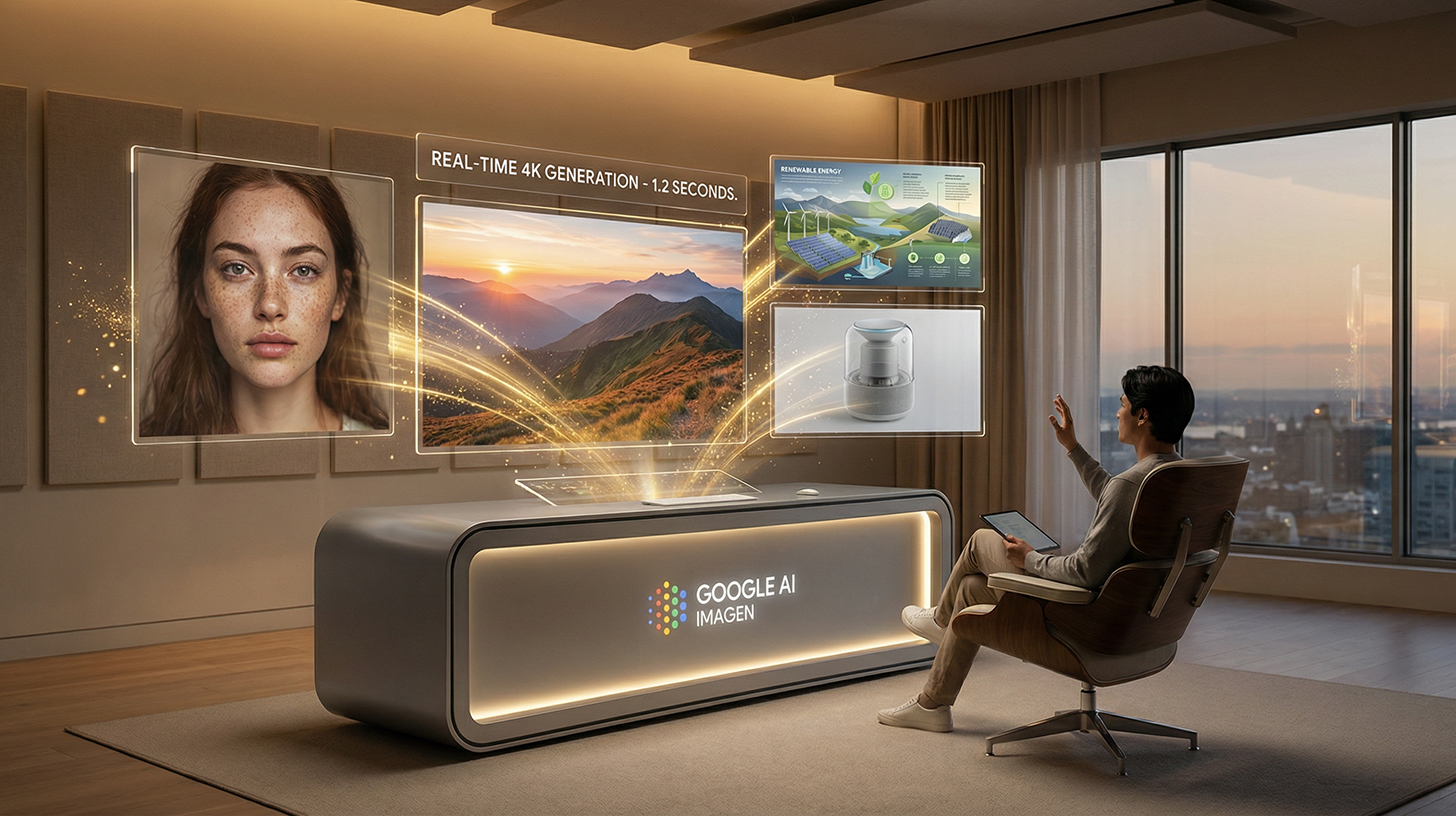
Nano Banana 2 merges professional quality with machine speed – Google's new image generator accesses the internet live – Image: Xpert.Digital
4K images in seconds: Google's new AI merges professional quality with top speed
Facts instead of hallucinations: The secret killer feature of Google's new image AI
For a long time, creatives had to make a painful compromise when it came to AI-generated images: either the model was fast, or it delivered professional quality. With the release of "Nano Banana 2," Google is now ending this dilemma and ushering in a new era of generative image production. Based on the Gemini 3.1 Flash Image architecture, the model combines, for the first time, blazing-fast machine speed with virtually flawless professional quality in native 4K resolution. But the true distinguishing feature of the new AI is its so-called "real-time web grounding": To avoid the dreaded AI hallucinations, Nano Banana 2 accesses Google Search in real time during image creation and integrates verified facts into the image. Thanks to groundbreaking identity consistency, error-free text rendering, and tamper-proof watermarks, the model leaves even strong competitors like OpenAI's GPT Image 1.5 in the dust – and provides the entire creative and advertising industry with a tool that revolutionizes existing workflows in fractions of a second.
The end of compromise: Why the image AI industry is experiencing its iPhone moment
A new chapter in generative image production
On February 26, 2026, Google released Nano Banana 2, the next evolutionary stage of its image generation model. What at first glance appears to be an incremental update, upon closer inspection reveals itself to be a fundamental recalibration of what AI-powered image generation can achieve. Nano Banana 2 is based on the Gemini 3.1 Flash Image architecture, thus combining for the first time the quality features of the previous Pro model with the extreme speed of the Flash series.
This approach resolves a conflict of objectives that has plagued the entire industry for years. Previous image generation models always had to weigh speed against quality. Fast models delivered acceptable, but not professional, results. High-quality models required significantly more processing time and were simply too slow for iterative workflows where creatives generate dozens of variations. According to official specifications, Nano Banana 2 achieves approximately 95 percent of the image quality of the Pro model with a three- to fivefold increase in speed.
Technical specifications and their significance
The technical specifications of the Nano Banana 2 mark a leap forward in several dimensions simultaneously. Its native resolution reaches up to 4K, its color depth is 16 bits, and it supports all common aspect ratios. Text rendering—the ability to accurately display written text as images—has been perfected to a level that works in multiple languages and is virtually error-free.
Particularly noteworthy is its ability to maintain identity consistency. Nano Banana 2 can identify and consistently maintain up to 14 different objects and up to five separate characters within a continuous workflow. In practice, this means a designer can keep a mascot, protagonist, or product design visually coherent across an entire series of images without the model forgetting or distorting its identity. Google demonstrated this capability using a consistent mascot—a baby kangaroo wearing a specific hat—that was reproduced identically across different scenarios.
Real-Time Web Grounding as a unique selling point
Perhaps the most disruptive innovation of Nano Banana 2 is its so-called Real-Time Web Grounding. Generative AI models naturally suffer from the tendency to hallucinate, i.e., to invent content, when they lack concrete knowledge. Nano Banana 2 addresses this problem by algorithmically accessing Google search data during the ongoing generation process.
For example, if the model is intended to represent real-world locations, specific historical events, or complex data visualizations such as current sports scores or demographic maps, it pulls verified facts and reference images from the web in real time and integrates them into the generated image. This capability is an exclusive feature of the Nano Banana 2, not offered by the Pro model or competing products.
For practical application, this represents a qualitative leap. A marketing team that wants to generate an infographic with current market data no longer receives hallucinatory figures, but fact-based visualizations. An architecture studio that wants to present a real building in a new context receives an accurate reproduction of the actual facade and not a vague interpretation.
The competitive landscape
In direct comparison with its competitors, Nano Banana 2 positions itself as an industry leader with specific strengths. On Artificial Analysis's objective leaderboards, the model is neck and neck with OpenAI's GPT Image 1.5. In purely atmospheric, cinematic niche categories, the highly specialized model FLUX.2 occasionally holds its own. However, in the crucial industrial application areas—structural clarity, mathematical understanding, identity recognition, and multilingualism—Nano Banana 2 remains unchallenged, according to tests.
A concrete comparison test illustrates this superiority. GPT Image 1.5 produced counting errors in a task with precisely placed objects, correctly arranging only 5 instead of the required number, which ruined the entire grid. Nano Banana 2 delivered a flawless result with exactly 36 correctly positioned objects.
Security and transparency through digital watermarks
With the increasing capabilities of generative image models, the need to identify AI-generated content also grows. To this end, Nano Banana 2 integrates Google's SynthID technology and, for the first time, couples it with the interoperable industry standard C2PA Content Credentials. This dual authentication makes it possible to trace the origin and AI-generated nature of every image, even if it is edited, cropped, or embedded in other contexts.
This is a crucial step forward for businesses, media outlets, and platforms. At a time when deepfakes and manipulated images are generating increasing distrust, standardized labeling creates a technical foundation for trust and transparency. Google has announced that its Gemini platform will also soon support C2PA.
Economic implications for the creative industries
The combination of professional quality, machine speed, and data-driven generation is changing the way the entire creative industry operates. Tasks that previously required time-consuming photoshoots, stock photo licenses, or hours of graphic design can now be completed in seconds. The implications range from the advertising industry to e-commerce and publishing.
The 4K resolution with 16-bit color depth makes Nano Banana 2 particularly suitable for print production and high-quality advertising materials for the first time. Until now, AI-generated images were primarily intended for digital channels. With native 4K output without compression artifacts, a new market is opening up, encompassing professional prepress, poster advertising, and catalog production.
Your global marketing and business development partner
☑️ Our business language is English or German
☑️ NEW: Correspondence in your native language!

Konrad Wolfenstein
I and my team are happy to be available to you as your personal advisor.
You can contact me by filling out the contact form here or simply call me at +49 7348 4088 965. My email address is: [email protected]
I'm looking forward to our joint project.


