
The dangerous logic of security thinking in marketing: The illusion of rational decision-making – Image: Xpert.Digital
Those who always wait for data end up making a mediocre decision
The data trap: Why a fixation on KPIs makes every brand mediocre
### Neither AI nor A/B testing: The real secret of the most successful "courageous brands" ### Apple, Nike & Co.: Why the best marketing decisions are often completely illogical ### Forget benchmarks! How constant measurement in marketing stifles true innovation ### Against the grain: Why strong brands rely on intuition instead of dashboards today ### The end of security thinking: Why AI will never build genuine brand trust ###
In today's marketing world, the apparent security of numbers reigns supreme. Every click is measured, every campaign subjected to A/B testing, and hardly a strategic decision is made without the reassuring safety net of KPIs and benchmarks. But this absolute faith in data has a massive blind spot: it merely optimizes the familiar, thus insidiously cultivating mediocrity instead of creating genuine differentiation. While artificial intelligence and performance dashboards increasingly shift the focus to short-term metrics, icons like Apple and Nike prove that true brand power isn't built in spreadsheets. It's the courage to make illogical decisions, the trust in one's own intuition, and a clear, distinctive stance that make the crucial difference in a world saturated with stimuli. Those who only ever wait for historical data squander the opportunity to actively shape the future. An analysis of the dangerous logic of security-oriented thinking—and why the world's most successful brands are willing to venture into the unmeasurable.
There's a widespread assumption in marketing departments, strategy consultancies, and management teams: that good decisions must be logical. That a decision is only justifiable if it's supported by data, validated by A/B testing, and legitimized by KPIs. This assumption sounds reasonable. It sounds professional. And it's fundamentally wrong in one crucial respect—at least when it comes to the core of a brand identity.
This isn't about demonizing data. Data is indispensable for operational decisions, campaign optimization, and budget allocation. The crucial difference lies in how it's used. Data explains what worked yesterday. Bold brand decisions build on what might be important tomorrow. This time gap is the crux of the problem.
When benchmarks become a shackle
Anyone who wants to build a strong brand must understand that differentiation, by definition, means being different from what others are doing. And what others are doing is precisely what is measured by benchmarks. Therefore, if decisions are primarily based on benchmarks, this inevitably leads to aiming for the middle ground. You optimize for the average, not for a distinctive position.
A study conducted by the Kantar Institute in collaboration with DMEXCO has shown that the 30 percent of ads tested that resonate most emotionally achieve a 61 percentile point higher score in the so-called Future Brand Demand metric than the 30 percent with the lowest emotional impact. This is not a minor effect, but a massive difference – and it arises not from optimizing for established patterns, but from emotional impact, which is often only measurable in retrospect. 55 percent of marketing managers consider emotions the most important success factor for advertising campaigns – yet in many companies, the first question asked is how something can be measured before deciding whether to implement it.
The psychology behind hesitation
Why are bold decisions so rarely made? The answer lies in organizational psychology. The larger a company, the more levels of decision-making it has. The more levels of decision-making, the greater the incentive to rationalize and hedge decisions. A decision based on data is defensible. A decision based on intuition and strategic courage exposes the decision-maker to personal risk. The result: risk aversion at the individual level translates into mediocre brand management at the organizational level.
Added to this is the growing complexity of consumer psychology. In its 2025 annual report, the BSI Institute pointed out that existing brand models systematically miss the mark when it comes to psychological reality because they operate at the level of attitudes and preferences, while the real crisis lies at the level of decision-making ability. Consumers are cognitively overloaded, overstimulated, and fatigued when it comes to making decisions. In this world, it's not the brands with the most data points that win, but those that project a clear stance and emotional coherence – qualities that cannot be directly optimized.
Neuromarketing as a bridge between intuition and evidence
Neuroscience makes an important contribution to this debate. Neurobranding—the application of neuroscientific findings to brand management—shows that colors, layouts, language, and imagery trigger unconscious reactions in the limbic system that significantly influence purchasing decisions. Familiar visual patterns, harmonious color schemes, and clear structures activate safety and trust signals in the brain. This sounds like optimization—but it's something else entirely: It's about consistently and boldly implementing the emotional essence of a brand, not about winning an A/B test over font sizes.
Trendview describes neuromarketing as a scientifically grounded approach that reveals how stimuli affect people, how they make decisions, and which emotional signals build trust. The methodology—facial coding, skin conductance measurement, heart rate analysis—provides insights into whether a campaign element bores or captivates, whether a testimonial builds trust or creates confusion. This is not a rejection of data orientation, but rather an expansion of the data foundation to include dimensions that traditional performance marketing systematically ignores.
🎯🎯🎯 Data-driven B2B industry hub as a quasi-in-house solution
The quasi-in-house solution: How Xpert.Digital closes operational gaps in B2B marketing and sales – Smart Content-Driven Business - Image: Xpert.Digital
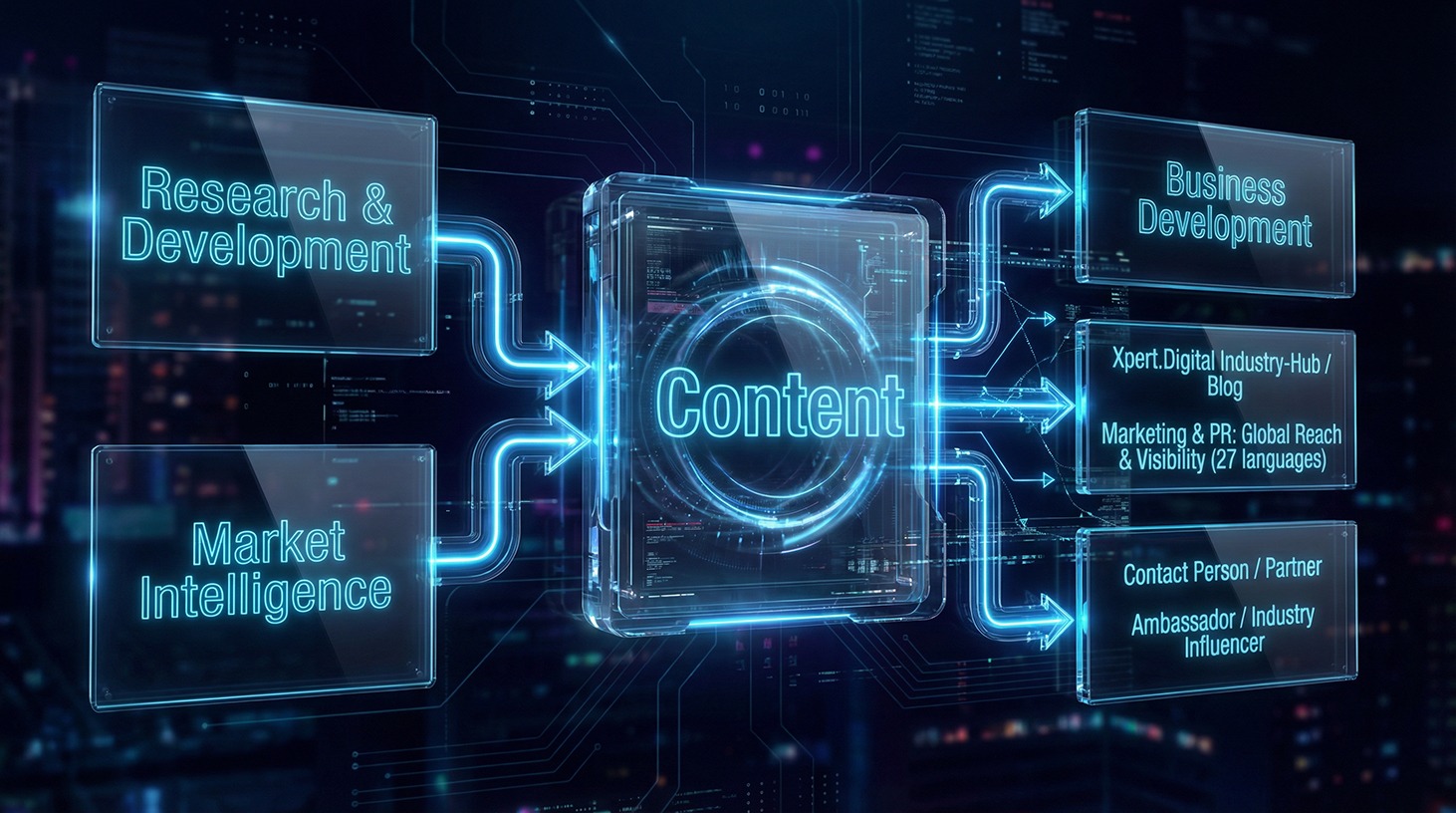
Xpert.Digital is a data-driven B2B industry hub led by Konrad Wolfenstein . The company acts as an external, quasi-in-house solution for industrial partners, closing operational gaps in marketing, content, and sales – without requiring additional resources on the client side.
More information here:
The most important skill in marketing: making decisions despite incomplete data
What Apple and Nike have taught us about courage
The most iconic brand decisions of the last few decades didn't seem logical at first. Apple's 1984 Super Bowl ad, which introduced the Macintosh, was a decision that defied every benchmark of advertising at the time. It didn't tell a product story. It didn't show technical specifications. Instead, it staged a cultural moment. Apple's creative director and management took a considerable leap of faith—and in doing so, established a brand identity that has endured for decades.
Nike's slogan "Just Do It" followed the same logic: simple, culturally charged, without a direct product statement. The value this slogan has created for the brand over thirty years can be proven in retrospect – before that, it was a gamble. 94 percent of consumers see authenticity as the most important factor for their brand loyalty, and authenticity doesn't arise from optimizing for external benchmarks, but from consistently living out an inner brand essence.
The AI Trap: Optimizing Existing Systems
The increasing integration of artificial intelligence into marketing and brand management exacerbates the problem. 86 percent of German marketing managers already use generative AI tools to increase efficiency and personalization. AI can analyze target group behavior, personalize content, and optimize campaigns in real time. These capabilities are valuable. The danger lies in misunderstanding their reach.
AI optimizes what is already known. It learns from historical data, identifies patterns in past behavior, and maximizes defined metrics. What it systematically fails to do: It cannot create a new category of meaning. It cannot develop a culturally resonant stance. As Wirksinn puts it, it has no stance, no intuition, and no sensitivity. AI can help scale messages, but not find the message. Brand management decides on the why and how – AI provides the what and when.
This distinction is often blurred in practice. When AI recommends a campaign variant with a 3.7 percent higher click-through rate, it seems convincing. What AI can't say, however, is whether this click-through rate strengthens or weakens the brand, whether it fosters long-term loyalty or optimizes short-term transactions. Over-optimization for short-term metrics is one of the key dangers of purely data-driven brand management.
Courage tokens versus security tokens
In practice, two archetypes of brand management can be observed. On the one hand, there are the so-called safety brands: They communicate consistently, but never surprisingly. Their campaigns are technically well-executed, but not culturally relevant. They optimize for existing target groups and gradually lose their appeal to new generations. On the other hand, there are the courage brands: They make decisions that are uncomfortable, go against the grain, and are difficult to measure in the short term. Patagonia, the outdoor company that openly campaigns against overconsumption and sells its own products on the secondhand market, is one such example. This decision contradicts every classic revenue maximization model—and has made the brand a global benchmark for brand values.
Wirksinn sums it up perfectly: An effective brand strategy considers technology, but anticipates people. It doesn't rely on volume, but on attitude. And attitude, by definition, cannot be optimized. It must be decided – by people who are prepared to commit to it even when the data doesn't yet paint a clear picture.
The correct use of data: a hygiene factor, not a compass
This doesn't mean data is irrelevant. It's a hygiene factor, not a compass. Data tells you whether a message is getting through. It doesn't tell you whether the message is correct. Data validates implementation decisions. It cannot replace strategic brand decisions. The crucial question in a strategy process is therefore not: Is this the right decision? But rather: Is this the boldest decision the company can justify at this point in time?
This question demands a different kind of leadership. It requires the ability to manage uncertainty, the courage to work against convention, and the confidence that strong brand decisions will pay off in the long run—even if the short-term KPI dashboard doesn't yet confirm it. It also requires a company culture that protects people who make bold recommendations and fail, rather than a culture that rewards those who make safe recommendations and change nothing.
Differentiation as the only lasting competitive advantage
In a world where products are becoming increasingly similar, where price transparency through digital channels is almost complete, and where AI is exponentially increasing the content output of all competitors, differentiation is not a nice add-on – it is the only sustainably defensible competitive advantage. And true differentiation doesn't arise from optimizing for what others are already doing, but from the willingness to do what others don't dare.
The most important skill in modern marketing is not the ability to analyze data. It is the ability to chart a clear and bold course despite incomplete data. Data can support this skill, but it cannot replace it. And therein lies the fundamental misconception: not that good decisions must be logical, but that logic alone is sufficient to make truly good decisions.
Your global marketing and business development partner
☑️ Our business language is English or German
☑️ NEW: Correspondence in your native language!

Konrad Wolfenstein
I and my team are happy to be available to you as your personal advisor.
You can contact me by filling out the contact form here wolfenstein@xpert.digital:or simply call me at +49 7348 4088 965. My email address is
I'm looking forward to our joint project.