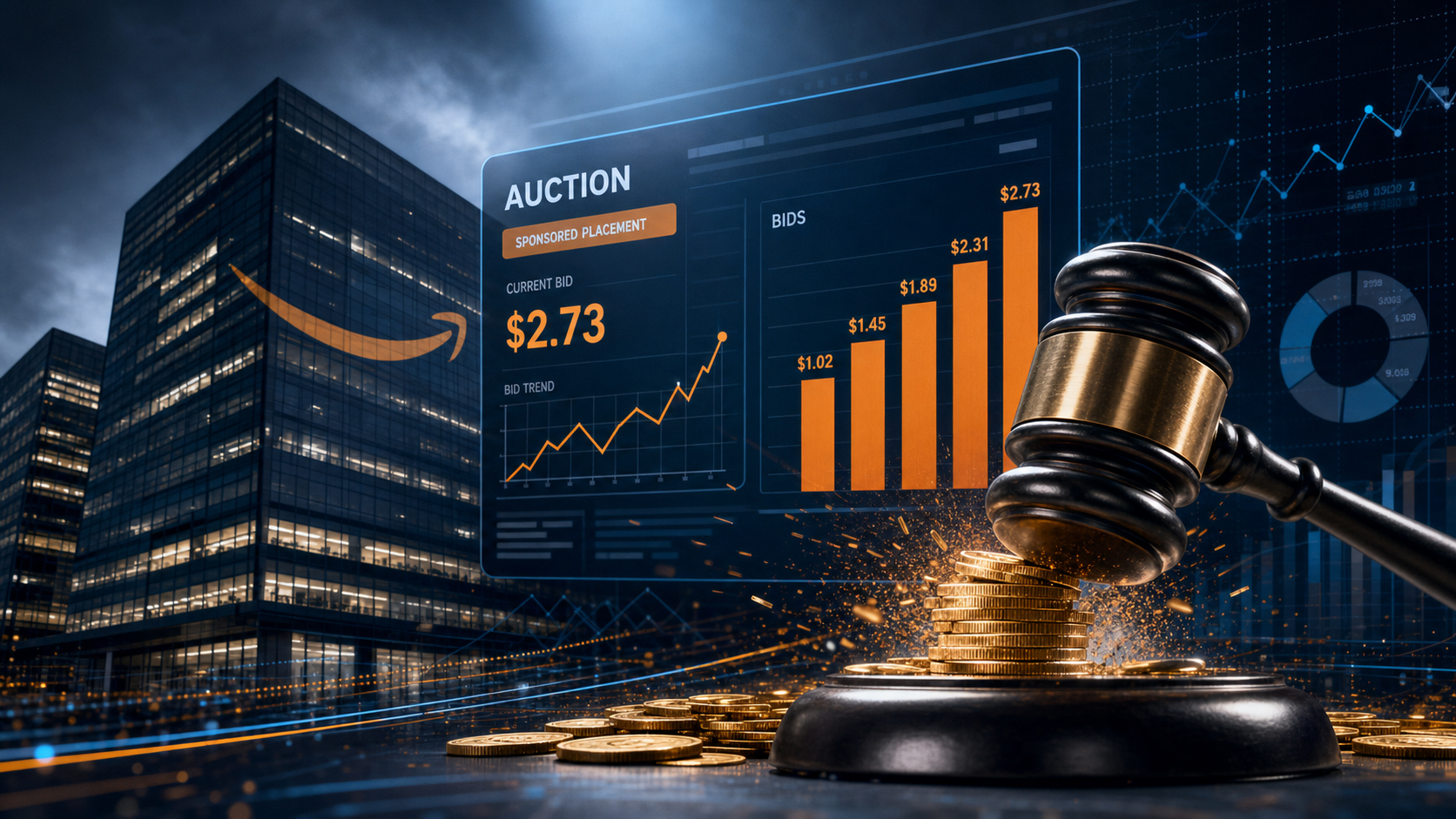
FTC sues Amazon: The hidden price markup – How the advertising empire allegedly defrauded its retailers of $20 billion – Image: Xpert.Digital
The fictitious competitor: The explosive internal documents in the Amazon advertising scandal
Billion-dollar lawsuit against Amazon: What retailers need to know now about hidden advertising costs
From a fair marketplace to price dictatorship? How Amazon manipulated its own advertising auctions
It's one of the most significant legal blows against the power of the tech giants: The US Federal Trade Commission (FTC) and 22 states are taking Amazon to court for alleged systematic deception in the multi-billion-dollar advertising business. At the heart of the more than 180-page lawsuit is the accusation that the e-commerce giant exploited its dual role as a marketplace and auctioneer to secretly collect price premiums through artificially manipulated ad auctions and internally fabricated competitors. The damage to the often heavily dependent, frequently medium-sized retailers is estimated at over $20 billion. Internal company documents, now coming to light as part of the lawsuit, reveal an unprecedented mechanism of algorithmic price manipulation, in which an initially fair bidding process was allegedly gradually undermined to the detriment of advertisers. For companies worldwide – including those on European marketplaces – these revelations raise a pressing question: Can Amazon's opaque algorithms still be trusted? This legal dispute is far more than a technical debate – it could change the rules of the entire platform economy forever.
The mechanics of deception: This billion-dollar lawsuit could change Amazon's platform forever
When the marketplace becomes a bottleneck – how honest can an auction be that invents its own outcome?
The lawsuit filed by the US Federal Trade Commission (FTC) and 22 states against Amazon marks one of the most serious regulatory challenges to date against the advertising practices of one of the world's largest digital corporations. At its core, the case revolves around whether a company that is simultaneously a marketplace operator, auctioneer, and market participant has systematically exploited its dual role for years to the detriment of more than a million advertising companies. The sheer scale of the allegedly unjustly obtained revenue, which the plaintiffs estimate at over $20 billion, illustrates the central yet opaque role that the advertising business now occupies in the corporation's business model. This dispute is therefore far more than a technical conflict over auction mechanisms; it touches upon fundamental questions of market power, algorithmic pricing, and trust in digital trading platforms as supposedly neutral intermediaries.
From trading platform to advertising conglomerate – the quiet transformation of a global corporation
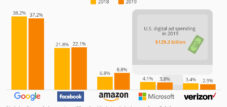
In recent years, Amazon has transformed itself from a purely online retailer into one of the world's leading advertising companies, whose advertising business now generates annual revenues of approximately $68 billion, making the company the third-largest digital advertising platform in the United States, behind established providers Google and Meta. This shift is economically logical, as advertising revenue offers significantly higher margins for Amazon than traditional sales of goods, where logistics, warehousing, and price competition have traditionally kept profit margins slim. For manufacturers and retailers selling on the platform, booking advertising space is no longer just an option, but, given the sheer number of competing offers, practically a prerequisite for visibility. Regulatory authorities believe that this structural dependency of more than 500,000 small and medium-sized enterprises presents a significant potential for abuse, which this lawsuit aims to address comprehensively in court for the first time.
The mechanics of deception – how a fair auction became a covert price fixing
At the heart of the allegation is an auction-theoretical procedure known as the second-price auction or Vickrey auction, which has been considered a particularly fair and incentive-compatible model for decades. In this procedure, the highest bidder does not pay their own bid price, but only a small amount above the second-place bid. This encourages advertisers to openly state their actual willingness to pay without fear of being penalized for an inflated bid. Amazon communicated precisely this procedure to its advertising clients as the basis for its ad auctions for the Sponsored Products, Sponsored Brands, and Sponsored Display formats, and used it for years as a foundation of trust for its entire advertising business. According to the complaint, however, the company began internally undermining this promise as early as 2018 by retrospectively replacing the actual auction result with a higher price set by Amazon itself. From 2019 onwards, this mechanism was then systematically expanded by introducing a so-called soft reserve price, which was reportedly openly described in internal company documents as a hidden premium.
The fictitious co-bidder – when the auctioneer himself becomes the opponent
What makes these allegations particularly explosive is the claim that Amazon used a so-called fictitious auction participant to bolster the artificially inflated prices, a participant explicitly identified as such in internal communications. A senior Amazon manager is said to have explained internally that the second-highest price in the auctions was not determined by an actual bidder, but by a substitute value calculated by Amazon. From an economic perspective, this is a classic sham bid, a long-established unfair practice in traditional auction houses, where the seller or a party closely associated with them places a bid to drive up the achievable price without any real demand. In a digital context with fully automated bidding processes and completely opaque calculations for advertisers, such a procedure is virtually undetectable, which, according to the lawsuit, explains the systematic nature of the alleged deception, which went unnoticed for years.
From exception to rule – when the second price effectively becomes the first price
The statistics in the complaint illustrate the extent of the alleged practice with alarming clarity. While a genuine second-price auction should mean that the winner only rarely has to pay exactly their own bid amount, this is precisely what happened in almost 80 percent of all cases with Amazon's Sponsored Products ads, and this percentage increased even further over time, particularly up to 2024. In effect, what was advertised as a fair second-price auction transformed in the vast majority of cases into a first-price auction, where advertisers had to pay exactly the amount they had originally calculated only as a safety margin for the unlikely event of very close competition. According to the allegations, this shift was particularly acute during periods of high demand, such as during Prime Day and Black Friday sales, when advertisers were already under increased competitive pressure and had little room to adjust their bidding strategies at short notice.
A business model under pressure to justify itself – Amazon's counter-narrative
Amazon immediately and unequivocally rejected the allegations, calling the lawsuit misleading because it fundamentally misunderstands how its advertising auctions actually work. The company points out that average winning bids for Sponsored Products search ads fell by roughly half between 2019 and 2024, which, in its view, contradicts the narrative of systematic price gouging. Furthermore, Amazon denies that higher advertising costs were passed on to end customers in any verifiable way, citing its fundamental promise of low and competitive retail prices. From an economic perspective, however, this objection is only partially refutable, as a declining average price over several years can be explained by numerous opposing factors, such as a massive expansion of the supply of advertising space, a change in the composition of advertisers, or general shifts in the competitive landscape, without necessarily contradicting a hidden margin on individual auction results.
🎯🎯🎯 Data-driven B2B industry hub as a quasi-in-house solution


The quasi-in-house solution: How Xpert.Digital closes operational gaps in B2B marketing and sales – Smart Content-Driven Business - Image: Xpert.Digital
Xpert.Digital is a data-driven B2B industry hub led by Konrad Wolfenstein . The company acts as an external, quasi-in-house solution for industrial partners, closing operational gaps in marketing, content, and sales – without requiring additional resources on the client side.
More information here:
Amazon under scrutiny: Evidence reveals covert price manipulation in advertising auctions – a shadow hangs over the auction system
The evidence from within the company
A crucial difference from previous, more abstract antitrust cases lies in the plaintiffs' line of reasoning, which relies heavily on internal company documents and communications. The 180-page complaint reportedly quotes statements from executives who internally described the hidden price markup as an extremely effective means of increasing sales and who allegedly justified the decision to introduce this practice explicitly with dissatisfaction with the previous revenues from the auction business. It is also alleged that executives deliberately gave misleading or incomplete answers to inquiring advertisers in order to avoid jeopardizing confidence in the existing auction system and to prevent losing the additional revenue by adjusting their bidding behavior. Such internal documents are highly valuable evidence for competition authorities because, unlike public statements, they reveal the actual internal motivations of the company and thus make it significantly easier to prove the intent to deceive than mere market observations.
Why small businesses bear the greatest risk
Of particular economic significance is the fact that more than 500,000 of the allegedly affected advertisers are small and medium-sized enterprises (SMEs), for whom advertising expenditures on the platform often represent a substantial and difficult-to-calculate cost. Unlike large brand corporations, these companies rarely have their own data analysis teams that could uncover hidden price distortions in complex automated auction systems and are therefore particularly dependent on the integrity of the rules communicated by the platform. A covert increase in advertising costs, which is practically impossible for individual advertisers to verify, hits these companies far harder than financially strong corporations, as lower margins in retail are more quickly eroded and there is no possibility of offsetting additional costs through other business areas. The complaint explicitly considers this circumstance to be particularly serious, as it alleges that a structural information asymmetry between a market-dominating platform operator and a multitude of small, dependent market participants has been systematically exploited.
A pattern with a history – Amazon's relationship with the American antitrust authorities
The current lawsuit is the third major legal battle of its kind between Amazon and the U.S. Competition and Markets Authority (CMA). Just a few months earlier, the company had agreed in a separate case to pay $2.5 billion to settle allegations related to misleading cancellation practices for its Prime subscription service. From a regulatory perspective, this cluster of lawsuits suggests a recurring pattern in which complex digital business processes are designed to be difficult for consumers and business partners to understand, while simultaneously generating substantial additional revenue for the company. For the current CMA leadership, which includes Commissioner Andrew Ferguson, the case also offers an opportunity to demonstrate a tougher stance toward dominant digital companies without having to resort to the typical, often protracted market definition debates of traditional antitrust law, since the lawsuit is primarily based on specific deceptive practices rather than abstract allegations of abuse of market power.
What's at stake – possible consequences for Amazon
In addition to a permanent court injunction to force Amazon to cease the practices in question, the plaintiffs are also seeking financial compensation for the affected advertisers and civil damages, the specific amount of which the complaint deliberately leaves unspecified. Given the alleged damages exceeding $20 billion and the numerous states involved, each with its own consumer protection laws, a settlement of a magnitude significantly exceeding previous payments by the company is realistically expected. For Amazon itself, however, the greatest risk is not solely the financial burden, but also the potential reputational damage among an increasingly important advertising client base, whose trust in the promised transparency of the auction mechanisms could be severely undermined by the proceedings. Should some of the allegations be upheld in court, further class-action lawsuits by individual affected companies would be a likely additional risk, potentially exacerbating the economic fallout for the corporation.
The deeper question is – can algorithmic market power be effectively controlled at all?
Beyond the specific case at hand, the lawsuit raises a fundamental question that is likely to be of considerable importance for the future regulation of digital platforms. When a company simultaneously defines the rules of a market, operates the technical infrastructure for their enforcement, and itself participates in the outcome of that market as an economically interested party, a structural conflict of interest arises that is difficult to resolve entirely through subsequent judicial review alone. Automated pricing mechanisms based on complex algorithms that are hardly comprehensible to outsiders naturally offer considerable scope for covert manipulation, the detection of which is generally only possible through internal document access within the framework of formal investigations and hardly through standard market transparency mechanisms or competitive pressure alone. This case should therefore also serve as a wake-up call for a more fundamental debate on mandatory transparency standards, independent auditing requirements, and structural separation requirements for platform operators who act simultaneously as market organizers and market participants – a line of discussion that is already being pursued in Europe within the framework of the Digital Markets Act with comparable objectives.
Impact on advertisers outside the United States
Although the present lawsuit formally relates exclusively to the American market and American consumer protection law, its practical implications for internationally active advertisers and retailers are considerable, as Amazon operates its advertising auction systems worldwide according to largely identical technical and organizational principles. For companies outside the United States that allocate advertising budgets on European or other international Amazon marketplaces, the proceedings provide at least a clear incentive to critically examine their own advertising expenditures and their actual cost-efficiency, and to rely more heavily on independent control mechanisms and a diversification of the advertising channels used. Particularly for internationally oriented medium-sized companies that already depend on a multitude of digital sales and advertising channels, the case underscores the strategic importance of not becoming overly dependent on a single dominant platform operator whose internal pricing mechanisms are largely beyond their control. In the long term, this realization is likely to provide impetus for alternative advertising platforms and a greater diversification of digital marketing budgets.
A precedent with signal implications for the entire platform economy
Regardless of the specific outcome of the proceedings, the lawsuit has already sent a significant signal to the entire platform economy, as it exemplifies how difficult it is for external market participants to independently verify the fairness of algorithmic pricing processes. The relatively muted reaction of Amazon's stock, with a decline of around 2.5 percent following the announcement of the lawsuit, suggests that the financial markets currently assess the risk of existential damage to the company as limited, which seems quite understandable given the broad diversification of Amazon's business model across retail, cloud computing, and advertising. Nevertheless, in the long term, the case is likely to contribute to a greater push by both regulatory authorities and institutional advertisers for mandatory transparency reports, independent auction audits, and clearly defined contractual assurances when using algorithmic advertising platforms. For the future design of digital advertising markets, this legal dispute could thus represent a similar milestone to previous antitrust proceedings against other technology companies, the consequences of which have had a lasting impact on the entire industry, far beyond the individual cases.
📈🚀 From visibility to trust 👀🤝 Your scalable path with Xpert.Digital


From visibility to trust: Your scalable path with Xpert.Digital - Image: Xpert.Digital
In industrial B2B, sustainable business relationships rarely emerge overnight. They develop step by step – through visibility, professional relevance, recurring touchpoints, and growing trust. Xpert.Digital's 4-stage model addresses precisely this: It offers a structured path that begins with a manageable entry point and can evolve into deeper collaboration in business development if needed.
Instead of relying on loud marketing promises, this model puts the relationship at the forefront. Companies start with clearly defined, easily calculable measures and then decide, based on their own experience, how far they want to expand the collaboration. A key factor for this undisturbed trust-building process: The platform completely avoids annoying advertising ads, so the editorial focus remains solely on the companies' expertise.
More information here:
Your global marketing and business development partner
☑️ Our business language is English or German
☑️ NEW: Correspondence in your native language!

Konrad Wolfenstein
I and my team are happy to be available to you as your personal advisor.
You can contact me by filling out the contact form here wolfenstein@xpert.digital:or simply call me at +49 7348 4088 965. My email address is
I'm looking forward to our joint project.