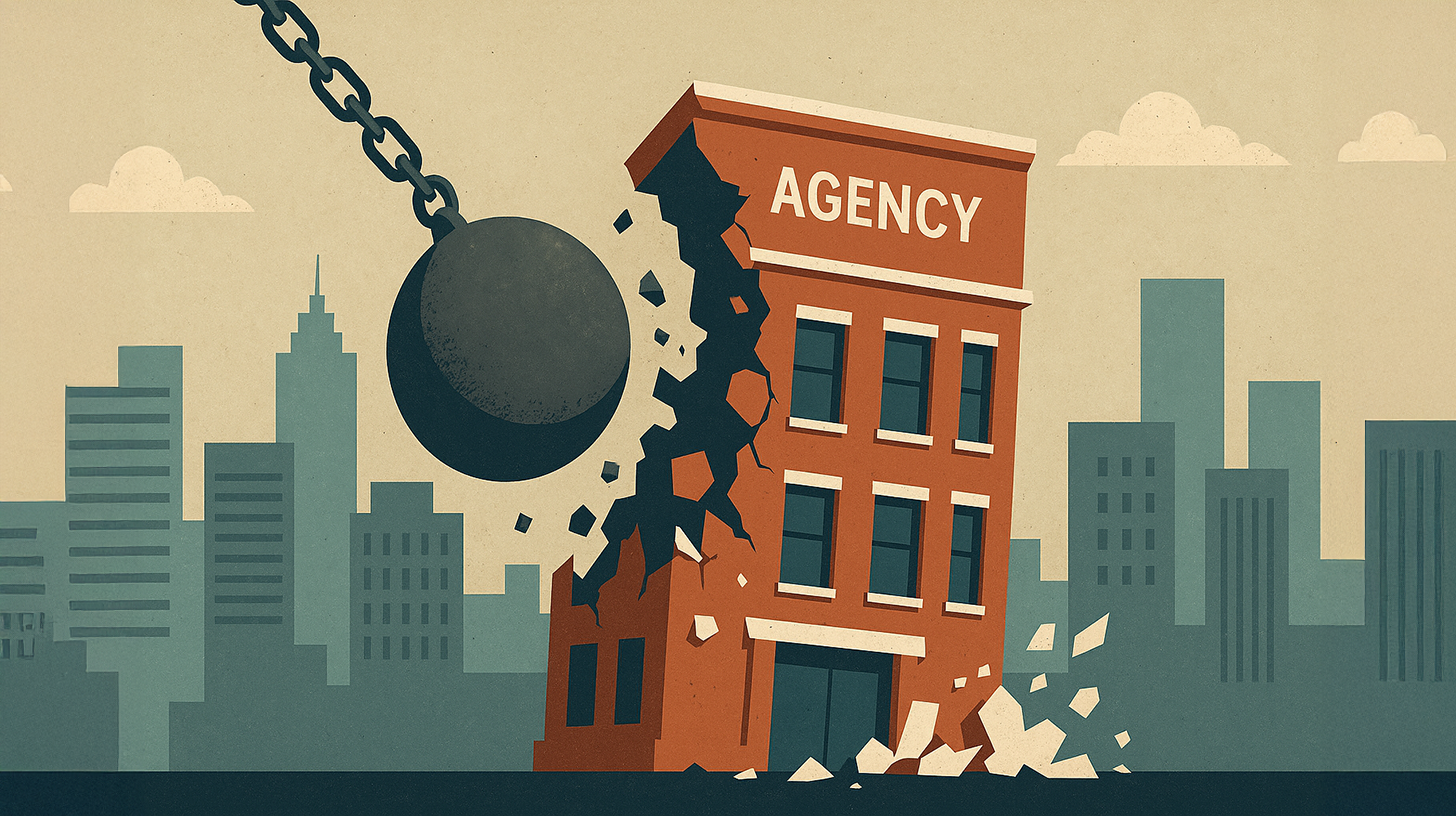
The great market shakeout: A watershed moment for the German creative industries – Why the classic agency model is now finally imploding – Image: Xpert.Digital
Over 180 bankruptcies by November: The stark figures of the German agency crisis.
End of the "time and material" era: Those who don't invest in AI and products now will disappear from the market.
With 183 insolvencies already recorded by November 10th alone, the market is experiencing a historic high in corporate bankruptcies. But anyone who believes this is merely a temporary economic downturn is fatally mistaken. Current analysis of the insolvency register and market data reveals that we are witnessing a fundamental structural crisis. The era of selling human labor for a fee ("time and materials") is being crushed by a toxic mix of AI disruption, margin erosion, and technological change.
From the dramatic rise in bankruptcies and the moral dilemma of the new "principal media" model to the inevitable question of exit strategy: this report gets to the heart of the matter. Learn why transforming into a platform provider or selling the agency are now the only remaining options for many owners – and why simply continuing as before is a sure path to the 2026 bankruptcy statistics.
The "time-and-material" era refers to a time when services – especially in IT, consulting and media – were predominantly billed according to the Time & Material (T&M) model: customers paid for actual working time and resources used, and the financial risk of additional expenses largely lay with them.
In contrast, the "Principal Media" model involves the service provider not only acting as a consultant but also purchasing, bundling, optimizing, and reselling advertising space as a "principal" itself, at a profit. This shifts some of the risk and responsibility to the service provider, who is then measured more directly by the results and performance of the media used. Overall, the pure time-and-materials approach is considered outdated, as modern models—such as "Principal Media" or value-based/agile approaches—place greater emphasis on results, added value, and shared risk.
When the business model implodes: Why the wave of bankruptcies in 2025 marks not just a crisis, but the end of the classic agency era.
The year 2025 marks a historic turning point for the German agency landscape. What was long considered a robust, high-growth sector is currently experiencing an unprecedented upheaval. A detailed analysis of the insolvency register and current market data reveals not only cyclical fluctuations but also a fundamental structural crisis in the "agency" business model. Driven by technological disruption, particularly artificial intelligence, and macroeconomic pressures, the industry is facing the largest wave of consolidation in its history. This report analyzes the causes of the record number of insolvencies, examines the shift from service provider to platform provider, and outlines why exit or radical transformation is becoming the only option for many owners.
Related to this:


The Statistics of Failure: Anatomy of a Record Bankruptcy
The raw figures paint a bleak picture of the current market situation. According to a recent analysis of insolvency notices from the official federal and state justice portal, a historic high was reached in 2025. By the cut-off date of November 10th, 183 agencies had already filed for insolvency. This represents a doubling compared to the previous year, and this is even before the end of the fourth quarter, which is traditionally often used for balance sheet adjustments. Conservative projections suggest that the psychologically and economically significant mark of 200 agency insolvencies will be significantly exceeded by the end of the year.
This development didn't come out of nowhere, but is the result of a toxic mix that has been brewing since 2022. While 2022 and 2023 were still characterized by a certain degree of resilience, the curve has been rising exponentially since 2024. Cumulatively, around three percent of market participants have involuntarily disappeared in the last two years. But the quantity of insolvencies is only one side of the coin; the quality of the affected companies shows that it's not just small, undercapitalized players that are affected, but also established medium-sized companies whose cost structures weren't adapted quickly enough to the new reality.
System question: The end of the classic service provider
The core of the crisis lies deeper than a mere slump in orders. It is an identity crisis for the entire sector. The first German-language Digital Agency Summit brought this issue into sharp focus and revealed a painful truth: the classic "time and material" model, i.e., selling human labor in exchange for a fee, is reaching its economic limits.
Futurist Joachim Graf, one of the most prominent voices in the German-speaking digital market, supports this with current data from iBusiness studies. The threat is existential: On the one hand, margins in traditional project-based business are eroding as clients increasingly bring budgets in-house or lose them to automated platforms. On the other hand, artificial intelligence is emerging not only as a tool but also as a substitute for entire value chains. The question of whether consulting – long hailed as a safe haven and a source of high margins – can offer salvation requires a nuanced approach. Consulting is only scalable if it is not tied to the physical presence of senior experts, which in turn undermines the traditional agency model.
The first German-language Digital Agency Summit was organized by iBusiness (Hightext Verlag, Munich) on December 3, 2025, and took place as an online event.
The conference was designed as an information and discussion platform specifically for agency management and board members. It was aimed at decision-makers from digital agencies who wanted to exchange ideas and network about the future of the agency business in a time of rapid change.
The Digital Agency Summit was embedded within iBusiness's three-day Future Conference 2025, forming the second day of the conference on December 3rd. Thematically, the summit addressed topics such as the strategic development of agency portfolios with AI and automation, as well as the successful acquisition and sale of digital agencies.
The Principal's Dilemma: When the agent becomes the merchant
Amidst this structural change, the market research company Forrester predicts a radical redefinition of the agency role by the end of 2026. The thesis is provocative, but economically plausible: agencies will have to abandon their classic role as "agents," that is, as fiduciary representatives of their clients' interests. Instead, they will transform themselves into platform providers and distributors of their own products and technologies.
This shift is exemplified by the term "principal media." In this model, agencies trade advertising inventory on their own account and at their own risk. They purchase reach and media assets cheaply, enhance them with data and technology, and resell them to their clients at a margin. From an economic perspective, this represents a massive shift in value creation: away from creative services and toward arbitrage, where capital, technology, and control over inventory converge.
For the market, this translates into significant efficiency gains in the short term. However, the price is an erosion of cultural and creative identity. When the focus is on margin through merchandise, neutral consulting becomes obsolete. The conflict between the client's interest (best service at the best price) and the agency's interest (selling its own inventory to maximize margin) is inherent in the system. The agency transforms from a partner into a vendor. The critical question, therefore, is: How much of a vendor can an agency become before it jeopardizes its brand and, consequently, its trust with clients?
🎯🎯🎯 Benefit from Xpert.Digital's extensive, five-fold expertise in one comprehensive service package | BD, R&D, XR, PR & Digital Visibility Optimization

Benefit from Xpert.Digital's extensive, five-fold expertise in a comprehensive service package | R&D, XR, PR & Digital Visibility Optimization - Image: Xpert.Digital
Xpert.Digital possesses in-depth knowledge across various industries. This allows us to develop tailored strategies precisely aligned with the requirements and challenges of your specific market segment. By continuously analyzing market trends and monitoring industry developments, we can act proactively and offer innovative solutions. The combination of experience and expertise generates added value and provides our clients with a decisive competitive advantage.
More information here:
From hourly rates to scalable platforms: How agencies can save their margins in the AI era
The Shoemaker Paradox: Branding for One's Own Purpose
An often overlooked aspect in the analysis of the agency crisis is the lack of visibility of the agencies themselves. The old adage that the shoemaker's children go barefoot proves fatally true in the digital industry. While agencies design complex communication architectures for their clients, they criminally neglect their own brand building.
In a market characterized by oversupply and interchangeability, the "invisible agency" becomes the first victim of budget cuts. A weak agency brand leads to a weak negotiating position in pricing and makes the company vulnerable to pure price competition. However, this also presents a massive opportunity for those who invest counter-cyclically. Never before has it been easier to gain visibility through sharp positioning and consistent thought leadership. Those who manage to position themselves not as a "jack-of-all-trades" but as a specialized solutions provider can buck the general downward trend. Self-promotion is no longer a luxury, but a matter of survival.
Related to this:

The AI-Native Organization: Leadership in the Age of Algorithmic Competence
Technological pressure demands not only new business models but also a new leadership style. "Leading in the AI Era" means far more than simply introducing ChatGPT licenses for employees. It's about transforming into an "AI-native organization.".
CEOs must understand that AI is disrupting traditional hierarchies and career paths in agencies. The pyramid of many junior staff who provided support and a few senior staff who refined the work is being turned upside down. AI is taking over the groundwork. In this context, leadership means empowering teams to use AI as a sparring partner and to make radically data-driven decisions. A centralized data foundation is becoming the agency's core asset. Those who don't have control over their data cannot efficiently train or deploy AI. The leader of the future is less the charismatic, old-school creative director and more the architect of systems that orchestrate human creativity and machine efficiency.
From hourly wage to asset: The economics of scalable products
Perhaps the most important strategic response to the crisis is the shift away from purely service-based businesses towards product- and asset-based models. The pressure to change due to short innovation cycles, skills shortages, and shrinking budgets makes simply "selling hours" unattractive.
A promising approach is the development of "open-core models" and proprietary software solutions. The platform swoox.io exemplifies this approach. Here, an agency recognized from its own experience that recurring problems in client projects shouldn't be solved manually every time. By developing its own software solution (in this case for automation or process optimization), the agency strategically expanded its service portfolio.
The economic leverage is enormous: Instead of spending developer hours on each project, which can only be billed once, the agency sells licenses or usage fees for its technology. The surrounding services – implementation and consulting – remain, but become scalable and more profitable thanks to the product. Clients benefit from faster results and access to innovations, while the agency decouples itself from the direct exchange of time for money and builds corporate value in the form of IP (Intellectual Property).
Exit strategies under consolidation pressure: Timing is everything
Given the market dynamics, many owners are considering an exit. The timing seems paradoxical: Why sell when the industry is in crisis? Yet it is precisely this pressure that is driving activity in the M&A (mergers and acquisitions) market. Thomas Keller and Magnus Schubert, experts in agency transactions, point out that the demand for "good" agencies remains high despite – or perhaps even because of – the AI hype.
Buyers, often larger agency networks or private equity investors, aren't looking for turnaround cases, but rather for specific assets: technological excellence, deep industry know-how in niche markets, or established client relationships that can be scaled. From the seller's perspective, "bride-grooming" is crucial. An agency is sellable when it operates independently of the owner, has clean, recurring revenue streams, and can present a clear story for the future (e.g., AI integration).
The sales process today requires more professional preparation than it did five years ago. KPIs must be on target, the second-level management must be in place, and dependence on individual major clients must be minimized. Those selling now often do so not out of necessity, but with strategic foresight, aiming to become part of a larger, viable entity. The market is consolidating ruthlessly: it's a case of "eat or be eaten.".
Related to this:

The agency is dead, long live the platform!
The wave of insolvencies in 2025 is not a temporary phenomenon, but rather a symptom of a final market shakeout. The model of the classic full-service digital agency, which can do a little bit of everything and primarily rents out staff, is obsolete. The future belongs to specialized technology boutiques that own their own intellectual property or to large platform players that efficiently combine media and technology. For the owners, this means either a radical transformation of their business model towards products and AI-driven services – or an orderly withdrawal through a strategic sale. A "business as usual" approach is the only strategy that guarantees a place in the 2026 insolvency statistics.
Your global marketing and business development partner
☑️ Our business language is English or German
☑️ NEW: Correspondence in your native language!

Konrad Wolfenstein
I and my team are happy to be available to you as your personal advisor.
You can contact me by filling out the contact form here wolfenstein@xpert.digital:or simply call me at +49 7348 4088 965. My email address is
I'm looking forward to our joint project.
☑️ SME support in strategy, consulting, planning and implementation
☑️ Creation or realignment of the digital strategy and digitization
☑️ Expansion and optimization of international sales processes
☑️ Global & Digital B2B trading platforms
☑️ Pioneer Business Development / Marketing / PR / Trade Fairs
Our global industry and economic expertise in business development, sales and marketing

Our global industry and economic expertise in business development, sales and marketing - Image: Xpert.Digital
Industry focus areas: B2B, digitalization (from AI to XR), mechanical engineering, logistics, renewable energies and industry
More information here:
A thematic hub offering insights and expertise:
- Knowledge platform covering global and regional economies, innovation and industry-specific trends
- A collection of analyses, insights, and background information from our key areas of focus
- A place for expertise and information on current developments in business and technology
- A hub for companies seeking information on markets, digitalization, and industry innovations