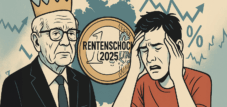
When persuasion replaces competence: The DGB's anti-pension concept and its self-proclaimed architects Ricarda Lang and Kevin Kühnert – Image: Xpert.Digital
More pensions on credit: Why the DGB plan with Kühnert and Lang fails in the face of reality
Ideology instead of arithmetic: Who actually sits on the new DGB pension commission?
Wishful thinking vs. facts: Lang and Kühnert's priceless pension promise
German pension policy faces one of its greatest historical challenges: the baby boomer generation is retiring, while the number of contributors is structurally declining. Amid this tense situation, in which the Federal Government's Pension Commission is proposing unpopular but mathematically necessary reforms such as a fully funded pension system and longer working lives, resistance is forming. The German Trade Union Confederation (DGB) has established its own pension commission, which is presenting an alternative proposal: higher pensions, no increase in the retirement age, and maintaining the option of retiring at 63.
But a closer look at the self-proclaimed architects of this plan raises profound questions. The panel includes two prominent career politicians, former Green Party leader Ricarda Lang and former SPD General Secretary Kevin Kühnert, whose backgrounds are characterized by strong communication skills but hardly by economic, financial, or professional experience. When a commission tasked with shaping the financial future of millions is so heavily influenced by political ideology and so little by scientific arithmetic expertise, it risks creating a debate that raises hopes but ignores the realities of financing. This is a detailed analysis of the fine line between legitimate political representation and a lack of expertise in the most important social policy area of our time.
Political ambassadors instead of pension experts – who actually sits on the DGB commission?
In January 2026, DGB (German Trade Union Confederation) chairwoman Yasmin Fahimi announced plans to convene a separate pension commission, intended as a counterpoint to the federal government's pension commission. The ambition was high: "We want to provide security, offer guidance, and, with our own compelling vision for the future, create a counterpoint to the constant narrative of crisis and sacrifice in the pension debate," Fahimi stated. The 13-member panel includes representatives from trade unions, academia, civil society, and social welfare organizations – among them Verena Bentele, president of the VdK (Social Association of Germany), and political science professor Jutta Schmitz-Kießler. However, two names attracted particular public attention: former Green Party leader Ricarda Lang and former SPD (Social Democratic Party) general secretary Kevin Kühnert.
Both individuals undoubtedly bring strong communication skills and political networks to the commission. However, their actual professional expertise deserves a sober assessment – far removed from partisan applause and media outrage.
A CV without a professional qualification: Ricarda Lang's academic and professional biography
Ricarda Lang was born on January 17, 1994, in Filderstadt and grew up in Nürtingen, Baden-Württemberg. After graduating from the Hölderlin Gymnasium there, she began studying law in 2012, first at Heidelberg University, then at Humboldt University of Berlin. She interrupted her studies in 2019 to pursue a political career, without completing her degree. She finally earned her Bachelor of Laws from Humboldt University in the summer of 2025 and has since been working towards her Master's degree.
Her CV contains virtually no professional experience in the conventional, economic sense. At 18, she joined the Green Youth, served as its federal spokesperson from 2017 to 2019, and seamlessly transitioned to the federal executive board of the Green Party. From 2022 to November 2024, Lang was co-chair of Alliance 90/The Greens. Since then, she has been a member of the German Bundestag, serving on the Committee on Labor and Social Affairs and the Petitions Committee. Since February 2025, she has held a quasi-institutional position as a member of the supervisory board of the German Society for International Cooperation (GIZ).
Her résumé is thus that of a consistently pursued party career – barely interrupted by actual work experience, business management, or economic analysis. Social security law, pension financing, or labor market research are conspicuously absent from her background. Under normal circumstances, this wouldn't be a flaw if the expectations were formulated more moderately. However, in the context of a pension commission whose findings are intended to influence public opinion and policy, this lack of specialized knowledge carries more weight.
Journalism studies dropout with a call center past: Kevin Kühnert's career path
Kevin Kühnert, born on July 1, 1989, in West Berlin, comes from a family of civil servants: his father worked in the tax office, his mother in the job center. After graduating from the Beethoven Gymnasium in Berlin-Lankwitz in 2008, Kühnert first completed a voluntary social year at a facility for children and young people. He then began studying journalism and communication studies at the Free University of Berlin in 2009, which he discontinued in 2010. From 2010 to 2014, he worked in a call center for the online toy retailer myToys.de.
Kühnert entered politics via the SPD's youth organization: from 2012 he was state chairman of the Berlin Young Socialists (Jusos), from 2015 deputy federal chairman, before assuming the federal chairmanship in 2017. Concurrently, between 2014 and 2019, he worked as a staff member in the offices of SPD female politicians. He began a distance learning degree in political science at the Open University of Hagen in 2016, but suspended it after his election as federal chairman of the Young Socialists and has not yet completed it. From 2021 to 2024, he served as general secretary of the SPD, resigning from this position in October 2024. Since December 2025, he has been head of the department for taxes, distribution, and lobbying at the organization Finanzwende.
Like Lang, Kühnert's professional biography, after his brief stint in a call center, consists almost entirely of work closely with political parties and associations. He never studied economics, social security law, or public finance. His knowledge of pension policy stems from politically motivated engagement with the topic, not from academic analysis or business experience.
The phenomenon of professional politicians without a profession: A structural observation
Kühnert and Lang are, in a sense, typical representatives of a phenomenon widespread in Germany: politicians whose entire biographies have unfolded within the political apparatus. This typology deserves no personal derision—it describes structural realities of a political system that rewards early party affiliation and makes career changes difficult. However, it carries genuine risks of misinterpretation when individuals from this milieu are declared "experts" in technically demanding policy fields.
The pension system is one of the most complex sets of rules in the German welfare state. It combines demographics, wage development, capital market dynamics, contribution mechanisms, fiscal policy, and individual investment behavior into a virtually incomprehensible structure. The demands placed on sound policy recommendations in this area are high. When Kühnert and Lang sit on the same commission as academics, such as professors, and representatives of the Paritätische Wohlfahrtsverband (a German umbrella organization for social welfare associations), they certainly have a legitimate role as political voices and communicators. The question is simply how their contributions are clearly distinguished from the academic expertise of other members and appropriately weighted—and whether public perception adequately reflects this distinction.
Self-proof of the knowledge gap: Ricarda Lang's pension estimate on Markus Lanz's show
An incident from January 2024 illustrates the problem emblematically. On Markus Lanz's talk show on ZDF, the host asked Ricarda Lang, then chairwoman of the Green Party, what the average pension in Germany was. Lang's answer was disarmingly candid: she "actually didn't" know the average pension and "actually had no concrete" idea of it. When pressed, she then estimated "approximately 2,000 euros.".
The reality at the time was quite different. Pensioners with at least 45 years of contributions received an average of €1,543 per month, men around €1,637, women €1,323. The average pension for all insured persons was even lower, at around €1,384. Lang had overestimated the average pension by about 30 percent. Lanz publicly corrected it, and Lang admitted that it was "even a bit lower"—an understatement.
The widespread media attention and online ridicule this incident triggered could easily be dismissed as tabloid mockery were it not for the fundamental factual knowledge involved. Anyone unfamiliar with the average pension cannot seriously assess whether the system is fair, where the safety net should be, or whether 70 percent of one's last net income represents a realistic promise. This basic data literacy is not a niche issue, but rather the ABCs of the pension debate. The fact that Lang has since completed her Bachelor of Laws and has also served on the Committee on Labour and Social Affairs since 2025 may indicate a learning curve. Nevertheless, the question remains valid: on what foundation does her committee work rest?.
Kevin Kühnert's pension positions: Politically consistent, but technically vulnerable
Kevin Kühnert is rhetorically far more assured on pension issues than Lang. As SPD General Secretary, he addressed the topic extensively and repeatedly took clear positions. In March 2024, he defended the coalition's second pension package on ntv's early morning program as a guarantor of maintaining living standards. He categorically rejected any increase in the retirement age – "not with us then" – and warned on ZDF's morning show that abolishing the early retirement option at 63 would not create more jobs, but would simply mean pension cuts for hard-working people.
An interesting side observation: In January 2026, Kühnert publicly declared that he considered his own pension entitlements as a former member of the Bundestag to be "completely unfair" and "scandalous." For just under four years in parliament, he receives 800 to 900 euros in retirement – an amount that averages 200 to 300 euros for ordinary employees with comparable service. This self-criticism is commendable. However, it perfectly illustrates the structural problem: The pension systems of politicians, civil servants, and the general public diverge so drastically that even their representatives only grasp the extent of the inequality in retrospect. That Kühnert now sits on a commission that, among other things, calls for the integration of politicians into the statutory pension insurance system is consistent – but also evidence that such insights mature relatively late for a career politician.
His fundamental statements on pension financing also reveal a selective choice of facts. In a 2024 ntv interview, Kühnert argued that the contribution rate of 18.6 percent was "at a very good level" because significantly more had been paid in the 1980s. This is historically accurate. What he omitted, however, is that demographic trends since the 1980s have fundamentally changed. The baby boomer generation is now retiring en masse, and the ratio of contributors to beneficiaries is structurally deteriorating. Even the Federal Court of Auditors warned that maintaining a permanent pension level of 48 percent between 2026 and 2036 would create a funding gap of approximately 235 billion euros.
The DGB concept in detail: More pensions through more redistribution
The concept presented by the German Trade Union Confederation's (DGB) pension commission in early July 2026 rests on two central pillars. First, the pension level of the statutory pension insurance is to be raised from the current 48 percent to 50 percent and then to 53 percent of the last net income. Second, employers are to be obligated to establish company pension schemes for all employees and contribute two percent of gross wages for this purpose. Together, these two pillars are intended to guarantee a pension level of 70 to 90 percent of the last net income in retirement.
Private pension provision plays no role in this concept. The concept is thus explicitly geared towards collective, state-organized social security and rejects the three-pillar model of the government commission, which combines statutory, occupational, and private pension schemes. The DGB concept categorically rules out a rising retirement age. The pension without deductions after 45 years of contributions is to be maintained.
Several sources are to be used for financing: "slightly increased contributions" to the statutory pension insurance, an increased federal subsidy in the form of a so-called "demographic subsidy," and tax revenues from high incomes, large fortunes, and capital gains. Furthermore, more people are to pay into the statutory pension fund—initially the self-employed and politicians, and in the long term as steps toward a comprehensive employment insurance scheme for everyone. With this, the German Trade Union Confederation (DGB) is taking up an idea that the Social Democratic Party (SPD) has long favored, but which has so far failed due to political feasibility and costs.
The document's brevity and preliminary nature are remarkable: the concept comprises only eleven pages. A longer final report is not expected until summer. For a concept intended to present a fundamental alternative to the federal government's official reform package, this is a rather meager document.
Our EU and German expertise in business development, sales and marketing


Our EU and German expertise in business development, sales and marketing - Image: Xpert.Digital
Industry focus areas: B2B, digitalization (from AI to XR), mechanical engineering, logistics, renewable energies and industry
More information here:
A thematic hub offering insights and expertise:
- Knowledge platform covering global and regional economies, innovation and industry-specific trends
- A collection of analyses, insights, and background information from our key areas of focus
- A place for expertise and information on current developments in business and technology
- A hub for companies seeking information on markets, digitalization, and industry innovations
Higher pensions without figures: The arithmetic weaknesses of the DGB proposal
Promises on credit: The DGB's financing logic and its weaknesses
The most critical question regarding the DGB concept is not ideological, but arithmetic: Who will actually pay for it in the end? And to what extent?
The federal budget already bears the brunt of pension financing. For 2026 alone, €127.84 billion is earmarked for pension insurance benefits – compared to €122.5 billion in the previous year. The federal government's general subsidy to the pension insurance system amounts to €64.36 billion, supplemented by an additional subsidy of €33.67 billion. The Federal Ministry of Labor and Social Affairs already has the largest single budget allocation in the entire federal budget – at €197.4 billion in 2026.
At the same time, the pension insurance system faces a foreseeable deterioration of its contribution structure. According to forecasts, the contribution rate of 18.6 percent is not expected to be raised until 2028 – but then to 19.8 percent, to 20.1 percent by 2030, and to 21.2 percent by 2039. The federal government itself estimates that the pension level cap of 48 percent stipulated in the pension reform package alone will burden the federal budget with approximately 122 billion euros in additional expenditure by 2039. The expansion of the mothers' pension would add another 62.7 billion euros.
Against this backdrop, aiming for an even higher pension level of 53 percent is simply not financially viable without a fundamental expansion of the revenue base. While the DGB's concept identifies sources – wealth tax, capital gains tax, and the inclusion of additional occupational groups – it fails to provide concrete figures. Calculations by the ifo Institute from previous years also warned that maintaining a permanent pension level of 48 percent by 2030 could necessitate a VAT increase to 23 percent or more if financed solely through taxes. The DGB's demand for a 53 percent pension level is significantly higher.
The idea of a universal social insurance scheme that includes civil servants and politicians has a rational core – more contributors with the same level of benefits relieves the system during the transition phase. However, the effects will only take hold in the long term, as newly included groups initially pay contributions but later also make claims. In the short term, this does not solve the pressing financing problems.
The government commission's alternative model: fact-based, unpopular, but more honest
The German government's Pension Commission, consisting of eight academics and three parliamentary representatives, chaired by Professor Constanze Janda and the former head of the Federal Employment Agency, Frank-Jürgen Weise, presented a 76-page report with 33 recommendations on June 23, 2026. Unlike the DGB paper, this report is substantial and contains concrete, quantified reform proposals.
The core recommendations of the government commission include: linking the retirement age to life expectancy from 2032 onwards, which could lead to a standard retirement age of 67.5 years in 2041; the introduction of a mandatory, capital-funded supplementary pension based on the Swedish model, financed equally by employees and employers with one percent of gross wages each; the abolition of the pension without deductions after 45 years of contributions in favor of a health-based protection pension for long-term contributors; and the gradual integration of the self-employed, civil servants and members of parliament into the statutory system.
These measures are politically hotly contested. Abolishing the early retirement age of 63 will hit hard those who have worked physically for decades. Linking the retirement age to life expectancy will gradually mean more work for everyone. But unlike the German Trade Union Confederation's (DGB) proposal, they are more coherent in their financing logic. Chancellor Friedrich Merz and Labor Minister Bärbel Bas announced their intention to implement the 33 recommendations fully and without any substantive compromises.
Two concepts, two worlds: A system comparison
| feature | DGB concept | Government Commission |
|---|---|---|
| Pension level | Increase to 53% | Stabilization at ~48% with transition factor |
| Retirement age | No increase | Linked to life expectancy, gradually from 2032 |
| Retirement at 63/64 | Receive | Abolition, replacement by a protective pension |
| Capital funding | No | Mandatory capital pension (2% of gross salary) |
| Private pension provision | No role | Third pillar |
| financing | Demographic subsidy from assets/capital, increased contributions | Capital-funded pillar + demographic factor |
| Employer burden | 2% for company pensions alone | 1% for capital pension (equally split) |
| Target level | 70–90% of net income | 70% of net income |
Both concepts share the goal of a pension that secures living standards. The fundamental difference lies in the transparency of their financing: The DGB concept promises more without precisely explaining how this can be achieved without structurally higher contribution burdens or increased public funds. The government concept takes the more difficult path of also regulating the benefit side – through longer working lives and funded pension components.
Ideology versus arithmetic: Why the DGB concept is more wishful thinking than a plan
The central weakness of the DGB's concept lies not in its goals – higher pensions are socially desirable – but in the discrepancy between the promise and a sound financial basis. The term "slightly increased contributions" is not an economic analysis, but a political euphemism. Even if the self-employed, civil servants, and politicians were included in the statutory pension insurance scheme, this would still generate pension entitlements for decades to come, which would then need to be financed.
A pension level of 53 percent of net wages instead of the current 48 percent sounds modest. But with an average gross monthly wage of around €4,500 recently and a corresponding pension level, every percentage point increase in the guaranteed pension level would result in a structurally increasing overall expenditure. The Bundesbank has already warned in previous scenarios that the demographically driven funding gap in the pension insurance system could become a systemic threat without reform measures.
The goal of using wealth and capital gains for financing also has economic policy limits. High wealth taxes in an internationally open capital market lead to capital outflows and a reduction in the tax base. This is not a neoliberal ideology, but rather the empirical finding from countries that introduced such taxes and abolished them again after a short time – including Germany itself (abolishing the wealth tax in 1997) as well as numerous European neighbors such as Sweden, France, and Austria.
This does not mean that the involvement of capital and assets in financing the welfare state is fundamentally wrong. The question is to what extent this is realistically possible without triggering macroeconomic repercussions that ultimately damage the wage and employment base – and thus contribution revenues – themselves.
The role of professional politicians in expert discourses: Legitimacy versus expertise
It would be unfair to delegitimize Ricarda Lang and Kevin Kühnert solely because of their biographies. Even experts with years of academic training have made spectacular errors in pension policy. Forecasts regarding contribution rate trends, the sustainability of the pay-as-you-go system, or the amount of pension adjustments have regularly proven to be either too optimistic or too pessimistic in the past.
However, there is a qualitative difference between the error of an expert, based on incomplete data or flawed model assumptions, and the error of a layperson who lacks knowledge of the fundamental parameters of their policy field. Lang's ignorance of the average pension should not be interpreted as a personal weakness, but rather as a systemic signal: A politician who served for years as women's policy spokesperson and party chairwoman should have been familiar with the core metric of German pension policy. Her lack of knowledge demonstrates how far removed the political milieu in which she operated was from the material realities of the people for whom she supposedly made policy.
Kevin Kühnert's case requires a more nuanced assessment. As SPD General Secretary, he addressed the pension issue much more intensively in his communications, has a better understanding of the institutional structures, and—through his new role with Finanzwende—brings at least some experience in fiscal policy. His self-critical approach to his own parliamentary pension entitlements demonstrates a certain degree of self-reflection. Nevertheless, he remains a political communicator without formal economic training—a role that can have its place in a 13-member commission with genuine academic participation, but one that should not be overemphasized.
The real question is: What should a DGB pension commission achieve?
The German Trade Union Confederation (DGB) is not an economic research institute. It is an advocacy group with a clear normative agenda: protecting employees, defending the welfare state, and safeguarding pension entitlements. This role is legitimate and socially necessary. In a pluralistic democracy, it is a fundamental aspect of the system that organized interests contribute their positions to public debates.
The problem arises when an interest group is positioned as the antithesis of a government commission staffed with academics, as if both operated on the same epistemic level. The German government's pension commission consists of eight university professors with proven backgrounds in pension research – including a member of the German Council of Economic Experts, an OECD head of social policy, and the president of a leading business school. The German Trade Union Confederation (DGB) commission, on the other hand, is composed of representatives from both politics and civil society, supplemented by a few academic voices.
This is not a shortcoming, as long as the role is clearly communicated. The DGB commission is developing a political counter-proposal that articulates societal values and interests – that is its actual mandate. Scientific pension research is not. If Kevin Kühnert and Ricarda Lang act in this context as political voices, articulating and communicating demands, that is their legitimate function. However, if they are implicitly positioned as "experts" who are professionally equivalent to the scientists on the government commission, an image is created that does not serve the public debate.
Anyone who reforms the pension system should know the pension system
Pension policy is one of those areas where the clash between normative conviction and sober systemic logic determines whether reforms are sustainable or simply too expensive. The DGB's concept formulates goals shared by many people in Germany: a reliable, adequate statutory pension without continuously raising the retirement age. These goals deserve serious political discussion.
But a proposal that promises higher pensions without precisely calculating the financing, that attempts to address the complexity of a century-long problem in eleven pages, and that prominently features figures like Ricarda Lang and Kevin Kühnert as representative commission members, sends the wrong signal. It suggests that pension policy is primarily a matter of the right political will – and not also a question of demographics, interest rate mathematics, and budgetary arithmetic.
Ricarda Lang completed her Bachelor of Laws in the summer of 2025 – a respectable achievement. Kevin Kühnert works at Finanzwende, focusing on taxes and distribution – his field of expertise is at least related to social security financing. Both demonstrate discernible development. But development is not the same as expertise. Public debate would be more honest and productive if this distinction were made more consistently – by those directly affected, by the German Trade Union Confederation (DGB), and by the media outlets that report on their positions.
A sound pension reform will ultimately be judged not by its popularity, but by its financial viability in thirty years. That is the real test – and it will be posed not by Kühnert and Lang, but by the generation currently in education and employment.